

Nick Schreiber sinks into his reddish-brown couch and props his head up on his open palm.
Translation: The man is tired. It's no wonder why; the 28-year-old cyclist recently returned from the 2009 Deaflympics in Taiwan to a new house on the southwest side with wife, Cecelia, and their six children.
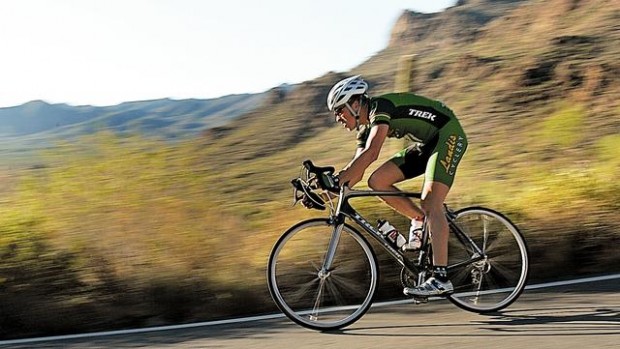
The Tucson native is a member of Landis/Trek Cycling, a Phoenix-based road racing team, and the United States Deaf Cycling team that he represented in Taipei, Taiwan, earlier this month.
Schreiber competed in four events at the Deaflympics. Three of those were letdowns, he said.
But the 50-kilometer point race was his time to shine, and he won the gold. A point race is done on a cycling track. The purpose is to cross the finish line first during designated sprint laps. Points are awarded for how the cyclists finish each lap.
People are also reading…
Schreiber, who also competed in the 2001 Deaflympics in Rome, was among 2,500 athletes from 77 countries at this month's event.
"I was really excited for him, because he was bummed out things weren't going the way he expected," Cecilia Schreiber said. "I knew it would happen. I told him he was going to win on my birthday."
Schreiber, who's a mechanic at Empire Machinery, will ride in the 70-mile Tour de Scottsdale this weekend, and plans to race in El Tour de Tucson on Nov. 21.
He recently discussed his goals, how he fits training in with a big family, and what he focuses on during races:
Q: How was your experience in Taiwan?
A: I really enjoyed it. Their food and their way of life, their loyalty to their country and the way they treated the U.S. team was really heart-warming. It was a good experience for me. There were a lot of people watching.
Q: Is it unusual to have a lot of people watching?
A: Yeah, here there isn't much support. The crowd is mostly people that are cyclists themselves. But over there, there are fans, tons of people, even kids. After the race, people were coming up to me asking for my autograph. It was kind of cool.
Q: What are your goals for this year?
A: Now that the Deaflympics are over, my goals are just to keep improving in time trialing. I would like to meetup to the pro level. That's a really huge goal of mine, to be a professional time trialist.
Q: What do you need to do to achieve that?
A: My coach will look at the schedule, and if he sees a good race that scouts will be at, we'll plan to train for that particular race about two months before so I'll peak at the right time. We'll just train, train, train to get to my peak. It's just about endurance. You know in the Tour de France how they have those aerodynamic helmets and they get in that crouch position and they go really fast? They're going 30 mph, maybe 32mph based on the flat time. I have a cute 28, 29mph, maybe, so I really have to push myself to go over that level. I have to lift weights, probably. I should.
Q: How many hours do you spend training each week?
A: It depends. If I have no races coming up, I don't train much. Maybe an hour or two hours a day. If a race is coming up, I might increase my time to two, three, four hours each day.
Q: Say you do have a big race coming up, what does a typical day of training look like?
A: In the morning, I'll ride to work, work until 3:30 and then go riding on Nogales Highway to Mount Lemmon. I ride up Mount Lemmon about 10 miles, and if I feel really good, I'll do intervals of five minutes each: five minute efforts and five minutes of rest in between each effort. Then I'll go back down and make sure I eat something so that my body can recover faster. Then I ride all the way back home.
Q: How many miles do you cover in one ride?
A: About 90 miles altogether, because I go to work in the morning, so that's like 10 miles right there. And then going out to Mount Lemmon and back here, it's about 90 miles in one day.
Q: Do you have a certain time span in which you'd like to turn pro?
A: Right now is actually a good time because I'm 28. From 28 to about 35 is usually a good time. I just want to touch it, just experience it one time. I don't want to be a pro and keep being professional. Maybe a two-year contract would be cool. But the experience, I just want to taste it.
Q: Your dad discovered you were deaf when you were 1. How did that happen?
A: Dad noticed that when he yelled or he dropped something, I would still sleep through it all. My dad called a friend and was like, "What's going on with Nick? He can't hear," and he said "Try tapping a pan behind his head and see if he reacts." So he went behind me when I was sleeping, and he tapped it, and I didn't react, and then he knew.
Q: How has that affected cycling?
A: Not much. I'm still the same as everybody else. It's a little tougher, because if it's rainy, I can't use my hearing aid. I have to really pay attention and use my eyes and watch the action. People can hear each other talking and shifting their gears. You can hear if somebody moves quickly, if they're going to attack, if they're communicating with each other. Sometimes it's scary, like in a criterium (a race held on a short course) and you don't have a hearing aid, you don't hear anything, and people are so close together.
Q: How do you compensate for not being able to hear your competition?
A: I just watch their body language. I really get a feel for what they're going to do, because it's consistent. It's like in football, if you're a quarterback and you read the defensive line. Do you pass it? Should you give the ball to the running back? You just have to read them.
Q: How do you manage your job, training and coming home to a wife and six kids?
A: I have to have a lot of patience. Sometimes my daughter and my son ask me, "Why are you always gone riding?" So I'll ride and come home and try to spend a little time with each one of my children.
Q: Do you have any superstitions or traditions for a race?
A: I just take some time to pray and ask for a good ride. I try not to think about whether I'm going to win. For me it's like, every time I think of something, it doesn't come true, so I try not to think of anything. Just relax, don't think, be calm.

 Sean Elliott: Homegrown talent gives Arizona basketball special spark in Final Four run


