

Iam a sucker for old-time baseball, and by old I mean anyone who hears the name Roy Smalley and asks "father or son?"
It thus came as an unexpected joy when Jim Garland, who plays golf and talks old-time baseball at the neighborly Country Club of Green Valley (and often at the same time), phoned to say that the aforementioned Roy Smalley (father) was on the first tee.
"I got to introduce Roy to the membership," said Garland, a Purdue grad who taught school in Indiana and grew up a 25-minute walk from Wrigley Field. "I told 'em that I would play hooky, walk to Wrigley and pay two-bits to watch Roy play shortstop for the Cubs."
That would have been 1948-53, a period of mostly bad baseball that did nothing to diminish Garland's love for the game. Upon request (or even not), Garland can recite the Cubs batting order, year to year, without error.
People are also reading…
"Roy," he recalls with a smile, "was usually batting eighth."
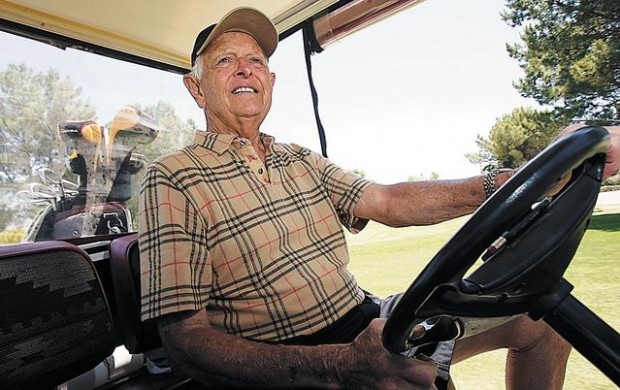
And so it was that when I arrived at the first tee at the venerable CCGV, Roy Smalley Jr., 82 years young, father of 1979 American League All-Star shortstop Roy Smalley III, had consented not only to a day of golf but mostly to a day of telling baseball stories.
It was a cross between bliss and heaven.
"We grew up on a farm in Springfield, Mo., during the depression, but my dad always made sure I had baseball equipment," Smalley remembered. "In 1944, I signed with the Cubs for a $2,500 bonus and $350 month, which seemed like big money. And then I spent 22 months in the Navy."
Smalley remained in baseball through 1962, retiring after managing the Reno Silver Sox to back-to-back California League championships. Top baseball salary: $18,000. He eschewed a chance to coach for his brother-in-law, the late Gene Mauch, who was then manager of the Philadelphia Phillies.
"I never did get hooked on the baseball lifestyle," he said. "I had a family to raise and a business to run."
Baseball in the 1940s and 1950s was such that Smalley spent one winter working as an usher at Santa Anita, a horse racing park in Southern California.
"Nobody recognized a ballplayer," he says. "Unless you were Warren Spahn or Stan Musial, everybody worked in the winter."
That is the short version.
More important than Smalley's career statistics (he hit .227 over 11 seasons), were the numbers he posted when he retired in 1994 after 30 years operating a vast industrial janitorial business in Los Angeles.
"Our yearly volume was $34 million," he says. He moved to Quail Creek in 2004 and still looks fit enough to take an extra base.
HBO rebroadcast its class baseball program, "When It Was a Game," Sunday morning, much of it filmed at Wrigley Field long before the Cubs had become lovable losers. If you pay attention, you can see Smalley turning the double play with none other than Emil Verban.
A few years before Verban died in 1989, Smalley accepted an invitation to the mother-of-all Cubs' fan clubs, the Emil Verban Society, founded by Cubs die-hards in Washington, D.C. It is a well-meaning group whose membership includes George Will, Bill Murray and Jim Belushi.
Verban's name has been connected to the Cubs' inability to win a World Series since 1908. Why? He hit one home run in 2,911 big-league at-bats.
Summoned to speak to the D.C. group, Smalley was flattered when he met Lynn Martin, former Secretary of Labor and a congresswoman from Illinois. She admitted that while growing up in Chicago, accompanying her father to Wrigley Field, Smalley had been "her hero."
Martin introduced Smalley to a gathering of about 400 Cubs fans and finished by saying, "and he's good looking, too."
It is not an introduction at Cooperstown, but it is better than "he batted eighth."
Along the way, Smalley played minor-league ball in Davenport, Iowa, and Shelby, N.C. He lost his job as Cubs shortstop when a rookie named Ernie Banks beat him out in spring training 1954.
Best player he ever saw: "Jackie Robinson."
Greatest ovation he ever heard: "Fidel Castro."
After being released by the Phillies, Smalley became a regular for the 1959 Class AAA champion Minneapolis Millers. In those days, the Class AAA champs played the Little World Series, and in '59, it happened to be against a team from Havana.
"We were on the field, ready to play, surrounded by soldiers armed with machine guns and 40,000 fans cheering wildly," he recalls. "Suddenly, a hush came over the crowd. The gate in center field opened, and in marched Fidel Castro with all of his generals.
"The crowd stood, waving white hankies, chanting 'FI-DEL! 'FI-DEL! FI-DEL!' It was a powerful moment. Fidel loved baseball. He came into our dugout and told our manager, Preston Gomez, 'If you need any (pitching) help, I'm ready.'"
The Cubans won. And so, too, has Roy Smalley.


 Tommy Lloyd's recruiting chops nationally known | Greg Hansen


