Skip to main contentSkip to main content
Register for more free articles.
Log in Sign up
Back to homepage
Subscriber Login
Keep reading with a digital access subscription.
Subscribe now
You have permission to edit this collection.
Edit
Arizona Daily Star
91°
  • Sign in
  • Subscribe Now
  • Manage account
  • Logout
    • Manage account
    • e-Newspaper
    • Logout
  • News
    • Sign up for newsletters
    • Local
    • Arizona
    • Business
    • Crime
    • Nation & World
    • Markets & Stocks
    • SaddleBrooke
    • Politics
    • Archives
    • News Tip
  • Arizona Daily Star
    • E-edition
    • E-edition-Tutorial
    • Archives
    • Special Sections
    • Merchandise
    • Circulars
    • Readers' Choice Awards
    • Buyer's Edge
  • Obituaries
    • Share Your Story
    • Recent Obituaries
    • Find an Obituary
  • Opinion
    • Submit a Letter
    • Submit guest opinion
    • Letters to the Editor
    • Opinion & Editorials
    • National Columnists
  • Sports
    • Arizona Wildcats
    • Greg Hansen
    • High Schools
    • Roadrunners
  • Lifestyles
    • Events Calendar
    • Arts & Theatre
    • Food & Cooking
    • Movies & TV
    • Movie Listings
    • Music
    • Comics
    • Games
    • Columns
    • Play
    • Home & Gardening
    • Health
    • Get Healthy
    • Parenting
    • Fashion
    • People
    • Pets
    • Travel
    • Faith
    • Retro Tucson
    • History
    • Travel
    • Outdoors & Rec
    • Community Pages
  • Brand Ave. Studios
  • Join the community
    • News tip
    • Share video
  • Buy & Sell
    • Place an Ad
    • Shop Local
    • Jobs
    • Homes
    • Marketplace
    • I Love A Deal
  • Shopping
  • Customer Service
    • Manage My Account
    • Newsletter Sign-Up
    • Subscribe
    • Contact us
  • Mobile Apps
  • Weather: Live Radar
  • Facebook
  • Twitter
  • Bluesky
  • YouTube
  • Pinterest
  • Instagram
© 2026 Lee Enterprises
Terms of Service | Privacy Policy
Arizona Daily Star
News+
Read Today's E-edition
Arizona Daily Star
News+
  • Log In
  • $1 for 3 months
    Subscribe Now
    • Manage account
    • e-Newspaper
    • Logout
  • E-edition
  • News
  • Obituaries
  • Opinion
  • Wildcats
  • Lifestyles
  • Newsletters
  • Comics & Puzzles
  • Buyer's Edge
  • Jobs
  • 91° Sunny
Share This
  • Facebook
  • Twitter
  • Bluesky
  • WhatsApp
  • SMS
  • Email

Arizona basketball: UA's impact on the NBA draft

  • Jun 25, 2015
  • Jun 25, 2015 Updated Jun 25, 2015
Prefer us on Google

Here's a look at some of Arizona's former NBA draftees. 

A trip down memory lane

A trip down memory lane 

Editor's note: In the days leading up to the June 25 NBA draft, reporter Zack Rosenblatt will take a trip down memory lane, dig into the Star archives, and look at some of Arizona's former NBA draftees, the path that took them to the pros, and what they've done since then.  

NBA draft flashback: D-Will improved dramatically during Arizona days

NBA draft flashback: D-Will improved dramatically during Arizona days

Derrick Williams draft profile

Arizona Wildcats fans have a lot of reasons to thank Tim Floyd.

When the UA was looking for a new coach before the 2009 season, Floyd turned down an offer to lead Arizona.

So the Wildcats moved on to Sean Miller.

Soon after that, with NCAA violations pending, Floyd resigned as USC coach, and the Trojans lost commitments from three of their incoming recruits — Lamont “MoMo” Jones, Solomon Hill and Derrick Williams.

Those names sound familiar?

All three signed on to play for Miller and be a part of his first UA recruiting class.

Little did Miller, or UA fans, know that Williams — the lowest-rated by most sites in a class that included Jones, Hill, Kyryl Natyazhko and Kevin Parrom — would become one of the shiniest stars in Arizona basketball history.

Williams started as a freshman, broke out as a sophomore and almost single-handedly brought UA basketball back from the dead on an improbable run to the Elite Eight, in the process establishing himself as one of the elite NBA prospects in the nation.

Here’s a look back at Derrick Williams’ path to the NBA draft.

At Arizona: After his junior year at La Mirada (Calif.) High School, Williams was rated outside of Rivals.com Top 150 prospect rankings and was not in Scout.com’s Top 100.

Before his senior season, Williams’ offers were from schools like Nevada, San Diego State, USC and ASU. Lute Olson and the Wildcats didn’t recruit him.

As a high school senior, Williams averaged 25 points per game and launched himself, finally, into Scout’s Top 100. Once he decommitted from USC, Miller and Arizona jumped into the mix, along with Memphis, before Williams ultimately picked the Wildcats as his college home.

“Growing up, I watched (Mike) Bibby, Jason Terry, RJ (Richard Jefferson) — I watched a lot of pros come out of here,” Williams said before his freshman season. “Just the tradition that they built up here, all the banners they have. I want to be a part of that.”

Miller said Williams “has as bright a future as anyone in our program.”

As a freshman, he arrived at 6 feet, 8 inches and 214 pounds. By the midway point of his freshman year, he had grown into a 240-pound post player.

And by then, Arizona could tell it had something special. Williams didn’t start the first game of his career, but was inserted into the lineup in Game 2 against Rice and had a solid all-around night, scoring 10 points with six rebounds, two assists and two blocks.

By the end of his freshman year, Arizona had gone 16-15 and missed the NCAA tournament, but Williams led the team in scoring and rebounding with 15.7 points and 7.1 rebounds per game, winning Pac-10 Freshman of the Year on top of being an All-Pac-10 selection.

He rose enough as a freshman that there was an outside shot he’d leave early for the draft. Williams didn’t, though, and he and the Wildcats were rewarded handsomely.

As a sophomore, Williams emerged as a star, leading Arizona to an unexpected 30-8 record and a regular-season Pac-10 title.

Arizona was a No. 5 seed in the NCAA tournament and drew a first-round game against Memphis. In that, Williams hit a late three-pointer and blocked a potential game-tying shot in the final seconds.

In a second-round game against Texas, he completed a three-point play in the game’s final seconds to win it for the Wildcats.

The Sweet 16 game, against heavily favored Duke, was his coming-out party. He scored 32 points — 25 in the first half — as Arizona advanced to its first Elite Eight since 2005 with a 16-point win over the Blue Devils.

“One fan told me, ‘My shirt is getting small from the 1997 championship. I need another one,’” Williams said. “So that right there just flipped the switch and just changed everything. We want to give everybody what they want.”

The Wildcats would lose to eventual champion Connecticut in the Elite Eight, but by then Williams had already taken Tucson, and the nation, by storm.

His final season stat line: 19.5 points and 8.3 rebounds per game with 59.5 field goal and 56.8 three-point percentages.

He was the Pac-10 Player of the Year, an All-American and a legitimate candidate to be the No. 1 pick in the 2011 draft.

The draft: Despite rumors that he was considering returning as a junior to the UA, Williams declared after the season that he’d be leaving for the draft.

“Derrick is a special player and rightfully should be considered to be one of the all-time great Wildcats,” Miller said. “As good of a player as he is, he is an even better person.”

During the season, Williams launched himself from being a likely first-round pick to a lock for the top five.

By the predraft process, the debate was between Duke’s Kyrie Irving and Williams, with most feeling Irving had the edge. Although, before the draft lottery, the feeling was if the Washington Wizards won the No. 1 pick, Williams would be their guy.

They didn’t, the Cleveland Cavaliers did, with the Minnesota Timberwolves picking No. 2.

Predraft, Williams worked out with only those two teams.

In the end, he went No. 2 to the Timberwolves, a team that already had Kevin Love, Michael Beasley and Wesley Johnson playing a similar position to Williams, considered a tweener and combo small and power forward.

He was the highest-selected Wildcat since Mike Bibby went No. 2 to the Vancouver Grizzlies in 1998.

From the archives: “Mike Bibby’s one of the greatest to ever play at U of A, and I’m honored to share that title with him. But he has a one-up — he won the title at Arizona. It’s just a great honor to be up there with him and be in this position. There’s just a small percentage of people who get this opportunity, and I want to take advantage of it.” — Williams after the draft.

As a pro: Four seasons into his pro career, Williams still hasn’t quite found a footing.

At 6-8, without the size or skill-set of a four, and without the perimeter abilities of a three, Williams has become a man without a position.

For two seasons in Minnesota, Williams fell behind in the rotation, getting 8.8 points per game as a rookie, and 12.0 in his second year.

In his third year, he was traded to the Sacramento Kings, where he’s averaged just 8.4 points per game off the bench in two seasons.

His athletic ability is still shining through — Williams participated in the 2012 NBA dunk contest and has become a frequenter of “SportsCenter’s” Top 10 List with the Kings.

This offseason, Williams will be a restricted free agent for the Kings.

His NBA career might prove to be forgetful, but certainly Arizona fans will never forget what he did for the Wildcats.

“I will tell you, if you really look at the history of individual players having great seasons, I think you’d have to put Derrick’s season up there with some of the great ones who’ve played at Arizona,” Miller said in 2011. “Because he’s not only doing it, but his team is winning right there with him.”

NBA draft flashback: Kerr proved doubters wrong at every level

NBA draft flashback: Kerr proved doubters wrong at every level 

Kerr draft profile

In May of 2014, Stephen A. Smith ranted about Steve Kerr on ESPN.

That shouldn’t come as a surprise — and that’s not in reference to the notoriously, well, loud analyst.

Smith doubted Kerr’s credentials as a coach when he was being considered for head coaching jobs with both the New York Knicks and Golden State Warriors.

The doubt was nothing new. Not for Kerr.

At every step of his career, there’s been plenty of doubts.

Doubts for why Lute Olson gave a scholarship to a unknown guard from Pacific Palisades, California.

Doubts that he was a college basketball player, or that he would be successful at the UA.

Doubts that he would come back from a potential career-ending injury.

Doubts that he deserved to be on an NBA roster.

This was just another one to add to the list.

On June 16, Kerr did what he always does — doubters be damned. He succeeded, winning an NBA title as the Golden State Warriors coach, the first rookie coach to do so since Pat Riley in 1982. That was one year before Kerr started his career at Arizona, a career that helped him get a shot at the NBA.

Here’s a look back at Kerr’s path to the NBA draft.

At Arizona: As the calendar struck July 1983, Kerr still didn’t have a college basketball home.

It got to the point that Kerr was prepared to be just a “regular” college student, maybe try to walk on somewhere or play in intramurals.

Then Lute Olson, recently hired as Arizona’s new coach from Iowa, caught a look at Kerr playing in a summer league game, after he had already graduated from high school.

“I was intrigued at how he handled himself on the court. His leadership ability was very apparent,” Olson said.

Olson arranged for a private workout, and the rest was history — Olson had a scholarship available, and gave it to Kerr, a 6-foot-3-inch guard, who had gotten interest only from Gonzaga.

As a freshman, Kerr was the second man off the bench for Arizona, averaging 22.6 minutes per game, scoring 7.1 points.

As a sophomore in 1984-85, Kerr was inserted into the starting lineup, scored 10.0 points and shot 56.8 percent, helping Arizona to its first NCAA tournament since 1977.

As a junior, Kerr averaged nearly a full 40 minutes per game (38.4) and scored a career-high 14.4 points as the Wildcats made the tournament again, losing in the first round for the second straight year.

That offseason, Kerr played for the USA basketball team — Olson was the coach — that competed in the FIBA World Championship in Spain alongside such players as Navy’s David Robinson and UA’s Sean Elliott.

There, Kerr tore up knee, putting his career in jeopardy. But, he missed just one season, and came back for his magical senior year of 1987-88.

That year, he only scored 12.6 points per game and set a UA record by shooting 57.3 percent on three-pointers. But he meant a whole lot more to what the Wildcats accomplished that season than was on the stat sheet.

In a February game at ASU, some Sun Devils fans started yelling nasty chants in reference to the murder of Kerr’s father, who had been killed in Beirut four years earlier.

Kerr responded by scoring 20 points in the first half, and Arizona won by 28 points.

“I was looking for my shot a little bit more,” Kerr said. “At halftime, I kind of got control of my temper. Maybe I should get mad more often.”

By the end of the season, Kerr was the emotional driving force behind Arizona’s first-ever Final Four berth, a game the Wildcats lost to Oklahoma as Kerr had his worst game of the year, missing 11 shots.

Regardless, Kerr finished his career one of the most beloved Wildcats in school history.

In 1999, Kerr’s No. 25 jersey was retired into the rafters at McKale Center.

“When I came here, if you had told me I’d have my jersey hanging in the rafters, I’d be scared,” Kerr said then.

“I would have thought the only way it would be up there would be if my body was still in it.”

The draft: Before the draft, there were doubts about whether Kerr — really an undersized shooting guard — belonged in the NBA.

He was projected as a second-round pick, at best, in the three-round draft.

Some teams reportedly had Kerr ranked anywhere from the top 40 to non-draftable. The Phoenix Suns had a list of 50 top prospects, and Kerr was not one of them.

Kerr remained confident, however.

“Now that I’ve had a chance to evaluate my chances against the best players in the country, I’d be shocked if I don’t get drafted,” he said. “I never used to think I’d get drafted, but now I know I can play.”

Kerr thought the Philadelphia 76ers might pick him, and the Cleveland Cavaliers and Los Angeles Clippers also were rumored to have interest.

Kerr wound up being drafted by the Suns anyway, at pick No. 50, or the 25th pick in the second round.

From the archives: “It’s very easy for everybody to say he was a sentimental pick coming from University of Arizona and me being friends with Olson. But I tell you the quickest way to get him to the NBA is to tell him he was a sentimental pick and can’t make it.” — then-Suns coach Cotton Fitzsimmons

As a pro: Kerr did, in fact, make it to the Suns, but only lasted in Phoenix for one season before he was traded to the Cavaliers.

He played in Cleveland for three seasons before he was traded to the Orlando Magic, where he played for one season before signing with Chicago in 1993.

In five years with the Bulls, he won three NBA titles, playing a key role alongside NBA legend Michael Jordan and stars Scottie Pippen and Dennis Rodman as a dead-eye, clutch shooter.

“We thought he would be good in this role, and he has been,” Bulls coach Phil Jackson said. “He’s proved his mettle.”

In 1995, Kerr famously got into a fight in practice with the uber-competitive Jordan.

They both moved on, and things, uh, worked out just fine.

“I don’t think I can really put the whole experience into words,” Kerr said after the first title win. “There were a lot of thoughts going through my mind — all the practices, all the games I’ve played in junior high, high school, college and the NBA — to get to this point.”

After his time in Chicago, Kerr spent four of his last five years with the San Antonio Spurs — with one season in Portland mixed in — and won two more titles.

He finished his 15-year playing career as the NBA’s all-time leader in three-point percentage to go with five NBA titles.

Not too bad.

After his playing career was over, he spent time as one of TNT’s lead game commentators, sandwiching a stretch in as the Phoenix Suns general manager. He was then hired as the Warriors coach before this past season.

He chose the Warriors over the Knicks and a chance to work for his old coach, Phil Jackson, now the Knicks president. Golden State won 67 games in winning its first title in 40 years.


Bibby: From can't-miss prospect to NBA star

Bibby: From can't-miss prospect to NBA star 

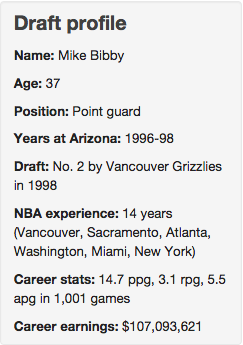
Bibby draft profile

It was a big deal when Mike Bibby chose Arizona out of high school.

Bigger than the rise in Tucson of Sean Elliott — that was a local kid who didn’t blow up nationally until he was a senior.

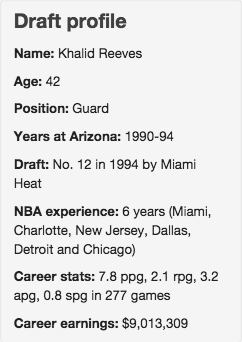
Bigger than Jason Terry or Khalid Reeves.

It was even bigger than all of Sean Miller’s top-level recruits he’s signed since coming to Arizona: Aaron Gordon, Stanley Johnson and the like.

Coming out of Phoenix Sunrise Mountain in 1996, Bibby was considered quite possibly the best Arizona high school basketball player of all time. He was the No. 1 point guard in the nation, drawing comparisons to Jason Kidd.

As a sophomore, UCLA, Duke and Arizona were among the schools already scouting him.

No pressure.

In college, while he might not have become a superstar — which might be because of the talent surrounding him at Arizona — he was still a resounding success.

That’s what it’s called when a freshman point guard leads a team to the national title.

No biggie.

His two-year career at Arizona helped him be picked the highest in the draft in Arizona history — matched only by Derrick Williams 13 years later.

Here’s a look back at Mike Bibby’s path to the NBA draft.

At Arizona: As a high school sophomore, Bibby was already being called the state’s best prospect since Elliott in 1984.

As a junior, he averaged 34.6 points, eight assists, six rebounds and four steals per game.

As a senior, he became the state of Arizona’s all-time scoring leader with 3,002 points.

For college, with his dad, Henry, having had a rich history at UCLA, the Bruins were thought to be a leader for recruiting Bibby, but he and his father never really got along, and Bibby committed to the Wildcats as a junior.

“At this stage, he’s the best we ever recruited,” Olson told the Star in 1996. “Some believe he is not only the best point guard in the nation, but the best player, period.”

With his level of talent, the expectation was that he wouldn’t last long at Arizona. One year, maybe two if the Wildcats were lucky.

“It’s the furthest thing in my mind how long I’m going to last at the UA,” Bibby said. “I’m just going to try to go in every year and play one year at a time.”

The Wildcats were lucky — he lasted two years. None — in program history — have been better than his first season.

In his first-ever game, Bibby scored 22 points in an upset win over No. 7-North Carolina, a game that set the stage for the rest of the season.

With the help of Bibby — along with Michael Dickerson, Jason Terry, Miles Simon and others — the Wildcats were a No. 4 seed in the NCAA tournament.

Miraculously, Arizona stormed through the tournament, upsetting three different No. 1 seeds on the way to winning the title against Kentucky.

In the Sweet 16 against overall No. 1 Kansas, Bibby almost single-handedly won the game for the UA, scoring 11 points in the last nine minutes of a 3-point win. He averaged 18.0 points per game for the tournament.

“He amazes me,” Terry said at the time. “That man has ice water in his veins.”

As a sophomore, Bibby developed more into the prodigious talent everyone expected, leading the team with 5.7 assists per game to go with 17.2 points. He was a consensus All-American and the Pac-10 Player of the Year.

The Wildcats went on to be upset by Utah in the Elite Eight that season, and Bibby, unsurprisingly, declared for the NBA draft.

The draft: The hype surrounding Bibby continued into the pros, as he was considered a lock from the get-go for the top five.

After the Los Angeles Clippers won the NBA draft lottery for the No. 1 pick, early rumors surfaced that Bibby was their target at the top spot. And this was a draft that included future All-Stars like Vince Carter, Paul Pierce and Antwan Jamison.

Bibby’s agent, David Falk, believed this to be so true that he didn’t let Bibby work out for anyone else besides the Clippers.

“It’s pretty obvious where we need to improve our team,” said Clippers executive Elgin Baylor. “It’s no secret we need to get stronger in the backcourt. Bibby is a player we like. The player that we would want, we know will be there.”

As the draft drew near, though, rumors started swirling that the Cliippers were looking at Pacific 7-footer Michael Olowakandi for the top pick.

And in the end, that’s what happened — Los Angeles picked Olowakandi, now considered one of the biggest draft busts of all-time, and Bibby was swooped up at No. 2 by the Vancouver Grizzlies.

“We feel he brings leadership to our team, he’s an excellent shooter, and he’s very unselfish; he’s infectious that way,” said Vancouver general manager Stu Jackson. “He’s a workaholic, and he’s very committed to the game, and he has a great feel for the game.

“Above all, though, Mike Bibby wins. Whether it’s high school, pickup games, Nike camp, or his first season at Arizona, he’s a winner.”

From the archives: “I’m not having hard feelings right now. I’m just happy to be drafted. I’ve been waiting for this my whole life. ... I’m so relieved right now.” — Bibby after the draft.

As a pro: To emphasize just how much the Grizzlies were ready to head the reins over to Bibby, they traded away point guard Antonio Daniels, their top pick the year before, to clear space for Bibby.

For Bibby, a proven winner, he had solid NBA players like Shareef Abdur-Rahim and Bryant Reeves to pass to, but the Grizzlies were still rebuilding and struggled to win even with Bibby in the fold. He spent three years in Vancouver before he was traded to the Sacramento Kings in 2001.

In Sacramento, Bibby formed one of the league’s best pick-and-roll duos with Chris Webber, and together they helped the Kings make it to the Western Conference finals in Bibby’s first year there.

“He’s very cerebral,” Webber said. “He’s a winner. He can do so many things. He’s a great scorer, too.”

Bibby’s best year in Sacramento came in 2005-06, when he averaged 21.1 points and 5.4 assists per game.

He would spend 6 1/2 seasons with the Kings before he was traded to the Atlanta Hawks in 2008, where he stayed until 2011 when he was traded to the Washington Wizards, who eventually waived him. Bibby closed out the 2011 season with the Miami Heat and then signed with the New York Knicks, where he spent his final NBA season in 2011-12.

Now Bibby is an assistant coach at his alma mater, Shadow Mountain High, where his son, Michael Jr,. currently plays.

NBA draft flashback: Terry soared from backup to star in both college, NBA

NBA draft flashback: Terry soared from backup to star in both college, NBA 

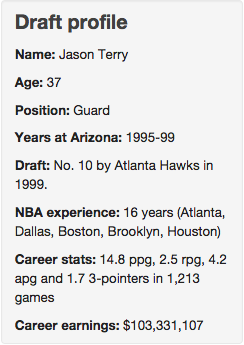
Terry draft profile

His name is Jason Eugene Terry.

He’s known better at JET, though.

He’s a fan favorite, known for his wide smile, fun-loving persona and for his three-point shooting, where after each one made, he spreads his wings and runs back down the floor.

At Arizona, Terry was perhaps best known for his unselfishness, accepting a role as a sixth man for the first three years of career, helping him be a driving force behind the 1997 NCAA title.

Now, 16 years after his career with the Wildcats ended, Terry is still playing in the NBA. Not only is he playing, but he started at point guard in the playoffs for a team that made the Western Conference finals.

Not bad for a guy that scouts said couldn’t shoot coming out of high school.

Terry is one of the most beloved Wildcats of all time, proven recently by the reception he got at his jersey retirement ceremony at McKale Center this past season.

It’s a career that catapulted him into being a top-10 draft pick, longtime pro and NBA champion.

Here’s a look back at JET’s path to the NBA draft.

At Arizona: As a Seattle native, it came as no surprise when Terry verbally committed to play for the Washington Huskies in 1994.

It came as much more of a surprise when he backed out of that commitment, and instead decided to become an Arizona Wildcat.

It couldn’t have come at a better time for the Wildcats, either, as the UA was looking for guards to help replace Damon Stoudamire.

“Future Stars,” a basketball recruiting magazine, had Terry rated as the No. 11 point guard prospect in the nation.

“I can’t fill in for Damon, no one can fill those shoes,” Terry told the Star in 1994. “But I love the challenge of going down there and competing with the other guys.”

Terry didn’t play much as a freshman, getting 9.8 minutes per game as the Wildcats made it to the Sweet 16.

As a sophomore, with elite prospect Mike Bibby coming in, Terry told Lute Olson he was fine with coming off the bench as a sixth man. On a team with Bibby, Michael Dickerson and Miles Simon, Terry was willing to take a backseat. And it paid off, of course.

“Others would have let their ego get in the way,” Olson said. “You can’t measure what his attitude means to the team.”

Well, we know now it meant a lot.

In 1997, the Wildcats stormed through the NCAA tournament, winning the title while overcoming three different No. 1 seeds along the way. Terry only averaged 7.7 points per game in the tournament, but contributed with some big shots and solid defense off the bench.

As a junior, with everyone returning to defend the title, Terry came off the bench again, although this time the Wildcats were beaten by Utah in the Elite Eight.

As a senior, though, Terry finally got his shot, and he was rewarded, even though he was faced with the tough task of leading a team with plenty of inexperience — freshmen Ruben Douglas, Richard Jefferson and Michael Wright all received significant playing time.

“You know, I just welcome the pressure,” Terry said. “I’ve been here so long in that background role that now I just want to help myself and A.J. (Bramlett) just shine.”

Terry was in the background no more.

He went on to tally a career-high 21.9 points and 5.5 assists and 2.8 steals per game, won Pac-10 player of the year, was a consensus All-American and even won National Player of the Year. He also broke the career and single season record for steals, both of which he still holds to this day.

The inexperience got the best of UA in the postseason, though, and No. 4 seed Arizona lost in the first round to 13th-seeded Oklahoma.

Nevertheless, Terry established himself enough to become a likely lottery pick in the 1999 NBA draft.

The draft: Early projections had Terry rated behind a few others at the point guard position — UCLA’s Baron Davis, Maryland’s Steve Francis, Utah’s Andre Miller and Duke’s William Avery.

Terry declined invites to predraft camps in Tempe and Chicago, and worked out for seven different teams.

The ones rumored to be showing the most interest predraft included the Phoenix Suns, Golden State Warriors, Toronto Raptors, Minnesota Timberwolves, Los Angeles Clippers and his hometown Seattle Supersonics.

The biggest question mark for the 6-foot-2-inch Terry was whether or not he could play point guard in the NBA.

By the time the draft came around, the concerns seemed to have been alleviated, as projections started putting him in the top 10, and as high as No.6.

Some analysts pegged Terry as one of the best defensive players in the draft.

In the end, Terry was picked at No. 10 by a team he never even worked out for — the Atlanta Hawks, who traded Mookie Blaylock for the right to draft Terry, clearing up a spot at the point guard position.

From the archives: “We wanted to get more athletic. We wanted to get quicker, and we wanted to shoot better. We felt he would help us in all three ways,” Hawks general manager Pete Babcock told the Star.

As a pro: Terry was already a full-time starter by his second season, and quickly established himself as a talented scorer, averaging more than 19 points per game in both his second and third years in the league.

Terry never had a winning record in five years with the Hawks, though, and was traded to the Dallas Mavericks in 2004.

After his first four years in Dallas, playing with NBA star Dirk Nowitzki, Terry did for the Mavericks what he once did for the Wildcats — accepted a role as a sixth man. And, again, it paid off.

In his first year off the bench, he won the Sixth Man of the Year award, scoring 19.6 points per game. In year three, the Mavericks won the NBA championship, beating LeBron James’ Miami Heat.

Since leaving the Mavericks after the 2011-12 season, Terry has bounced around a bit. First signing with the Boston Celtics and spending one season there before being traded to the Brooklyn Nets. Late in his first season with the Nets, he was traded to the Sacramento Kings, who he never actually played for.

The following offseason, Terry, now 37, was traded to the Houston Rockets, where he played a key role off the bench this past season before starting in the playoffs due to injuries.

Terry has said he intends to play another season or two before pursuing a career as a coach, either collegiately or professional. Terry is third all-time in NBA history in three-point shooting with 2,076 made, behind just Ray Allen and Reggie Miller.

NBA draft flashback: Elliott was NBA All-Star after time in Tucson

NBA draft flashback: Elliott was NBA All-Star after time in Tucson 

Elliott draft profile

Few names resonate in the Old Pueblo quite like this one.

More than Jason Terry.

More than Steve Kerr.

More than Derrick Williams, even Sean Miller.

He’s the one person that, maybe, comes close to rivaling the love for Lute Olson in Tucson.

It’s Sean Elliott — a Wildcats star, an NBA All-Star, and, perhaps most importantly, a legendary Tucsonan.

A Cholla High School grad, Elliott put Tucson on the map when it came to basketball.

They just don’t make 6-foot-8-inch, 205-pound, do-everything forwards in Tucson. Not then, and, really, not now.

“People won’t just believe I’m from Tucson,” Elliott said toward the end of his Wildcat career. “I’m always running into people who tell me I must have moved from Chicago or something.”

If he had been from Chicago, maybe Elliott never ends up a Wildcat, Olson doesn’t get the signature player of his entire UA coaching career, and the trajectory of Arizona’s program is altered.

But Elliott was from Tucson, and certainly the Arizona faithful is thankful that.

After his time in Tucson, Elliott had a successful NBA career too.

Here’s a look back at Elliott’s path to the NBA draft.

At Arizona: Elliott committed to Arizona as a junior at Cholla. Arizona’s timing couldn’t have been better, either — Elliott burst onto the national scene as a prospect during his senior season, scoring 31.1 points per game, leading the Chargers to a 24-3 record and being named a McDonald’s All American.

It should come as no surprise that soon after his high school career ended, Cholla named its gymnasium after its former star.

“You weren’t sure early about Sean, because the competition in Tucson wasn’t good,” said then-UA assistant Ken Burmeister, who recruited Elliott. “But once we saw him match up against the best in the country, wow.”

Initially, Elliott didn’t want to play for Arizona. But Olson sold him.

“Nothing exciting had ever happened here, but I bought Coach Olson’s whole program,” Elliott said. “He said we’d be national championship contenders and we’d sell out our arena. I believed him and he turned out to be right. I just figured why go 2,000 or 3,000 miles away from home when you can get it all right in your backyard.”

From the get-go, his addition to Arizona was a resounding success.

As a freshman, he led the team in scoring — which he would go on to do in all four seasons — with 15.6 points per game, leading the Wildcats to a 23-9 record and a No. 9 seed in the NCAA tournament.

As a sophomore, Elliott improved to 19.3 points per game, and the Wildcats went 18-12 and earned a No. 10 seed.

As a junior, he became a force to be reckoned with, and catapulted the Arizona program to new heights in the process. Elliott was a consensus All-American, the Pac-10 Player of the Year and scored 19.6 points per game. The Wildcats went 35-3 and made their first trip to the Final Four.

“Sean is the most talented player I’ve had the good fortune to coach in 30 years,” Olson told the Star. “No one in America can do what he does.”

Initially, Elliott’s plan was to leave for the NBA if Arizona reached the Final Four. But, with some prodding from his mother, Odimae, to finish his degree, Elliott returned for his senior campaign and had the best season of his career.

He set career highs with 22.3 points, 7.2 rebounds and 4.1 assists per game. He was a consensus All-American and Pac-10 Player of the Year again, and was the national player of the year as well. Arizona went 29-4 on the season, but lost in the Sweet 16 to UNLV.

Nevertheless, Elliott’s stock had never been higher as he entered the 1989 NBA draft.

The draft: After his college career ended, Elliott was considered a prime candidate — along with Duke’s Danny Ferry, Oklahoma’s Stacey King, Louisville’s Pervis Ellison and Michigan’s Glen Rice — for the No. 1 overall pick in the draft, belonging to the Sacramento Kings.

Then, rumors started swirling that Elliott had liver problems and a bad knee that would deteriorate in a few years and limit his potential. Elliott denied these rumors, but they still persisted throughout the draft process.

Throughout college, Elliott wore a knee brace stemming from an injury he suffered while in high school, which raised concerns among scouts. But as it turned out, Elliott had his knee tested by multiple NBA team doctors who deemed him fine.

So, his stock never actually fell. Before the draft, Elliott spoke with the Kings, but never worked out for them. He did work out for the Miami Heat (who had the No. 4 pick) and the Los Angeles Clippers (No. 2).

In the end, Elliott was swooped up at No. 3 by the San Antonio Spurs.

Said Red McCombs, the Spurs owner: “Everyone knows we would have preferred Danny Ferry, but we got a great player.”

From the archives: “Oh no, it’s not a disappointment,” Elliott said, when asked if he wanted to go No. 1 overall. “I wanted to go someplace where I’d fit in. I think this is a team with a lot of potential to be a good team.”

As a pro: Remember those injury concerns?

Elliott started his career playing in 546 of a possible 574 regular-season games in seven seasons.

In two of those seasons — 1992-93 and 1995-96 — Elliott was an All-Star. He had a stint in Detroit in 1993-94 after he was traded for Dennis Rodman, but was traded right back to the Spurs one year later and spent the rest of his career in San Antonio, winning an NBA title in 1999.

Shortly after the championship run, Elliott announced that he had been playing with a kidney disease and needed a transplant.

After getting surgery in August, he miraculously returned to the court in March. Elliott played one more season in the league after that before retiring, ending a pro career that lasted 12 seasons.

Not bad for a Tucsonan who was supposed to be out of the league quickly with injury concerns.

Since his playing career ended, Elliott has spent time as both an NBA and college basketball analyst, even calling some Arizona Wildcats games in the process.

His No. 32 is retired by both the Wildcats and Spurs.

NBA draft flashback: Mills impressed during short stint with Cavs

NBA draft flashback: Mills impressed during short stint with Cavs 

Mills draft profile

Chris Mills came to Arizona carrying some baggage.

Mills was forced to leave the University of Kentucky after his father allegedly received $1,000 from a UK assistant coach, getting caught as the money supposedly fell out of an envelope at a delivery office.

After Mills’ career at the UA ended, some more allegations arose.

One that, again, his father was given “unlimited use” of a former sports agent’s cars. And also, allegations arose that Mills — or someone close to him — forged signatures to change a failing grade to passing to allow him to graduate.

In part because of the drama, people forget how good Mills was on the court. 

He was consistently Arizona’s best player on a team that included seven future NBA draft picks, including college stars like Khalid Reeves and Damon Stoudamire.

A 6-foot-7 forward with scoring and rebounding ability, he was as talented a Wildcat as there maybe ever was, and it helped his stock as he entered the 1993 NBA Draft.

Here’s a look back at Reeves’ path to the NBA Draft.

At Arizona: Mills was among the nation’s most sought-after high school recruits. A two-time California state player of the year at Fairfax (Calif.) High School, Mills averaged 33 points, 13 rebounds and four assists per game as a senior, and picked Kentucky over UCLA, UNLV and Syracuse.

When it came time to leave Lexington — after a freshman season where he averaged 14.3 points and a career-high 8.7 rebounds per game — Mills considered UCLA and Arizona. The Bruins backed out, so Arizona was an easy choice. He committed to the Wildcats in June 1989.

“I knew coach Lute Olson had an outstanding program and I have watched Arizona play on television,” Mills said. “I like the style they play. I like the team concept. Coach Olson knows exactly what it takes to win.”

Olson compared Mills favorably with UA legend Sean Elliott.

“He’s quiet, he’s well-mannered, he’s intelligent, he’s talented as an individual,” Olson said, “but the name of the game is team play, and he’s a team player.”

After sitting out the required year as a transfer, he made his Wildcats debut in 1990, already leading the UA in scoring (15.6) with 6.2 rebounds and 2.0 assists per game. That season, the Wildcats went 28-7 and made the Sweet 16.

After that, though, as Mills improved, the Wildcats suffered two of the worst NCAA tournament exits in program history.

When Mills was a junior, and led UA in both scoring and rebounding, No. 3-seed Arizona was eliminated by 14-seed East Tennessee State.

The next year, Mills averaged 20.4 points per game, was named an All-American and won Pac-10 player of the year. But the No. 2-seed Wildcats suffered an unprecedented first round loss to 15-seed Santa Clara, led by Steve Nash.

Those two losses were no fault of Mills, though — he averaged 18.0 points and 7.0 rebounds in defeat. 

The draft: Most pre-draft projections had Mills in a tier below the 1993 Draft’s elite players, which included Chris Webber, Shawn Bradley, Jamal Mashburn, Anfernee Hardaway and now-ASU coach Bobby Hurley.

Mills visited with half of the league’s team for workouts, and early projections had him going to the Detroit Pistons (with picks No. 9 and No. 10) or the Los Angeles Clippers at No. 13.

Elgin Baylor, the Clippers general manager and an NBA legend as a player, said: “"He can play. He is a basketball player."

Mills fell further than expected, dropping out of the Top-20 before the Cleveland Cavaliers drafted him at pick No. 22.

After the draft, he signed a 5-year rookie deal worth $5.22 million.

From the archives: "I was back there wondering, 'Where am I going to go?' I guess I'll have to (work hard and) let those teams that passed on me know they made a mistake." — Mills on the TNT broadcast of the draft.

As a pro: Before his career even started, Mills had a cameo alongside a number of other NBA players in the Nick Nolte-led basketball film “Blue Chips.”

He impressed early in his tenure with the Cavaliers, leading one local beat reporter to write: “"This guy is a 6-6 athlete with a 23-year-old body and a 33-year-old head. He doesn't need to be told to rebound. Tell him to double-team and when to stay with his man on defense, and he'll remember. Even better, he follows his jumper to the backboard, making him a rarity in the NBA - a player who doesn't assume every shot he takes is going in."

Mills would spend four seasons with the Cavs, the best of which came in 1995-96 when he scored a career-high 15.1 points per game.

Then, he started bouncing around the league. In 1997, he was traded to the New York Knicks; in 1999, he was moved to the Golden State Warriors, in 2003 he was traded to the Golden State Warriors and a few months later, the Dallas Mavericks. Finally, he was traded again in 2004 to the Atlanta Hawks, but was cut one month later, ending his NBA career.

He wound up playing10 seasons in the NBA, with a career scoring average of 11.2 points per game.

NBA draft flashback: Stoudamire shot his way to Hawks

NBA draft flashback: Stoudamire shot his way to Hawks

Stoudamire draft profile

Salim Stoudamire already had the name recognition when he came to the UA.

That’s what happens when your cousin is Damon Stoudamire, one of the more beloved ex-Wildcats in team history.

He was a Stoudamire in both name and skill set. Both were lefty guards, a bit undersized for their position — Damon a 5-10 point guard, Salim a 6-1 shooting guard — and had a nice shooting stroke.

Salim, in fact, might have had the smoothest stroke in Arizona history. He’s arguably the best long-range shooter the UA has ever seen.

Salim Stoudamire posted a terrific college career, even if he didn’t quite have the same impact as his “Mighty Mouse” cousin.

And, like Damon, that eventually led to the NBA, too.

Here’s a look back at Salim Stoudamire’s path to the NBA draft.

At Arizona: Stoudamire came to Arizona the career scoring leading in Oregon Class 4A history, starring at Lake Oswego High School.

Choosing Arizona was a no-brainer, especially considering Salim’s connection to his famous cousin.

“He excelled in their program, and I feel I can do the same,” Stoudamire told the Star when he committed in 2000. “(This decision) feels great.”

Stoudamire came to the UA in a class that also included Channing Frye.

Off-court issues were never an issue with Stoudamire, but his attitude on the court, at times, was an issue, and led to a few suspensions at the UA, too.

“People take my personal expression in the wrong way,” Stoudamire said. “They think I’m mad at somebody else or something. But the reality is I’m mad at myself. I’m a perfectionist. But nobody’s perfect.

Nevertheless, Stoudamire burst out the gates, winning Pac-10 Freshman of the Year and guiding the Wildcats to a Pac-10 championship, scoring 28 points in the tournament final against USC. He also set a UA record for free throw percentage (.904).

By his junior year, Stoudamire started becoming a shooting force to be reckoned with, as he scored 16.3 points and made 2.7 three-pointers per game.

As a senior, he posted the type of season that might not happen at the UA for a long time — he shot 50 percent (.504) from the field, 50 percent (.504) from three and 90 percent (a UA record .910) from the free throw line, along with scoring 18.4 points per game, twice scoring 37 and setting a school record in making nine 3-pointers in one game against Oregon State.

“The shots he was making & that was video-game type stuff,” Frye said after that OSU game. “His range is, basically, just forever.”

He finished his Arizona career it’s all-time leading free throw percentage and three-point shooter, and second only to Steve Kerr percentage-wise from three. He was an All-American as a senior, too.

The draft: There was no questioning Stoudamire’s ability to shoot and score.

But that wasn’t enough to offset other concerns from NBA personnel — particularly, both his lack of size (6-foot-1) and lack of point guard skills. Attitude and maturity were also question marks.

“Every team has a guard on their team who may not fit a position but brings a particular skill; Salim obviously has that,” Suns player personnel man David Griffin told the Star. “In addition to that, Salim’s a good defensive player.”

Stoudamire was projected as a borderline first-round pick, and worked out with 13 teams before the draft, including the Suns, Boston Celtics, Toronto Raptors and his hometown Portland Trailblazers.

One team he didn’t work out for? The Atlanta Hawks, who wound up making him the first pick in the second round.

From the archives: “At first, I had mixed emotions because I knew 30 players aren’t better than me. Then I thought about it and realized it was the perfect situation for me.” — Stoudamire to the Star after the draft.

As a pro: Atlanta was coming off a league-worst 13-69 record.

Things didn’t get much better with Stoudamire in the fold.

As a rookie, Atlanta won just 26 games as Stoudamire averaged what would be a career-high 9.7 points and 1.2 assists per game while shooting .380 from long range, a mark worse than all four years he played at Arizona.

In Year 2, Stoudamire scored 7.7 points per game as Atlanta went 30-52.

Then in what would be Stoudamire’s last year in the NBA, the Hawks went 37-45 and Stoudamire fell to 5.7 points per game in just 35 games played.

After that, he played two seasons with the D-League’s Idaho Stampede and Reno Bighorns. He was signed by the Fort Wayne Mad Ants in 2013 but was cut before the season and spent that season playing professionally in Venezuela.

NBA draft flashback: Mercurial Williams won title with Bulls

NBA draft flashback: Mercurial Williams won title with Bulls 

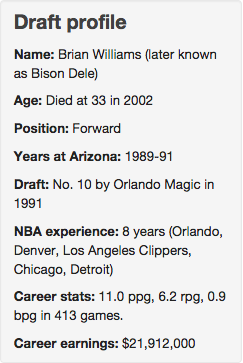
Williams draft profile

Brian Williams was quite a story.

If his life were made into movie — and there’s plenty of material to do that — it might be called “The Curious Case of Bison Dele,” or “Brian Williams’ Series of Unfortunate Events.”

He played his Arizona career as Brian Williams, changing his name to Dele at the tail end of his professional career to honor his Native American and African heritage.

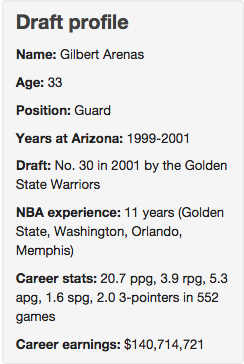
As talented as any big man to ever play for Lute Olson, Williams was on the Gilbert Arenas spectrum in terms of personality.

Teammates nicknamed him “The Terminator.”

He played the saxophone, violin and trumpet and got a pilot’s license, and after retiring from basketball, he often traveled to Lebanon, the Mediterranean and the Australian Outback. He eventually purchased a catamaran to sail the South Pacific.

Early in his NBA career, he dealt with blackouts due to a heart ailment, and was once arrested for possession of marijuana.

Dele tragically lost his life at sea, on his catamaran, killed by his twin brother. Miles Dabord then proceeded to assume his name and purchase more than $150,000 in gold.

As a basketball player, though, his talent was never in question. And coming out of Arizona, he was a top-10 pick.

Here’s a look back at Bison Dele’s path to the NBA draft:

At Arizona: Brian Williams quickly showed his talent in his first year of college basketball — it just wasn’t spent at Arizona.

The Santa Monica (Calif.) High School product started his college career at Maryland, where he averaged 12.6 points and 6.0 rebounds per game as a freshman.

After the season, Williams announced his intent to transfer because of “philosophical differences” with coach Bob Wade.

He picked Arizona over offers from UCLA, Duke and Loyola Marymount.

After sitting out one year to meet transfer rules, Williams started right away as a sophomore, although it was a year mired in criticism due to inconsistent effort.

Before the season, ESPN analyst Dick Vitale picked Williams as an All-American. That didn’t quite pan out — he averaged 10.6 points per game with 5.7 rebounds. The NCAA tournament showed him both at his best — he scored 28 points against South Florida in the first round — and at his worst: Williams played 14 minutes and did not score against Alabama in the second round.

“He gets the bad rap because he’s so talented, but he played so inconsistently,” UA forward Matt Muehlebach told the Star in 1990. “There were all kinds of rumors about whether he was part of the team. But it wasn’t all his fault. The blame has to go to everyone.”

The next season, Williams got his act together and thrived. He was an All-Pac-10 selection and honorable mention All-American after getting 14.0 points per game, 7.8 rebounds and shooting 61.9 percent from the field. The Wildcats made the Sweet 16 that season before losing to Seton Hall.

The draft: As a 6-foot-10-inch big man with athleticism and tantalizing talent, it didn’t come as too much of a shock when Williams left one year early for the NBA draft.

“I know a lot of people in Tucson are sad, especially those who looked forward to seeing me play next year,” Williams said, “but I’m comfortable with my decision because I believe I am major league. I’m ready to move on.”

Williams was projected as a lottery pick, with some people projecting him as high as No. 6 overall to the Dallas Mavericks or No. 7 to the Minnesota Timberwolves.

On draft day, he fell past Dallas and Minnesota before being picked up by the Orlando Magic at No. 10

From the archives: “It’s a good feeling. I’m going to make Orlando proud. In a few years they’re going to look back at this draft and say what a success it was.” — Williams to the Star

As a pro: Williams’ pro career got off to a rocky start. He held out until the regular season had already started, demanding more money than the Magic were offering; at one point, he even requested a trade.

He made his debut with the Magic eight games into the season and finished his rookie season averaging 9.1 points per game.

Williams’ second year was cut short because of injuries and other issues, and he played just 21 games on a team that included rookie Shaquille O’Neal and a young Steve Kerr.

Orlando soon traded Williams to the Denver Nuggets for Anthony Cook, another former Wildcat. Williams played there for two years before being traded again to the Los Angeles Clippers.

His lone season in Los Angeles was the best of his career, as he tallied career-highs with 15.8 points, 7.6 rebounds and 1.9 assists per game. He signed with the Chicago Bulls in the offseason and was part of a team that won the 1997 NBA championship.

Finally, he signed a $40 million contract with the Detroit Pistons, where he spent his final two seasons. Williams changed his name to Bison Dele before abruptly retiring with $36.45 million left on his deal.

NBA draft flashback: After his NBA flight, 'Big Bird' thrived in Tucson

NBA draft flashback: After his NBA flight, 'Big Bird' thrived in Tucson

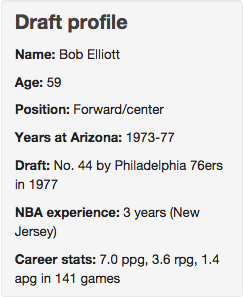
Bob Elliott draft profile

The year 1972 turned out to be an important one for the Arizona Wildcats.

It was the year the UA plucked Dave Strack from Michigan to be its athletic director, who proceeded to bring Fred Snowden — an assistant on Michigan’s coaching staff — to be Arizona’s new basketball coach.

This soon led to a commitment from center Bob Elliott, a prep star in Ann Arbor, Michigan.

That trifecta of new additions to the Wildcat family might have changed the course of UA basketball.

Elliott quickly established himself as a star — and one of Arizona’s all-time greats — and helped to put the UA basketball program on the map.

Eventually for Elliott, it led to an NBA career and one of the more interesting post-playing careers of any former Wildcat.

Here’s a look back at his path to the NBA draft.

At Arizona: The 6-foot-10-inch Elliott, nicknamed “Big Bird,” had his pick of colleges coming out of high school.

“My father and I sat down and wrote a list of the criteria concerning a school’s past history both academically and athletically,” Elliott told a local paper, “and that eliminated a lot of schools right away.”

The list was eventually trimmed to two — Michigan and Arizona.

Elliott wanted something different, plus with a little convincing from Snowden, he became a Wildcat.

“I had lived in Ann Arbor all my life until I came to school, and to me it would have just been another transition of going through school if I had gone to Michigan, like junior high school to high school,” he said.

“I felt I needed, for my own personal maturity, to get out of Ann Arbor and see other parts of the country and meet other people.”

Elliott started as a freshman on a UA team that also featured six future NBA draft picks, including Eric Money, Coniel Norman and Al Fleming, Arizona’s all-time leading rebounder.

That year, Elliott averaged a double-double — 16.5 points, 10.5 rebounds per game — which is something that’s been done only five times since, including once more by Elliott. The team went 19-7, Arizona’s best mark in 24 years. In one game against Arizona State, Elliott tallied 38 points and 25 rebounds.

As a sophomore, with Money and Norman off to the NBA, Elliott began his ascent to stardom. He led Arizona with 23.3 points per game and 7.7 rebounds, guiding the Wildcats to a 22-7 record and a National Commissioners Invitational Tournament berth.

In his final two years, Elliott led the Wildcats to two NCAA tournaments and was an All-American. He finished his career as Arizona’s all-time leading scorer — he’s now second — and second-leading rebounder, and a three-time All-WAC selection.

A stellar career led to a near-certain selection in the 1977 NBA draft.

The draft: Elliott was viewed as one of the better prospects entering the draft.

In 2011, the Star compared Elliott to Arizona’s Derrick Williams, who was drafted that year No. 2 overall. Elliott could play anywhere from small forward to center, could beat players off the dribble and could shoot from all over the floor.

But, “being Big Bird had nothing to do with my leaping,” Elliott joked.

Regardless, an Associated Press article from 1977 listed Elliott as one of its top-30 prospects entering the draft.

Elliott fell to the second round before being selected at pick No. 42 by the Philadelphia 76ers. One pick later, the Sixers also selected Elliott’s Arizona teammate, guard Herman Harris.

“It’s the ultimate dream,” Elliot told the Star. “Back in the second grade, you say I’m Kareem, and you’re Walton. Now we have a chance to play in the big league.”

As a pro: Neither Elliott nor Harris would ever play a minute for the Sixers.

Harris, in fact, never played in the NBA, while Elliott spent the 1977-78 season in Italy after being cut by the Sixers before his rookie season. Elliott eventually signed with the New Jersey Nets.

Elliott played for the Nets for three seasons, and then one season with the Detroit Spirits of the Continental Basketball Assocation (CBA).

Elliott never quite became the NBA star that he was in college — his career averages were just 7.0 points and 3.6 rebounds per game — but he had a successful career in Tucson after his playing career ended.

He has been a broadcaster and a sports agent, and he now owns an accounting practice in the city.

He wrote a book, released in 2014, titled “Tucson: A Basketball Town” about the Fred Snowden era and the rise of popularity for the Wildcats in Tucson.

NBA draft flashback: Bayless was first of UA's one-and-done players

NBA draft flashback: Bayless was first of UA's one-and-done players 

Bayless draft profile

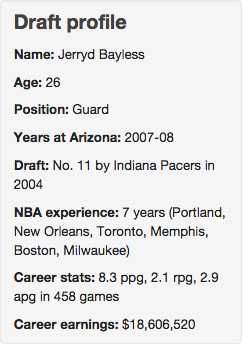
Jerryd Bayless is something of a trend-setter for Arizona.

He’s not exactly someone who left the UA and became one of its beloved alumni, and that, as much as anything, might be because of the one year he played in Tucson — 2008, the swept-under-the-rug Kevin O’Neill-led season.

The “one” in that is what made Bayless something of a trend-setter for the Wildcats, or at least the originator at UA.

That is, Bayless came to Arizona a highly-touted recruit, and left after one season. One-and-done, like Aaron Gordon, Grant Jerrett and Stanley Johnson have done since. With the modern landscape as it relates to the NBA, coupled with Sean Miller’s recruiting prowess, it’ll happen again, too.

But Bayless was first, and there wasn’t another until after the Lute Olson era.

Bayless hasn’t amounted to an NBA star, or even a consistent starter, but it was hard to argue too much with the decision at the time, considering all he did in his lone year as a Wildcat.

Regardless, Bayless recently finished his seventh season in the league, with his sixth team.

Here’s a look back at Bayless’ path to the NBA draft.

At Arizona: Bayless was something of a prodigious prep Arizona talent coming out of Phoenix St. Mary’s, as he’d already started getting looks as a high school freshman.

Olson was in full pursuit of him as a sophomore.

At the time, Bayless, a 6-foot-3-inch guard, was considered the state’s best prospect since ex-Wildcat Mike Bibby came out of Phoenix in 1996. By his senior season, Scout.com had Bayless rated the No. 9 prospect in the nation, ahead of future studs such as Oklahoma’s Blake Griffin and ASU’s James Harden.

Bayless committed to Arizona early, in 2005 during his junior season, picking the Wildcats over Texas. He was joined in the 2007 class by Jamelle Horne.

“It was the best place for me,” Bayless told the Star. “I want to be coached by Lute Olson. He’s a legend.”

By the time he arrived at Arizona, the Wildcats were in the midst of dealing with the tumultuous end to Olson’s coaching career, and Bayless never actually played for Olson, instead playing his one season for interim coach O’Neill.

In that season, Bayless set a number of UA freshman records, including points scored in a game (39, against ASU), total points scored (592) and 30-point games (four). He also averaged 19.7 points per game, second only to Coniel Norman. As a team, though, the Wildcats disappointed, losing in the first round of the NCAA tournament to West Virginia.

The tumult at UA, coupled with his presumed first-round stock, led Bayless to declare for the draft after one college season.

The draft: During the pre-draft process, Bayless was still projected as a likely top-10 pick, despite the roller-coaster ride that was his lone year at UA.

“I signed up for one thing and got another going to Arizona this year,” Bayless told the Star. “It was definitely a learning experience and I learned a lot from it, but everything still worked out pretty well.”

After the NBA draft lottery revealed the Seattle Supersonics would have the No. 4 overall pick, many began projecting Bayless in that slot.

The speculation was such that then-Sonics rookie Kevin Durant even texted Bayless about the possibility of playing with him. The Knicks, at No. 6, were also reported as a possible home for him.

On draft day, the Sonics wound up drafting UCLA guard Russell Westbrook, and the Knicks picked Italian forward Danilo Gallinari, as Bayless dropped out of the top 10. He was picked at No. 11 by the Indiana Pacers and soon after traded to the Portland Trailblazers.

From the archives: “I’m excited for the opportunity. Obviously, I wasn’t waiting. I didn’t know I was going to be left (undrafted) that long. But there’s an opportunity there and I’m going to a good team that needs a couple of good parts to win. I’m really excited to be playing with Greg Oden, Brandon Roy and all those great players they already have there.” — Bayless to ESPN after he was picked.

As a pro: Even though he’s only been in the league for seven seasons, Bayless has already earned a “journeyman” tag for how much he’s moved around.

After two seasons in Portland, Bayless was traded to the New Orleans Hornets, where he stayed for just a month before being shipped off again, this time to the Toronto Raptors.

Bayless would play one more season in Toronto before signing with the Memphis Grizzlies as a free agent on a two-year, $6.1 million deal.

After a season and a half with Memphis, he was traded again to the Boston Celtics, where he played out the remainder of the 2013-14 season before signing with the Milwaukee Bucks before this season on a two-year, $6 million contract.

For the Bucks, Bayless averaged 7.8 points, 2.7 rebounds and 3.0 assists per game coming off the bench.

NBA draft flashback: Ex-Cat Woods, a 2nd-round pick, struggled to find a home in NBA

NBA draft flashback: Ex-Cat Woods, a 2nd-round pick, struggled to find a home in NBA

Woods draft profile

Loren Woods spent his freshman year of college learning from senior Tim Duncan.

Yes, that Duncan, the long-time NBA star, one of the most recognizable names in the sport.

In college, at Wake Forest, Duncan was the rare elite prospect that stayed in college all four years, building up enough hype from four impressive seasons to be one of the most highly touted guys ever to enter the NBA draft.

As a sophomore, Woods was supposed to step in, and replace him. To replace Tim Duncan.

No pressure.

It didn’t quite work out, much to the chagrin of Wake Forest faithful, but to the benefit of Lute Olson and the Arizona Wildcats.

After two years with the Demon Deacons, Woods transferred to the UA, and away from Duncan’s massive shadow.

“If you hear that (Tim Duncan) stuff every single day, it gets on your nerves,” Woods told the Star in 1999.

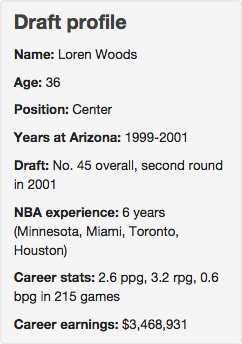
In the end, it certainly worked out — Woods’ two years in Tucson were a resounding success, both for Woods and the team, and it helped him get drafted into the NBA in 2001.

Here’s a look back at Woods’ path to the NBA draft.

At Arizona: When Woods, a 7-foot-1-inch center from St. Louis, announced his intent to leave Wake Forest, the Wildcats and Seton Hall were at the top of his list. Seton Hall was up there because of a previously established relationship with Pirates coach Tommy Amaker.

He still picked Arizona, though.

“I just asked coach (Lute) Olson one question: ‘Will there be a chance for a national championship with the players you’ve brought in?’ “ Woods said in 1998. “He said, ‘Yes.’ That was it for me.”

So Woods sat out the 1998-99 season due to transfer rules, impressing the Wildcats staff in practice along the way, before debuting as Arizona’s new starting center as a junior in 1999. And he was a breakout — Woods led the team in scoring (15.6 points per game), was second in rebounds (7.5) and was a force in the low-post, getting 3.9 blocks per game and a school-record 14 in one game against Oregon.

Toward the end of the season, Woods suffered a back injury, causing him to miss the NCAA tournament, in which the No. 1 seeded Wildcats lost in the second round to Wisconsin.

After the season, he was expected — along with forward Richard Jefferson — to leave early for the NBA draft.

Neither one left, and Arizona was rewarded handsomely, outside of a six-game suspension Woods received for accepting illegal benefits. Woods’ stats fell off a bit (13.2 points, 6.5 rebounds, 2.9 blocks per game), but Arizona did not, making it all the way to the NCAA title game before losing to Duke.

The draft: As a 7-1 shot-blocking center, Woods was certainly a lock to be drafted.

The where was more of a question.

Coming in, there were questions about his strength, his history with back injuries and concerns with his suspension at Arizona.

Before the draft, Woods was confident he’d be a top pick, with the Orlando Magic at No. 15 showing the most interest.

It didn’t quite work out that way.

Instead, Woods fell all the way to the second round before finally getting picked by the Minnesota Timberwolves at No. 46 overall.

From the archives: “The more I thought about it, the more frustrated and the more angry I got about it. But I understood that there were some possible rumors going around about my back, and teams freaked out. Teams aren’t going to invest millions of dollars into a player if they don’t think he’s going to be a good player for the next two or three years. I got my first lesson of the business side of the NBA.” — Woods to the Star after the draft

As a pro: In the NBA, Woods’ career didn’t quite pan out the way many thought it would.

He lasted two seasons in Minnesota, never even playing 10 minutes per game, before he signed with the Miami Heat.

He only played there for one season before he was selected by the new Charlotte Bobcats in an expansion draft, but he never played for the Bobcats, eventually signing with the Toronto Raptors, where he played for two seasons.

Woods signed with the Sacramento Kings in 2006, but was cut before the season. Finally, Woods played for the Houston Rockets on two 10-day contracts in 2008 before he was cut for the final time after that season. In between the Rockets and Kings, he played in the D-League, Lithuania and Turkey, and after Houston cut him, he bounced around overseas, playing in Spain, Iran and Lebanon.

The best season of his career came in 2004-05 with the Raptors, when he averaged 3.9 points, 4.9 rebounds and 0.9 blocks per game.

NBA draft flashback: Injuries slowed NBA career of ex-Cat Dickerson

NBA draft flashback: Injuries slowed NBA career of ex-Cat Dickerson 

Dickerson draft profile

Michael Dickerson is an unfortunate case study in what could have been.

If not for injuries, Dickerson’s impact in the NBA may have been much greater.

He was an adept scorer, something he showed particularly in his final two years at Arizona, and that quickly translated to the pros.

Then injuries derailed him, and his professional basketball career ended soon after it started.

“I proved that I can play,” Dickerson told the Commercial Appeal in 2009. “I always think about how good I might have been if I never got injured.”

Nonetheless, it’s hard to still not call Dickerson’s basketball career a successful one.

Here’s a look back at Dickerson’s path to the NBA draft.

At Arizona: Dickerson committed to Arizona in November of 1993, picking the Wildcats over Washington State, and joining a class that included Miles Simon, Donnell Harris, Kelvin Eafon and junior college transfer Ben Davis.

“He has long arms and is very explosive,” Lute Olson told the Star. “He has the best first step of anybody I saw this summer. From the three-point line I saw him take one dribble and slam it. And he’s a gym rat. I don’t know that I’ve ever seen a player more like that than he is.”

His first two years in Tucson weren’t exactly filled with playing time — as a freshman, he scored 138 points in 29 games, and started just twice in the final 19 games of his sophomore season, in which he averaged 11.9 points per game.

As a junior and senior, the 6-foot-5-inch guard was a breakout. He tallied a team-high 18.9 points per game in the 1997 NCAA championship-winning season, and another 18.0 in 1998.

As a senior, overshadowed by teammates Simon and Mike Bibby, he was left off a final list of John Wooden Award candidates.

“I’m not even in the top 30,” Dickerson told the Star. “Whoa. Imagine that. Someone, somewhere thinks there are 30 college basketball players better than Michael Dickerson.”

For how talented he was as a scorer, Dickerson still sometimes struggled in big moments. In a 1998 Elite Eight loss to Utah, he shot 2 for 12 with six points; and in the Final Four against UNC in 1997, he was 1 of 10 with five points.

That, at least before the pre-draft process, became a question mark as he prepared for the NBA draft.

The draft: Despite those postseason struggles, Dickerson was still viewed as a one of the top shooting guards in the draft and a likely middle first-round pick.

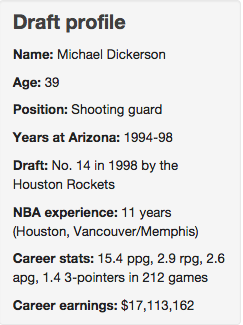
Dickerson reportedly impressed in workouts for the Houston Rockets (who had three first-round picks) and the Sacramento Kings, and also worked out for the Atlanta Hawks, Phoenix Suns, New York Knicks, Charlotte Hornets, Philadelphia 76ers and his hometown Seattle Supersonics. On draft day, the Rockets were looking to find a replacement for the recently retired Clyde Drexler, a Hall of Fame wing, and decided Dickerson was the guy, selecting the UA shooting guard at No. 14 in the first round.

Soon after the draft, Dickerson signed an endorsement deal with Converse.

From the archives: “(Drexler) was a Hall of Famer and I don’t expect to fill his shoes. I can’t do that.’ But I’m just going to go in and do what the coaches want me to do. If they want me to get the ball inside to Hakeem (Olajuwon), I’ll do that. If they want me to shoot, I’ll do that. But I can’t replace Drexler.” — Dickerson to the Star after the draft

As a pro: After just one season in Houston — in which he averaged a solid 10.9 points per game — Dickerson was shipped to the Vancouver Grizzlies in a blockbuster three-team, eight-player trade.

In Vancouver, Dickerson joined his UA teammate,Bibby, who was picked at No. 2 in the 1998 draft by the Grizzlies.

Dickerson’s first season in Vancouver was a resounding success, as he played — and started — in every game, finishing second on the team with 18.2 points per game. In 2000-01, he scored 16.3 per game in 70 games played. This led to the Grizzlies signing Dickerson to a six-year, $43 million contract before the next season.

Unfortunately, he wouldn’t come close to playing out that deal.

Just four games into the season, Dickerson suffered a stress fracture in his groin area, forcing him to miss the rest of the year. The next season, after just two games, he was again lost for most of the year due to complications from the same stress fracture. After three months of rehab, Dickerson returned for four more games before straining an abdominal muscle and developing a sports hernia. So in 2003, Dickerson announced his retirement, with $29 million still left on his contract.

He attempted a comeback with the Cleveland Cavaliers in 2008, to no avail, and played in Spain for one year before retiring from basketball for good.

NBA draft flashback: Stoudamire made quick impact with Raptors

NBA draft flashback: Stoudamire made quick impact with Raptors 

Damon Stoudamire draft profile

Throughout his basketball career, Damon Stoudamire has a tendency to leave a place much beloved.

He left his hometown of Portland for the Arizona Wildcats and Tucson.

After four years, he left Tucson and the UA for a long career in the NBA, including a return back to Portland for seven years in the pros.

How much does Portland love Mighty Mouse? A local brewery named a beer Damon Stoutmire after the city’s revered point guard.

After a couple of years on Sean Miller’s staff as an assistant, Stoudamire left again for Memphis.

Regardless, the short-in-stature Stoudamire is one of the Arizona faithful’s all-time favorite players for what he did as a Wildcat and also afterward.

Here’s a look back at Stoudamire’s path to the NBA draft.

At Arizona: He was supposed to go to Louisville.

In 1991, as the 5-foot-10-inch guard neared a college decision, the Cardinals were the presumed favorite. In the end, though, Stoudamire picked the Wildcats, of course.

“I went back and forth quite a bit, but Arizona’s pitch never changed. They’ve been there from the start,” Stoudamire told the Star. “Lute Olson said the same things to me that he said all along.”

Stoudamire was the crown jewel of a class that included forward Ray Owes, and he certainly lived up to that, progressing over his four-year career from a reserve point guard to a consensus All-American as a senior.

In his final two years, he averaged 18.3 and 22.8 points per game, along with 7.3 assists per game as a senior. He also scored 45 points against Stanford in a 1995 game and 40 against Washington State in another. Oh, and he helped the Wildcats to the Final Four in 1994, scoring 27 points in an Elite Eight win against Missouri.

Stoudamire considered leaving early for the draft after his junior year, but ultimately returned as a senior, which proved to be a smart move for his NBA draft stock.

The draft: Stoudamire was viewed as a “but” player entering the draft. What does that mean?

Scouting reports would say: “he has tremendous skills … but he’s only 5-10.”

His height, seemingly, was his Achilles’ heel. But in a weak point guard draft, he still seemed to be a lock for the first round and a likely top-15 pick.

Still, the Atlanta Hawks’ vice president, Pete Babcock, said, ““If you’re small, you have to do something very, very well ... and I don’t know if Stoudamire will.”

Before the draft, Stoudamire visited the Milwaukee Bucks, Minnesota Timberwolves, Portland Trail Blazers, Los Angeles Clippers, Sacramento Kings and Toronto Raptors.

Ultimately, Toronto’s general manager — Hall of Fame point guard Isaiah Thomas — wanted a point guard, so they picked Stoudamire at No. 7, making him the highest drafted player under 6 feet since the lottery was established in 1985.

Toronto fans — yearning for UCLA star Ed O’Bannon — booed Stoudamire when he was announced as the Raptors pick.

From the archives: “I wasn’t bummed (when the fans booed). Once everything wears off initially, the fans will come to realize what Damon Stoudamire is all about.” — Stoudamire to the Star after the draft.

As a pro: Stoudamire burst out the gates as a rookie, totaling 19.0 points, 9.3 assists, 4.0 rebounds and 1.4 steals per game, winning the 1996 NBA Rookie of the Year award.

In his second year in Toronto, he posted a career-high 20.2 scoring average. In the midst of Year 3, Stoudamire was traded to Portland in a five-player deal, sending Stoudamire back to his hometown.

Stoudamire spent seven years as a Blazer, making the playoffs five times, including two Western Conference finals. He spent the last three years of his career in Memphis and San Antonio. He considered trying out for the Houston Rockets before the 2008-09 season, but instead chose to retire after 13 years in the league.

Soon after, Stoudamire began his coaching career, starting out as a director of player development at Rice. He was then an assistant for the Memphis Grizzlies under Henry Bibby, was with the Memphis Tigers on Josh Pastner’s staff for two years, then spent another two in Tucson before deciding in May to return to Memphis on Pastner’s staff.

NBA draft flashback: Walton found role, home with NBA champion Lakers

NBA draft flashback: Walton found role, home with NBA champion Lakers 

Walton draft profile

Before anyone really knew who Luke Walton was, they knew his dad.

In 1997, when the San Diego high school star chose Arizona for college — over Bill’s alma mater, UCLA — the headlines read “Bill Walton’s son picks the Wildcats.”

By the end of his time at UA, and pro career, Luke certainly made a name for himself.

And not just because of his father’s wild commentary either — during one game, while Walton was playing for the Lakers, Bill told the viewers: “I told Luke, you’re young, you’re rich, and you’re living in Beverly Hills. If you’re not having the time of your life right now, I have failed you as a father.”

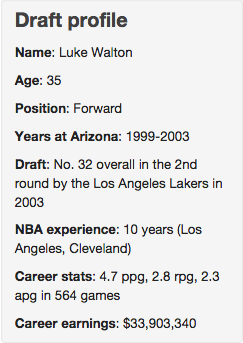
In the end, Luke did just fine for himself, playing 10 years in the NBA — the same number as his father — before becoming a coach.

Here’s a look at Luke Walton’s path to the NBA draft.

At Arizona: Bill Walton was a basketball legend at UCLA, and so the general assumption was that Luke would — or should — play for the Bruins.

That was just the perception.

“My dad didn’t put any pressure on me to go to UCLA or anywhere else,” the younger Walton said after picking the Wildcats over USC, UCLA, Utah and Boston College in 1997. “He respects Coach (Lute) Olson very much, so he was very happy when I told him I was going to Arizona.

He came to the UA in the same recruiting class as Richard Jefferson and Rick Anderson but missed his true freshman season with an injury.

Walton played 25.5 minutes per game as a redshirt freshman, and 20.4 per game in the 2001 national title runner-up season. As a junior, Walton broke out, showing off some impressive all-around abilities for a 6-foot-8-inch forward. That year, he averaged 15.7 points, 7.3 rebounds, 6.3 assists and 1.6 steals per game.

He fell off a bit as a senior — he dropped to 10.8 points, 5.6 rebounds and 5.1 assists — but at that point he had already proved himself talented enough in the eyes of NBA scouts.

The draft: Walton’s college numbers were impressive, but some scouts believed his lack of a position — not quite athletic enough to be a three, not quite big enough to be a four — along with some health concerns stemming would hurt him in the draft.

After playing well at the NBA pre-draft camp in Chicago, Walton worked out for the Phoenix Suns, who said Walton had a shot at becoming a late first-round pick.

Close enough: The Los Angeles Lakers selected Walton with the third pick in the second round.

From the archives: “I grew up when my dad was playing for the Celtics, and we used to root for the Celtics, but since I’ve gotten older, I’ve loved to watch the Lakers play. It’s just an amazing feeling right now. It’s hard to describe, but it’s what I’ve been dreaming about since I was a kid.” — Walton to the Star after the draft.

As a pro: Walton became a key contributor off the bench for a couple of teams that made it to the NBA Finals.

He barely played as a rookie but received more playing time in 2008, 2009 and 2010. The Lakers made three NBA Finals during that span, winning two of them.

His best season in the league came in 2006-07, when he averaged career-highs across the board: 11.4 points per game, 5.0 rebounds and 4.3 assists.

Walton would play eight seasons with the Lakers before being traded to the Cleveland Cavaliers, where he played in 2012 and part of 2013.

During the 2011 NBA lockout, Walton served as an assistant coach at the University of Memphis. Now, he’s an assistant on ex-Wildcat Steve Kerr’s staff with the Golden State Warriors — and once again has a courtside seat at the NBA Finals.

NBA draft flashback: Demic UA's lone first-rounder before Lute

NBA draft flashback: Demic UA's lone first-rounder before Lute 

Demic draft profile

There are two timelines to consider in Arizona Wildcats basketball history.

There’s B.L. — Before Lute. There’s A.L. — After Lute.

Eighteen Arizona Wildcats have been picked in the first round since 1983, the year Lute Olson was hired as the UA’s head coach. That number will grow to 20 if Stanley Johnson and Rondae Hollis-Jefferson are selected this year.

Before Lute?

One.

In 1979, 6-foot-9-inch forward Larry Demic was picked No. 9 overall by the New York Knicks.

He was the first first-rounder, top-10 pick, and elite Arizona prospect. In a way, Demic started the trend of top-tier talent to come out of the UA highly touted in NBA circles.

Here’s a look back at Demic’s path to the NBA draft.

At Arizona: For his first two years in Tucson, Demic was buried on the bench behind Bob Elliott, Al Fleming, Jerome Gladney and Phil Taylor. All four of them wound up being NBA draft picks.

Demic considered playing elsewhere.

“The thought of transferring crossed my mind,” Demic told the Star in 1979. “But I never really considered doing it. I am glad I did not.”

In his final two years, Demic exploded.

As a senior, he averaged a double-double — 19.3 points and 10.3 rebounds per game — was an All-Pac-10 selection, and twice scored more than 35 points.

“Larry had his chances to transfer,” coach Fred Snowden said at the time. “I know that. I know other coaches were after him. But I told him to believe in me, and he would get his chance.

“I told him I felt he could come on strong in his last two years here and he would arrive on time, enhancing his chances in the draft. And he did.”

The draft: There was no such thing as Draft Express, and mock drafts weren’t really a thing in 1979.

It was more about word of mouth and reputation.

The Associated Press published a list of the 1979 draft’s top 23 prospects, and Demic wasn’t on the list.

Among the names on that list? Future NBA Hall-of-Famer Magic Johnson, who would be picked No. 1 overall by the Los Angeles Lakers.

Demic participated in six postseason all-star games, though, and impressed, piquing the New York Knicks’ interest.

The Knicks, who had two of the draft’s first nine picks, flew him in to meet their coaching staff and personnel.

On draft day, they followed through. After Demic’s name was announced at Madison Square Garden, where the draft was held, Knicks fans booed him; they wanted New York to draft Jim Spanarkel of Duke.

From the archives: “This is a dream. Three years ago, who’d ever thought I’d be in this position? It wasn’t like I was destined to be in the NBA like Magic Johnson. It was evident when he left high school he was going.” — Demic to the Star in 1979

As a pro: Demic had a solid rookie season for the Knicks, playing in all 82 games, averaging 7.0 points and 5.9 rebounds per game.

But playing time dwindled in his next two seasons with the Knicks, from 22.8 minutes per game as a rookie to 12.7 in Year 2 and 7.4 in Year 3.

He spent the 1983 season with the CBA’s Detroit Spirits before finishing his playing career with stops in the Philippines and Puerto Rico. He won a championship in the Philippines playing for the Crispa Redmanizers.

NBA draft flashback: Reeves' senior year paid off

NBA draft flashback: Reeves' senior year paid off 

Reeves draft profile

When, Khalid Reeves arrived at Arizona in 1990, Lute Olson was in his eighth year as Arizona’s coach and the Wildcats had made six straight NCAA tournaments.

The next four years would prove to be symbolic of Reeves’ career as a Wildcat — for three years, flashes of talent, inconsistency, and postseason disappointment. Mixed in for Reeves was some legal trouble, too.

Reeves’ senior season changed everything.

The Wildcats made a deep tournament run and Reeves got it together, vaulting himself into prime position for the 1994 NBA draft.

Here’s a look back at Reeves’ path to the pros:

At Arizona: Olson pulled a recruiting coup when he landed Reeves, a star at Christ the King High School in Queens, N.Y. Reeves was both a McDonalds and Parade All-American.

Reeves scored 9.1 points per game as a freshman, despite sharing touches with Chris Mills, Brian Williams, Sean Rooks and Matt Muehlebach. His numbers rose to 13.9 points per game as a sophomore, then dipped to 12.3 as a junior.

Reeves was inconsistent during his first three seasons, just as capable of struggling from the field as breaking out for 20 or more points.

In three elimination NCAA tournament games, he shot 22.7 percent from the field.

“My confidence level is feeling kind of low,” he said as a junior. “It’s hard for me to make decisions now. It’s hard for me play when I don’t feel I have the support of other people.”

That all changed in Reeves’ senior season.

He averaged 23.2 points per game, a UA record, and scored 40 points in one game. Reeves was named a consensus All-American and guided Arizona to the 1994 Final Four. Many, including the Star, argued that his season might have been the greatest in UA history.

The draft: Following his stellar senior year, Reeves became attractive to NBA personnel. He attended the Nike Desert Classic in Phoenix and impressed after the season, scoring 69 points in 67 minutes over three games.

The 6-foot-3-inch guard was a projected lottery pick throughout the pre-draft process. Pre-draft buzz linked Reeves to the Los Angeles Clippers at No. 7 and Los Angeles Lakers at No. 10.

“Teams have to make the determination that he can play point guard,” an NBA scout told the Star of Reeves’ collegiate experience at shooting guard. “Those that do, like him better than those that don’t, but everybody likes his ability. There’s no questioning his skill level.”

In the end, he missed the lottery by one pick, going No. 12 to the Miami Heat. Reeves signed a five-year, $8.5 million rookie contract.

From the archives: ”Going from college ball to pro ball will be the hardest part for me. But playing point guard is all that I’ve ever wanted. And now I’m finally having the chance. It’s like ... heaven.” — Reeves, to New York Daily News in 1994.

As a pro: Reeves only lasted one season in Miami — getting what would be career-highs of 9.2 points, 2.8 rebounds, 4.3 assists and 1.1 steals per game — before being shipped in a blockbuster trade to the Charlotte Hornets, along with Glen Rice and others, for star center Alonzo Mourning.

Reeves bounced around the league for the rest of his career, spending time with the New Jersey Nets, Dallas Mavericks, Detroit Pistons and Chicago Bulls. He then went overseas, finishing in Venezuela in 2005.

Over six NBA seasons, Reeves averaged 7.8 points per game and made the playoffs once.

After his playing career ended, Reeves spent time as an assistant coach at his alma mater, Christ the King.

NBA draft flashback: Unique Arenas used draft snub as motivation

NBA draft flashback: Unique Arenas used draft snub as motivation 

Arenas draft profile

His name is Gilbert Arenas.

His name is also “Agent Zero” and “Hibachi.” Both were self-anointed nicknames.

During a live broadcast of an Arizona-UCLA game a couple years ago, colorful color commentator Bill Walton declared “Gilbert lost his mind” as the camera panned to Arenas in the Pauley Pavilion crowd.

Bill Walton said someone else lost their mind. Let that sink in.

This is Gilbert Arenas, one of the truly unique personalities to ever call himself a Wildcat.

His big personality, though, matched his talent. Well, most of the time. He was good for the Wildcats, and at times great in the NBA, before his career faded as injuries mounted and personality concerns arose.

But all in all, it’s hard not to say Agent Zero had a successful career in the NBA.

Here’s a look back at Arenas’ path to the NBA draft.

At Arizona: Two guards came to Arizona in its 1999 recruiting class.

One was Jason Gardner, widely considered a top-10 recruit. The other was Arenas, who was under the radar, widely rated outside the nation’s top-100 by most recruiting sites. Arenas, from Van Nuys, California, picked Arizona over Kansas State and DePaul.

Arenas certainly didn’t stay under the radar.

The 6-foot-3-inch guard came in and quickly established himself as a talent to watch. He scored 14 points in his first career game — a start — against Kansas State, ironically, and just kept getting better from there.

As a freshman, he scored 15.4 points per game in helping Arizona to a No. 1 seed in the 2000 NCAA tournament, where the Wildcats would lose in the second round to — sound familiar? — Wisconsin.

In 2001, with everyone returning — Gardner, Luke Walton, Richard Jefferson, Michael Wright and Loren Woods, to be exact — the Wildcats had one of the best seasons in program history, finishing 28-8 and making it to the national title game, losing to Duke by 10. Arenas led the team in scoring, with 16.2 per game.

That would be Agent Zero’s final year in Tucson.

The draft: Considered a likely first-round pick, Arenas decided to leave for the NBA after two years with the UA, saying at the time, “When I came here two years ago without much recognition, I always thought I’d play here for four years. But after two great years in Tucson, I feel like I’m ready to take the next step and play in the NBA.”

Arenas joined teammates Jefferson and Wright in declaring. At the NBA pre-draft camp in Chicago, Arenas impressed scouts, further establishing himself, presumably, as a mid-to-late first-round pick.

“Look what kind of year he had,” Arenas’ father told the Star. “He’s definitely a first-round (pick). There’s no doubt about that.”

Despite the perception, Arenas was still without the skill set of a point guard, and at 6-3, undersized for a shooting guard. As a result, Arenas fell out of the first round, and was selected with the second pick of the second round by the Golden State Warriors.

From the archives: “I didn’t think I would drop into the second round, but it’s exactly perfect for me (to go there). I’m just going to have to work harder. By the end of the year, I will be one of the top five players in this class.” — Arenas to the Star in 2001

As a pro: It didn’t take long for Arenas to prove everybody wrong, again.

He became a full-time starter in Golden State by the end of his rookie year, and in Year Two, he was already scoring 18.3 points per game.

After two seasons with the Warriors, Arenas signed with the Washington Wizards on a six-year, $60 million contract. There, he thrived. His three-year stretch from 2004-07 is probably the best stretch of any former Wildcat in the NBA — Arenas scored 27.7 points per game and made three All-Star games. In 2008, he signed a six-year extension with the Wizards worth $124 million.

Starting in 2009, things went downhill. Arenas first got into trouble for taking a firearm into the Wizards arena, and then found trouble again in 2010 when he brandished a firearm at a teammate following a gambling dispute. As a result, he was suspended for the season.

Arenas would only play two more seasons in the NBA — with the Orlando Magic and Memphis Grizzlies — before spending a season playing for the Shanghai Sharks in China.

NBA draft flashback: Iguodala turned No. 9 pick into solid career

NBA draft flashback: Iguodala turned No. 9 pick into solid career

Iguodala draft profile

The Golden State Warriors in 2015 are filled with some names very familiar to Arizona Wildcats fans.

There’s Steve Kerr, head coach, and assistant coach Luke Walton.

Andre Iguodala comes off the bench for the Warriors as their sixth man, sacrificing playing time for the betterment of the team and a chance at his first-ever NBA title.

Sean Miller, he of the “honor the process” mantra, would certainly be proud of that.

For Iguodala, it makes sense — the 6-foot-6 forward is in his first NBA finals, 11 years into his NBA career.

It’s a pro career that started back in 2004 with the Philadelphia 76ers, after a two-year college stint in Tucson.

Here’s a look back at Iguodala’s path to the NBA draft.

At Arizona: Iguodala, a four-star recruit, initially committed to play at Arkansas out of high school, picking the Razorbacks over the Wildcats. But when Norm Richardson was fired as Arkansas’ head coach, Iguodala switched to Arizona, forming one of Lute Olson’s then-most highly touted recruiting classes, along with Hassan Adams, Chris Rodgers and Chris Dunn.

Iguodala spent two years with the Wildcats before leaving early for the NBA.

In his two years, ‘Iggy’ — from Springfield, Illinois — established himself as an all-around talent with impressive athleticism, posting career averages of 9.6 points, 6.6 rebounds, 3.4 assists and 1.5 steals per game, and also set an Arizona record with three career triple-doubles.

The draft: After Arizona lost in the first round of the NCAA tournament to Seton Hall in 2004, Iguodala took more than three weeks to decide if he would leave for the NBA.

Spoiler alert: He did.

“I feel the time is right for me to fulfill a lifelong dream of playing in the NBA,” Iguodala said then.

It made sense: Iguodala was projected as a top-10 pick by most draft prognosticators.

Before the draft, some rumors circulated that the Chicago Bulls, his home state team, were considering him as the No. 3 pick.

“There are questions about his outside shot, but he’s a good all-around player,” a scout told the Star in 2004. “He’s a good passer, defender and he has that long, athletic body that’s all the rage right now.”

In the end, Iguodala went No. 9 to Philadelphia, a team looking for some support for superstar Allen Iverson.

From the archives: Iguodala took his first call from Sixers general manager Billy King.

“He just said, ‘Kobe Bryant went 13th, and Tracy McGrady went 11th, so there’s nothing wrong with being picked lower than you thought,’ Iguodala recalled. “Hey, I’m just happy to be picked.”

As a pro: Iguodala has had one of the more successful pro careers of any Arizona Wildcat. He spent his first eight years in Philadelphia, where he made the playoffs five times and was named an All-Star in 2012.

After that season, Iguodala was traded to the Denver Nuggets before becoming a free agent in the offseason, signing with the Warriors for four years and $48 million.

In the NBA, Iguodala established himself as a top-notch athlete — he participated in the 2006 NBA Dunk Contest — and as one of the league’s best defenders, guarding the other team’s best player for most of his career. He was named to the NBA’s All-Defensive first team in 2014, and the second team in 2011.

Because of his accomplishments, Iguodala was inducted into Arizona’s Ring of Honor in 2012.

Related to this collection

Arizona Daily Star
  • Facebook
  • Twitter
  • Bluesky
  • YouTube
  • Instagram
  • Arizona Daily Star Store
  • This is Tucson
  • Saddlebag Notes
  • Tucson Festival of Books
Prefer us on Google

Sites & Partners

  • E-edition
  • Classifieds
  • Events calendar
  • Careers @ Lee Enterprises
  • Careers @ Gannett
  • Online Features
  • Sponsored Blogs
  • Get Healthy

Services

  • Advertise with us
  • Register
  • Contact us
  • RSS feeds
  • Newsletters
  • Photo reprints
  • Subscriber services
  • Subscription FAQ
  • Licensing
  • Shopping
© Copyright 2026 Arizona Daily Star, PO Box 26887 Tucson, AZ 85726-6887
Terms of Use | Privacy Policy | Advertising Terms of Use | Do Not Sell My Info | Cookie Preferences
Powered by BLOX Content Management System from bloxdigital.com.
  • Notifications
  • Settings
You don't have any notifications.

Get up-to-the-minute news sent straight to your device.

Topics

News Alerts

Breaking News