

The governor was there. The mayor. PGA Tour representatives. The Conquistadores. Some golf pros. City and county politicians.
It was the most distinguished group of guests at El Rio Golf Course since Ben Hogan, Byron Nelson and Sam Snead used to play the Tucson Open on that historic turf a million years ago.
The occasion? To announce that Tucson's inaugural WGC-Accenture Match Play Championship had raised $1.5 million for youth charities, part of it designated for the First Tee of Tucson program.
No, this isn't another golf story. It's more of a kids-become-adults-through-golf story.
Not all of the money you spent at the Gallery Golf Club in February went into the pockets of Henrik Stenson and Geoff Ogilvy.
Some of it will be spent to build a 4,000-square-foot clubhouse at the humble El Rio facility, a clubhouse that will be stocked with educational tools, including computers, for more than 500 Tucson kids, most from disadvantaged and lower-economic backgrounds.
People are also reading…
Fruition of the First Tee program has been an uphill struggle for more than a decade.
"We've been at this since about 1993,'' said Mike Hayes, deputy director of Tucson City Golf. Former city recreation director "Jim Ronstadt showed me the original plans way back then. The concept was to build the facility at Silverbell Golf Course. Well, here we are at El Rio in 2007.''
The First Tee of Tucson has taken root.
"You should see the kids out here during the week,'' said Gene Catalano, a longtime host/starter at El Rio. "From 5:30 to 9 at night, we've got tons of kids. It just keeps getting bigger and bigger. This is an example of a program that is working."
Here's how it is supposed to work:
Lupita Sanchez is a Tucson legal secretary, a single mom whose boss heard about the First Tee program and encouraged her to investigate it. She was hopeful her son, 14-year-old J.D. Gorman, could get involved.
"Not for the golf, the golf is an extra," Sanchez said. "I wanted J.D. to be exposed to the life skills program, to be exposed to mentoring and goal-setting. Being in this program has changed his demeanor.''
A few weeks ago, J.D. was awarded a summer scholarship to a local YMCA program because he was said to have had the "best manners'' in his group.
"J.D. loves it," Sanchez said. "He has really changed. He's grown up a lot since being in this program. I come home from work and he'll say: 'Sit down, mom, take it easy. Let me do something for you.' Do I think it's because he has been in the First Tee program? Absolutely."
Hearing Lupita Sanchez's story, David Noble, executive director of the First Tee of Tucson program, absolutely beams.
He operated a similar First Tee program (it has 247 chapters globally) in Pine Ridge, S.D., before launching Tucson's operation a year ago.
So far, Noble has patiently done his day-to-day business in a not-so-elegant backroom of the El Rio clubhouse. It doesn't smell particularly good in there, the phones aren't always in working order, and it wouldn't be a shock if someone found Jimmy Hoffa, or someone, buried under the age-old shower room.
But Noble had made the best of it. He's a get-things-done operator who has drawn more than 500 kids, ages 6-17, into the program while awaiting funding for on-site facilities. He estimates that ground will be broken, at the back end of the El Rio driving range, this summer.
"This program is at least twice as successful, in its start-up stages, as our program in South Dakota,'' he said. "I thought we'd have half as many kids as we've had. But every day, one or two more kids and their parents walk through the door."
The First Tee program, which was founded jointly by the PGA Tour, the LPGA, the USGA and Augusta National, is a mission bent on providing affordable and accessible golf to kids not traditionally exposed to the game.
But it's hardly stick a tee in the ground and tee it up golf.
Instead, Noble and his volunteer teachers spend their time teaching civic responsibility and sportsmanship, building self-esteem and promoting character development. He calls the First Tee facility "our campus."
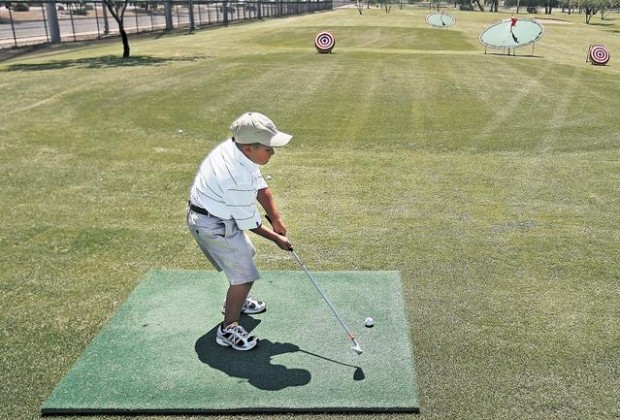
Next week, for the first time, the young golfers will be taken from the vast practice area — a three-hole facility within El Rio's redesigned driving range — and allowed to play some real golf on the El Rio course.
"This is just the beginning," said Noble. "We're just scratching the surface. We're going to have many, many success stories."


