

A creeping concern is growing in Tokyo where Team USA’s stranglehold on the Summer Olympics is under threat.
Some high achievers like the U.S. women’s gymnastics team — winners of the previous four major international meets — have fallen to earth. The American women settled for a silver medal Tuesday amid the chaos of superstar Simone Biles stepping off the Olympic stage because of the mental strain of living up to the gold standard foisted upon her.
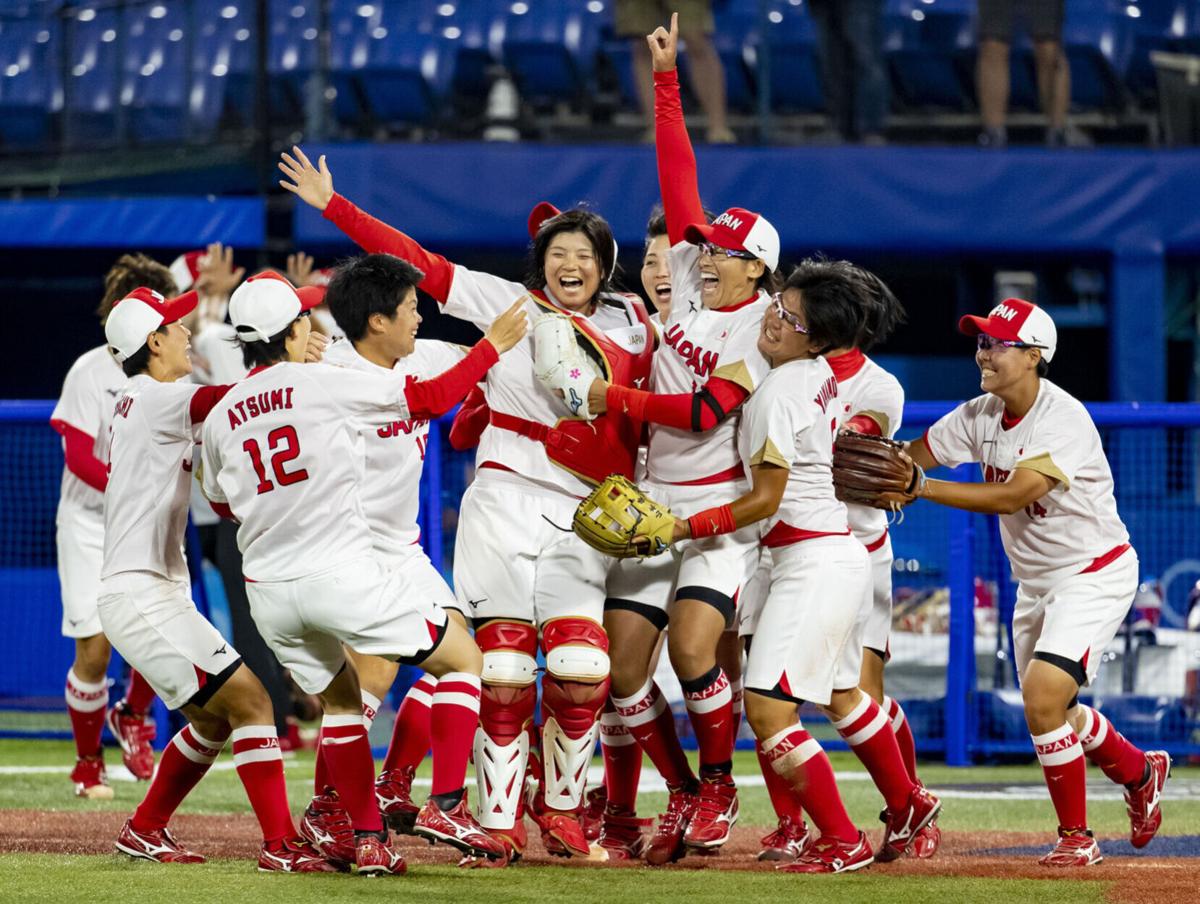
The U.S. softball team, which once crushed rivals, also lost on Tuesday, falling to host Japan 2-0 in the gold medal game, while the top-ranked women’s soccer team barely advanced to the knockout round after an underwhelming scoreless draw against Australia.
Then there was the men’s basketball team’s 83-76 opening-game defeat to France last weekend — the Americans’ first Olympic setback in men’s hoops since 2004.
People are also reading…
Entering competition Tuesday night the United States had the most overall medals with 25 but was one behind Japan in gold medals — 10 to 9. So far, it has failed to meet its gold standard in events it usually dominates.
The shaky first week raises begs the question: Is this the death of American sports supremacy as we know it?
“People get older and dynasties crumble,” Olympic historian Bill Malon said Tuesday from Tokyo. “The Roman Empire went away.”
In other words, nothing lasts forever. Not even when talking about one of the greatest athletes in our lifetime like Biles.
She astonishingly tumbled from her perch after the weight of expectation in the pre-Olympic buildup became too much to handle.
After winning four gold medals at the Rio Games in 2016, Biles told reporters on Tuesday that her love of gymnastics had been stripped from her.
“This Olympic Games, I wanted it to be for myself,” Biles said. “I was still doing it for other people, so it hurts my heart that doing what I love has been kind of taken away from me to please other people.”
Lost in the hoopla is that Biles, 24, is one of the hundreds of victims of Larry Nassar, the Michigan State and USA Gymnastics team physician who is serving a prison sentence for molesting women and girls.
While training for the Tokyo Games, Biles has criticized sports officials, including those from the U.S. Olympic & Paralympic Committee, for not doing enough to prevent future episodes of sexual abuse.
The reigning world champion soccer team, like Biles, came to Tokyo with expectations of greatness. But the United States opened the tournament with a 3-0 thrashing by Sweden and, honestly, was outplayed by Australia on Tuesday.
“The one thing that surprised me a little bit was that they were a bit passive in their pressing, and I’m used to seeing them very, very aggressive,” Australia coach Tony Gustavsson said in a news conference.
Did you know that there are 72 countries that have never won an Olympic medal?
That will have to change when the U.S. plays the Netherlands on Friday morning in a quarterfinal showdown featuring the 2019 World Cup finalists. The United States won that game 2-0.
It is going for its fifth gold medal and trying to become the first country to win the World Cup and Olympics back-to-back.
But the United States failed to medal for the first time in the Olympics in 2016 when nemesis Sweden eliminated the Americans in the quarterfinals in Brazil.
Bob Condron, a former USOPC executive who attended 16 Olympics, is optimistic about the coming days.
“There are always going to be some disappointments,” he said Tuesday. “But at the end of the rodeo the U.S. is best. The Olympics are our shining moment.”
The Tokyo Games end Aug. 8 so the final chapter still needs to be written. But anyone paying attention can see the direction the normally dominant Team USA is headed after a few days of head-scratching performances.
Not that this is the first time results have led to concern. When an all-star college team led by David Robinson won “only” a bronze medal at the 1988 Seoul Games, USA Basketball officials had enough of the pretense.
They presented the world with the original Dream Team of NBA stars four years later in Barcelona.
The latest version of NBA stars has lost its sense of invincibility as France showed over the weekend. U.S. coach Gregg Popovich highlighted the point by reminding reporters that the NBA is a global game now.
“That’s a little bit of hubris if you think that America should just roll the ball out and win,” he said.
The changing outlook might be bad for American Olympians, but it is good for the Olympics. What many seem to forget, competition makes sports worth watching.
As much as we have marveled at Stanford swimmer Katie Ledecky winning races by half a length, she sucked the drama from the pool by her dominance at the 2012 and 2016 Games.
So imagine the suspense the other day in watching an older Ledecky give everything she had against Australia’s Ariarne Titmus in the 400-meters freestyle.
Ledecky, 24, finished with her fastest time in five years — 3 minutes 57.36 seconds — but she lost.
Ledecky could not have shown more joy over the silver-medal swim because she gets it. It’s about giving the best performance wherever that might fall.
Triumph against the odds provides the riveting experience to keep Olympic audiences returning. If not for those heart-tugging moments the 17-day sports showpiece would have been as stale as day-old bread a long time ago.
Without the Miracle on Ice and Boys on the Boat, the Games might never have become the billion-dollar engine it is in 2021.
“There is nothing broken about it,” said Harvey Schiller, former executive director of the U.S. Olympic & Paralympic Committee. “No one told the other side they were supposed to lose.”
The U.S. Olympic women’s basketball team is one of the most dominant dynasties in all of sports. Here are the numbers to prove it.
63 consecutive victories in FIBA competition

The U.S. national team, the No. 1 squad in the world per FIBA rankings, boasts 63 consecutive wins in official FIBA competitions, starting with the 2006 World Cup bronze-medal game (the game before, the U.S. fell to Russia in the semifinals). Across that 15-year span, the U.S. women have won three World Cups and another three Olympics.
What’s even more astounding is that since 1996 the U.S. national team is 112-1 in major international competitions, including Olympic, World Cup and FIBA AmeriCup and Olympic qualifying play.
49-game Olympic win streak

The U.S. has won 49 straight Olympic games, starting with the 1992 bronze-medal game and running through the 2016 gold-medal game. Team USA can make it 50 with a victory Tuesday against Nigeria in its Olympic opener.
Put another way: U.S. women’s basketball has not lost in the Olympics in the lifetimes of half their players for Tokyo, including Ariel Atkins (24), Jewell Loyd (27), Napheesa Collier (24), Chelsea Gray (28), A’ja Wilson (24) and Breanna Stewart (26).
In all, the U.S. national team is 66-3 throughout 10 Olympic competitions. The other two losses came in 1976, when the U.S. took home silver.
30.4 average margin of victory

The U.S. women don’t just win, they win big. During the program’s 49-game Olympic win streak, Team USA has defeated opponents by an average margin of 30.4 points. Their average margin of victory was even higher in Rio: 37.3.
Moreover, the 2016 Olympic team scored at least 100 points in six of its eight games, including the gold-medal game.
Seven straight golds at stake

Team USA’s eight gold medals in the 11 Olympics since women’s basketball was added to the Summer Games in 1976 is impressive as it is. But starting with the 1996 Atlanta Olympics, the U.S. Olympic team has won six consecutive gold medals — a level of dominance rarely seen in sports.
The U.S. men’s basketball Olympic team won seven straight golds from 1936-1968, a streak the women are heavily favored to match in a couple of weeks. India’s men’s field hockey program is currently tied with the U.S. women’s basketball team with six straight golds from 1928-1956.
Fifth gold within reach for Bird, Taurasi

Basketball and UConn legends Sue Bird and Diana Taurasi are joining an exclusive club of basketball athletes who have played in five Olympic games. That group of eight athletes in all features U.S. basketball legend Teresa Edwards, who won four Olympic golds and one bronze with Team USA.
But the duo are also within reach making history by becoming the first basketball athletes to win five Olympic golds. There are four other Olympians (in fencing and equestrian) who have taken home at least five golds in the same event or discipline.
Bird, who was named one of the Team USA’s flag bearers Wednesday, is already the most decorated FIBA athlete in the world with a combined nine Olympic and World Cup medals, one ahead of Taurasi and Edwards.
11 have won all four major championships

U.S. Olympians don’t just take care of business on the international stage but domestically as well.
Eleven players in the program’s history, including four on the current Olympic team, have won an Olympic gold, FIBA World Cup gold, WNBA title and NCAA championship, including Bird, Stewart, Taurasi, Swin Cash, Tamika Catchings, Cynthia Cooper, Asjha Jones, Brittney Griner, Maya Moore, Sheryl Swoopes and Kara Wolters.
60 gold medals collectively

Bird and Taurasi aren’t the only frequent medalists on the squad. The 12 members of the U.S. Olympic roster collectively hold 60 gold medals in major international tournaments (three of which are in 3x3 events).
This will be the fourth and third Olympics for Sylvia Fowles and Tina Charles, respectively, and both have winning experience at the World Cup (three for Charles, one for Fowles). Griner and Stewart are also one-time Olympic and two-time World Cup gold medalists.
Even Olympic newcomers Loyd and Wilson have won gold before at the 2018 World Cup, while Atkins, Collier and Skylar Diggins-Smith took home gold in 3x3 events, youth tournaments or the FIBA AmeriCup. Chelsea Gray is the only Olympian on the roster without a gold medal to her name — yet.
Two losses in exhibitions last week

The improbable happened last week during the U.S. Olympic team’s training camp in Las Vegas when the star-studded roster lost back-to-back exhibition games, first against the WNBA All-Stars (less surprising) and two days later against Australia minus Liz Cambage (more surprising). The national team hadn’t lost consecutive exhibitions since 2011 and is now 200-18 overall in exhibitions since the 1995-96 national team tour leading into the Atlanta Games.
Should American fans be worried about the U.S. Olympic team? Probably not. Team USA looked much more like itself when it breezed past Nigeria in its third and final tune-up before heading to Tokyo and is already using that momentum to ensure the squad peaks at the right time and adds to its history of dominance.
“Obviously we lost those two games back to back, which nobody wanted to do,” Bird said Wednesday. “But at the same time, I think it taught us some things, we learned some things, and we’re going to use that in this week of practice and try to get better every day. But the mood’s been great. If anything, those losses could end up being our biggest wins, if you will.”


