
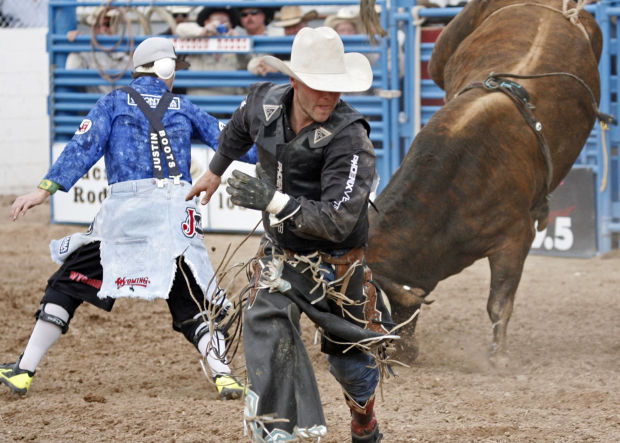
The life of some professional rodeo cowboys is exactly as you’d imagine it.
Hauling from one event to another, chew packed firmly tight, the road getting longer and longer, only to return home to cows that need milking and horses that need wrangling.
For others, though, rodeo has become big business, the good life, not an udder to be tugged. They are no different than any professional athlete who trains, competes and trains some more.
In fact, Kaycee Feild — who won the bareback competition at Sunday’s La Fiesta de los Vaqueros — compares himself and his competition to Ultimate Fighting Championship fighters.
Times have changed, he said.
“They’re not just guys coming off a ranch who are tougher than everybody else and can kick some butt,” Feild said. “We put our time in the gym. We study it. We study every bit of it.”
People are also reading…
Feild, with over $1 million in lifetime career winnings (minus the usuals – taxes, expenses, gas, entry fees), still calls himself a cowboy even though life is a bit cushier now. With three consecutive world titles at the National Finals Rodeo, he no longer needs another gig, ranching or otherwise, to pay the bills.
Soon to be 27, Feild was 18 when he first knew he was going to be a bareback rider for good. For the first few years, the will didn’t match the wallet. He needed to earn enough to fund a burgeoning career, one with plenty of expenses, and plenty of risk.
But he had his eye on the prize(s).
“I wanted a gym, access to a bucking machine, practice horses,” Feild said. “It took me three years to where I could come back from rodeoing, still pay the house payment, go to the gym every day and prepare myself to be a champion.”
The better the preparation, the better the performance, the better the payoff, and Will Lowe certainly knows that.
The 31-year-old bareback rider has more than $2 million in career winnings, a product of being on the road more than 200 days a year, competing in more than 80 rodeos a season.
But people forget those career winnings only stack that high because they’re willing to get after it. There are no professional contracts, no “appearance fees.” The bills get so lofty because they’re checking in, night after night, to a new roof in a strange town.
“It’s a lot more work than people think,” Lowe said. “It’s hard on a person. Don’t know when your next paycheck is coming. If you don’t draw good, you’re already out of it. It ain’t what people think.”
Which only makes it stranger when you hear the goal.
Right where it started.
You give most fellows $2 million, there’s a nice Hawaiian island with their name on it. Maybe a place in the Hamptons, or a Malibu beach house.
Not these guys.
“When I’m done rodeoing, I’m gonna buy more land than … I mean, nobody’s gonna see me,” Feild said. “I’ll go to three or four rodeos a year, maybe, and that’s it. And only maybe. I want to be on my ranch, I want to be alone. I want to be a cowboy. I want to wake up every day, I want to work cows every day and ride a horse until the day I die.”
Added Lowe: “I don’t think you’d ever catch me in a neighborhood setting. I ain’t gonna move to the suburbs. I like being secluded, out there by myself, room to roam.”
Why? Why settle for the familiar? Why not enjoy the trappings of it all, the fancy mid-city high-rises and the travel?
Two reasons: The grind …
“It’s probably because we’ve driven so many miles,” Lowe said. “You travel so much and you’re on the move so often, going and blowing, here one night, 1,000 miles somewhere else the next day. It just really appeals to a feller to be able to sit in one spot and not have to go all over the place.”
… and the gratification.
“You watch 50 calves being born, and you have to pull half of them out of their mother,” Feild said, “and you bottle feed them — a whole herd of cows and you maybe have a bottle, a rope and a thing of penicillin — and you’re horseback and it’s snowing, and at the end of the year, all your cows are 800-pounders and you take them to the sell and you make your paycheck — there’s nothing more gratifying than that.”