

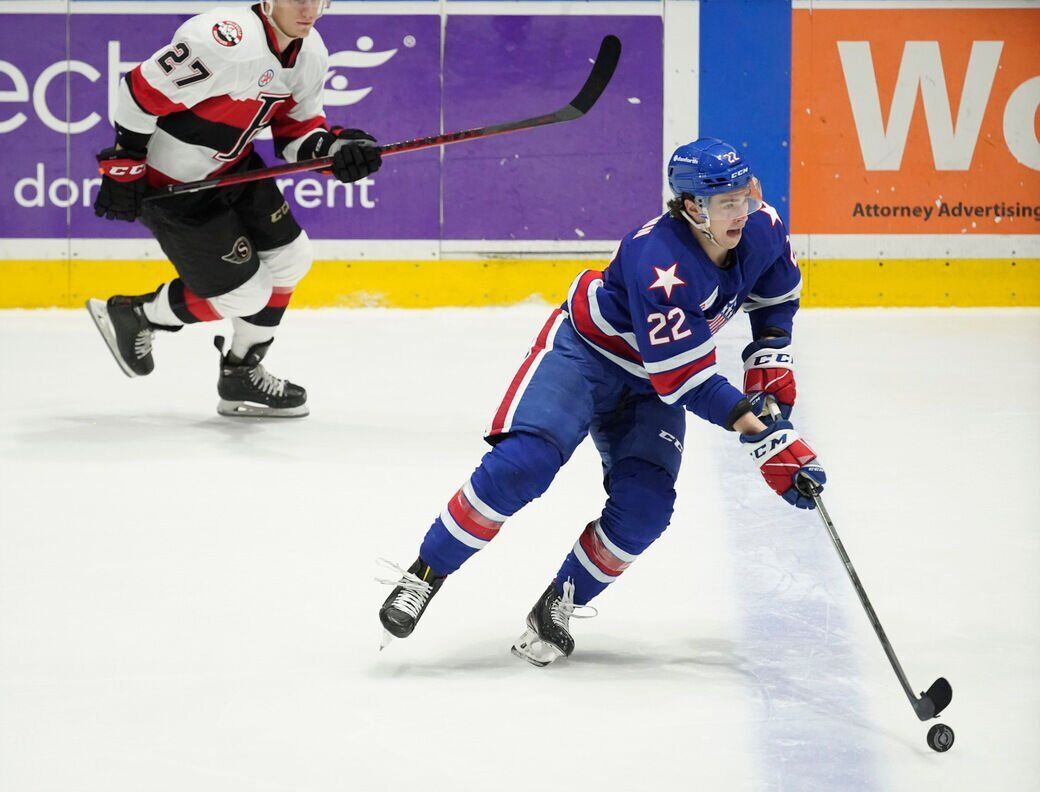
ROCHESTER – JJ Peterka leaned against a wall outside the Amerks’ dressing room in Blue Cross Arena and flashed a smile as he recalled the first time he was on the ice with Jack Quinn at the Sabres’ Prospects Challenge in September.
“Our chemistry was there right away,” Peterka, a 20-year-old rookie winger, said. “We brought it here to Rochester and started scoring so much together. It felt so good.”
Peterka and Quinn quickly discovered they had more in common than the same draft year. The duo shared a relentless drive to help the Rochester Americans win games and to become impact players with the Sabres in the NHL.
Peterka’s origin story includes a time in Austria when he ran out of usable hockey sticks because he broke them in the shooting room at Red Bull Ice Hockey Academy. Through countless hours of practicing his shot in his family’s basement and numerous on-ice sessions to hone his skating, Quinn developed into one of the top prospects in the 2020 NHL Draft.
People are also reading…
Competing against each other to be the Amerks’ best player in practices and games, Peterka and Quinn authored remarkable rookie seasons in a league where it’s uncommon for first-year forwards to lead their team in scoring.
Peterka led all AHL rookies with 68 points in 70 games, recording the most points by an AHL player in his under-20 season since Guy Chouinard had 80 as a 19-year-old with Nova Scotia in 1975-76. At only 20 years old, Quinn was named the league’s rookie of the year – Rochester’s first to earn the honor since Mika Noronen in 1999-2000 – with 26 goals and 61 points in 45 games. Both were on the all-rookie team.
The dynamic forwards helped the Amerks reach the second round of the Calder Cup Playoffs, where they lead their best-of-five series against Utica, 2-1. Game 4 is Tuesday night in Rochester at 7:05 p.m. Their rapid development, along with the ascent of other prospects on the Amerks, is another significant step for the Sabres in their quest to build a winner in Buffalo.
“It’s been remarkable to watch,” said Jason Karmanos, assistant general manager for the Sabres and general manager of the Amerks. “The two of them, at their age to do what they’ve done this season in the American Hockey League, is really special. It’s exciting for the future and it’s something we’re really happy about.”
Rochester had four of the AHL’s top scoring rookies in the regular season in Peterka, Quinn, Brandon Biro and Linus Weissbach, as the prospects combined for 82 goals and 207 points. Defensemen Mattias Samuelsson and Casey Fitzgerald used their time in Rochester this season to become full-time contributors for the Sabres.
Samuelsson, 22, earned a promotion to Buffalo in January and quickly became one of the Sabres’ most trusted defensemen, earning a spot on the top defense pair next to Rasmus Dahlin in the final weeks of the season. Peyton Krebs, a 21-year-old center acquired in the Jack Eichel trade, joined the Amerks following the life-changing move in November and has eight points in five playoff games after spending much of his season with the Sabres. Ukko-Pekka Luukkonen took more steps toward his goal of becoming a franchise goalie.
This is the first normal season for Rochester since Kevyn Adams became the Sabres’ general manager and overhauled the organization’s plan for its AHL affiliate by replacing successful coach Chris Taylor with Appert, who had a strong track record working with young players during his time with the USA Hockey National Team Development Program.
The AHL played a shortened season without playoffs in 2020-21, and the top prospect in Rochester, Quinn, was limited to only 15 games because of injury. Covid-19 protocols and positive tests negatively impacted the season for all involved, and the NHL’s adoption of a taxi squad left the Amerks with fewer high-end players.
The Sabres’ vision for Rochester became clear over the past 12 months. Karmanos joined the organization last spring following successful stints in Pittsburgh and Carolina. He worked with Appert to build a roster that includes veterans who can teach prospects the habits necessary to make the NHL. There was no overpaying for players on one-way contracts who would take ice time and opportunity away from prospects.
Michael Mersch returned as captain, accomplished AHL defenseman Ethan Prow signed with Buffalo, and the Sabres brought West Seneca native Sean Malone back as a depth forward who had the talent to help in the NHL. Their leadership kept the Amerks afloat when Appert was forced to use a makeshift roster for weeks because of injury.
The group built on the behind-the-scenes culture that began to take root the prior season.
“One really positive aspect of this year is the shift in atmosphere around both teams,” said Karmanos. “Obviously coming out of the pandemic with all the changes in recent years, trying to take a step forward and building a new culture, one that’s positive, looking forward to the future. I think one of the really positive aspects is we were able to replicate that here. The coaching staff, Seth Appert, Michael Peca, Mike Weber, did a great job bringing the same type of feel that (Don Granato) and his group, along with Kevyn, have created in Buffalo.
“That atmosphere breeds excitement among all the players and the staff surrounding the team. It’s been a big contributing factor to what’s going on.”
Development isn’t linear. There are ebbs and flows for even the most talented players. Peterka, a second-round draft pick in 2020, had only four goals through his first 23 games of the season and had to learn to use his elite skating ability on defense. Quinn has zero goals, one assist and 10 shots on goal in five playoff games.
There was a time early this season when Appert was considering ways to help both players when he called then-Detroit Red Wings coach Jeff Blashill, a college teammate at Ferris State. Blashill reminded Appert how the two Sabres prospects are accomplishing what few have in the AHL.
“Blash was like, ‘What these kids are doing doesn’t happen in the American Hockey League,” said Appert. “'This is extremely abnormal for 19- and 20-year-olds to be leading your team in scoring, to be the offensive drivers, to put up the points those guys are producing.'”
Shortly thereafter, Peterka had 48 points in 47 games to begin 2022, and the Amerks were 14-3 this season when he recorded a multi-point game. He was the club’s first 60-point rookie since Thomas Vanek in 2004-05. In the playoff series against Utica, Peterka had a hat trick in Game 2. His all-around play, even without the puck, sparked a comeback win in Game 3.
Quinn, 20, had 19 multi-point efforts, 10 power-play goals and six game-winners in the regular season, despite missing six weeks with a lower-body injury. His 1.36 points per game ranked third in the league, and his two-way game appears ready for the NHL. In Peterka and Quinn, Appert sees similarities with 2019 top draft choices Jack Hughes and Trevor Zegras, who were teammates at the NTDP.
“I saw this at the national program, and one of the best things we do at the national program is we put the 20 or so most talented, most competitive players in one birth year on the ice with each other every single day and they push each other to be great,” said Appert. “Jack Hughes’ competitiveness made Trevor Zegras a great player because he had to try to catch up to him.
"I think JJ and Jack, especially those two, a lot of our guys, it's that competitiveness. If JJ is having a great practice or great games – it’s not a negative competitiveness, it’s a healthy competitiveness – Jack wants to match that. And if Jack spends an hour in the shooting room that day, JJ wants to spend an hour in the shooting room. That level of healthy competitiveness should drive the entire organization, but it certainly drives individual prospects.”
This is what Adams envisioned for Rochester when he became general manager of the Sabres in June 2020. He wanted the Sabres and Amerks to have an environment in which young players can develop the habits necessary to win. There are parallels between what they’re building now and what occurred with the organization during the lockout in 2004-05, when Vanek, Jason Pominville, Derek Roy, Ryan Miller and Paul Gaustad, among others, led Rochester to the second round of the Calder Cup Playoffs.
They brought that winning culture to Buffalo upon their permanent promotions to the NHL, setting the stage for long, memorable Sabres playoff runs the following two seasons.
Peterka and Quinn are determined to bring a Calder Cup to Rochester, rewarding a fan base that filled Blue Cross Arena for the Game 3 overtime win Sunday. They also have a clear vision for the future. Both made their Sabres debuts this season – Quinn scored his first career NHL goal against Dallas in January – and watched from afar as Granato had the Sabres' young core play at a 102-point pace over the final two months.
With lessons learned in Rochester, the duo plans to take their show on the road to Buffalo following a championship run with the Amerks.
“If you look at that for the future, we have so many great pieces,” Peterka beamed. “If we put it all together, glory days ahead.”


