
Skip to main contentSkip to main content
Register for more free articles.
Log in Sign up
Back to homepage
Subscriber Login
Keep reading with a digital access subscription.
Subscribe now
You are the owner of this collection.
Edit Collection
You have permission to edit this collection.
Edit
Arizona Daily Star
88°
  • Sign in
  • Subscribe Now
  • Manage account
  • Logout
    • Manage account
    • e-Newspaper
    • Logout
  • News
    • Sign up for newsletters
    • Local
    • Arizona
    • Business
    • Crime
    • Nation & World
    • Markets & Stocks
    • SaddleBrooke
    • Politics
    • Archives
    • News Tip
  • Arizona Daily Star
    • E-edition
    • E-edition-Tutorial
    • Archives
    • Special Sections
    • Merchandise
    • Circulars
    • Readers' Choice Awards
    • Buyer's Edge
  • Obituaries
    • Share Your Story
    • Recent Obituaries
    • Find an Obituary
  • Opinion
    • Submit a Letter
    • Submit guest opinion
    • Letters to the Editor
    • Opinion & Editorials
    • National Columnists
  • Sports
    • Arizona Wildcats
    • Greg Hansen
    • High Schools
    • Roadrunners
  • Lifestyles
    • Events Calendar
    • Arts & Theatre
    • Food & Cooking
    • Movies & TV
    • Movie Listings
    • Music
    • Comics
    • Games
    • Columns
    • Play
    • Home & Gardening
    • Health
    • Get Healthy
    • Parenting
    • Fashion
    • People
    • Pets
    • Travel
    • Faith
    • Retro Tucson
    • History
    • Travel
    • Outdoors & Rec
    • Community Pages
  • Brand Ave. Studios
  • Join the community
    • News tip
    • Share video
  • Buy & Sell
    • Place an Ad
    • Shop Local
    • Jobs
    • Homes
    • Freedom RV AZ
    • Marketplace
    • I Love A Deal
  • Shopping
  • Customer Service
    • Manage My Account
    • Newsletter Sign-Up
    • Subscribe
    • Contact us
  • Mobile Apps
  • Weather: Live Radar
  • Facebook
  • Twitter
  • Bluesky
  • YouTube
  • Pinterest
  • Instagram
© 2026 Lee Enterprises
Terms of Service | Privacy Policy
Arizona Daily Star
News+
Read Today's E-edition
Arizona Daily Star
News+
  • Log In
  • $1 for 3 months
    Subscribe Now
    • Manage account
    • e-Newspaper
    • Logout
  • E-edition
  • News
  • Obituaries
  • Opinion
  • Wildcats
  • Lifestyles
  • Newsletters
  • Comics & Puzzles
  • Buyer's Edge
  • Jobs
  • Freedom RV AZ
  • 88° Clear
Share This
  • Facebook
  • Twitter
  • Bluesky
  • WhatsApp
  • SMS
  • Email

Affordable childcare in Tucson

  • Caitlin Schmidt
  • Jul 10, 2022
  • Jul 10, 2022 Updated Jul 10, 2022

As cost of child care spirals, Tucson officials look to bridge the gap

This story was made possible by a grant awarded to La Estrella de Tucsón by Solutions Journalism Network, an organization dedicated to promoting journalism that analyzes community responses to specific problems.


Affordable, high-quality child care has become out of reach for more than 90% of Arizona families, with Hispanic women facing an even steeper challenge to obtain those services due in large part to an insurmountable wage disparity.

In Spanish

Read this story in Spanish

Child care is affordable if it costs no more than 7% of a family’s income, according to the U.S. Department of Health and Human Services. By that standard, only 8.7% of Arizona families can afford infant care, financial experts say.

Research by The Economic Policy Institute, an independent, nonprofit think tank, shows that child care is unaffordable for typical families in Arizona, and completely out of reach for minimum wage workers, who make $12.15 per hour. In 2019, Tucson’s median household income was $43,425, substantially lower than the state’s median household income of $58,945, according to the most recent census data.

In this series

Part 1: As cost of child care spirals. Tucson officials look to bridge the gap

Part 2: Pima County working to build powerful preschool legacy following failed effort

Part 3: Arizona program gives low-income parents a chance at care

Part 4: It takes a village: Tucson organizations step up to support families with care

You are now reading part 1

This series was made possible by a grant awarded to La Estrella de Tucsón by Solutions Journalism Network, an organization dedicated to promoting journalism that analyzes community responses to specific problems.

The average annual cost of infant care in Arizona is $10,948 — 3.7% more per year than in-state tuition at a four-year public college. Child care for a 4-year-old costs $8,547 per year, meaning a typical family in Arizona would have to spend 35.2% of its income on child care for an infant and a 4-year-old, according to the EPI.

And with Latinas facing a sizable wage gap, an already difficult cycle becomes vicious, Tucson Mayor Regina Romero said.

“The less money we get in our pockets, the less high-quality preschool we can afford,” Romero said. “There are deeper structural barriers that we have to dismantle in order to have better education outcomes and better economic outcomes.”

While Arizona isn’t the most expensive state in the country in terms of child care (it costs more in states where the cost of living is higher, with Massachusetts topping out at more than $20,000 per year,) it is one of 33 states where infant care costs more than college.

EPI senior economist Elise Gould said that for decades, the narrative centered around the individual failings of families who were unable to afford child care, but the tide has since turned.

“People now realize that it’s a pretty widespread problem, it isn’t just a low-income problem,” Gould said. “I think in the last few years, it’s really come to the fore in the national discourse.”

Over the last four or five decades, hourly wages have grown incredibly slowly, meaning in part that households have needed parents to work more and more, causing the demand for child care to increase, Gould said.

“When you think about what it really costs compared to how much people make, it’s just eating away a huge amount of their budget,” Gould said. “In a lot of ways, child care is way too expensive for many families, but the flip side of that is that often times, it’s actually not expensive enough.”

In an interesting twist, child care workers are often unable to afford child care of their own. Nationwide, the families of child care workers are more than twice as likely to live in poverty as other families, and a median child care worker in Arizona would have to spend nearly half her wages to put her own child in infant care, according to the EPI.

“Those child care workers are some of the lowest paid workers in our country,” Gould said, adding that as long as child care workers receive such low pay, those jobs will continue to remain vacant, resulting in wait lists and a shortage of high quality child care options. “If you want high quality care for your kids, you’re going to have to pay for it.”

Gould said it’s important to recognize that child care workers in the current economy are undervalued.
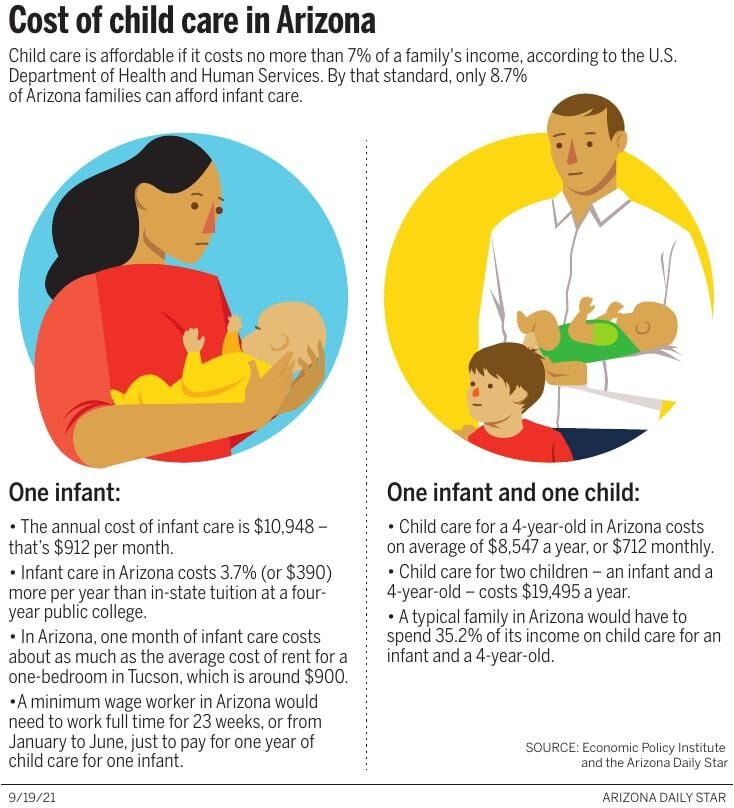
Download PDF Cost of child care in Arizona

“They’re undervalued for the kind of work they do, they’re undervalued because of who they are,” Gould said. “Something like 90% of child care workers are women. Many Black and brown women, many immigrant women. Some of those wages reflect the value society has placed on that type of work and those workers themselves.”

High demand, low supply

While the lack of affordable, high-quality child care is a nationwide issue, Arizona has faced some distinct challenges over the years, said Michelle Saint Hilarie, senior statewide program director of Arizona’s Child Care Resource and Referral.

Hilarie, who has worked at AZCCRR for 20 years, said that for the first time in her tenure, the state’s Department of Economic Security is doing a tremendous job in terms of innovating and securing new partnerships with community groups to administer programs and services and create more options for families. This includes the colocation of DES staff within different organizations to meet clients on-site, at places they’re already going to receive services.

Hilaire said Arizona was already in a downward spiral prior to the pandemic, with the number of certified family child care providers — people who care for up to four children in their homes — at an all-time low.

“Working families don’t work traditional hours as commonly anymore, so the need for nontraditional care, 24/7 availability is in really high demand, and there’s almost no supply for that,” Hilarie said, calling it a chronic issue.

Complicating things is the lack of workforce to fill child care vacancies, Hilarie said, pointing to a recent survey by the National Association for the Education of Young Children that said in Arizona, 84% of child care programs reported not being able to find employees.

“Forever our problem was we had tons of child care and a huge waiting list for financial assistance, and families couldn’t get the care they needed because they couldn’t afford it,” Hilarie said. “Now, we have families who need care who can get assistance, and there’s no child care available.”

In addition to the lack of affordable, high-quality options for infants and day care-aged children, Hilarie said that a lack of before- and after-school programs is creating additional difficulties for parents of kids in kindergarten through sixth grade.

Hilarie called the recovery efforts “really, really hard,” but said that there are some incredible initiatives in the works.

AZCCRR runs a website in both English and Spanish and a phone line that helps Arizona families find affordable child care that fits their budget and schedule. They run a state database of all licensed child care centers, connecting families with regulated providers who have undergone appropriate background checks.

“If they go to social media or to the internet to try to find a provider, they may not find a provider who is actually regulated,” Hilarie said. “If there are reviews … it’s subjective to whatever that personal experience has been. When you’re searching for care, it’s a highly personal choice, and there’s so many programs out there.”

Desert Spring Children's Center

A preschooler draws during a class at Desert Spring Children’s Center in Tucson. The cost of high-quality child care for toddlers is out of reach for most Arizonans.

Mamta Popat, Arizona Daily Star

AZCCRR gives families tools that allow them to evaluate and do the research to make the most informed decision for their child, and they’ll have a list of options to choose from based on their needs.

“You can’t get that anywhere else,” Hilarie said. “The biggest piece of education we provide is education on financial assistance options, because it’s very confusing and overwhelming.”

With multiple government programs, the option to use state and federal tax credits and other types of financial assistance, it can be challenging for families to figure out the option that best fits their needs and qualifications, Hilarie said.

Stepping up to fill in gaps

Recognizing the need for affordable, quality child care, some employers, schools and agencies have stepped up to help fill the void.

At Pima Community College, counselors and others refer students to the state’s 211 phone line, the referral service for social service agencies, according to spokeswoman Libby Howell.

“We are working on plans to place a child care facility on the Desert Vista campus, hopefully sometime by next spring,” Howell said. The early learning center will part of the state’s Head Start program, and be available to students, staff and community members. Priority will go to students, then staff and if there are still spots available, the public.

El Rio Healthcare refers new hires, employees and, if needed, patients to the Arizona Child Care Resource and Referral website, “since child care needs are so different with everyone,” said marketing coordinator Nathan Holloway.

Such outreach efforts intensified during the COVID-19 pandemic, when schools were shut down, offering online learning only.

Last year, El Rio created a COVID child care assistance fund to help employees who were working and needed support with unexpected child care expenses, Holloway said.

The fund paid a one-time reimbursement to employees with children ages 5 and older who were enrolled in school.

El Rio didn’t stop there while their employees were working on overdrive to help the community. The emergency child care project, which ran from March through July 2020, helped provide care for 63 children belonging to 42 of its employees.

With $52,000 spent by El Rio on YMCA day camps for kids ages 5-12 and nearly $10,000 in payments to private child care providers for kids younger than 5, it was a heavier lift than expected.

“We came in at $20,000 over the amount covered by our grant funding,” Holloway said.

The city used $1.25 million of federal pandemic relief funds for child care. Thanks to a group of activists and nonprofits, it was able to distribute scholarships to many families — especially frontline workers — at a time when day care centers were shutting down.

The Economic Policy Institute’s Gould said there have been a lot of conversations about women having to take the brunt of the recession, due to the caregiving needs.

“This was not just about kids in child care, this was also affecting kindergarten kids and the parents and first- and second-graders,” Gould said. “If you have to go to work in person, you can’t leave these kids alone.”

Nonprofits have long stepped in to fill the gap and assist clients struggling with child care issues, even before the pandemic.

“YWCA believes that child care is a huge barrier for women,” said Imelda Esquer, director of the YWCA of Southern Arizona’s Latina Leadership Institute, who has heard firsthand from many how difficult it is to complete their educational goals due to the child care barrier.

Esquer said one woman told her that having no access to child care for her two kids was a huge obstacle to her attending her GED classes. Other women struggling to complete their GED course work have asked if they could bring their children along to classes, due to the high costs of both child care and transportation.

While the Latina Leadership Institute doesn’t have a formal child care referral process just yet, Esquer says they do support women bringing their kids with them.

“We have a program called YKids which makes a tremendous difference and positive impact on the community we serve,” Esquer said.

YKids has two components: homework help and gardening, exercising and crafts.

“We encourage the Ykids and mothers to share what they learned while being at the same center,” Esquer said, adding that the institute is working to implement the two-generation, or 2Gen, approach to its programming. 2Gen builds family well-being by simultaneously working with children and the adults in their lives together.

Afterschool program: Las Abuelitas

Leonora Oquendo, 6, works on her homework while Suzeth Rodriguez, a volunteer, keeps an eye on Oquendo during an after school program at Las Abuelitas, 440 E. 26th St. Las Abuelitas, a community run by the Primavera Foundation, has a dozen affordable apartments as well as a free after school program.

Rebecca Sasnett, Arizona Daily Star

The path to a sustainable future

Local leaders are well aware that it’s going to take more than referral lines and nonprofits stepping up to solve the problem. They point toward the state and federal government to take charge.

The path to a sustainable future is two-pronged, and includes the need to expand capacity of the “high-quality system” and providers that accept DES, as well as the need to improve coordination and outreach, Pima County Administrator Chuck Huckelberry said in an email.

“Over the next three to five years, there is significant opportunity to improve the preschool and child care system locally and in Arizona, due to the vast sums of federal pandemic relief funding for the industry, increased awareness of the problem, and the county’s new program,” Huckelberry said.

The Pima Early Education Program Scholarships (PEEPS) program focusing on families with incomes at or under 200% of the federal poverty level aims to serve about 1,200 children this year, roughly 20% of the program’s target.

Huckelberry estimated that there are roughly 9,000 Pima County children who fall within the aforementioned group and are not attending a high-quality preschool through some type of subsidy.

Thanks to the Trump and Biden administrations, through the CARES Act, Coronavirus Response and Relief Supplemental Appropriations Act and the American Rescue Plan Act, Arizona secured about $1.2 billion in federal relief funding to help child care providers survive the pandemic. Last fall the city of Tucson allocated $500,000 in CARES Act funding for child care scholarships, administered through Catholic Community Services of Southern Arizona.

However, the greatest challenge to increasing access to high-quality preschool and child care is that there simply aren’t enough classes and providers that are rated or accredited as “high quality,” Huckelberry said.

Chuck Huckelberry

“Over the next three to five years, there is significant opportunity to improve the preschool and child care system locally and in Arizona, due to the vast sums of federal pandemic relief funding for the industry, increased awareness of the problem, and the county’s new program,” said Pima County Administrator Chuck Huckelberry.

Rick Wiley, Arizona Daily Star

“There are more funds available for subsidies and scholarships than can be spent because of this bottleneck,” Huckelberry said, pointing toward two paths to quality.

The first is through First Things First’s Quality First improvement program and rating system for preschools and child care centers.

Quality early learning centers include caregivers and teachers who know how to work with infants, toddlers and preschoolers; learning environments that encourage creativity and imaginative play; hands-on activities that stimulate and encourage brain connections in kids; positive relationships that provide young kids with the individual attention they need and caregivers who provide regular feedback to parents on their child’s development.

For the past several years, there was a long wait list to get into Quality First, along with limited funding. But thanks to some pandemic-related windfalls, temporary funding could help alleviate some of the issues.

DES will be using federal pandemic recovery funding to move 800 providers statewide off the waitlist and into Quality First over the next few years, and First Things First is also making sponsorship options available for providers to move into the program.

One-time pandemic funding will also help deal with the issue of accreditation.

“Some providers are nationally accredited, but unlike Quality First, there isn’t public funding to support accreditation,” Huckelberry said. “It is a cost paid by the provider and providers serving largely low income families may not be able to afford the cost or see much of a return on the investment.”

DES pays a higher child care subsidy reimbursement rate for some national accreditations, and this year, those will surpass the First Things First scholarship rates for nationally accredited and Quality First providers.

“(This makes) it more attractive to providers to be nationally accredited and/or in Quality First, and to accept children with DES child care subsidies,” Huckelberry said.

Resources

  • For help finding child care that fits your family's needs, visit Arizona Child Care Resource and Referral's website at azccrr.com. Call AZCCRR at 1-800-308-9000 Monday through Friday from 8 a.m. to 6 p.m., or Saturday from 8 a.m. to noon.
  • Find child care providers participating in the Quality First program by visiting qualityfirstaz.com.

While the state is left to figure out how to make the one-time funding increases sustainable, United Way has been hard at work on the Accelerate Quality development program, which was developed to complement the county’s PEEPS program.

As part of the program, preschools with a 2-star rating from Quality First can receive financial and other assistance to increase quality and prepare them to score at a 3-star level, which is considered high quality.

Accelerate Quality was funded by donations from Tucson Medical Center, El Rio, Southern Arizona Leadership Council, Community Foundation of Southern Arizona, other philanthropic donors and individual donations.

“Preschools not yet in Quality First can receive assistance in completing the application and preparing for the rating assessment, and those already in Quality First with a 3-star or greater rating who have space to add additional classes can receive financial or other assistance in getting those additional classes operational,” Huckelberry said.

Herencia Guadalupana Lab School,

Elizabeth Ridout, an infant teacher at Herencia Guadalupana Lab School, prepares a bottle. The average annual cost of infant care in Arizona is $10,948.

Rebecca Sasnett, Arizona Daily Star

However, the major roadblock toward expansion in Pima County comes in the form of a lack of qualified teachers and child care professionals, according to Huckelberry.

“Currently TUSD and Amphi’s new PEEPS classes are on hold because they have been unable to hire teachers,” Huckelberry said. “This was an issue pre-pandemic and is even more of an issue now — nationally and locally.”

With no short-term solution to the teaching shortage in sight, Huckelberry said there are lots of discussions underway.

Huckelberry pointed toward ease of access as another issue, which comes down to the need to improve coordination and outreach.

“It needs to be easier for families to access the variety of financial aid available,” Huckelberry said.

First Things First, DES and Head Start all have different eligibility criteria and applications. While DES and First Things First are discussing coordinating their income eligibility checks, Huckelberry said more work needs to be done.

“The county has an opportunity now to advocate for system-level changes via our regularly scheduled meetings with FTF, DES and Head Start, as well as our role as a funder and contractor,” Huckelberry said.

“Long term, the state needs to increase funding for this purpose as they spend almost no state funding on this,” Huckelberry said. “The county, cities and towns, and other local funding partners now have a vested interest in seeing this system improve and in working together to advocate for increased state funding.”

Changing the trajectory

Mayor Romero said the road to accessible, affordable, high-quality child care needs to start at the federal level.

A $3.5 trillion proposal under discussion in Congress could potentially be a lifejacket for women in the workforce in more ways than one, Romero told the Star.

Earlier this month, Senate Democrats voted to pass a budget resolution that would direct committees to draft a bill that would invest substantial funding into child care, education, health care, paid leave and climate initiatives.

Regina Romero

Tucson Mayor Regina Romero said the road to accessible, affordable, high-quality child care needs to start at the federal level.

Josh Galemore, Arizona Daily Star

The resolution would make child care more accessible, create universal pre-K and more.

“Universal pre-k for 3- and 4-year-olds and child care for low-income working families could be a game-changer for the country,” Romero said. “That could be the solution to the issue that we see throughout the country in terms of affordable child care.”

It won’t be happening just yet though, as the Senate’s vote is the first step in the process. The House of Representatives also needs to approve a budget resolution before Congress can craft and pass final legislation, which could take months.

Romero said that while affordability is a serious problem, there’s also the issue of child care deserts in low-income areas, where high-quality child care is harder to find.

Nearly half of all Arizonans live in a child care desert, regions with an under-supply of licensed child care, according to a 2018 report from the Center for American Progress. Nationally, Latino and Hispanic families have an even tougher time finding child care near their homes: Almost 60% of that demographic lives in a child care desert.

Many Latino parents also rely on extended family or friends for child care, said Pima County Supervisor Adelita Grijalva. Grijalva said both she and her mother relied heavily on family members while raising their babies; Grijalva attributes her Spanish-speaking abilities to growing up so close to her nana.

While intergenerational connections are important, those who rely solely on family members miss out on the long-term developmental benefits of highly trained educators at high-quality preschools, she said.

“A lot of times those parents and grandparents don’t have the skills, necessarily, to help with early reading and early literacy,” she said. “Those things, and the social skills, are things that our abuelitas and nanas can’t provide.”

Studies have shown that children that start their education earlier are more likely to be successful throughout their educational careers, which helps families and communities move forward.

“I’m proud of what we’re doing, I’m pretty sure the investment Pima County is making is 100% the right move,” Romero said. “But we can’t do it alone. We need the federal government and state government to step up and help create high-quality, affordable child care. We need the federal government to see this as an investment in our future.”

The Economic Policy Institute’s Gould agreed, saying public investment of this magnitude is great to be done at the federal level, where those kinds of resources are available.

“It’s a long-term investment that’s not just good for Tucson or Pima County or the state, but for our country,” Romero said. “It could change trajectory of our country.”

What does this story mean to you?

Knowing how this story may have influenced you can help steer future reporting that provides value to readers.

Please let us know what you think by taking our survey at tucne.ws/1igc

Pima County working to build powerful preschool legacy following failed effort

This story was made possible by a grant awarded to La Estrella de Tucsón by Solutions Journalism Network, an organization dedicated to promoting journalism that analyzes community responses to specific problems.


A couple of months after her 3-year-old daughter Mariah began attending free preschool through Head Start, Tucson mom Janet Cervantes noticed something pretty amazing.

In Spanish

Read this story in Spanish

Normally, the toddler’s reaction to someone taking a toy from her involved a lot of screaming and crying, Cervantes recalled.

“After the teachers working with her at school, she completely changed,” Cervantes said. “She actually started saying, ‘Hey, I was using that. Can you please wait your turn?’ There was a lot more communication than just tears and yelling.”

In this series

Part 1: As cost of child care spirals. Tucson officials look to bridge the gap

Part 2: Pima County working to build powerful preschool legacy following failed effort

Part 3: Arizona program gives low-income parents a chance at care

Part 4: It takes a village: Tucson organizations step up to support families with care

You are now reading part 2

This series was made possible by a grant awarded to La Estrella de Tucsón by Solutions Journalism Network, an organization dedicated to promoting journalism that analyzes community responses to specific problems.

Now 8 years old, Mariah is thriving in elementary school, and in August, Cervantes started her 4-year-old son Juan Enrique in Head Start’s extended-day program. The full-day option was crucial to Cervantes, allowing her to work more hours at In-N-Out Burger, as well as giving her son an extra boost before he starts kindergarten next year.

“He’s never actually been around kids his age, especially with the pandemic,” Cervantes said. “He missed out for a whole year on a lot of things. I’m happy that he’s finally in the classroom and he’s finally getting a feel of all that.”

Head Start, and other providers of high-quality early childhood education, are getting a boost this fall, thanks to a $10 million infusion of funding approved by the Pima County Board of Supervisors in May.

The funding will benefit more than 1,200 low-income children whose families could otherwise never afford quality preschool.

“I can’t stress enough what an exciting time it is for high-quality early learning in Pima County,” said Jessica Harrington, senior regional director in Southern Arizona for First Things First, the state’s early childhood agency. The agency offers support and grants to those providing services to children ages birth through 5. “To see the community come together in the spirit of supporting young children and families is just really inspiring.”

The new county program, known as Pima Early Education Program Scholarships, or PEEPS, funds access to preschool in three ways:

First Things First will offer an additional 599 scholarships for low-income children to attend high-quality preschools enrolled in the agency’s “Quality First” program;

Seven school districts will offer high-quality preschool to an additional 480 children;

and Head Start preschool programs will offer extended day programs for an additional 205 children at its locations in Pima County.

Prohibitive cost

Averaging $836 per month, the cost of child care for a toddler is nearly as much as the average cost of rent for an a one-bedroom apartment in Tucson — about $900 a month — making it prohibitively expensive for most families, according to a 2018 research brief from the University of Arizona, commissioned by the Women’s Foundation of Southern Arizona.

Cervantes, who earns about $20,000 per year, plus her husband’s income as a truck driver, said she’s grateful for the free early-education opportunities provided by Head Start. She has friends who pay $200 per week for child care.

“I’m like, holy moly, that’s a lot,” she said. “I feel like this should be available to anyone.”

Ninety percent of a child’s brain growth happens before age 5, so investments in early education during this time period pay off exponentially down the road.

Social-emotional intelligence gained in preschool paves the way for academic and career success, said Reem Kievit, director of early childhood and community education for the Tucson Unified School District, which is building out new preschool classrooms to accommodate PEEPS students.

“You reduce school dropout rates, you’re reducing poverty, you’re creating adults that can go into the workforce or go into college and be successful,” she said.

Preschool promise

While advocates are celebrating the local funding devoted to child care, getting here wasn’t easy — and there’s still a long path ahead before access to preschool is universal.

The win comes four years after the failed Strong Start Tucson ballot initiative was rejected by voters, dashing advocates’ hopes to address the child care crisis. The proposed half-cent sales tax increase would have generated about $50 million annually to help pay for children to attend high-quality early learning programs.

Bill Berk, former director of Outer Limits preschool, was one of the leading advocates for Strong Start Tucson, which failed by a wide margin in the 2017 local election.

“When we got killed at the ballot box, the people who were against Strong Start Tucson eventually came to us and said, ‘We know we need to do something. But we didn’t like what you had designed,” he said. “It started the conversation.”

The importance of early childhood education is no longer controversial. A recent survey of 400 people, commissioned by the Arizona Early Childhood Funders Collaborative, found 76% of Arizonans support the state investing in early childhood education for children ages birth to 5.

The broad support comes from the proven benefits — socially and economically — of investing in children from a young age, said Monica Brinkerhoff, associate vice president for early childhood education for the United Way of Tucson and Southern Arizona, which was also a leader in Preschool Promise.

The estimated return-on-investment for high quality early education is between $7 to $12 for every dollar invested, according to research by human development researcher and economist James Heckman, she said.

“It’s just a good investment,” Brinkerhoff said. “It’s good for the community, it’s critical to a stable workforce now and it helps prepare the workforce of tomorrow.”

So advocates regrouped, launched years of focus groups and established Preschool Promise, a diverse community-wide working group, including representatives from the business community, nonprofits, parents, educators and public sector stakeholders like the County Administrator’s office — all committed to finding a solution to the child care crisis.

“You can fail spectacularly, figure out what you did wrong, engage the people who told you you were wrong, and come up with a different path forward,” said Kelly Griffith, executive director of the Center for Economic Integrity in Tucson and a leader in the Preschool Promise initiative.

The group tried to address all the objections to Strong Start Tucson, including criticisms that it would only benefit children within the city limits and that the proposed tax had no expiration date. Preschool Promise leaders also made sure to solicit opinions from rural and tribal communities, bringing them into the fold.

On entrenched social issues, “it really takes a collective approach. We need all hands on deck, we need the whole community to come together,” Brinkerhoff said.

The resulting PEEPS framework is a testament to the power of finding consensus by engaging one’s critics, Harrington said.

“This felt like a true community effort,” said Harrington, who provided data from First Things First during her work with Preschool Promise. “We really want to ensure that it’s not just about young children accessing early learning — it’s about them accessing quality early learning. That’s when we yield the greatest outcomes.”

Expanding access

Before finding Head Start a few years ago, Tucson medical assistant Cielo Higuera was paying $300 per week for child care for her son Christian.

“Rent and child care were my most expensive bills. Not even the electric bill with the AC going all day,” she said. “I was pretty much working for rent and child care.”

Christian, 6, is now in first grade, but Higuera’s 3-year-old Chloe now needs child care. Higuera recently got a job offer to do patient intake at St. Mary’s Hospital emergency room, and Head Start’s extended-day preschool program for Chloe allowed her to accept the job offer.

“She’s super attached to me. At first I was very nervous,” Higuera said. “It seems like a very long day for a 3-year-old. But she’s been in it two weeks now and it’s proving to be very good for her. The first day she had a rough time but after that, she just leaves the car by herself like, ‘Bye, mommy, see you later.’”

Higuera-Valencia family

Cielo Higuera, left, recently got a job offer to do patient intake at St. Mary’s Hospital emergency room, and Head Start’s extended-day preschool program for her 3-year-old Chloe allowed her to accept the job offer. Also pictured are Alain Valencia with children Camila Valencia, 10, and Christian Valencia 6.

Courtesy of Cielo Higuera

Head Start, which has 11 preschool classrooms in 10 sites across Tucson, received $1.1 million for the current year from the PEEPS funding, said Erin Lyons, CEO of Child-Parent Centers, the Head Start grantee for Southeastern Arizona. The agency serves 2,900 children across five counties, including 1,700 in Pima County.

While some parents prefer the partial-day option for their kids of 3½ or 4 hours of care, most need a full day of care and education for their kids, due to their work or school schedule, she said.

But there are never enough extended-day slots available, she said.

“Sometimes parents can’t enroll with us, even though they really want to, because we don’t have space in classrooms with longer hours,” Lyons said. “We’re grateful for the opportunity” to expand availability.

Tucson’s largest school district, TUSD, is integrating new classrooms into its existing free preschool programs, located at elementary schools throughout the district. Those programs are inclusive, meaning they are 50% students with special needs — social, emotional or academic — and 50% students who are typically developing, Kievit said.

Before the pandemic, TUSD often had 1,000 families on the waitlist for that program, she said.

“That’s why we were really excited to get eight new classrooms, because the demand is much higher than the supply,” she said.

But demand still exceeds supply: TUSD has already received more than 200 applications for those 144 slots funded by PEEPS, she said.

Educator shortage

Advocates acknowledge that the PEEPS approval is just the beginning. Many high-quality child care centers closed during the pandemic, and a shortage of preschool educators means existing centers are still scrambling to hire teachers.

Tucson Unified and Amphi school districts have had to delay the opening of their new PEEPS-funded classrooms until October, because they’re still struggling to find high-quality staff, said Nicole Fyffe, assistant to County Administrator Chuck Huckelberry.

Kievit of TUSD said the district is devoting all of its PEEPS funding to the salaries of certified teachers in the new PEEPS classrooms. Each of its eight new PEEPS preschool classrooms will have a maximum of 18 students each, adding capacity for an additional 144 kids total, ages 3, 4 and 5, she said. Each classroom will also have two teaching assistants, whose salaries will be covered by the PEEPS funding.

Other costs, like furniture and materials, will be covered out of TUSD’s budget.

“We want to make sure and focus on quality,” she said.

But despite a commitment to paying teachers a higher wage, TUSD has not been able to find educators to fill those positions, she said.

“Families are so desperate to get started. They call us all day, every day, ‘When can my kids start?’” Kievit said.

Kievit said the fourth wave of the COVID-19 pandemic is certainly driving the hesitancy among educators. Yet she’s surprised at the extent of TUSD’s hiring challenges.

“I don’t know what else to do,” she said in late August. “We’ve partnered with all the colleges and universities: Pima, UA, ASU. We’ve reached out to DES and they’re trying to recruit for us. … It’s insane. Where are the people?”

Recruiting teachers is also almost impossible at the pay rates that most preschools are able to offer, said Berk, former director of Outer Limits preschool.

Berk said he and his wife began their work in early childhood education because they cared deeply about providing high-quality learning opportunities to children, no matter how much money their families earned. But he soon learned that to keep the school operating would require tuition from more families who could afford to pay out of pocket.

“We went into this wanting to work with all families, wanting to make sure everybody has access to high-quality preschool,” he said. “But the fact was, if we stuck to our guns, we would not be in business.”

Like most preschools, Berk said most of his teachers were low-income, single mothers, and three-quarters of them only had a high school degree. With Berk’s support, and professional development funding from First Things First, many worked to get a degree from Pima Community College, he said.

But Berk was pained that he couldn’t pay his educators what they were truly worth and still keep his business open. The realization of the impossible financial calculations facing preschool directors led him to start focusing on public policy, in an effort to change the entire system.

“The whole system is balanced on the backs of primarily low-income, single, uneducated women,” he said. “That’s who is working in this field, most of them because they care so much about kids and are willing to do a really difficult job, for very little money.”

The crucial pillars of high-quality preschool include highly educated teachers and small classes with low student-to-teacher ratios, he said.

“That all costs way more than even middle-class families can afford, if they’re paying the true cost of child care,” he said.

The needle is starting to move in the right direction, advocates say.

Arizona Department of Economic Security reimbursement rates for child care centers were stagnant for almost 20 years, until rates finally went up in 2019, said Barbie Prinster, program director for the Arizona Early Childhood Education Association, a membership-based nonprofit that represents licensed child care centers.

But still, “we aren’t paying them what they’re worth,” Prinster said. “We’re not just day care providers or babysitters — we’re building brains.”

Quality learning

At Desert Spring Children’s Center in Tucson, the teaching philosophy is rooted in the Montessori and Waldorf schools of thought, and the “Reggio Emilia” learning philosophy. The Reggio philosophy emerged in Italy after World War II with an eye toward inoculating children against the rise of dictators by supporting free-thinking and tolerance, Director Sara VanSlyke said.

It’s a community-led, collaborative learning philosophy, in which children bring ideas and questions, and teachers and parents follow their lead, she said. The school has a rich environment for exploration, with a science center, sand and water tables for art exploration and a playground with gardens, trees and tons of lizards for nature exploration, VanSlyke said.

Teachers are trained to create the most positive environment for children, from using warm voices, eye contact and body orientation to engage children in positive interactions, she said. It’s that attention to children that helped the center achieve five stars in First Things First’s voluntary quality rating system, “Quality First,” she said.

“Getting four stars is hard enough, but a five-star (rating) is really grueling,” she said.

Desert Spring Children's Center

Otto Sandy, left, and Jasper Smith play together at an indoor sandbox in a preschool class at Desert Spring Children’s Center, 740 E. Speedway. The center achieved five stars in First Things First’s voluntary quality rating system.

Mamta Popat, Arizona Daily Star

Desert Spring has eight Quality First scholarships, which cover about $600 of the center’s $850 monthly rate, she said. Parents with scholarships only have to pay half of the remaining amount per month, she said.

PEEPS support for those scholarships may be a drop in the bucket, but “it’s a big deal,” VanSlyke said. “Every family that is helped and every child that is helped, that is making a difference in that family’s life. It might be a drop (in the bucket), but every drop is important.”

Aurelia Lozano just started teaching at Desert Spring. Lozano, who dropped out of high school when she had her first child at age 17, noted that she was hired based on her four years of experience working with children in the YMCA and her warm personality, Lozano said.

Lozano said when her son Aydan was born, Lozano was just learning how to be an adult, while raising her baby and looking for work.

“I had to drop out of high school to focus on being a mom,” she said. “At that time, I didn’t realize how important education was.”

But having her own children has changed her perspective on schooling, she said. Lozano is finishing her GED and making plans to get an associate’s degree at Pima, followed by a bachelor’s at UA. That type of focused professional development is common among teachers at Desert Spring, Lozano said.

“Being around those teachers really showed me it’s possible,” she said.

After 10 years together, Lozano and the father of her children are engaged. They now have a 3-year-old daughter, Azareya, who attends Desert Spring on a PEEPS scholarship, in the classroom next door to where Lozano teaches. Azareya is thriving in preschool, she said.

The PEEPS program is expanding scholarships offered through “Quality First.”

First Things First, which is funded through a tobacco tax, launched Quality First a decade ago, said Liz Barker Alvarez, the agency’s policy director. The program partners with providers to improve the quality of their programs through an initial assessment that identifies strengths and weaknesses; a child care health consultant who can help with quality health practices, and incentives and funding for quality improvements, such as new playgrounds or professional staff development, Barker Alvarez said.

Preschool programs that score at least three out of five stars on First Things First assessments can offer Quality First scholarships to parents earning up to 200% of the federal poverty level. For a family of four, that’s $53,000 per year. (DES subsidies for child care go to families earning up to 165% of the federal poverty level.)

In 2013, when Quality First released its first provider ratings for its 850 participating programs, about one-quarter of them met or exceeded quality standards, meaning they earned between three and five stars, on a five-star scale, she said.

By 2020, 79% of more than 1,000 participating providers in Arizona received between three and five stars, she said.

Those improvements sometimes took years of concerted effort and support, she said.

“It takes time, it takes intentionality, it takes resources, and providers need ongoing support to maintain that” level of quality, she said.

In Pima County, close to 200 Pima County early care and education providers are participating in Quality First, and 142 of them were allocated PEEPS scholarship funding, said Barker Alvarez of First Things First. That includes 118 center-based providers, including school districts, and 24 family child-care homes. And 114 of the PEEPS providers also have a contract with DES, she said.

Sustainable change

In the Sunnyside Unified School District, 83% of students in the district qualify for free/reduced lunch — an indicator of poverty — and scholarships for quality preschool are in high demand, said Ana Gallegos, SUSD chief of schools officer. At times, the district has had up to 80 families on the waiting list for preschool scholarships.

With the PEEPS funding, the district is adding two classrooms for scholarship students this year at its Ocotillo Early Learning Center, on South Campbell Avenue, Gallegos said. Ocotillo has a five-star rating from First Things First’s “Quality First” program, which it has been a part of for 10 years.

“What this means is now we can serve more families, especially our needier families,” she said. “God, it’s almost like a lifeline, to be able to offer a quality preschool program and that will also ensure the children will be ready for kindergarten — and not just kinder, but for the future.”

Crucially, PEEPS funding is supposed to be sustained over the long-term, Gallegos said.

A few years ago, Sunnyside received a grant that funded the construction of six extra preschool classrooms.

Desert Spring Children's Center

Arwen Haskell plays at the indoor sandbox in a preschool class at Desert Spring Children’s Center.

Mamta Popat, Arizona Daily Star

But, Gallegos said, “When the grants went away we had to close them.”

“For us, it is very encouraging that Pima County wants to make this a sustainable project,” she said. “If the funding is there, we’re looking forward to next year adding two or three more preschool classrooms.”

The Pima County Board of Supervisors recently approved a plan to devote federal American Rescue Plan Act dollars to fund PEEPS for the next three years, Fyffe said.

“The beginning”

The need for early childhood education is only one pressing issue related to children’s well-being, said Harrington of First Things First. Nearly one in five Arizona children lived in poverty in 2019, according to Kids Count data, a project of the Annie E. Casey Foundation.

“There’s a lot to talk about, and I hope we continue the conversation,” Harrington said. “This is just the beginning.”

Universal preschool must be the ultimate goal, educators agree.

“We really believe every child should have access to high-quality early education,” said Brinkerhoff of United Way. “Cost should not be a barrier.”

Even parents of moderate means who aren’t living at or below 200% of the federal poverty level, are forced to settle for cheaper and lower quality child care, said Kievit of TUSD.

Parents often feel overwhelming guilt about “settling” for lower-quality care, Kievit said.

“That’s a really scary predicament to have to be in, and no one should have to do that when you’re just trying to survive and pay the bills,” she said.

“This is a social justice issue,” she added. “Yes, we want to start with people who can’t afford anything. But my hope is one day we have federal, state and county funding to help subsidize this for all families.”

What does this story mean to you?

Knowing how this story may have influenced you can help steer future reporting that provides value to readers.

Please let us know what you think by taking our survey at tucne.ws/1igc

Arizona program gives low-income parents a chance at career advancement

This story was made possible by a grant awarded to La Estrella de Tucsón by Solutions Journalism Network, an organization dedicated to promoting journalism that analyzes community responses to specific problems.


Two years ago, Monique Ortega, 26, felt trapped. A single mom of two young children, she was struggling to find work that was stable enough for her to qualify for a child care subsidy from the Department of Economic Security. At the time, she was living in Phoenix and the cost of living was high. She struggled to pay $50 a week for basic child care so she could go to work.

In Spanish

Read this story in Spanish

The stress was constant and demoralizing, she said.

“I just felt helpless. I had no support system when I was in Phoenix. It was really just me on my own,” said Ortega, who dropped out of high school when she was 16. Although she got her GED, all of her job prospects seemed like dead ends, she said.

In this series

Part 1: As cost of child care spirals. Tucson officials look to bridge the gap

Part 2: Pima County working to build powerful preschool legacy following failed effort

Part 3: Arizona program gives low-income parents a chance at care

Part 4: It takes a village: Tucson organizations step up to support families with care

You are now reading part 3

This series was made possible by a grant awarded to La Estrella de Tucsón by Solutions Journalism Network, an organization dedicated to promoting journalism that analyzes community responses to specific problems.


After moving to Tucson, she found the Pathways for Single Mothers program, a project of the Women’s Foundation of Southern Arizona. The program provides wraparound services, including scholarships for full-time, high-quality child care, transportation, tuition and an emergency fund for parents pursuing a qualifying certificate or degree program.

“I don’t think I ever had that experience in my life, where I felt like, actual support,” she said. “Being a mom, it’s always about your kids.”

Ortega chose a logistics and supply-chain management certification program through Pima Community College, and finally, she felt hope.

“I didn’t know anything about logistics, but this sounded like something that could really help me get on my feet,” she said. “It was a way out. I didn’t want to keep doing the same cycle and not having anything to show for it.”

Thanks to a new amendment to Arizona statute, more low-income parents will have the opportunity for social mobility. HB 2016, signed by Gov. Doug Ducey in April, waives a 20-hour-per-week work requirement for parents receiving Arizona Department of Economic Security child care subsidies. That means low-income parents who are already qualified for DES child care subsidies will have the option to enroll at an accredited educational institution or employment training program and still maintain their child care subsidy.

The legislation is already in effect, but the benefit to parents is still a ways off.

DES is currently establishing contracts with colleges and universities to create a scholarship program which will help outline eligibility requirements, DES spokeswoman Tasya Peterson said. The expanded eligibility should be in effect by spring 2022.

Child care scholarships will be available to students pursuing degrees in programs that lead to economic self-sufficiency, including nursing, early childhood education and K-12 education. DES is also partnering with the Women’s Foundation to make sure the new scholarship program is successful, Peterson said.

Currently, 36,439 Arizona families qualify for DES child care subsidies.

The success of the Pathways pilot program, now in its second year, demonstrated the need for HB 2016, said Amalia Luxardo, CEO of the Southern Arizona Women’s Foundation, one of the major proponents of the legislation. So far, 23 women have participated in Pathways for Single Mothers, and 13 of them are Latina.

Tens of thousands of low-income women in Southern Arizona could benefit from HB 2016, Luxardo said. Research from the University of Arizona, commissioned by the Women’s Foundation, estimates that 33,000 low-income single mothers in Southern Arizona have no postsecondary education and could dramatically improve their financial situation with targeted training and education programs, such as the one-year certificates in fast-growing industries offered by Pima Community College. But completing those training programs almost always requires access to child care.

By covering the cost of child care, the state could save $20,000 for each family who is able to achieve financial self-sufficiency and get off public assistance, Luxardo said.

“You’re talking about millions of dollars that could be reallocated to other things,” Luxardo said.

And the legislation will be of particular help to Latino families, she said.

In Arizona, there are 323,558 households led by single women with children, according to a Women’s Foundation analysis of data from the 2019 American Community Survey, a program of the U.S. Census Bureau. About 40% of those holdholds — 129,681 of them — are led by Latina women, the data showed.

While many may have extended family to rely on, “there’s only so much our families can do for us before we get to a point where we’re all overextending ourselves,” Luxardo said.

Single mothers are half as likely as other women to have a four-year degree, driving lower wages for that demographic, according to a research brief from the University of Arizona. None of the five most common occupations for single mothers of young children provide a median wage higher than $30,000, the brief said. Even working full-time, these mothers are still likely to live in or near poverty and require public assistance to survive.

HB 2016 brings self-sufficiency into the reach of more families, said Magdalena Verdugo, CEO of YWCA Tucson.

“It’s a huge win,” Verdugo said. Supporting women on the path to self-sufficiency is the goal of much of YWCA’s programming and services, and YWCA has also connected women to the Pathways program, introducing them to “careers that they possibly never thought they could have,” she said.

The Pathways program intentionally focused on promising career pathways that don’t require a four-year degree and in which women can earn a true living wage.

But many of those fields, like logistics and building construction technology, have been traditionally male-dominated, and women may have been reluctant to pursue them in part due to a sense that they wouldn’t be as flexible for the needs of working parents, Verdugo said.

Consistency, particularly in housing and education, is crucial for kids, but achieving that requires parents to be stable first, Verdugo said.

“We need to stabilize the mom or parent in order to extend that stability to the child,” she said.

During the pandemic, with child care centers and schools shutting their doors, many are realizing how crucial child care is for families, Verdugo said.

Yet much of the child care burden has fallen to women during the pandemic, who put their lives and careers on hold to stay at home with their children, she said.

Advocates are hopeful that there is growing momentum around support for high-quality preschool, in terms of its benefits for both children and parents.

“If there’s anything good that came out of COVID it’s that it revealed to a lot of people the critical role that child care plays for two generations,” said Liz Barker Alvarez, policy director for state agency First Things First, the state’s early childhood agency, funded by a tobacco tax, which supports early learning and development of children ages birth through 5. “More and more policymakers at all levels are starting to recognize that early learning is something we do need to invest in.”

“Game-changer”

Leaders at Pima Community College were cautiously hopeful that HB 2016 would pass this year, said Brian Stewart, vice president of Pima’s Northwest Campus.

“It does tell us there’s a shift in our community, recognizing that children really are our future and our lifeblood,” he said.

Pima Community College is working to add on-campus child care capacity to accommodate an anticipated influx of parents taking advantage of HB 2016, Stewart said.

Pima’s research shows that the Desert Vista and West campuses have fewer existing high-quality providers of early childhood education, he said. Without convenient child care options for students, it’s more likely they’ll struggle with their studies, he said.

Pima Community College West campus

Research from the University of Arizona estimates that 33,000 low-income single mothers in Southern Arizona have no postsecondary education and could dramatically improve their financial situation with targeted training and education programs, like the one-year certificates in fast-growing industries offered by Pima Community College.

Mike Christy, Arizona Daily Star

“Students have to drive somewhere, drop their kids off, run to campus, run back to pick up their kids at child care,” he said. “That means they take less classes, or they miss classes. … There’s no back-up support.”

Construction of new child care centers will begin first at the Desert Vista campus on the south side, where 60% of students are Latino, Stewart said. The center should be complete by summer 2022, and it will start small, serving 15 to 20 children ages 3 to 5, then grow as needed, he said.

“We really want to support parents who are putting their child in high-quality early learning programs, which exist but they’re necessarily right next to our campuses,” he said.

Existing child care deserts in Tucson — areas with an undersupply of licensed child care providers — have been exacerbated by the pandemic, he said.

“What we know is a lot of child care providers closed during COVID,” he said. “There’s already a desert, it just makes the desert worse. (In surveys,) our students were speculating that without child care, they will not come back to school. It’s just not possible.”

In talks with parents about their child care needs, First Things First staffers learned that lack of access to child care was a significant barrier in furthering their education, said Jessica Harrington, senior regional director in Southern Arizona for First Things First.

Fast-track programs, like the 13-month licensed practical nursing program at Pima Community College, are better options for working parents — but missing even one class due to a child care emergency could derail a student’s studies, she said.

“That coursework is incredibly important, but if you miss a day, your education could be jeopardized. You have to be there every single class, and making up classes is really hard,” she said.

With HB 2016, “We think this is going to be a huge game-changer,” Harrington said. “We’ll see a lot more interest from families to be able to be in a position now to access and to focus on their higher education.”

Arizona at work

HB 2016 will make a real difference in the lives of parents seeking to improve their financial position, said Pam Valencia, a workforce enrollment specialist at Pima County’s Arizona at Work program, a statewide workforce development network, formerly known as One Stop.

Between 85% and 90% of her clients are Latina, the majority single moms, she said.

For years, Valencia’s clients faced a massive waiting list for DES child care subsidies. And for her clients who needed child care so they could go back to school, those subsidies were unavailable, she said.

That was a common situation: Valencia recalled one client who was working as a caregiver and who hoped to become a licensed practical nurse and secure a higher wage. But without access to child care for her children, she was stuck in the same low-paying job, Valencia said.

“That’s really rough when you see somebody who’s making, at that time, $10 an hour, who probably could be making $20-something an hour” with training, she said. But before HB 2016, pursuing that training would have required giving up DES child care subsidies, she said.

“They lose hope. I would see a lot of clients that were frustrated, like, ‘I’m trying to better myself. Don’t they see it?’” she said. “It was disheartening to see that, but there was nothing I could do at the time.”

HB 2016 has removed at least that one barrier for her clients, she said.

Looking ahead

While HB 2016 is a start, state leaders must truly commit to supporting early childhood education, said Barbie Prinster, program director for the Arizona Early Childhood Education Association, a membership-based nonprofit that represents licensed child care centers and advocates with the legislature.

The pandemic brought an infusion of federal emergency relief dollars to the state, which has helped rescue the child care industry. But the state’s general fund only devotes $7 million to child care for children in the custody of the Department of Child Safety, the state’s child welfare agency. That’s compared to $85 million general fund dollars, before massive cuts that were prompted by the 2008 recession, said Nicole Fyffe, assistant to County Administrator Chuck Huckelberry.

“The question a lot of us have is whether the state will step up and restore general funding to at least pre-2008 recession levels, after COVID federal funding ends,” Fyffe said.

During the 2008 recession, then-Gov. Jan Brewer defunded the low-income working parent portion of child care assistance, and it was never restored, Prinster said.

“We’re so thankful for the federal money,” Prinster said. But, she said, “If all the federal funding today went away, we still wouldn’t be funding working families. It’s really kind of contradictory to the governor’s messaging around ‘Arizona is open for work.’”

Advocates must continue to lobby the state legislature to devote funding to child care, she said.

“Child care is part of our infrastructure. It’s part of our economy,” she said.

For Pathways program participant Ortega, education has become a steppingstone to a better life. Ortega said when she was growing up, her father instilled in her the importance of education. But when he died of cancer when she was a teen, Ortega said she lost all motivation, dropping out at age 16.

Monique Ortega

Monique Ortega, 26 mother of Aaliyah, 8, and Dominick, 6, is taking part in a logistics and supply-chain management certification program through Pima Community College.

Mamta Popat, Arizona Daily Star

“I gave up on myself,” she said. She gave birth to her daughter Aaliyah at age 18, around the time she got her GED, and then she had her son Dominick at age 20.

Today, Ortega is throwing herself into her pursuit of higher education. Her logistics classes count toward the associates degree she’s now pursuing at Pima Community College, and she plans to get her bachelor’s degree after that.

Ortega’s children are now 6 and 8 and in elementary school, so she doesn’t need child care support anymore. But she said the other support services offered by Pathways have been critical to her success.

If HB 2016 had been around when she desperately needed access to child care, she would have started pursuing her new career path years ago — and avoided a lot of stress, she said.

How to apply

HB 2016 allows the Arizona Department of Economic Security to waive the 20-hour-per-week work requirement for parents who are already receiving child care subsidies, and who want to transition to a qualified education program. That waiver will likely be in effect by spring 2022.

But parents do need to be working to secure the DES subsidies in the first place. Only then will they have the option of maintaining those subsidies, while enrolling as a “full-time student in a vocational, technical, or trade certification, or an associate degree or bachelor's degree program, that is tied to the parent's employment goals,” DES spokeswoman Tasya Peterson.

Parents interested in applying for DES child care subsidies should visit des.az.gov/child-care and click on the “Families” tab near the bottom of the web page. 

To be eligible, a family’s household income cannot exceed 165% of the federal poverty level, which is $43,725 for a family of four.

“If that legislation had been around earlier, I would have started all this earlier,” she said. “I would recommend it to any woman, anybody who feels like they’re stuck in a situation like mine.”

What does this story mean to you?

Knowing how this story may have influenced you can help steer future reporting that provides value to readers.

Please let us know what you think by taking our survey at tucne.ws/1igc

Fifteen people from six countries took the oath of allegiance during a naturalization ceremony at the Tumacacori National Historical Park, about 50 miles south of Tucson, on September 17, 2021. It was their final step in becoming U.S. citizens. The ceremony was part national Citizenship and Constitution Days. Video by: Mamta Popat / Arizona Daily Star

Mamta Popat

It takes a village: Tucson organizations step up to support families with care

This story was made possible by a grant awarded to La Estrella de Tucsón by Solutions Journalism Network, an organization dedicated to promoting journalism that analyzes community responses to specific problems.


As parents struggle to find affordable, quality child care, a number of Tucson nonprofits and organizations are stepping up, trying to help families any way they can.

In Spanish

Read this story in Spanish

Proving the old saying “it takes a village to raise a child,” some programs help directly, providing care, others offer services that allow parents and child care providers to enhance learning for babies, toddlers and school-age children.

According to the U.S. Department of Health and Human Services, child care is deemed affordable if it costs no more than 7% of a family’s income. However, for infant care specifically, which tends to be a bit pricier than caring for toddlers, only 8.7% of families in Arizona can afford an infant care program.

In this series

Part 1: As cost of child care spirals. Tucson officials look to bridge the gap

Part 2: Pima County working to build powerful preschool legacy following failed effort

Part 3: Arizona program gives low-income parents a chance at care

Part 4: It takes a village: Tucson organizations step up to support families with care

You are now reading part 4

This series was made possible by a grant awarded to La Estrella de Tucsón by Solutions Journalism Network, an organization dedicated to promoting journalism that analyzes community responses to specific problems.

That means a large chunk of local families spend a higher percentage of their income on child care, impacting other expenses.

“We want to help change the system,” said Make Way For Books CEO Jenny Volpe.

Here are some ways Tucson nonprofits and businesses are providing resources for families who need it most.

When preschool isn’t an option

Make Way For Books started in 1998 and focuses on improving and enhancing the literacy skills of children.

About 80% of the families the organization serves are in poverty, Volpe said, and many are reached through community partners, word of mouth and social media recruiting.

“Achievement gaps between children in poverty and their more affluent peers become apparent by 18 months of age,” Make Way For Books says on its website. “In Tucson, 39% of children (0-5) live in poverty. For families struggling to make ends meet, early education is not obtainable.”

According to the organization, 90% of brain growth happens by the age of 5. Make Way For Books says that children who receive a high-quality education before then are 40% less likely to be held back a grade and 70% more likely to graduate high school.

Understanding that many Pima County children don’t have access to traditional preschool, Make Way For Books launched a program called Story School, which helps train parents in providing an at-home education in literacy.

“Culturally, some families would never choose preschool anyway — even if they were given a scholarship,” Volpe said of families who lean on friends or family instead of day cares or preschools. “We wanted to be a resource for those families, too.”

Story School isn’t a child care service, but is a 10-week two-generational program. It teaches literacy skills to children typically of ages 0 to 5 years old, alongside a parent who is trained on how to then hone in on those skills at home.

The deadline for Story School this year has passed, but families can apply through makewayforbooks.org/storyschool to be on the waiting list for the program’s next series in February.

Make Way For Books

Make Way For Books has a program called Story School, which helps train parents in teaching literacy skills to their children. The program switched to virtual meetings during the pandemic.

Courtesy of Make Way For Books

“(Story School) doesn’t replace preschool, but it has a lot of similar learning outcomes,” Volpe said. “Our kids ‘graduate’ Story School with improved literacy skills and also social skills. (Families) can’t afford preschool and they want their children to interact with a school-like environment and other kids.”

The more than 1,000 children who go through Story School — which is offered in both English and Spanish, as about 40% of families speak Spanish — receive a backpack with 20 culturally-relevant books, plus anything else they may need for additional activities. They can also stay involved with Make Way For Books until they’re 5 years old through “Story School University.”

Since moving to a virtual platform due to the COVID-19 pandemic, Story School has seen a 34% enrollment increase between the 2019-2020 year compared with 2020-2021.

Through case studies and interviews, Volpe said Make Way For Books knows 75% of the children who participate in Make Way For Books programs go on to read at or above grade level in kindergarten through third grade.

Make Way For Books also has a professional development program called The Story Project, which works with preschool teachers, as well as parents and grandparents who run child care services from their homes.

Another local program that focuses on teaching vital skills to kids is one run by the University of Arizona’s Garden Kitchen, as part of its Cooperative Extension. Prior to the pandemic, the Garden Kitchen also provided workforce development to preschool staff.

Garden Kitchen

Ed Beltran, left, community outreach assistant with the University of Arizona’s Garden Kitchen, demonstrates how he pours soil and compost into a garden bed while teaching staff and teachers about gardening at Erickson Head Start child parent center, 3333 S. Mann Ave. The Garden Kitchen works with preschools to teach kids as well as teachers about gardening, nutrition and physical activity.

Rebecca Sasnett, Arizona Daily Star

The program that works with early childhood centers teaches kids (and sometimes teachers and parents) gardening, nutrition and physical activity, specifically working with centers where at least 50% of the enrollees are in poverty. The program is free to the centers who want it.

“These are underserved communities,” program coordinator Glenda Garcia said. “As community outreach specialists, that’s where our focus is — closing that gap in disparities. We’d like for all of our communities to have all the information that’s available to everyone else. If they can’t get to it, then we’re gonna bring it to them.”

Eventually, the Garden Kitchen hopes to work with families who can’t afford preschool at all, similar to the methodology behind Make Way For Books’ Story School.

“We would love to be able to come into the home and help them that way,” Garcia said.

“One of the things we did see — and me personally, my wife and I used to foster some kids in the neighborhood who needed some help — we utilized a lot of child care within the neighborhood that are run out of homes,” said community outreach assistant Ed Beltran. “Those are the centers a lot of families go to because that’s what they can afford.”

In the last four years, Garcia estimates that the Garden Kitchen has worked with at least 34 early childhood centers, some of which stay on board for years. The program works with home-based preschools like Beltran mentioned, in addition to standalone centers and many preschools through Head Start.

Head Start, run through Child-Parent Centers, offers partial-day and full-time classrooms for families who qualify for the Department of Economic Security child care subsidy, and home-based services, in which pregnant women and children through age 3 are visited by a Head Start family educator once a week.

Beyond babies and toddlers

About seven years ago, The Primavera Foundation created Las Abuelitas, a 12-unit affordable housing complex initially built for grandparents raising grandchildren.

Las Abuelitas is home to a community center that houses a very small after-school program for kids between the ages of 5 and 14 years old. After-school program coordinator Victor Rodriguez promotes the school to families living in Las Abuelitas, plus other neighbors and schools in the South Tucson area.

“Our hardest part was: Where is the cutoff?” said community engagement coordinator Alonzo Morado, referring to the ages of the children the program accepts.

They decided to follow similar guidelines as Tucson Unified School District, accepting kindergarteners through 14-year-olds, citing a nearby center for teens.

For families who have kids under 5 years old, Rodriguez provides parents with resources for other day cares in the community and services that provide financial aid.

The best part about the program, though: It’s completely free for the families.

“We started it for free and we’ve kept it for free,” Morado said.

For the first five years, missionaries ran the program. Eventually, the program began collecting books, receiving small grants, and then Rodriguez hopped on board.

The program accepts children on a first-come, first-served basis. This year, 35 kids are enrolled.

The after-school program has homework and reading time, plus activities such as gardening and crafts. Rodriguez said he’s seen anecdotal evidence of academic improvement in the kids and this year, he hopes to work with parents to review kids’ grades in school to track their progress.

The program also often works with the University of Arizona College of Public Health, in which students visit each semester and work with the kids on homework, reading and health lessons such as hygiene and caring for the environment.

During the program’s existence, other special visitors have included the UA women’s basketball team, the Tucson Roadrunners and local firefighters.

Las Abuelitas

Leonora Oquendo, 6, places her pencil in her bag after finishing her homework during the after-school program at Las Abuelitas, 440 E. 26th St.

Rebecca Sasnett, Arizona Daily Star

“We’ve had different people come talk to them because we want to expose them to the wide world,” Morado said. “Last week, we went to the University of Arizona and it was their first time seeing a college. It was really amazing to see their faces light up — for them to see there was more for them than just high school and then work.”

“One of the biggest things is we want to make sure the families are served and the kids are in a safe space and that they’re progressing through school,” Morado said. “Our mantra is, ‘pathways out of poverty,’ and we know the best way out of poverty is through a good education and that’s why we do the after-school program. That’s why it’s important for us to expose (the kids) to the UA because a lot of times, kids in low-income areas don’t know that can be a part of their world.”

Another after-school program in Tucson is the city-run KIDCO, which costs $500 for city residents per school year and serves up to around 900 kids in kindergarten through fifth grade. Currently, around 700 kids are enrolled.

Payment plans are available for KIDCO, as are 50% discounts for low-income families. Families have to apply for the discount prior to registering for the program. Though there is no waiting list for the discount, there could be a waiting list for specific sites.

A preschool built on poverty

Ernestina Fuentes knows the plight of poor children because she was one. So when she decided to create a preschool, it was important that she not only serve those families, but that the families see themselves reflected in the staff.

“Many of the people on the board and people who stay with us and work with us have been these children here,” she said. “We come from this neighborhood here. I graduated from Sunnyside. I grew up in this neighborhood. My mom was an immigrant. We were in poverty. But then I was able to go to Harvard because I had the values and support of the community.”

“I wanted to come back and support other people. These children can do the same and there were other people who felt the same (as I did),” she said. “My research was that (early childhood education) needs to be different. What’s happening now will never get them out of poverty.”

Herencia Guadalupana Lab Schools, located at 6740 S. Santa Clara Ave., near Valencia Road and 12th Avenue, provides a high level of cognitive learning for children who otherwise wouldn’t be exposed to it, Fuentes said.

“Year after year, thousands of children are lost to the culture of poverty,” Fuentes said. “We can turn them around to be powerful, contributing people who build our world. We want to help this happen to every child we touch.”

Herencia Guadalupana Lab School,

Teaching assistant Martin Alvarez helps 1- and 2-year-olds read a picture book at Herencia Guadalupana Lab School, 6740 S. Santa Clara Ave.

Rebecca Sasnett, Arizona Daily Star

“Poverty is way beyond (a number),” Fuentes added. “There’s an attitude, there’s a cultural perspective. We have families who have four generations of poverty who have lost their spirit. That’s what we’re combating.”

Guadalupana has built a model in how staff talks and interacts with children. The model nurtures the values of resilience, perseverance, goal-focus and self-regulation, Fuentes said.

For example, if a child needs help opening a package of crackers, Guadalupana staff won’t open it for them. Instead, they’ll ask questions — such as “do you think you can open it with a pair of scissors?” — that spark kids’ interest in opening it themselves.

Fuentes said it may seem counterintuitive, but Guadalupana staff want to make sure children are making their own decisions.

“We have incredibly strong children,” Fuentes said.

Another piece in the puzzle is that some children that Guadalupana serves have experienced trauma.

“The first thing you do is (ask), ‘What do they need?’ … and provide it,” Fuentes said. “You analyze. You don’t react. You support and create a situation for them to be secure and happy and strong.”

Most of the evidence of children’s growth after leaving Guadalupana is anecdotal.

Fuentes said she knows of at least 20 children who after leaving Guadalupana, either skipped kindergarten and went straight to first grade or were able to enter a mixed kindergarten-first grade class.

“One charming little boy went into kindergarten and I said, ‘How’s kindergarten?’ and he goes, ‘I was too smart. They put me in first grade,’” Fuentes recalled.

Fuentes estimates that 80% of Guadalupana families are bilingual in English and Spanish, with some families only being Spanish speakers. Out of 16 staff members, 14 are bilingual.

For children who are monolingual in Spanish or need more language support, staff will teach instructional lessons in Spanish, but pivot to teaching enrichment activities — such as plays and music — in English.

Currently, the majority of children that Guadalupana serves are those in foster care, with the expense fully covered by DES.

For those without a state subsidy, the average cost per month at Guadalupana is $600 for a child ages 3 to 5 years old — less than the average cost of child care for a 4-year-old in Arizona of $712 per month, according to the Economic Policy Institute.

Flexibility is available for families unable to afford the cost, Fuentes said.

“Dr. Fuentes worked with me financially because we were just on my husband’s income at the time,” said Regina Chavez, a parent of two children who attended Guadalupana.

Ernestina Fuentes

Ernestina Fuentes, executive director of Herencia Guadalupana Lab School, goes through a bucket of items while reorganizing toys in 2020.

Rebecca Sasnett, Arizona Daily Star

“I feel like Dr. Fuentes worked with me so much. It was never like, ‘Oh, my God, what am I going to do?’” Chavez said.

Chavez previously lived in San Diego and was a stay-at-home mom because she couldn’t afford to pay for child care. When moving to Tucson, Chavez learned about Guadalupana and enrolled her then-3-year-old daughter and later her son.

“I liked that there was a lot of one-on-one stuff to do with the kids,” she said. “My daughter benefited from it — she went into a kinder-first class, not just a kinder class. She was doing first grade stuff at a kindergarten age.”

“I felt like all the other schools were run more like a day care,” she said of her experience looking into other child care options. “And with Dr. Fuentes’ school, they want them to learn.”

Chavez said she’d love to see more scholarships offered at preschools.

“I just think you have to constantly be thinking about low-income-based families and how they’re affected and how you can help,” she said.

Junior Togafau agreed. Two of his great-grandchildren, who he adopted in 2018, attended Guadalupana thanks in part to financial aid awarded to him from the state during the adoption process.

He thinks his kids received the upper-hand because of Guadalupana.

“It prepares them for their journey through school and you get a good head start,” he said. “It’s not a crash course. You’re building their interest, you’re building their knowledge. You’re building their attitude.”

“It’s always nice to know there’s a place where you send your (kids) and you know they’re being taught skills and values and are given the opportunity to expand their horizons,” he said.

But he knows that one of the biggest problems with sending children to preschool is the cost.

“I think there should be more scholarship programs and more things to help families who can’t bear the cost of tuition,” he said.

Fuentes is researching ways to reduce the cost and where to get funding to do that, including the school’s crowdsourced scholarship fund which can be found at hgls-prek.com/ways-to-give. Currently, Guadalupana offers five scholarships with First Things First, plus four partial scholarships from Quality First.

Beyond cost, Fuentes said she believes Guadalupana has yet to reach those who need it most, such as undocumented families, parents who don’t qualify for DES by a dollar or two and families who are unaware they qualify for DES assistance at all.

“One of the reasons is people are frightened and people don’t trust,” she said, adding that stopping to evaluate a child’s preschool journey often isn’t an option when parents are “living in survival mode.” She hopes to do more outreach soon.

Guadalupana currently serves around 60 children, with space for about 20 more. Over the course of eight years, Fuentes estimates that the school has served between 800 and 900 children.

One of Fuentes’ next goals is to build an early childhood center in a prominent location on the south side. She’s hoping to serve 200 children there, plus add offices to connect families with resources such as DES.

What does this story mean to you?

Knowing how this story may have influenced you can help steer future reporting that provides value to readers.

Please let us know what you think by taking our survey at tucne.ws/1igc

Caitlin Schmidt

Caitlin Schmidt

Related to this collection

Most Popular

Photos: KXCI’s 2nd Annual Baila el Pueblo–A Desert Music Festival

Photos: KXCI’s 2nd Annual Baila el Pueblo–A Desert Music Festival

Music fans braved the record heat and turned out to the Cathedral Square for KXCI’s 2nd Annual Baila el Pueblo–A Desert Music Festival, March …

Photos: UFW founders César Chávez and Dolores Huerta in Tucson over the years

Photos: UFW founders César Chávez and Dolores Huerta in Tucson over the years

Dolores Huerta, co-founder with Cesar Chavez of the United Farm Workers of America union, and others told the New York Times, for a report pub…

Photos: Arizona State bombs Arizona 16-5 in the first game of their Big 12 series

Photos: Arizona State bombs Arizona 16-5 in the first game of their Big 12 series

The Sun Devils ripped six homers and plated runs in every inning on the night in run-ruling the Wildcats 16-5 to open their three game weekend…

Photos: 57th Annual Fourth Avenue Spring Street Fair

Photos: 57th Annual Fourth Avenue Spring Street Fair

The 57th Annual Fourth Avenue Spring Street Fair returns to the Historic 4th Avenue. It features 300 artisans, local food vendors, and live en…

Photos: Final day of play in the 2026 Cologuard Classic

Photos: Final day of play in the 2026 Cologuard Classic

Steven Alkers edges Padraig Harrington in an extra hole of play to take his second consecutive Cologuard Classic, March 22, 2025, Tucson, Ariz.

Photos: Cologuard Classic at La Paloma Country Club, day one

Photos: Cologuard Classic at La Paloma Country Club, day one

Day one of the Cologuard Classic by Exact Sciences kicked off at La Paloma Country Club on Friday morning.

Photos: Cologuard Classic Pro-Am day 1

Photos: Cologuard Classic Pro-Am day 1

Day one of the Cologuard Classic Pro-Am kicked off on Wednesday morning; bringing together professional and amateur golfers to play 18 holes a…

Photos: Arizona baseball drops its midweek game to New Mexico 6-3

Photos: Arizona baseball drops its midweek game to New Mexico 6-3

The Wildcats erased a first inning deficit in the second, but gave it right back in the third, surrendering four runs in a 6-3 loss to the vis…

March 19 recap: Tucson news you may have missed today

March 19 recap: Tucson news you may have missed today

Thursday's news: What you missed while you were at work.

19 political cartoons target the war in Iran

19 political cartoons target the war in Iran

The nation's top cartoonists react to the U.S. and Israel's war with Iran. 

Arizona Daily Star
  • Facebook
  • Twitter
  • Bluesky
  • YouTube
  • Instagram
  • Arizona Daily Star Store
  • This is Tucson
  • Saddlebag Notes
  • Tucson Festival of Books

Sites & Partners

  • E-edition
  • Classifieds
  • Events calendar
  • Careers @ Lee Enterprises
  • Careers @ Gannett
  • Online Features
  • Sponsored Blogs
  • Get Healthy

Services

  • Advertise with us
  • Register
  • Contact us
  • RSS feeds
  • Newsletters
  • Photo reprints
  • Subscriber services
  • Subscription FAQ
  • Licensing
  • Shopping
© Copyright 2026 Arizona Daily Star, PO Box 26887 Tucson, AZ 85726-6887
Terms of Use | Privacy Policy | Advertising Terms of Use | Do Not Sell My Info | Cookie Preferences
Powered by BLOX Content Management System from bloxdigital.com.
  • Notifications
  • Settings
You don't have any notifications.

Get up-to-the-minute news sent straight to your device.

Topics

News Alerts

Breaking News