

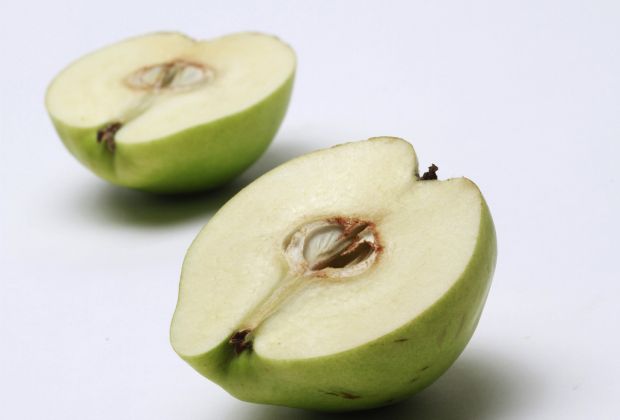
At first glance — and even, quite frankly, after extended contemplation — there is little to hint that the quince is one of the most delicious of fall’s fruits. It is rough-hewn and blocky in appearance, like someone’s first woodworking project gone horribly wrong. And should you make the mistake of taking a bite of it raw, that’s kind of how it tastes too.
But you know about judging things on first impressions. Take that same quince, give it a little careful tending and you’ll find a fruit that is utterly transformed.
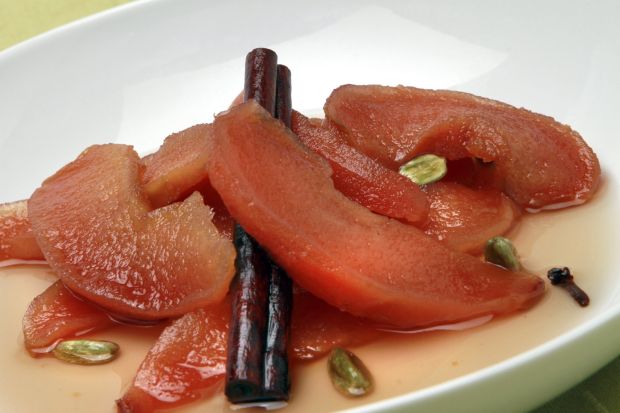
Cook quince — slowly and gently, bathed in just a little bit of sugar syrup — and the flesh that was once wooden and tannic turns a lovely rose hue, with a silky texture and a subtly sweet, spicy flavor that recalls apples and pears baked with cinnamon and clove.
The usual way to cook a quince is by poaching it in spiced simple syrup. That’s easy enough, but I’ve come to favor a slightly different technique from my old friend Deborah Madison’s cookbook “Seasonal Fruit Desserts.” She bakes them in a syrup made partly with white wine and spiced with cinnamon, clove and cardamom along with tangerine or orange zest.
People are also reading…
It seems to me that when baked this way, quince takes less time to cook through, and it achieves that perfect rosy color more reliably. Plus, there’s that nice bit of caramelization that the edges pick up.
The fruit is available in Tucson, including at the Sprouts at 4282 N. First Ave., where it goes for four for $5. Whole Foods at 5555 E. River Road will have quince in stock next week. There they sell for $1.50 a pound.
Stir together yogurt and honey, and spoon it over some of this quince for a little bite of something sweet after dinner. On the other hand, because it’s not overpoweringly sweet, combined with plain yogurt it makes a perfect breakfast.
Use it as an accompaniment for a cheese plate — maybe a little Red Hawk, a little Parmigiano and, of course, some Gorgonzola.
Add the cooked quince to fruit compote made from dried fruits poached in spiced syrup.
Wrap the cooked quince in crepes, with a little sweetened fromage blanc.
Bake it in a strudel, mixed with dried sour cherries and walnuts.
Use it as a base for a clafoutis. Arrange cooked quince in the bottom of a baking dish, pour clafoutis batter over top (made by blending « cup sugar, 3 eggs and » cup each whipping cream and milk until smooth, then pulsing in ƒ cup of flour) and bake at 400 degrees until puffed and brown, about 45 minutes.
Make any of a multitude of jams and jellies.
Because the flavor of cooked quince is more spicy than sweet, it can also be used in savory dishes, in much the same way you might serve applesauce with pork.
It’s proof that even the most unlikely foods can shine if you just give them a little attention.