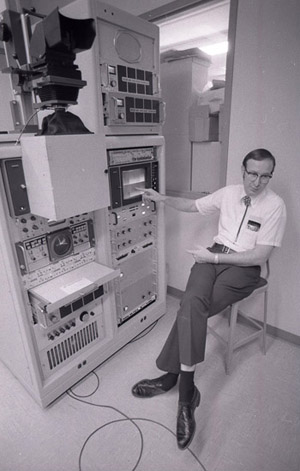
Back in 1973, it wasn’t Mars that the University of Arizona space scientists were watching, it was Jupiter. A spacecraft, named Pioneer 10, was headed to Jupiter carrying a camera built by scientists from the UA Lunar and Planetary Laboratory. The tv monitor that would receive the images, was also built at the UA.
[photo moved to image asset]
AP/NASA file photo
Pioneer 10
Pioneer 10 had been working its way to Mars since 1972. The camera it carried was designed by a team headed by Dr. Tom Gehrels of the LPL. Color pictures of the cloud-shrouded planet would be sent back to the NASA Ames Research Center in California. On the historic flyby of the planet, the monitor created and built by L. Ralph Baker of the Optical Sciences Center would display the image.
People are also reading…
[photo moved to image asset]
1973 Star photo
L. Ralph Baker and with the tv monitor for Pioneer 10 pictures.
Since the probe would be a half billion miles away, it would take 40 minutes for the signal to be received. The camera only picked up red and blue, but after the image was displayed on the monitor, green was electronically added. The tv monitor was to allow the American public to view the event as it happened. It was also going to be used on Pioneer 11.
The little spacecraft traveled past Jupiter at 82,000 mph on December 3, 1973. Originally planned as a 21-month mission, Pioneer 10 flew right on by Jupiter and, much to everyone’s surprise and delight, it kept going for the next 30 years. The last signal from Pioneer was received in January 2003.


 Lloyd to get clarity on Arizona basketball future this week | Greg Hansen