

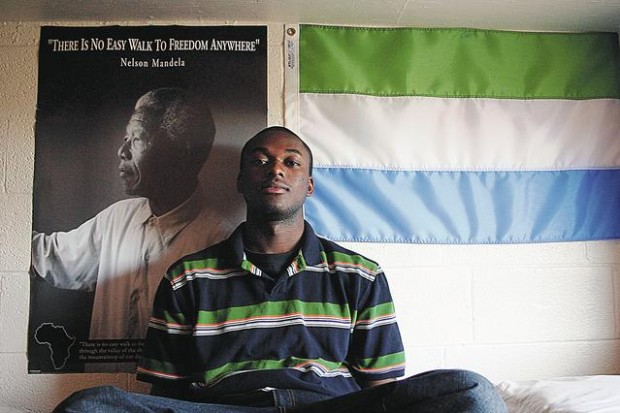
Joseph Sakendu Jones Jr. is a student at the University of Arizona, majoring in political science. He originally is from Sierra Leone, West Africa, and came to the United States as a refugee in 2000. The civil war in Sierra Leone lasted from 1991 until 1999, and according to the BBC, it resulted in 50,000 fatalities and 100,000 mutilation victims. A half-million people are thought to have fled the country.
"In Sierra Leone, school is not hard. There was war in Sierra Leone, so I didn't care about school that much, just like the other kids my age. Going to school was the tough part — so school here is harder than in Sierra Leone because you have to do more. The teachers in Sierra Leone also kick kids' asses. So that was the problem — they are allowed to. It was a problem if you didn't do your homework and you went to school. You would have to stand in lines, and if you didn't have your homework, then you [would be] beaten up by the teachers with a ruler.
People are also reading…
We came here because of the war. If there was no war in Sierra Leone, I would still be there. We used to have a youth education system in Sierra Leone. I heard it was one of the best in West Africa before the war. Then the war went on for years, and everything was destroyed and there was no school system. That's why I'm glad to be here, because I have the opportunity to get an education. For kids in Sierra Leone, it's not like they can go to school. They're not going anywhere, because there are no job opportunities. The only thing you could do if you went to school in Sierra Leone is become a teacher, and it's not like they're getting paid.
If you drop out, you can sell food and stuff. The population of kids that goes to school is really low. It's normal to drop out. [Teachers] don't expect you to go all the way through high school. You also pay through high school, and it's hard because [if] you have no parents, no one is paying for you.
So that's why my dad is here and paying for a lot of friends and family back home to go to school. They wouldn't have the opportunity to do that because of war. My dad came here two years before I did, and he was paying for my school back in Sierra Leone. So if it wasn't for that, I wouldn't have been in school either. I don't plan on going back to Sierra Leone right now, but I'd like to work for the United Nations or something that will allow me to travel back and forth to Sierra Leone.
I guess most of the people in the U.S. think that since you're from another country, and maybe you don't speak English, that you aren't as smart as they are. But you don't have to speak English to be smart."
Hawa Bealue / 110°


 Faculty concerned about changes to U of A admissions policy
