

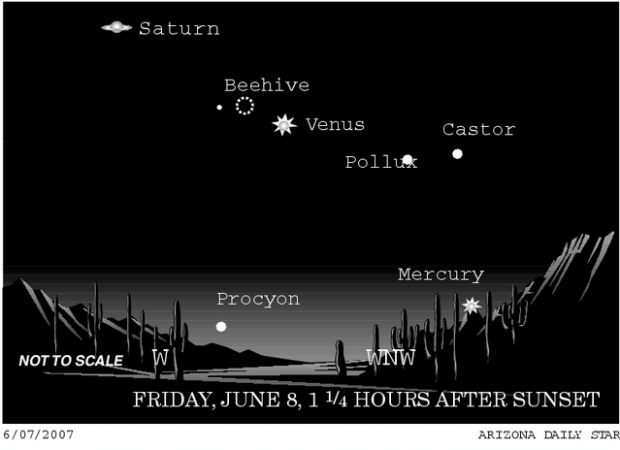
The entire month of June offers great planetary and stellar viewing after sunset.
Last week we noted the planetary lineup of Mercury, Venus and Saturn in the western sky. Now we can add Jupiter to the list, because it's becoming visible in the evening sky as it gradually transitions from being a morning object.
Jupiter is nearly clearly across the sky from Mercury and Venus, and more than halfway across the sky from Saturn.
Venus reaches its greatest elongation (distance) from the sun on Friday, when it's 45 degrees from the sun.
Venus isn't far from the Beehive, a large star cluster. The Beehive is also known as M44, because French astronomer Charles Messier (1730-1817) included it as the 44th object in his catalog of important sky objects. Messier was only interested in discovering comets and made his now famous list of objects so others would not confuse them with comets. His list contains some of the brightest star clusters, galaxies and nebulae in the sky, and amateur astronomers spend endless hours viewing and photographing the Messier objects.
People are also reading…
The Beehive is easy to see with the naked eye on a good dark night with clear skies and no moon. It's also called Praesepe (Latin for manger), and is sometimes described as a "little cloud." The Beehive contains up to 350 stars, and is 577 light-years away from us. It may be a bit of a challenge to see now because it's fairly low in the western sky, but give it a try and then look for it with binoculars — it will be a gorgeous sight.