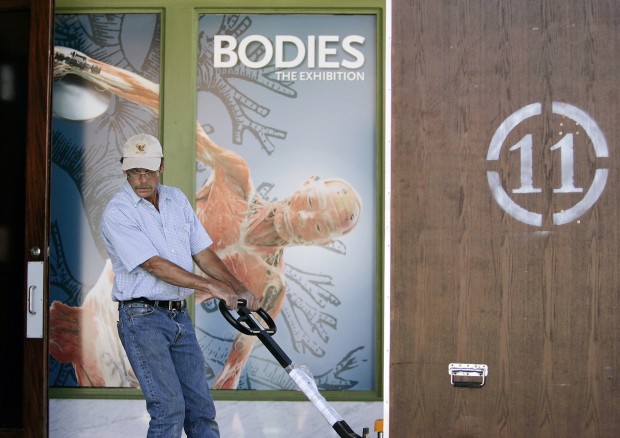
A controversial exhibit featuring plasticized corpses is coming to Tucson.
"Bodies . . . The Exhibition" will be at the Rialto Block, 300 E. Congress St., starting in May.
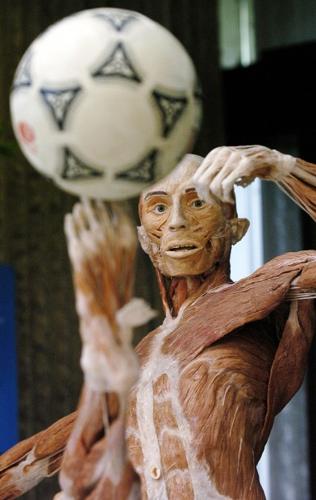
The show features specimens that have been dissected and preserved through a plastination process and illustrates how human anatomy varies from person to person.
Some of the bodies are posed doing everyday activities like playing volleyball or conducting an orchestra.
But questions about the origins of the bodies have dogged the exhibition.
A 2008 report by ABC News quoted a Chinese source who alleged cadavers were obtained through a black market in Chinese bodies, which could have included executed prisoners.
That report triggered an investigation by the New York attorney general.
People are also reading…
Premier Exhibitions, which produces and manages the show, denied the accusation, saying it gets its corpses from Dalian Medical University in China. But the company later acknowledged that it didn't know for sure where its bodies came from or how they died.
In a statement announcing a settlement with Premier, New York Attorney General Andrew Cuomo said the company used "the remains of individuals that may have been tortured and executed in China."
As part of the settlement, Premier was required to post a disclaimer at its New York shows, in part saying: "With respect to the human parts, organs, fetuses and embryos you are viewing, Premier relies solely in the representations of its Chinese partners and cannot independently verify that they do not belong to persons executed while incarcerated in Chinese prisons."
Scott Stiteler, one of the owners of the portion of the Rialto Block where the exhibit will be held, said the dispute over the origin of the bodies was news to him.
"That's something you're going to have to talk to the 'Bodies' people about," he said. "I'm not familiar with that controversy."
Premier Exhibitions didn't return calls Friday and Monday for comment.
Similar exhibits in other cities have attracted thousands of people and made millions of dollars.
In 2007, Phoenix hosted "Body Worlds 3," a show created by Dr. Gunther von Hagens, who pioneered the plastination technique.
Von Hagens said he's stopped accepting bodies from China and that today he uses only bodies from consenting donors.
The "Body Worlds 3" show set attendance records at the Arizona Science Center.
"We saw a year's worth of attendance in the four months it was here," said Chevy Humphrey, Arizona Science Center president and CEO.
Humphrey said Premier Exhibitions reached out to the Arizona Science Center five or six years ago about bringing "Bodies: The Exhibition" to Phoenix, but the center was worried by the show's inability to prove that its cadavers were donated willingly.
"I did not get the answers that made me feel at ease," Humphrey said.
At a 2008 show in Kansas City, donor-consent forms linked to bodies in the exhibit were found not to be authentic.
Last year, Hawaii became the first state to ban the exhibition of human corpses for profit. Lawmakers there said the possibility of profiting off executed prisoners from China would not be tolerated in a state where many residents come from Asian backgrounds.
If Tucson's "Bodies" exhibit is as successful as exhibits in other cities, there could be lots of bodies downtown looking for a place to park their cars. Parkwise officials say they hope the new parking garage west of Hotel Congress will be open in time for "Bodies . . . The Exhibition."
Stiteler, who was part of the partnership that bought and successfully redeveloped the old Martin Luther King apartments into a rental building, said crews have been working hard to get the Rialto Block ready.
"(Premier) was in Tucson and looked at several sites, and Rialto is just a beautiful building," he said.
The Downtown Tucson Partnership has scheduled a news conference for 10 a.m. today at the Rialto Block to announce more details.
Contact reporter Coley Ward at 807-8429 or cward@azstarnet.com

 Faculty concerned about changes to U of A admissions policy