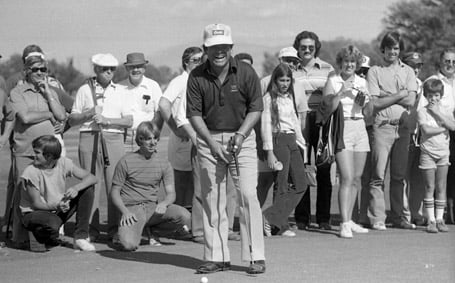
In September 1979, Lee Trevino conducted a one-day golf exhibition and clinic at Randolph Golf Course. Here are some of his golfing tips he shared with the crowd.
[photo moved to image asset]
1979 Star photo
Lee Trevino laughs with his fans at a clinic at Randolph North.
SLICE
It’s simple to correct a slice. No. 1, 90 percent of the golfers who slice… take the club inside. I go outside then come back in. What happens to them (slicers), when they take the club back inside they reel over and when they reel over, they’re glancing the ball. They’re hitting the ball in the inside left of the number and putting an outer spin on it.
There is no way you can control that unless you change the backswing. Everything is done in the swing.
People are also reading…
Another thing, you have to see the individual’s grip. It’s difficult to tell why an individual is slicing if you don’t see where he’s holding his hands.
HOOK
A hook is breaking down. It’s like using a golf club as a pendulum. The butt of the club is moving the opposite way of the club head… he is closing the face of the club. In other words, now you’re hitting on the right-hand side of the number and putting an inner slice on the ball.
Another thing about hooking, a person will sometimes use what we call a short thumb. You take your thumb and push it down the shaft and you can see how strong the back of your hand gets. Bring it back, and your hand is weak. Your right hand takes over when you have a short thumb. There’s no strength in your left hand. If you hook a ball, the big secret is to stretch the thumb down. What it does is it makes the left hand dominant. It leads. If you have short thumb, your fingers open up and then the right hand takes over automatically.
FAIRWAY WOODS OR IRONS
Ninety-nine percent of the people try to help the golf ball into the air. Golf club have degrees of elevation to them. They have loft. For example, a 5-iron is elevated 31 degrees. They go in increments of four degrees. The sixth iron has 35; the seventh iron has 39 the eighth iron has 43 and so on. You never have to help the ball up. You mash it into the ground and then it slides up the club head.
The same thing is true with a wood. You never hit up on a wood because if you hit on the ball it puts an over spin on it and drives it back into the ground. That’s called a topballing. You have to hit down on the ball, even with a fairway wood. You want to take a divot if you can, a small divot.
HITTING OUT OF THE SAND
There are different lies and different sand; it’s hard to say. But to be a good bunker player, you have to have 75 percent of your weight on your left foot (right foot for lefthanders). This enables the club to come straight up and down. If you have too much weight on the right side, you take the club away too low and you blade every bunker shot. You’re never able to get it up.
People think that they should put their weight on the right side, but it works just the opposite.
PUTTING
I spot putt, just like bowling. I look for spot. If I read a 30-foot putt and I feel like its going to break a foot, I’ll get behind the ball and take a straight line a foot to the right of the hole and pick a spot six inches in front of the ball and hit the ball over that spot. Then I know I’m square. It’s difficult to square yourself 30 feet away. But you know that spot is in the line you want to go.