

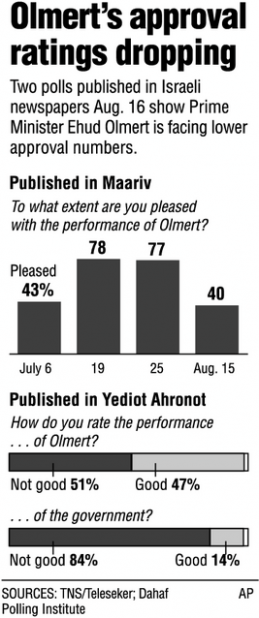
JERUSALEM — Prime Minister Ehud Olmert tried to defuse growing public anger Monday over his handling of the war against Hezbollah, promising to rebuild rocket-scarred border areas but rejecting peace talks with Syria, a key supporter of the Lebanese guerrillas.
With efforts to recruit troops for an international peacekeeping force facing resistance from Europe, the week-old truce appeared increasingly fragile.
The Israeli army said its soldiers still in southern Lebanon awaiting deployment of the peacekeepers shot two Hezbollah guerrillas who approached in a "threatening manner" late Monday. A Hezbollah official called the report "untrue."
In Israel on Monday, hundreds of reservists signed a petition calling for an official inquiry into the conduct of the war, some marching outside Olmert's office to demand his resignation.
People are also reading…
The war initially enjoyed broad public support but it withered as the fighting dragged on and the Israeli death toll grew. Critics said Israel's political and military leaders were indecisive, set unrealistic goals and settled for an insufficient truce.
The harshest criticism has come from reserve soldiers returning from Lebanon who complained about poor command and a lack of food, water and equipment.
"No goal was achieved. … Nothing was done in this war," Roni Elmakyes, whose son Omri was killed in the fighting, told Israel Radio.
Even the army's leadership began to show signs of dissent. Brig. Gen. Yossi Hyman, the outgoing head of infantry, said this week that "we all feel a certain sense of failure."
During a tour of the north Monday, Olmert said the second-guessing would undermine the army. "I won't play this game, the game of beating ourselves up," he said.
The Defense Ministry has already established a team to look into the war, but the panel of retired generals has been derided as toothless.
Olmert on Monday rejected a proposal to resume peace talks with Syria, a key Hezbollah supporter. The three main U.S. allies in the Arab world — Egypt, Jordan and Saudi Arabia — have been pushing for a revival of negotiations between Israel and Syria because they are worried the Lebanon war has given a boost to Iran, an ally of Syria.
Olmert said talks could resume only if Syria stops supporting militant groups.
"Syria is a committed, aggressive member of the axis of evil, which starts in Iran," he said.