

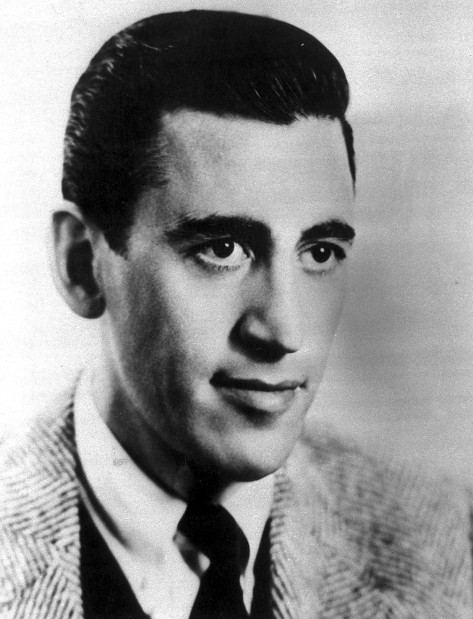
NEW YORK - J.D. Salinger, the legendary author, youth hero and fugitive from fame whose "The Catcher in the Rye" shocked and inspired a world he increasingly shunned, has died.
Salinger, 91, died of natural causes at his home on Wednesday, his son, actor Matt Salinger, said in a statement from Salinger's longtime literary representative, Harold Ober Associates Inc. He had lived for decades in self-imposed isolation in a small, remote house in Cornish, N.H.
"The Catcher in the Rye," with its immortal teenage protagonist, the twisted, rebellious Holden Caulfield, came out in 1951, a time of anxious, Cold War conformity and the dawn of modern adolescence. The Book-of-the-Month Club, which made "Catcher" a featured selection, advised that for "anyone who has ever brought up a son" the novel would be "a source of wonder and delight - and concern."
Enraged by all the "phonies" who make "me so depressed I go crazy," Holden soon became American literature's most famous anti-hero since Huckleberry Finn. The novel's sales are astonishing - more than 60 million copies worldwide - and its impact incalculable.
People are also reading…
Decades after publication, the book remains a defining expression of that most American of dreams: to never grow up.
Salinger was writing for adults, but teenagers from all over identified with the novel's themes of alienation, innocence and fantasy, not to mention the luck of having the last word. "Catcher" presents the world as an ever-so-unfair struggle between the goodness of young people and the corruption of elders, a message that only intensified with the oncoming generation gap.
Novels from Evan Hunter's "The Blackboard Jungle" to Curtis Sittenfeld's "Prep," movies from "Rebel Without a Cause" to "The Breakfast Club," and countless rock 'n' roll songs echoed Salinger's message of kids under siege. One of the great anti-heroes of the 1960s, Benjamin Braddock of "The Graduate," was but a blander version of Salinger's narrator.
" 'Catcher in the Rye' made a very powerful and surprising impression on me," said Pulitzer Prize-winning novelist Michael Chabon, who read the book, as so many did, when he was in middle school. "Part of it was the fact that our seventh-grade teacher was actually letting us read such a book. But mostly it was because 'Catcher' had such a recognizable authenticity in the voice that even in 1977 or so, when I read it, felt surprising and rare in literature."
The cult of "Catcher" turned tragic in December 1980 when crazed Beatles fan Mark David Chapman shot and killed John Lennon, citing Salinger's novel as an inspiration and stating that "this extraordinary book holds many answers." A few months later, a copy of "Catcher" was found in the hotel room of John David Hinckley after he attempted to assassinate President Ronald Reagan.
By the 21st century, Holden himself seemed relatively mild, but Salinger's book remained a standard in school curriculums and was discussed on countless Web sites and a fan page on Facebook.
Salinger fans shared their grief Thursday on social networks. Topics such as "Salinger" and "Holden Caulfield" were among the most popular on Twitter. CNN's Larry King tweeted that "Catcher" is his favorite book. Humorist John Hodgman wrote, "I prefer to think J.D. Salinger has just decided to become extra reclusive."
Salinger's other books don't equal the influence or sales of "Catcher," but they are still read, again and again, with great affection and intensity. Critics, at least briefly, rated Salinger as a more accomplished and daring short-story writer than John Cheever.
"The Catcher in the Rye" became both required and restricted reading, periodically banned by a school board or challenged by parents worried by its frank language and the irresistible chip on Holden's shoulder.
"I'm aware that a number of my friends will be saddened, or shocked, or shocked-saddened, over some of the chapters of 'The Catcher in the Rye.' Some of my best friends are children. In fact, all of my best friends are children," Salinger wrote in 1955, in a short note for "20th Century Authors."
"It's almost unbearable to me to realize that my book will be kept on a shelf out of their reach," he added.
Salinger's last published story, "Hapworth 16, 1928," ran in The New Yorker in 1965. By then, he was increasingly viewed like a precocious child whose manner had soured from cute to insufferable. "Salinger was the greatest mind ever to stay in prep school," Norman Mailer once remarked.
In 1997, it was announced that "Hapworth" would be reissued as a book - prompting a negative New York Times review. The book, in typical Salinger style, didn't appear. In 1999, New Hampshire neighbor Jerry Burt said the author had told him years earlier that he had written at least 15 unpublished books and kept them locked in a safe at his home.
"I love to write, and I assure you I write regularly," Salinger said in a brief interview with the Baton Rouge (La.) Advocate in 1980. "But I write for myself, for my own pleasure. And I want to be left alone to do it."
The mystery of the safe continued Thursday. Salinger's representative at the Ober agency, Phyllis Westberg, declined comment on whether the author had any unpublished work. Spokeswoman Heather Rizzo of Little, Brown and Co., Salinger's longtime publisher, said she had "no news on future releases."