TAYLORVILLE — Whether U.S. Sen. Dick Durbin will seek reelection in 2026 remains in question, but the five-term Democrat says an answer is coming "soon."
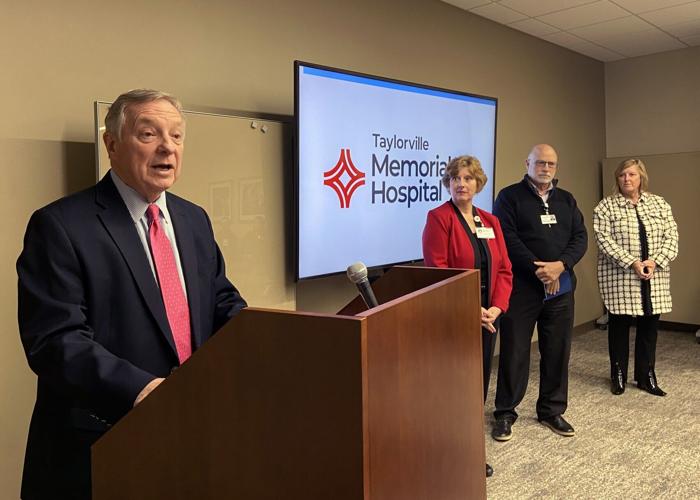
Durbin, of Springfield, also defended his recent vote to advance a GOP-backed government funding bill during an appearance at Taylorville Memorial Hospital to discuss the potential impact of Medicaid cuts.
He said his decision to join nine Democrats and all but one Republican last week to invoke cloture on the funding bill — effectively paving the way for its final passage — was "an effort to avoid shutting down the government," an outcome he said would have been far worse.
"I have never voted for a shutdown, and I didn't last week," said Durbin, who voted against the final bill, which was immediately signed by President Donald Trump and funds the government through September.
People are also reading…

U.S. Sen. Dick Durbin speaks at Taylorville Memorial Hospital on Thursday, March 20, 2025, about the possible impact of Medicaid cuts to rural communities.
The decision by Durbin and others to advance the bill left Democrats bitterly divided as they seek to mount an effective resistance to Trump's second administration.
Opponents argued that it gives Trump too much leeway to move federal funds around and codifies the work of Elon Musk's Department of Government Efficiency, or DOGE. They also said that by caving, Democrats ceded perhaps the only leverage they had, a filibuster, to get concessions from Republicans, who control the White House and Congress.
Gov. JB Pritzker, among Trump's most pugnacious critics, said at an unrelated event in Urbana on Wednesday that those who supported the measure were "dead wrong."
"A lot of good has been done by those people, but just broadly, this was an enormous mistake," Pritzker said, though not mentioning Durbin by name.
Durbin, in response to Pritzker, said that if the government had shut down, Trump and Musk would have carte blanche to take a wrecking ball to government departments, agencies and programs.
"Well, I respect the governor and I respect his right to make the decisions that are part of his office," Durbin said. "I hope he respects mine as well."
"But I'll tell him the basics: The basics are that a shutdown of the government gives to the president more power than before the shutdown," Durbin said. "The president decides who is an essential employee and who is nonessential."
"You know what DOGE and Elon Musk are doing, agency by agency?" Durbin asked, then mentioning specifically the effort to eliminate the Department of Education.
"Under a shutdown situation, the president has even more authority to do more terrible things like that," Durbin said. "I don't like that. I didn't want to see that happen. I hope that we find that there's a bipartisan approach that can avoid that in the future."
When asked what he thought might go differently during the next spending bill negotiation, Durbin conceded: "I don't know the answer."
"But I think there are Republican senators whom I've spoken to who want to see a different approach, Durbin said. "They want to have bipartisanship and compromise and do the best we can."
But, Durbin said that he's "not naïve."
"President Trump has made countless executive orders and countless changes in government and we're not going to turn the pages back," Durbin said. "He is in charge as president. But when it comes to basic spending priorities such as Medicaid, I think we should have bipartisanship in that approach."
One of the next large battles will be over a larger budget resolution.
Last month, House Republicans approved a budget framework that calls for more than $4.5 trillion in tax breaks that would disproportionately benefit the wealthiest Americans and $2 trillion in spending cuts largely to social programs.
This could potentially mean steep cuts to Medicaid, which provides coverage for more than 3.4 million Illinois residents and is considered a necessity to support safety net hospitals in low-income communities and rural areas.
"If we do substantial cuts in Medicaid, it could have an impact on individuals, first and foremost, but certainly on the survival of clinics and hospitals around the nation, and particularly in Downstate Illinois," Durbin said. "And that's why I wanted to come here today."
Durbin met with downstate hospital executives, who warned of the impact cuts could have on the communities they serve.
Jay Hodges, the chief financial officer of Carlinville Area Hospital, said that about 20% of the hospital's patients are on Medicaid.
"We are part of a little network of three other small independent hospitals, and we serve eight counties in rural Illinois. And this would be devastating if these kind of cuts happen," Hodges said. "Let me say we're all for eliminating waste and fraud from the system, but general reductions to the patients that are receiving these vital services, we'd not be for."
Announcement coming 'soon' on 2026 plans
Durbin, who turned 80 last November, told reporters that he will make an announcement "soon" regarding his plans for the 2026 election.
In an interview with Lee Enterprises after Thursday's event, Durbin said that his age, physical health and mental ability will all be factors in his decision. He has been in the Senate since 1997 after serving 14 years in the House.
"It's an eight-year decision. It's two years of campaigning and six years of service. Of course, (age) is a factor," Durbin said.
"Incidentally, I love this job, and I feel like I could do it for another term," Durbin continued. "I don't have any doubts in my mind. But I want to be a realist and take a look at the realpolitik situation of election and the real human condition of pledging eight years."
Waiting on Durbin's decision are several ambitious Illinois Democrats. Many have already started jockeying for position in anticipation of a crowded primary for what would be an open seat for the first time in a generation.
Among the most-mentioned potential candidates are U.S. Rep. Raja Krishnamoorthi, a Democrat from Schaumburg, who has more than $17 million in his campaign account, and Illinois Lt. Gov. Juliana Stratton, who told Lee Enterprises in an interview earlier this month that she would "strongly consider" a run for Durbin's seat should he retire.
Other names connected to the race include U.S. Rep. Lauren Underwood of Naperville, U.S. Rep. Robin Kelly of Matteson and former Chicago Mayor Rahm Emanuel. A number of other Democratic elected officials are expected to give the race a look too if Durbin steps away.
Durbin said that Illinois has "an extraordinary bench," saying that "at least five" House Democrats from Illinois are "ready to serve if called on" along with all the statewide constitutional officers.
"We have a deep bench, and that is not a concern of mine as I make this decision," Durbin said. "I'll be making it based on other things."

Durbin
Contact Brenden Moore at brenden.moore@lee.net. Follow him on Twitter: @brendenmoore13