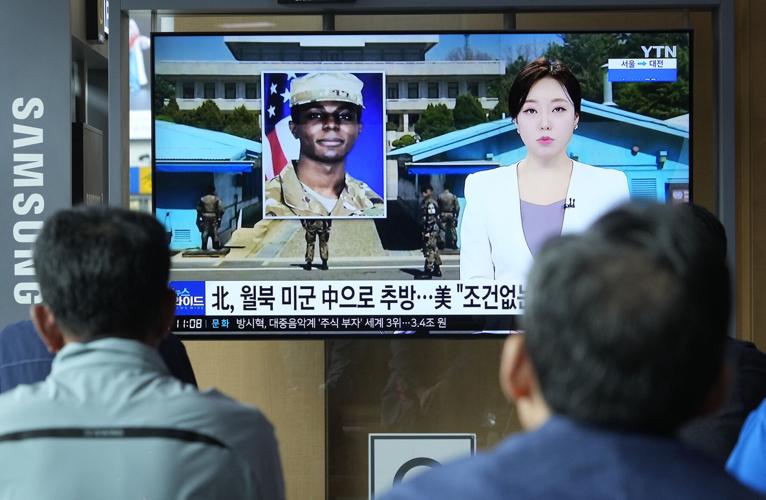
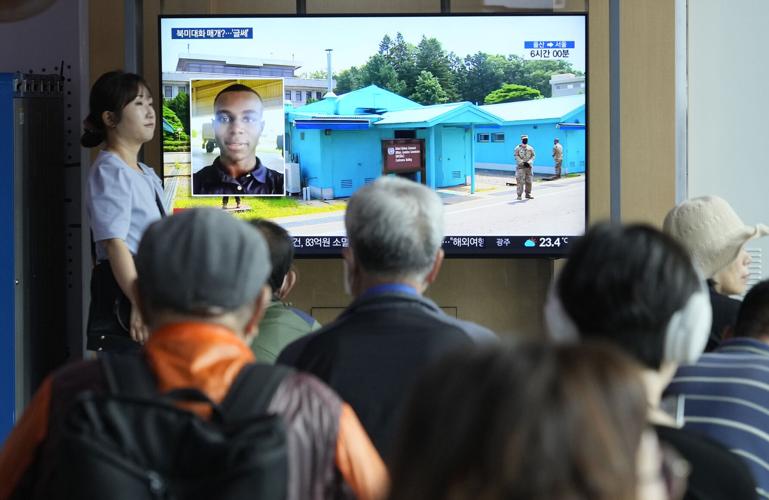
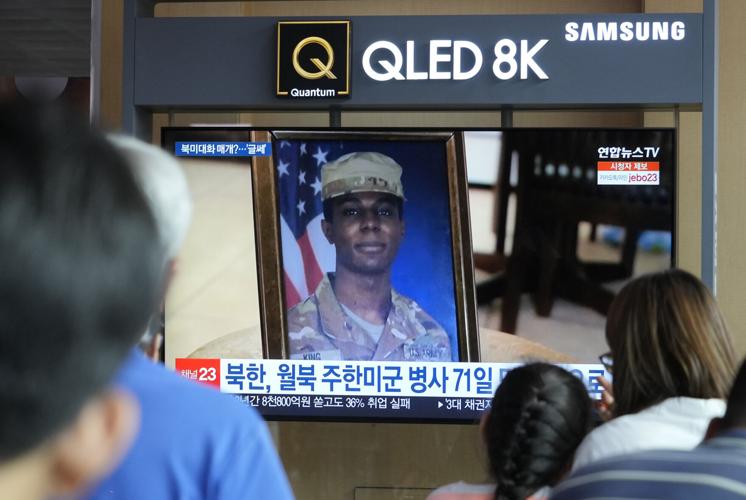
A TV screen shows a file image of American soldier Travis King during a news program Thursday at the Seoul Railway Station in Seoul, South Korea.
SEOUL, South Korea — Maybe it never made sense for North Korea to hold on to Pvt. Travis King.
Just over two months after he sprinted into North Korea across the heavily fortified inter-Korean border, King was put on a plane back to America after the North released him into U.S. custody.
Several recent American detainees had been held for over a year — 17 months in the case of Otto Warmbier, an American college student who was arrested during a group tour. Warmbier was in a coma when he was deported, and later died.
King's case was unique, not least because he was one of the 28,500 American troops stationed in South Korea to deter potential aggression from the nuclear-armed North.
There was speculation that North Korea would try to maximize the propaganda value of an active duty U.S. soldier who voluntarily crossed into its territory, reportedly because he was disillusioned with racism in the military and American society.
People are also reading…

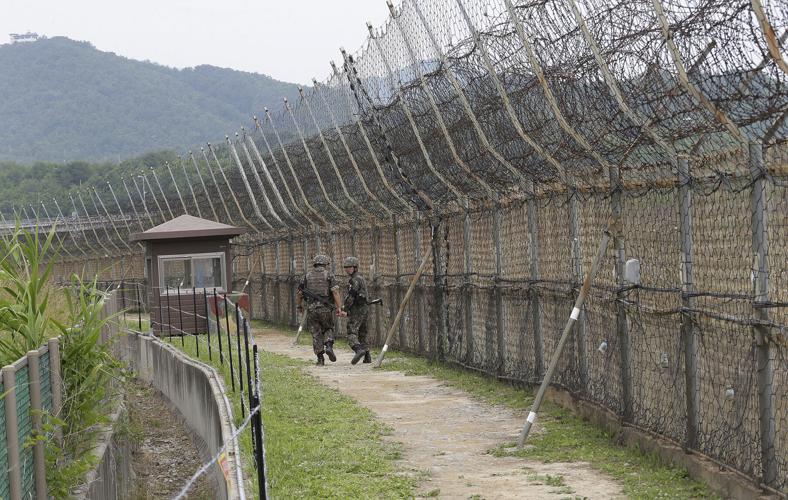
South Korean soldiers patrol the DMZ Peace Trail on June 14, 2019, in the demilitarized zone in Goseong, South Korea.
The North has often been accused of using American detainees as bargaining chips, but Biden administration officials said they made no concessions to secure King's release.
Pyongyang did not provide a detailed explanation when it announced the expulsion. In a brief report, the official Korean Central News Agency said King confessed to illegally entering the North because he harbored "ill feeling against inhuman maltreatment and racial discrimination" within the U.S. Army and was "disillusioned about the unequal U.S. society."
Some previous foreign detainees have said after their releases that declarations of guilt while in North Korean custody were made under coercion.
The North may have simply decided that King was more trouble than he was worth.
Analysts say the 23-year-old's legal troubles could have limited his propaganda value. At the time he crossed the border in July, King was supposed to be heading to Fort Bliss, Texas, following his release from prison in South Korea on an assault conviction.

A TV screen shows a file image of American soldier Travis King during a news program Thursday at the Seoul Railway Station in Seoul, South Korea.
As a low-ranking serviceman, King was clearly not a meaningful source of U.S. military information. The North would have been unable to justify the costs of providing him food, accommodation, security guards and translators, especially when it was uncertain what it would get from the United States amid stalled diplomacy.
"North Korea is actually good at doing the math on these things," said Moon Seong Mook, a retired South Korean brigadier general who participated in past military talks with the North.
"They concluded that the longer he stays, the more of a burden he becomes."
Pyongyang probably also didn't want to wait out a protracted negotiation with the U.S. Considering their prolonged diplomatic freeze, any gain was unlikely to be worth the trouble of dragging out his detention.
North Korea likely spent much of King's 71 days in custody weighing his potential as a propaganda asset. In the end, KCNA's brief description of King's supposed frustrations with American society and the U.S. military was all the North was going to get out of him, said Hong Min, an analyst at Seoul's Korea Institute for National Unification.

A TV screen shows a file image of American soldier Travis King during a news program Thursday at the Seoul Railway Station in Seoul, South Korea.
Unauthorized crossings across the Demilitarized Zone separating the Koreas are extremely unusual, and King was the first American soldier to do it in decades. Previous soldier defectors, like Charles Jenkins or James Dresnok in the 1960s, were treated by Pyongyang as propaganda assets, showcased in leaflets and films attacking the U.S. and praising the North's regime.
Other Americans were detained, publicly condemned and handed harsh penalties based on confessions of anti-state activities they later said were coerced. Freeing them often required lengthy backdoor negotiations and high-profile U.S. officials flying into Pyongyang to secure their release.
King's case was different in many ways.
King's legal troubles and the intense media coverage surrounding his dash across the border zone likely made it difficult for Pyongyang's propaganda writers to craft a story about a disillusioned U.S. soldier escaping evil imperialists, Hong said.
"Everyone knew why it happened and everyone saw how it happened," he said.
Hong said King's swift release also reflects North Korean efforts to present itself as a responsible government that abides by international norms and laws, and may be meant to answer criticism about its human rights record as it seeks to build a more assertive diplomatic profile.
During a session of North Korea's rubber-stamp parliament this week, leader Kim Jong Un called for the country to take a larger role in a coalition of nations confronting the United States in a "new Cold War," KCNA said Thursday.
"I think the only reason they would have considered keeping (King), was the discrimination angle, to be able to put a face to counter-criticisms of America's human rights situation," said Jenny Town, a senior fellow at the Stimson Center in Washington and director of the North Korea-focused 38 North website.
"But that doesn't seem to have been compelling enough for them to let him stay."