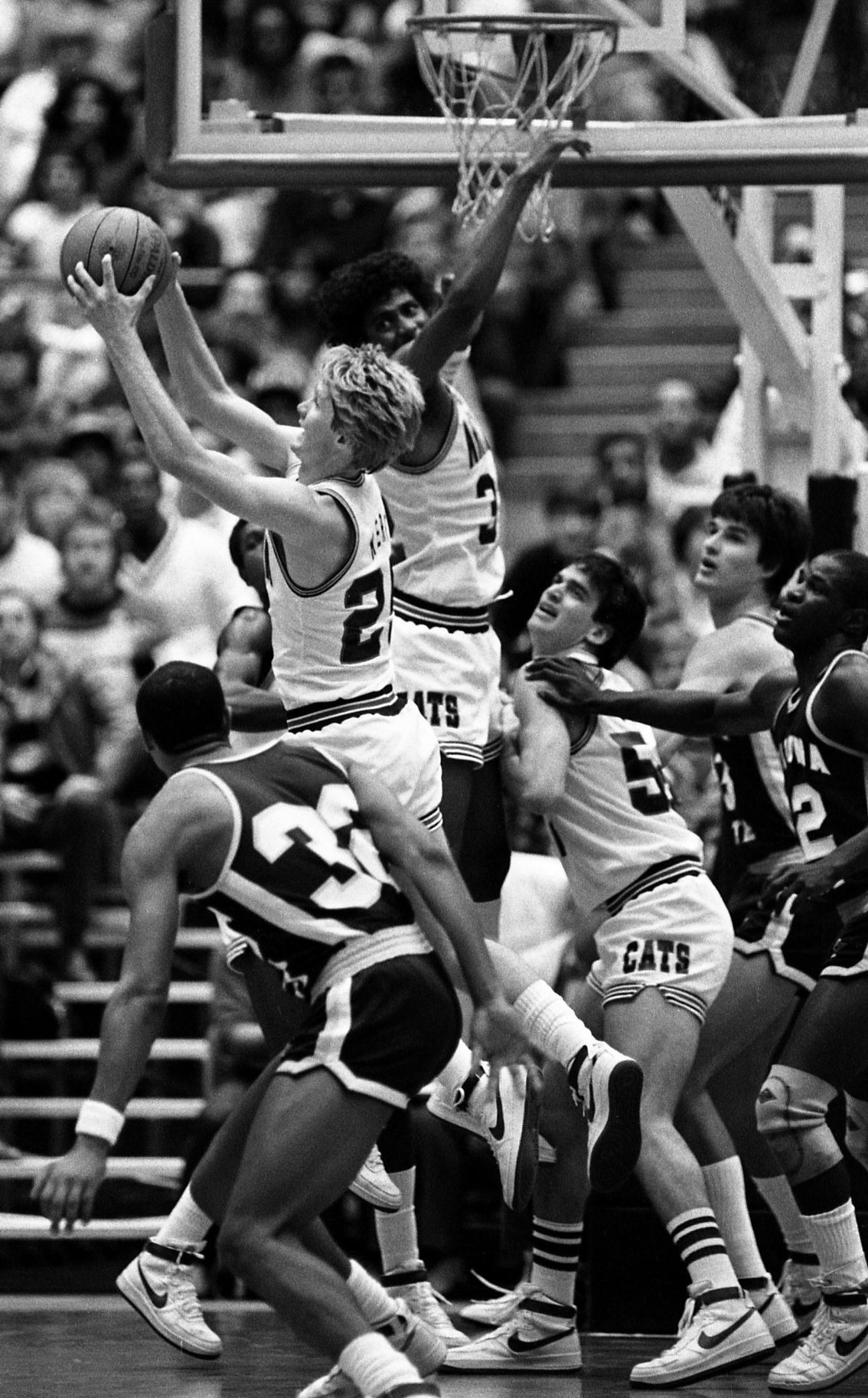
Arizona’s Steve Kerr grabs a rebound against Arizona State on Jan. 20, 1984, at McKale Center. Kerr, a freshman, was playing just days after his father was assassinated in Beirut. Photo by Joe Vitti / Arizona Daily Star
Jan. 20, 1984: Steve Kerr plays first game after his father’s assassination
The largest McKale Center crowd in two years (10,213) filed into the arena for the annual UA-ASU game on Jan. 20, 1984, and they weren’t there to see the Sun Devils or what remained of a once-heated rivalry.
Arizona was 3-11. ASU had a nine-game winning streak against the Wildcats.
Many came to honor All-America linebacker Ricky Hunley, who was presented with his jersey, No. 89, at halftime. And some came to see first-year coach Lute Olson; 30 of his Augsburg College classmates had flown to Tucson from Minnesota for the weekend.
Most, however, came to see little-known freshman guard, Steve Kerr, whose father, Malcolm Kerr, president of American University of Beirut, had been assassinated two days earlier.
People are also reading…
Kerr, a backup guard, averaged 3.7 points per game.
None of the 10,213 could have suspected the Friday night game in late January would trigger one of the most amazing stories in college basketball history, and ultimately, in the NBA.
One of the worst days in UA sports history would become one of the best.
A few minutes before tipoff, Arizona assistant coach Scott Thompson told Kerr there would be a moment of silence before tipoff. The team would remain in the dressing room until it was over.
UA coaches were trying to get the proper read on their freshman guard from Pacific Palisades, California. Would the ceremony be too much for him? Was it appropriate to put him in the game a little more than 48 hours after he learned of his father’s death?
Most in the crowd of 10,213 didn’t know Steve Kerr from any of the other newcomers on Olson’s first Arizona team.
But Kerr told Thompson he wanted to be on the court.
“It was pretty tough,” he said after the game, the first time he had been interviewed by reporters in Tucson. “It was probably the most emotional moment of my entire life.”
Two years later, sitting on a patio of a Champs-Elysees restaurant on a Sunday afternoon, preparing for the 1986 World Championships, Olson told Jack Rickard of the Tucson Citizen and me his memories of that night at McKale Center.
“I cried,” he said. “Who didn’t? And I didn’t just cry once.”
Olson said he did not alter his game plan to suit Kerr, or play to the crowd.
“By then, after three months with Steve, we knew a little bit of what we had,” Olson said. “He was a remarkable shooter and a leader. But all the rest? No. I don’t think anyone knew.”
Eight minutes into the game, Olson inserted Kerr. On the UA’s first possession, 18 seconds later, Kerr caught a pass in front of the Arizona bench. He shot from about 20 feet.
Nothing but net.
Those at McKale Center reacted with an ovation normally reserved for a game-winning finish.
Ninety seconds later Kerr hit another jumper. By game’s end, Arizona ended ASU’s 9-0 streak and won with ease 71-49. Kerr scored 12 points in 25 minutes, with no turnovers.
“I had to play,” said Kerr. “What happened to my father was a tragedy, but life goes on. The easiest time in the last few days was when I was out there on the court shooting. If I’d have sat out this game, it would’ve been 10 times tougher.”
Even ASU coach Bob Weinhauer was engulfed by the moment.
“It’s hard to sit here and say I felt good for him,” said Weinhauer. “Maybe I’m not as upset as I should be, but I didn’t want him to make every shot.”
The struggling UA basketball program, 4-24 a year earlier, struggled no more; they went 8-6 in the final 14 games and a year later were in the first of 25 consecutive NCAA Tournaments.
Seats at McKale Center were valued like never before. As the love and legend of Kerr grew, public address announcer, Roger Sedlmayr began a singular chant.
After each of Kerr’s baskets, the PA man would say “Steeeeeve Kerrrrrr!”
The crowd, even louder, would repeat it. “Steeeeeve Kerrrrrr!”
By 1986, Kerr was an All-Pac-10 point guard. That summer, he was part of the rotation in Team USA’s gold medal run at the World Championships, a team of amateurs beating the pros from the Soviet Union, Yugoslavia, Brazil and Italy. Kerr tore the ACL in his knee in the semifinal victory over Brazil and flew home a day before Olson’s team upset the Soviets in the gold medal game.
Six weeks later, recovering from knee surgery at his California home, Kerr wrote a letter to the Star. It was published on Sunday, August 17, 1986.
“I’m writing this letter to thank the people of Tucson for all the incredible support I’ve received in the weeks since I injured my knee,” he wrote. “I’ve received hundreds of cards and letters. During my stay at St. Mary’s Hospital my room was filled with flowers, plants and candy. All this support has really cheered me up, and also inspired me to rehabilitate my knee and return to the court as soon as possible.
“As much as I’d like to thank each and every one of you with a personal letter, that would be impossible. Instead, I write this one letter to thank all of you for your concern and support.
Steve Kerr, Pacific Palisades, Calif,
P.S. I’ll be back in 1987-88 to help the Cats to our third straight Pac-10 title.”
Not only did Kerr return in ’87-88, he led Arizona to the nation’s No. 1 ranking, a 35-3 record and the Final Four.
Where are they now: Kerr, who played on five NBA championship teams in Chicago and San Antonio, coached the Golden State Warriors to the 2015 NBA title. He turns 51 in September.
How they did it: Gonzaga had the first crack to recruit Kerr out of Pacific Palisades High School, but second-year coach Jay Hillock did not offer Kerr a scholarship after a campus tryout when he was matched against Zags senior point guard John Stockton.
Cal State Fullerton coach George McQuarn offered Kerr a scholarship and he accepted.
“I think Arizona was trying to find someone better,” Kerr told me during that 1986 trip to France and Spain. “I waited but Fullerton was persistent. I figured I wouldn’t hear from Arizona so I accepted, although I didn’t sign anything.”
A few days later, Olson phoned and said he was sorry Kerr would not be a Wildcat.
“Somewhere along the line we had a miscommunication,” Olson told me. “I thought he wanted to go to Fullerton.”
A few days later, with Malcolm Kerr as an intermediary, Kerr told Olson he wanted to play at Arizona.
The rest is pinch-me-it’s-true history.
Photo: Arizona’s Steve Kerr grabs a rebound against Arizona State on Jan. 20, 1984, at McKale Center. Kerr, a freshman, was playing just days after his father was assassinated in Beirut. Photo by Joe Vitti / Arizona Daily Star