

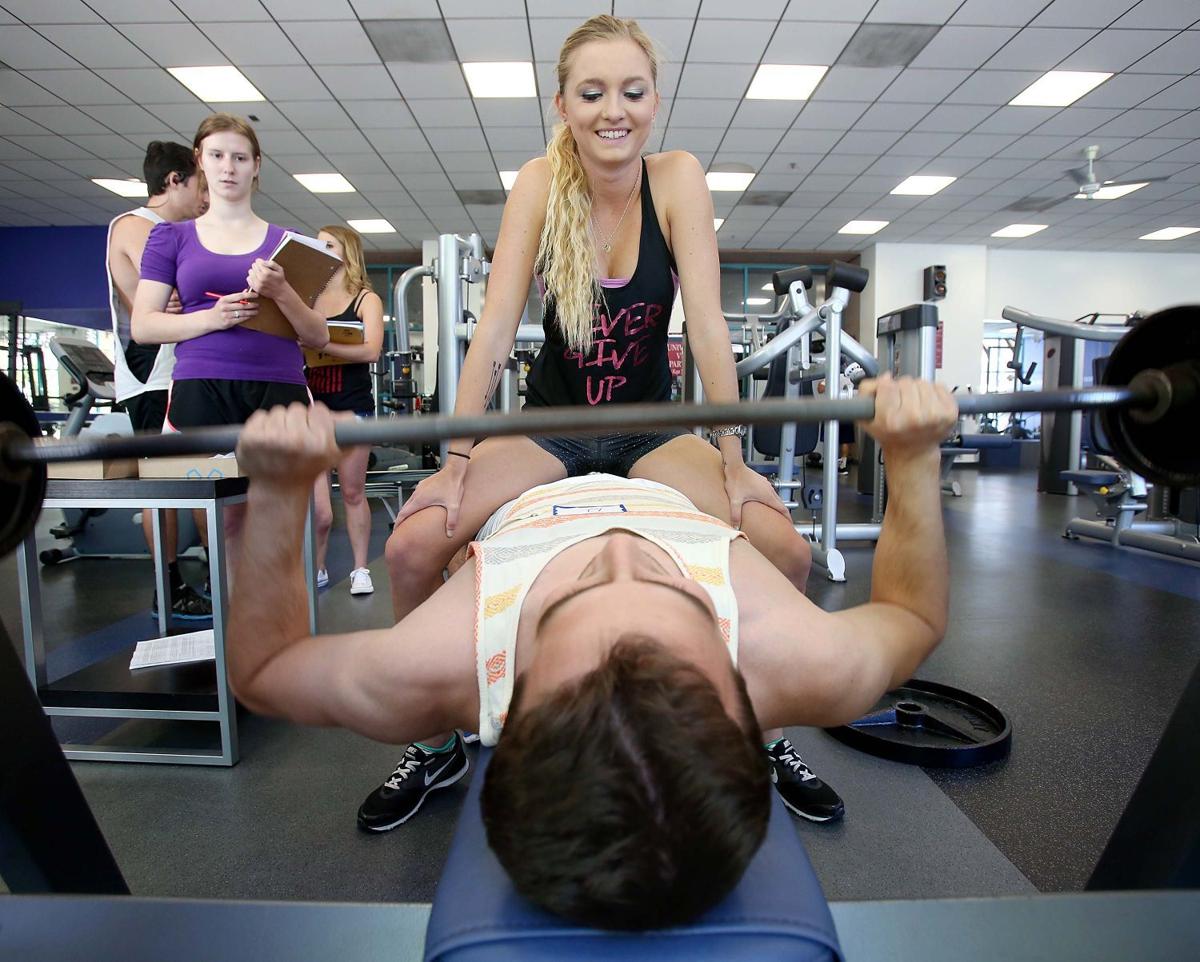
Standing with a clipboard and timer, University of Arizona senior Samantha DiBaise is all business as she orders a female student to sit in the lap of a bench-pressing male.
DiBaise, 21, times the student as he bench presses for 45 seconds. She gives him a 15-minute rest before he comes back to try it again — this time without a woman in his lap.
The bench-pressing students, who volunteered while they were working out at the UA Campus Recreation Center, complete the exercises as part of a randomized clinical trial that DiBaise and her classmates are conducting for an undergraduate UA course called “Evidence-based medicine.”
The class teaches students to look at medicine with a critical eye, ideally so that they do not put blind trust in the health system. It combines the hard facts of statistics with the values of how the data should be applied, upending the rote memorization often associated with medical education. Many students in the class plan on careers in the health field.
People are also reading…
“I find it’s really easy for students to look back into the distant past and think about how stupid doctors were back then with leeches and so on,” said Joanna Masel, a UA professor of ecology and evolutionary biology, who created the class four years ago. “And then we get closer and closer to the present and mistakes keep happening. So they are just much more prepared to question the present by seeing the mistakes of the past.”
Verifying a meme
DiBaise’s group is questioning an Internet meme that cited an unnamed “study” that concludes men’s lifting skills improve when a woman sits on his lap, due to increased testosterone or the need to impress the woman.
The students included 56 men in their clinical trial and divided them into four groups that tried the lifting exercise — both with and without the female on their lap — with each group assigned a different variation. Each student got a number; no names were used.
After an analysis, the students found that having a woman sit on a man’s lap while he is bench pressing causes the man to do one more rep than when no woman is on his lap. DiBaise calls this “statistically significant,” which means it’s large enough to matter.
“Many men would want to be able to perform that extra rep,” she said.
Negatives of mammograms
As part of the class students have learned facts versus hearsay about the Affordable Care Act. They’ve also taken a second look at mammogram screening recommendations, considering whether the benefits outweigh the harms of overdiagnosis and overtreatment.
“I get the students to come up with a value statement of what’s an acceptable ratio of lives saved to overdiagnosis. It’s good to see in the classroom that people have genuinely different values,” Masel said.
“Pretty much no one comes out of the class believing in routine screening for women 40 to 50 years old, partly because the evidence for benefits is very slim and partly because there’s radiation harm. The younger you get the radiation, the greater the risk.”
And when someone says a mammogram saved her life, Masel teaches her students to question that claim, too.
Overdiagnosis happens when someone is identified as having cancer, and is treated as a cancer patient with surgery and radiation, perhaps chemotherapy, yet would have been fine with no treatment at all, she explained.
“It turns out cancer is a normal part of the aging process, and we all have little teensy tiny cancers that don’t bother us as we get older,” Masel said. “The body is pretty good at fighting them. We don’t need to know about every single cancer.”
Trusting the data
Shaina Hasan, a 21-year-old senior who plans on applying to medical school, says the class has given her a bigger-picture view of the health system. She’s also found herself questioning the application of some drugs on the market.
Drugs are being used to treat patients without enough evidence to prove they are effective, she said. Some get approved for one condition and then doctors prescribe them for something else without science to show it works.
“We have this idea that medicine in ancient times was primitive because it was based on these ideas with little reasoning or evidence to back up why the treatment would work,” Hasan said. “But nowadays we commit the same errors.”
DiBaise said one of her main takeaways from the class is that if a study cannot be reproduced, then the data cannot be trusted. Her group’s study successfully reproduced the results from students in a previous class, with added verification measures.
“Lots of claims are made about products and treatments daily,” she said, “and it is good to know how to do the research to see if the claims are not only backed by research, but that the claims are backed by multiple different studies.”
An education trend
When she was creating the course with the help of a grant from the Howard Hughes Medical Institute, Masel could not find any similar evidence-based medicine class for undergraduates.
Two professors have since talked to her about starting comparable undergraduate classes at other schools. Masel believes health education in general is moving in the direction of more critical thinking.
“There are lots of evidence-based medicine programs in med school but they are not going to do a class project on benchpressing,” she said. “There’s a freedom of doing it with the undergraduates.”
At the end of the semester, students write papers about how they would reform the health system. Masel encourages them to have what she calls internally consistent beliefs — balancing their thoughts on medical care against who pays for it, for example.
The UA has offered Masel’s course long enough that she’s getting feedback from students who have gone on to medical school, or into the workplace. One recently contacted her to say she was working in a doctor’s office that used vertebroplasty, a procedure in which special cement is injected into a fractured vertebra.
But the latest research shows a conservative approach of bed rest, pain relievers and physical therapy can be equally effective. Masel’s former student told the doctor about that research and the office stopped using the procedure, she said.
“That’s the thing that’s the most rewarding,” Masel said.


