

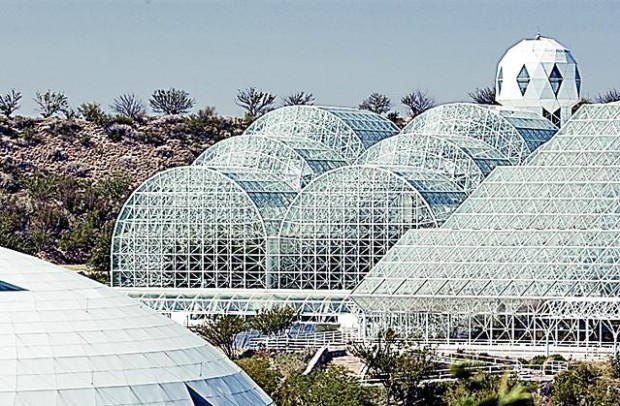
ORACLE — Biosphere 2 never unplugged from Earth, but the University of Arizona, which now runs the giant terrarium as a research center, will come closer to making it self-sustaining with installation later this year of 470 photovoltaic panels.
The panels were donated by Solon America, the Tucson arm of a German solar company that also owns an interest in GlobalSolar, the thin-film manufacturing company on Tucson's East Side.
At a news conference Wednesday, Biosphere 2 officials said they expect to save $8,000 on electric use at the Biosphere's casitas and conference facilities after the panels are mounted on a ridge above the glass-domed Biosphere.
The solar array will also be used for research projects by scientists and students at the UA and as an educational tool for visitors.
The panels will not be plugged into the electric grid, said Nate Allen, Biosphere 2's sustainability coordinator. They will supply electricity while the sun is shining and offset peak demand for electricity needed for cooling the buildings, Allen said.
People are also reading…
The panels, valued by the company at $229,000, are leftover models of the "first generation" thin-film photovoltaic panels produced by GlobalSolar and Solon, said Solon President and CEO Olaf Koester. They have less than half the efficiency of conventional solar panels, but can be produced much more cheaply, he said.
"Every single part of those panels is from Tucson," said William Richardson, head of research and development for Solon.
Richardson said careful measurement of the panels' performance over time will be valuable information for his company.
"Silicon's been around 50 years," he said. "Thin film is very new, and we're very interested in knowing what happens to these things over time." Instead of a thick and expensive layer of silicon, the panels use a copper indium gallium (di)selenide compound often abbreviated as CIGS.
Alex Cronin, associate professor of physics in the UA College of Optical Sciences, will lead the project to monitor the performance of the array.
Cronin and his students already employ a variety of monitoring techniques on 600 photovoltaic modules from 20 manufacturers at Tucson Electric Power's solar test yard.
Cronin said the Biosphere array can be used for a variety of research, including new storage systems for electricity generated by solar.
Travis Huxman, director of Biosphere 2, said the solar array and the experiments attached to it will become part of Biosphere 2's educational program. "We will use them to educate people about the way in which the world is changing," he said.
Allen said Biosphere 2 used solar water heaters in its original construction but never installed photovoltaic panels. "Solar has come a long way since construction of this facility," Allen said.