

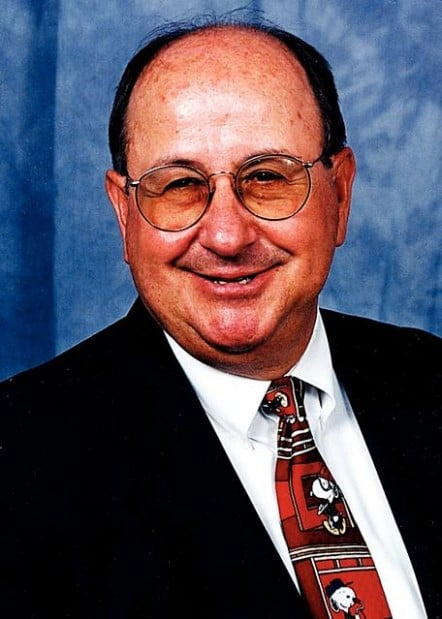
Tucson will always be an Estes home town. Even years from now, when we've filled our sprawling destiny and finally met Phoenix in Pinal County, when the valley is filled with sunshine-seeking Midwestern transplants who have never heard of the Estes name, Tucson will still be an Estes home town.
It's hard to imagine what Tucson would have been like without Bill Estes Jr., who died last week at 70. He built our starter homes and neighborhoods, pushing the edges of Tucson far and wide during the '70s and '80s, embracing the inevitability of growth while sparking hot debates over sprawl. He owned the Toros and donated to charities and the University of Arizona.
Estes lived such a big life here, it's hard to know where to begin in such a short column.
There are his numerous projects: Midvale Park, La Reserve, Loews Ventana Canyon Resort among so many others. And there are the fights over sprawl, particularly Rocking K on the southeast side and those bighorn sheep on Pusch Ridge to the northwest. For many involved, the old wounds over Rocking K have never healed.
People are also reading…
But I'd prefer to start with the hand of destiny for a family company that built more than 40,000 homes in Arizona, many of them in the Tucson area.
"We were in the right place at the right time, and Bill was the right man for the right time," his longtime wife, Shirley, said.
A little background: Estes was born in Everett, Wash., in 1938, moving to Tucson with his parents at the age of 5. His father, W.A. "Bill" Estes, started a modest home-building company, Chessman Construction, in 1947 that later became Estes Homes.
Estes Sr. built his first house near East 22nd Street and South Alvernon Way, buying three more lots after the home sold. And so it went.
"Since I was in junior high, I always planned to go to work with my father," Estes Jr. said in 2002 after his father had died.
And indeed, following his dreams, Estes took over the company in the early '70s. He and his father sold it in 1972 to Singer Housing Co. only for Estes Jr. to buy it back in 1977.
From there, Estes reshaped his father's company, taking it to levels no one imagined. Sure, he continued to build starter homes, but Estes Homes pursued commercial deals and master-planned communities and even mortgage investments. His crowning achievement was probably Ventana Canyon, although many have said he was most proud of the affordable, quality housing in Midvale Park on the city's southwest side.
Estes may have been the right man to harness Tucson's explosive growth in the '80s, but there was more to his success than timing.
"It was more than good timing. He was a very good land buyer. He bought in areas that he thought were pretty and would sell and where people would want to live," said Kip Volpe, chief financial officer of the Estes Co. "He always felt that growth was inevitable. All he was doing was serving those people who came here."
Estes embraced growth as an inevitable and good force that would make Tucson a dynamic place. People were coming, lured by endless sunshine, and they had to live somewhere.
"When I think of Los Angeles," he once said in a 1972 Daily Star story, "I think of the Los Angeles Rams, Disneyland, cultural attractions and people. People — that's what growth is all about, and it makes for an exciting place to live."
The typical Estes home was basic. No frills.
"I want to say the right thing. It wasn't great homes, but there were a lot of them," said Don Diamond, who partnered with Estes on several projects including the infamous Rocking K.
The Donald might have been a little rough in that description. I'd say Estes Homes were of good quality, but basic.
"I think of entry-level housing," said Doug Noll, who worked for Estes for nearly 20 years. "I think that's what Bill would want to be thought of, too. ... I think he was most proud of the thousands of homes that he provided to the entry-level buyer."
Over the years Estes was adept at finding a price range for the entry-level market. When other home builders were selling homes for $15,000, Estes was coming in at $13,000. His company regularly surveyed "middle-income buyers" to pin down what they wanted in a home.
He was able to cut costs because he had his own work crews and often focused on less expensive land toward the outskirts of town.
"If I feel that I can sell homes with a reasonable profit, I will go anywhere," he said to the Star in 1974. "We need to know there is a group of people who want to live there."
That interview was done for a story about infill, and Estes made it clear he didn't see infill as an effective way to build affordable homes for retirees, young couples and families.
"We made sure that at the end of the day we gave the most value and the most utility within the price range that we had to remain in," said Chris Sheafe, a partner in Estes Homes. "Bill was a very significant driving force in making sure that we didn't break that discipline of understanding what we needed to charge for our project."
By the early- to mid-'80s Estes Homes was a dynamic company. A player in multiple markets. And here in Tucson, Estes was building affordable homes on the south side, upper-level homes in La Reserve and the majestic Ventana Canyon, probably his most environmentally sensitive project as he transplanted countless mesquite and cacti.
Given his success, it's no surprise that Estes wound up at the center of our most controversial debates over development. During the Rocking K days, critics regularly assailed him for blading and grading desert.
"He resented people who said he was a raper of the desert," his wife, Shirley, said. "He said if people didn't want a house, he wouldn't build it."
And therein lies the Tucson paradox. We all want to be the last people to move here. Estes knew better.
Estes would eventually almost lose his company during the RTC days before building it back up and selling it to Kaufman and Broad, which is now KB Home, for $47 million. Toward the end of his life, he would advocate for improving education, serving on the state Board of Education and founding a charter school.
His company is slimmed down now, and Estes is gone. But with 30,000 homes here — think of all those kitchen conversations — Tucson will always be an Estes home town.