


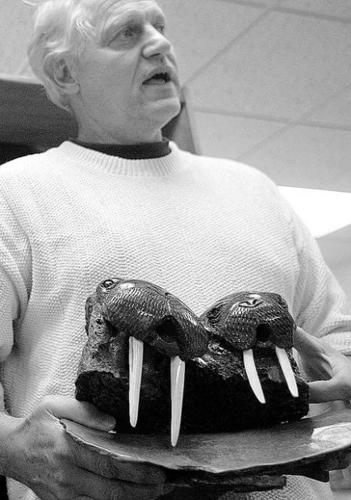
ANCHORAGE, Alaska — In the downtown ivory shops, alongside whale baleen baskets and walrus tusk statuettes, tourists finger curios made from the fossils of shaggy Ice Age beasts that died on the tundra thousands of years ago.
Woolly mammoth fossils, abundant on rivers and beaches in Alaska's interior, are shaped into jewelry or etched with scrimshaw, then sold to collectors and retail shops.
Alaska's borders contain the largest caches of mammoth remains in the United States, and a consistently cold climate has kept much of it in carveable condition.
"In the rest of the country, it isn't in very good shape, and it's rather rare.
"The permafrost and the muck helped preserve it better here," said Dale Guthrie, professor emeritus at the Institute of Arctic Biology in Fairbanks.
People are also reading…
As the warmer temperatures and round-the-clock daylight of summer draw tourists to the state, ivory shop owners anticipate the inevitable questions visitors have about mammoth ivory.
"Most people don't even know about it until they come up here, and then they see it in the store and go, 'Hmmm, mammoth ivory?' " said Barbara Lynd, owner of Alaska Arts and Ivory.
Many don't know that mammoth ivory is legal to carve and, unlike hundreds of other wildlife products, can be taken across nearly any border in the world. A few have asked where they can go to see a live mammoth.
"They're not really clued in to the fact that they're extinct," Lynd said.
Fossils unearthed by nature
Delicate lines of scrimshaw depict a herd of the elephant-like beasts on a slab of a tusk in front of her cash register. The piece will sell for about $4,500, Lynd said. Necklaces of polished beads cost between $100 and $400.
Mammoth fossils, which look like large pieces of driftwood, are unearthed by shifting rivers and eroding coasts in a swath that stretches from Fairbanks to Bethel, up the western coast and through the great oil fields of the North Slope.
For the past 15 years, Charles Foster of Kotzebue has searched for mammoth tusks and bones every summer at a secret location along a river. He sells the ivory to buyers in Anchorage, Fairbanks and Juneau.
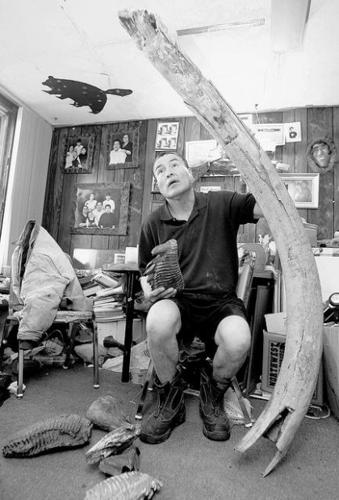
Leftover bones and tusk fragments are kept in a bulging cardboard box under a table in his small living room. A dark closet next to the front door is filled with several dusty tusks.
Using a shovel and pick, Foster collects about 15 pieces a summer near Kotzebue, just above the Arctic Circle on Alaska's western coast.
A school maintenance worker known for his fossil-finding skills, he sells the teeth for $500 each, while the tusks sell for a higher price he wouldn't disclose.
"I can get a four-wheeler with four of these teeth," Foster said as he picked through the box of mammoth tusks, teeth and leg bones.
The remains are somewhat protected by laws that ban their removal from state or federal land.
But with an uncountable number of mammoth fossils spread over hundreds of thousands of square miles of sparsely populated land, law enforcement can't keep tabs on them all.
Lynd said most of her inventory comes from people she's known for two decades.
"I trust they are getting it from the right places," she said.
Scrimshaw artist George Vukson, who sells pieces to Lynd and other shops and collectors, said most of his ivory supply comes from Alaska Natives who find it while hunting.
Vukson, of Knik, pays $35 to $70 a pound for fossilized mammoth ivory, depending on quality.
The ivory is sometimes easier to sell to international tourists than carvings and crafts from living species, shop owners said, because laws to prevent wildlife trafficking between countries are less strict for mammoth remains.
Because mammoths are extinct, all the animals' parts, from tusks to bones to teeth, are legal to buy and bring through customs, without fees or permits, in almost every country, the U.S. Fish and Wildlife Service says.
International trade legal
International tourists are generally safe buying mammoth ivory, soapstone and usually antler from moose and caribou, while whale, walrus and certain furs are either banned or require permits and fees, Lynd said.
Even travelers cutting through Canada to the U.S. by car or cruise ship must forfeit animal parts that are banned or lack the required paperwork at Canadian customs.
To the untrained eye, mammoth ivory looks like ivory from its relative, the elephant.
But cross-hatch markings on the tusks are distinct from elephants, and the ivory is creamier than elephant ivory, which is stark white. Unlike elephant tusks, mammoth is fossilized and tends to be brownish or blueish from centuries of absorbing minerals in the ground.
Lighter shades are found in Siberia, where tusks are preserved in ground that thaws less frequently than in Alaska.
The ivory is valuable to researchers, who use the tusks to track mammoth growth rates, seasonal eating and drinking patterns and migration trends based on the types of plants the animal was eating.
Scientists vary in their opinions about the excavation and sale of mammoth ivory by private, largely untrained individuals, said Guthrie, whose study on mammoth extinction appeared recently in the journal Nature.