

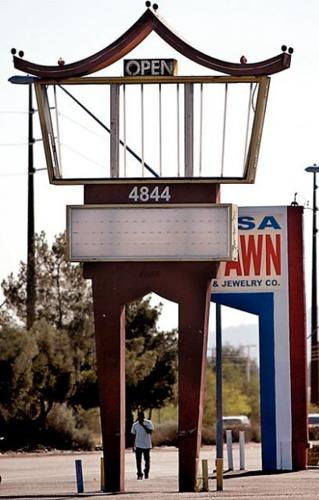
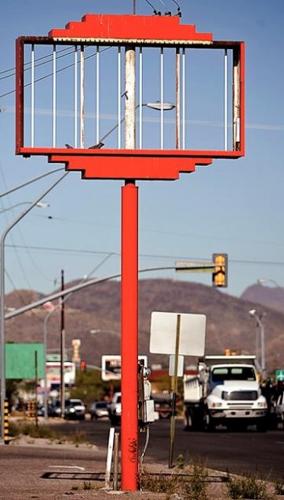
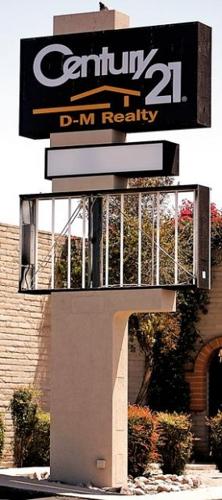
Talk about a sign of the times. Head down any one of our busiest streets, and you'll see the latest trend in commercial real estate: ghost signs.
Ghost signs pop up when businesses die.
They happen when commercial property owners lose their tenants and can't find replacements. The signs come down, but the frames remain, broadcasting nothing to the world. Call them advertisements for thin air, if you will.
And with this recession deepening, more and more ghost signs are lining our streets.
If you're like me, you've probably seen ghost signs countless times along our busiest roads, and yet never really noticed them.
I sure hadn't paid much attention to these empty sign frames — why would I? — until Mark Biery, a broker with Chapman Lindsey Commercial Real Estate, pointed them out at this year's commercial market forecast. At that conference, Biery practically begged property owners to either replace them with new signs, or at least fill in the empty space with some boards.
People are also reading…
"What's the point of having a sign that is empty?" he said during a recent interview. "Why doesn't the building owner put the sign down or put something into it?"
The short answer to those questions is the signs, empty or filled, have value.
The most visible ghost signs are throwbacks from a time when Old Pueblo business owners could pretty much build towering signs that could be seen by drivers far and wide. (Does anyone remember the 30-foot-tall Marilyn Monroe sign outside the Marilyn Motel on the old North Miracle Mile? What became of that sign?)
These days, though, things are much tighter.
The city's sign code doesn't allow signs to be taller than 12 feet on major roads such as Speedway and 22nd Street, but the older signs are grandfathered in as long as they are on businesses similar to the original — for example, what began as a retail store still must be a retail store. So, the value of a tall sign, even if it's empty, is pretty clear.
"They are the ones you see," said Glenn Moyer, a city planning administrator. "There are 1,100 non-conforming signs in the city, out of 29,000."
Unfortunately for those who find these non-conforming signs to be eyesores, the city doesn't have the staff to be checking the signs out to see if they meet code or are grandfathered in.
Moyer said the city will respond to complaints about signs and investigate them, but "we don't have the resources to go around looking for trouble."
For his part, Biery understands why someone might see value in a massive outdated sign.
But he sees addressing ghost signs as a beautification cause.
"I think they contribute to making Tucson dilapidated and run-down," he said. "For me, personally, I think something newer with a better design and a modern look to it is more attractive and eye-catching."
Unfortunately for Biery and those who agree with him, we are probably in store for more ghost signs over the coming year.
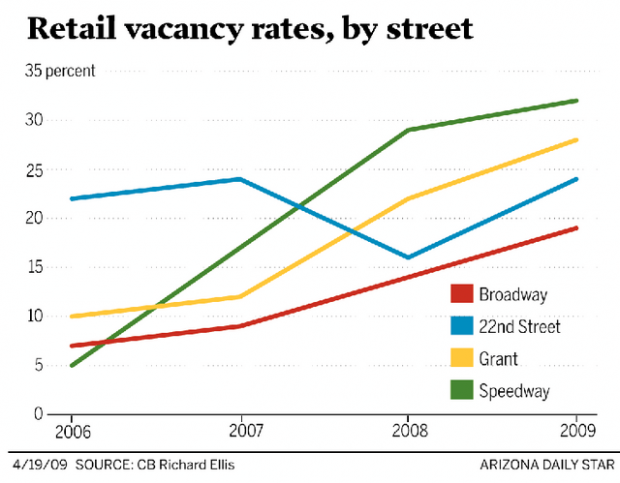
As this recession deepens, office and retail vacancies along our major east-west roads have soared.
Retail and office vacancies on Grant and Speedway have hit 28 and 32 percent for the stretches of those roads between Campbell and Wilmot, numbers from CB Richard Ellis commercial brokerage show.
It's not much better on Broadway and 22nd Street, where office and retail vacancies have hit 19 and 24 percent.
That's a lot of shuttered businesses, and in turn, a lot of potential ghost signs.