

LOS ANGELES — If floating weightless and peering down on a shimmering-blue Earth sounds appealing, you might consider being a space tourist.
As long as you have a fat wallet.
Two years after the first privately financed space flight jump-started a sleepy industry, more than a dozen companies are developing rocket planes to ferry ordinary rich people out of the atmosphere.
Several private companies will begin building their prototype vehicles this summer with plans to test fly them as early as next year. If all goes well, the first tourist could hitch a galactic joy ride by late next year or 2008 — pending approval by federal regulators.
Unlike the Cold War space race between the United States and Soviet Union that sent satellites into orbit and astronauts to the moon, this competition is backed by entrepreneurs whose competition could one day make a blast into space cheap enough for the average Joe.
People are also reading…
"This time, it's personal. This space race is about getting 'us' into space," said space historian Andrew Chaikin.
For now, commercial space travel remains exclusive.
Over the past few years, three tourists have paid a reported $20 million each to ride aboard a Russian rocket to the orbiting international space station.
The three who made it spent about a week weightless and described the experience as "paradise" and "wondrous." The most thrilling part for millionaire U.S. scientist Gregory Olsen, who blasted off last year, was viewing the swirling Earth from the dark of space.
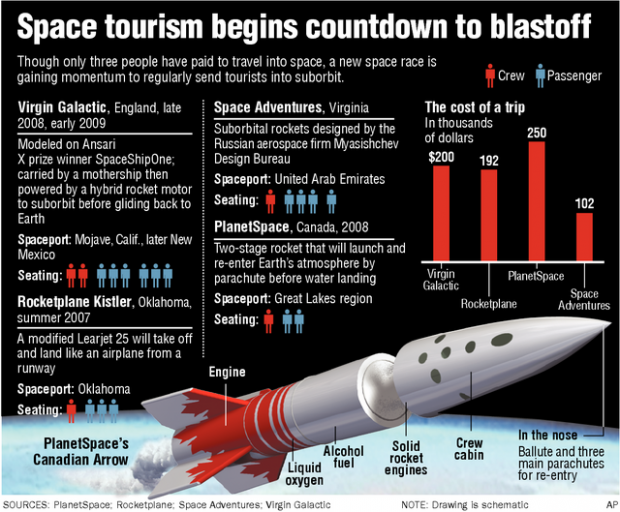
Prospective prices for the next round of personal space flights aren't so astronomical — a seat aboard one of the yet-to-be-built commercial spaceships will fetch between $100,000 to $250,000. Space entrepreneurs expect the price tag to drop once the market matures.
Tourists will get what they pay for.
Instead of days in space, the commercial spaceships under development will only reach suborbital space, a region about 60 miles up that is generally considered the beginning of the rest of the universe. Since the private spaceships lack the speed to go into Earth orbit, the flights are essentially up and down experiences — lasting about two hours with up to five minutes of weightlessness.
It's more of a ride than those offered by several companies that use Boeing 727s to produce a half-minute of weightlessness through a series of maneuvers about 25,000 feet up. Those flights, which generally sell for about $3,000, never reach space.
"It's like an upside-down bungee jump," said John Logsdon, director of the Space Policy Institute at George Washington University. "There'll be a few moments to view the Earth and then you come right back down."
Here is a rundown of several companies that will start building their private spaceships this summer:
● The biggest name is Virgin Galactic, a space tourism firm founded by British billionaire tycoon Richard Branson. Branson has partnered with Burt Rutan, whose SpaceShipOne in 2004 became the first private manned craft to reach space, to build a fleet of suborbital commercial spaceships called SpaceShipTwo.
SpaceShipTwo is about the size of a corporate Gulfstream jet that can hold six tourists and two crew members. Like SpaceShipOne, it will be powered by a hybrid rocket motor and use a "feathering" technique to glide back to Earth. Test flights are scheduled for late next year.
Virgin Galactic plans to fly the first passengers for $200,000 apiece by late 2008 or early 2009, with the first leaving from California's Mojave Desert and later flights from a proposed spaceport in New Mexico.
● Oklahoma-based Rocketplane Kistler is one of Virgin Galactic's biggest competitors. Rocketplane Kistler, whose main investor is American businessman George French, hopes to start test flights next January and fly commercially by next summer.
The company is building a souped-up, 42-foot-long suborbital Lear jet that can seat three passengers and a pilot. Unlike SpaceShipTwo, which would piggyback atop a mothership to a certain height, the Rocketplane XP would take off and land like an airplane using turbojets and rockets.
● Space Adventures, a Virginia-based space travel agency, is known for brokering three tourists to the international space station.
Last month, Space Adventures announced a partnership with members of the Ansari family — the major funders of the $10 million X Prize won by SpaceShipOne — to develop Russian-designed suborbital rockets that would launch from a proposed spaceport in the United Arab Emirates by 2008.
● PlanetSpace, backed by American businessman Chirinjeev Kathuria, is building a 54-foot-long, three-seat suborbital rocket that would launch from the Great Lakes region and re-enter Earth by splashing into the water. It hopes to fly 2,000 passengers in the first five years, beginning in 2008.
Some market studies have shown the public has an attitude of "If you build it, we will come." Futron, a Bethesda, Md.-based aerospace consulting firm, estimated that revenues in the infant space tourism industry could exceed $1 billion a year by 2021 with the greatest demand in suborbital flights in which passengers spend mere minutes in space.
Before tourists can lift off, several federal hurdles must be cleared. Federal regulations that will govern human space travel and spell out safety and training requirements are expected to be wrapped up this summer.
Transportation Secretary Norman Mineta last month told a gathering of space entrepreneurs that the government would move swiftly to grant space travel licenses to companies that can prove they can operate safely.
That's good news for people like Chaikin, the space historian.
"I've been hoping and dreaming all my life to go into space. Now I actually have a shot at doing it."