

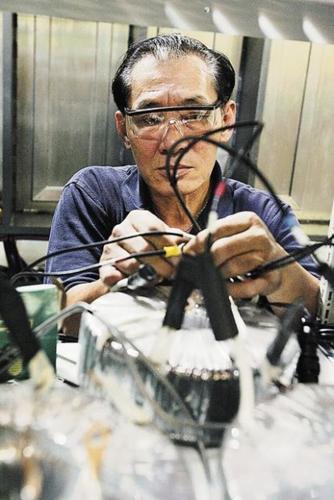

From candy wrappers to windowpanes, Tucson-based Gen-eral Plasma Inc. has been making the machines to cover it all — in thin film.
Now equipped with new technology, General Plasma is taking thin-film coatings to new heights — and sizes — with the ability to cover objects as large as solar panels.
General Plasma, 546 E. 25th St., was founded by company President John Madocks in 1997, and quickly grew to 15 employees in an 11,000-square-foot building.
In the last two years the company has grown to more than 70 employees operating from three buildings, totaling 45,000 square feet.
The company's growth spurt mirrors the recent boom in the solar power industry, Madocks said.
"We've been lucky. We were in the right place, at the right time, and in the right position to participate in this growth," he said.
People are also reading…
General Plasma's participation comes in the form of machines capable of covering big sheets of glass or plastic with a film derived from gas particles.
The gas used to create the film is called plasma, and it allows products to be coated at much lower temperatures than other methods of chemical-vapor deposition, which require heating, Madocks said.
Thin-film coatings are used to cover an array of products, for many different reasons.
In the food industry, aluminum thin films are put on the inside of bags and wrappers to lock in water and retain the product's freshness. Anti-reflective films are put on sunglasses, car windows and even picture frames to decrease glare. Films are also put on electronics with liquid crystal displays, like some televisions and computer monitors, Madocks said.
General Plasma was built on the production of thin-film application machines for the glass- and plastic-packaging industries, Madocks said.
Now, the company is growing on solar-power business.
Demand for thin film
Thin films are critical to the solar industry as an alternative to the expensive crystalline silicon usually used to produce solar panels, said Joseph Simmons, UA Materials Science and Engineering Department head, and co-director of the UA's Arizona Research Institute for Solar Energy.
The market for thin-film solar panels is projected to reach $2.3 billion by 2011, according to a report by Virginia-based marketing research firm NanoMarkets, LC.
"Thin film is making big leaps in capacity," said principal analyst Lawrence Gasman. "When making the forecasts I was surprised to see the demand for thin film and the capacity begin to match up."
The capacity, or efficiency, of the thin film is completely dependent on the film's composition, Simmons said.
Because research is still being conducted on what makes the most effective thin film, "if you know how to make high- quality thin film, you have a real advantage in the market," he said.
Other companies currently using plasma to create thin films do not have the technology to cover large materials quickly, Madocks said.
"When you're talking about 2 meter-wide rolls of plastic, a big sheet of glass, or a solar cell, the same little source used to cover a computer chip doesn't adapt well," Madocks said.
Used in solar-cell production
One local customer, Global Solar Energy Inc., uses General Plasma machines to produce copper indium gallium selenide, or CIGS, solar cells.
The CIGS cells are easier to handle than crystalline-silicon cells, which require a thicker coating, said Global Solar President Michael Gering.
"Our cells are flexible. It can bend, you can drive on it, you can roll it up. If you shoot a bullet through it, except for where the bullet went through, it will continue to operate," Gering said.
The CIGS cells have a 19 percent efficiency rate — the rate at which they convert sunlight to electricity — which surpasses the rates of other solar-cell thin films available, Gering said.
General Plasma's new technology cuts down on material cost and waste by covering more of the product at one time, said Patrick Marcus, the company's electrical-engineering manager.
Allowing companies to produce more efficient solar panels at a lower cost will make the solar industry an even bigger part of future business, Madocks said.
THE FACTS
Name: General Plasma
Founded: 1997
Employees: About 70
Location: 546 E. 25th St.