The Arizona men’s basketball team is back in the Elite Eight for the first time in 11 years.
Five Takeaways are back, too, after a one-game hiatus.

Michael Lev is a senior writer/columnist for the Arizona Daily Star, Tucson.com and The Wildcaster.
Here are my top five observations from No. 1 seed Arizona’s 109-88 victory over No. 4 seed Arkansas in the Sweet 16 round of the NCAA Tournament on Thursday night in San Jose, California:
1. Indefensible
This was not “40 Minutes of Hell.”
That was the nickname given to Nolan Richardson’s Arkansas squads back in the day. Those Razorbacks pressed and ran for the full 40, regularly turning over and wearing out opponents.
People are also reading…

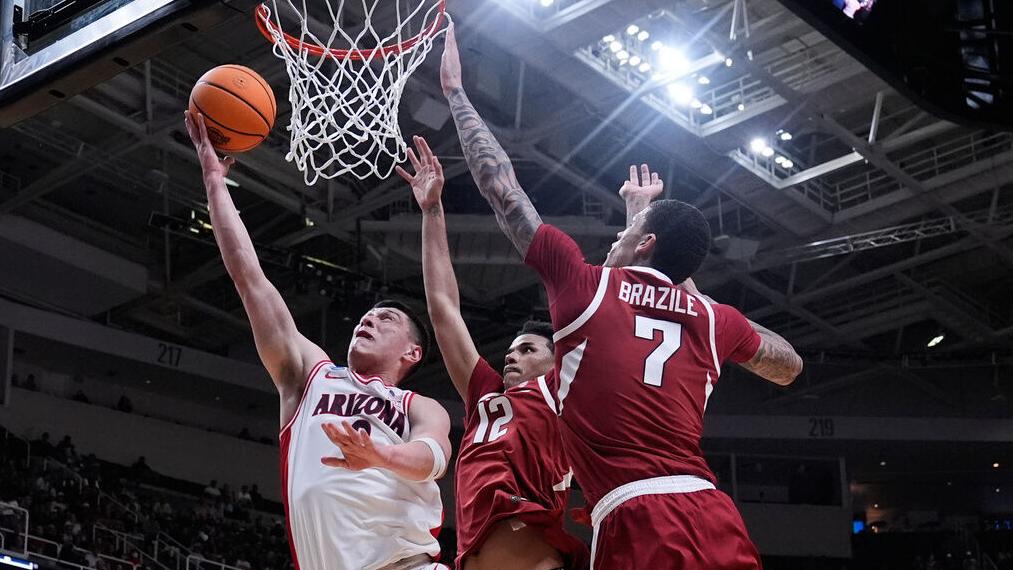
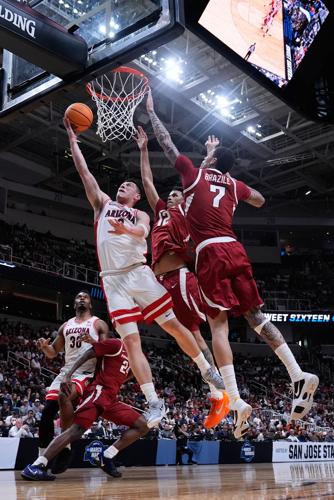
Arizona forward Koa Peat drives past Arkansas forwards Malique Ewin (12) and Trevon Brazile (7) during the second half in the Sweet 16 of the NCAA Tournament, Thursday, March 26, 2026, in San Jose, Calif.
These Razorbacks love to run. They don’t defend nearly well enough to defeat a team like Arizona.
Arkansas barely put up any resistance as the UA rolled to a season-high 109 points. The Wildcats shot 63.8% from the field, their second-best mark this season. They have shot better than 60% three times in 2025-26 — with two coming against SEC opponents (Auburn, Arkansas).
The Wildcats destroyed the Razorbacks with one of Tommy Lloyd’s favorite plays — clearing one side for a pick-and-roll. If Koa Peat or Tobe Awaka didn’t get a dunk or layup out of that play, they got to the line. One time, Awaka achieved both.
Arizona’s power forwards were two of six Wildcats to score in double figures. Awaka, Jaden Bradley and Motiejus Krivas were the low men with 14 points apiece. Brayden Burries led the way with 23. Peat had 21. Ivan Kharchenkov had 15.

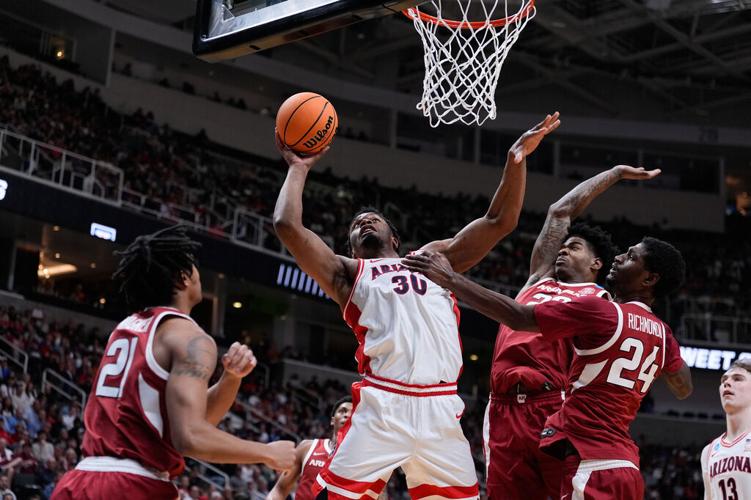
Arizona forward Tobe Awaka drives to the basket during the first half in the Sweet 16 of the NCAA Tournament against Arkansas, Thursday, March 26, 2026, in San Jose, Calif.
Tommy Ball at its finest.
We heard plenty about Arkansas’ talent, length and athleticism heading into the game, and it was all on display. But in many ways, this was a typical John Calipari team of recent vintage: plenty of flash, not nearly enough substance.
The Razorbacks made a ton of highlight plays. Meanwhile, the mature, methodical Wildcats steadily pulled away.
2. The arc vs. the line
Fun fact: Both teams made five 3-pointers Thursday night.
Arkansas attempted 23, Arizona just eight.
One thing I’ve noticed throughout the tournament is that even the good teams settle for rushed or contested 3-point shots way more often than they should. This UA team rarely falls into that trap.
Arizona is patient, precise and determined to get to the basket and/or the foul line. The Sweet 16 game produced a typical result for the Wildcats in that regard: They made more free throws (30) than the Razorbacks attempted (26).
A little more about those numbers:
Arizona’s eight 3-point attempts were its second fewest this season, trailing only the season opener vs. Florida (five).
The Wildcats’ 39 free-throw attempts — boosted a bit by Arkansas’ flagrant- and technical-foul shenanigans — tied for their second most this season. (One of the other instances happened to be Sunday’s game vs. Utah State.)
That all feels deliberate, doesn’t it?
Arizona likes playing fast; the Wildcats rank 54th nationally in KenPom’s adjusted-tempo metric (possessions per 40 minutes, adjusted for opponent). But Arizona seldom settles for 3’s and isn’t willing to get into a 3-point shootout.

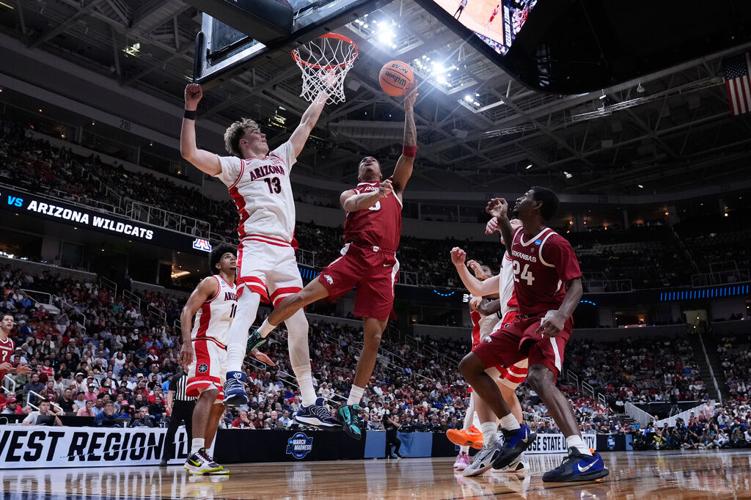
Arkansas guard Darius Acuff Jr. shoots over Arizona center Motiejus Krivas during the second half in the Sweet 16 of the NCAA Tournament, Thursday, March 26, 2026, in San Jose, Calif.
It kinda happened against run-and-gun Alabama back in December, when the Wildcats hoisted 26 3-point attempts, tied for their second most this season. But they reverted to form in the second half of that game, shooting just nine — and making five. They mostly just bullied the Crimson Tide into submission.
The Razorbacks know the feeling.
3. Defending Acuff
No player got more pub entering Thursday than Arkansas freshman guard Darius Acuff Jr., who did his part with 28 points.
But similar to how Arizona has defended other projected lottery picks, the Wildcats made him earn them.
Acuff, who appeared to injure his right arm in the second half, shot 8 of 19 from the floor — 42.1%. He was shooting 48.6% heading into the game and had virtually the same success rate (48.7%) in Arkansas’ first two NCAA Tournament games.
Arizona didn’t present Acuff with any exotic looks. The Wildcats simply have multiple players who could guard him.
Bradley and Burries took on most of that responsibility. Kharchenkov chipped in, too. They’re all long and strong.
And if you happen to get by them? Krivas, Awaka and Peat are usually lurking in the paint. Krivas had a pair of blocked shots, his third game in a row — and sixth time in the past seven contests — with two or more.
Arizona faced BYU’s AJ Dybantsa, another projected top-five pick, twice this season. He scored 59 points in those games — but needed 52 shots to get there, including a 6-of-24 performance in Provo. Dybantsa shot 36.5% vs. Arizona, 52.4% against everybody else.

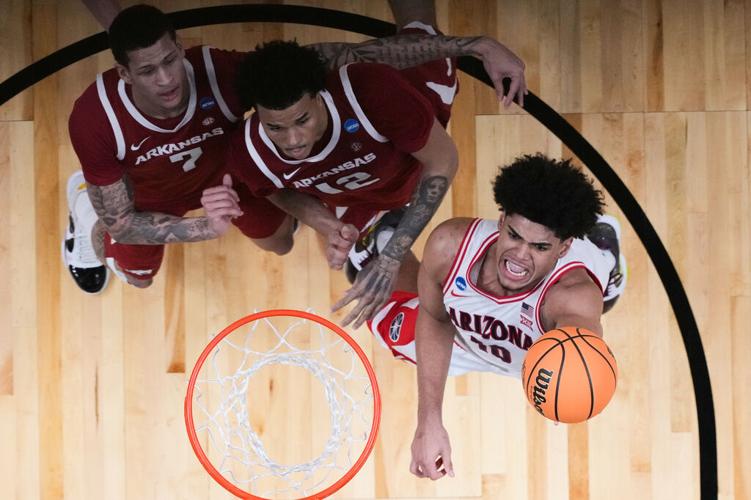
Arizona forward Ivan Kharchenkov drives past Arkansas forwards Malique Ewin (12) and Trevon Brazile (7) during the first half in the Sweet 16 of the NCAA Tournament, Thursday, March 26, 2026, in San Jose, Calif.
Houston’s projected lottery pick, Kingston Flemings, shot 9 for 29 — 31% — in two games against Arizona. He shot 48.7% against everybody else.
What about Kansas’ Darryn Peterson? He shot 38.1% (8 of 21) vs. Arizona, 44.2% against everybody else.
So it wasn’t just you, Darius.
4. Ivan’s greatness
It’s hard to single out any one Wildcat when six hit double figures — a feat topped only in the Dec. 22 game against Bethune-Cookman, when seven Cats did it.
But I’m going to spotlight Kharchenkov today because he deserves his flowers — and I’ve been reticent to give them to him.
Among the UA players who cracked double digits, Kharchenkov needed the fewest field-goal attempts (six) to get there. He also had the most free-throw attempts (10). And his plus/minus rating of plus-22 was the best on the team.
Although he performs his role-player part to a tee, Kharchenkov is nothing if not aggressive. He fearlessly slashes to the basket and has little if any regard for the bodily harm he knows he’ll absorb along the way.
Kharchenkov has a crafty midrange game, too. He can hit floaters and fadeaways and has a good feel for which shot is best in a given situation. He also has the body control and footwork to execute those shots — no doubt honed under the tutelage of his father in Europe.
Of course, Kharchenkov’s best attribute is his defense. He can guard wings and perimeter players. And he’s just big enough to play small-ball power forward if Arizona’s bigs get into foul trouble.

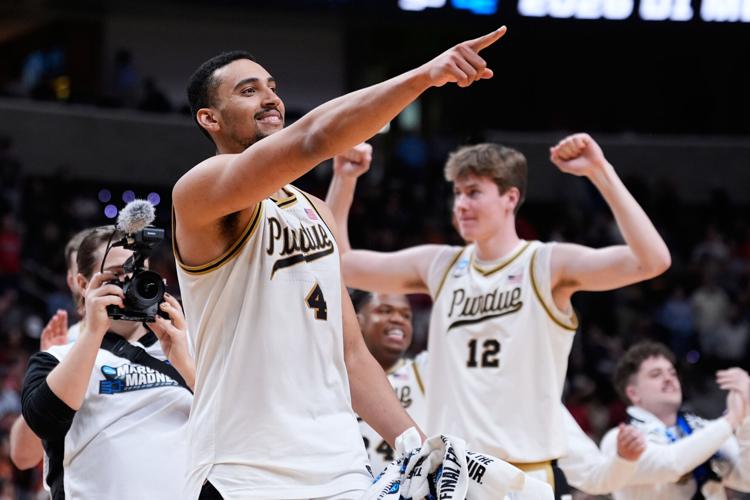
Purdue forward Trey Kaufman-Renn (4) celebrates after a win over Texas in the Sweet 16 of the NCAA Tournament, Thursday, March 26, 2026, in San Jose, Calif.
Kharchenkov has been the most unexpected key contributor among the Wildcats’ eight rotation players. I remember how surprising it was when he appeared in the starting lineup for the opener. But it makes perfect sense now; he’s the ideal complement to Arizona’s back- and frontcourt studs.
5. Cats vs. Boilermakers
Arizona has one more hurdle to climb to reach the Final Four for the first time since 2001.
Just like 2014 and ’15, a Big Ten team stands in the Wildcats’ way.
It’s not Wisconsin this time but Purdue, the Big Ten Tournament champ and the No. 2 seed in the West Regional.
Purdue can’t match Arkansas’ length and athleticism (nor Arizona’s bulk and depth). But I’m certain the Boilermakers will play with more grit and composure than the Razorbacks.
Purdue’s starting lineup features four seniors, including the rarest of rarities these days — three seniors who’ve spent their entire careers in West Lafayette.
If it seems like Braden Smith, Fletcher Loyer and Trey Kaufman-Renn have been around forever it’s because, well, they have. All three were in the starting lineup when Purdue beat Arizona 92-84 on Dec. 16, 2023, in Indianapolis. Two current Wildcats played in that game — Bradley and Krivas — and they both came off the bench.
Which squad will be playing in Indy next week? I like the Wildcats’ chances. They’re bigger, better and playing with a ton of confidence. If they felt any pressure in the Sweet 16 round, they sure didn’t show it.
Of course, the game was never close. I expect Purdue to put up a tougher fight — but nothing Arizona can’t handle.
These Wildcats have aced every test this season. They’re ready for their Final Four exam.
Contact sports reporter/columnist Michael Lev at mlev@tucson.com. On X (Twitter): @michaeljlev. On Bluesky: @michaeljlev.bsky.social

Michael Lev
Sports Reporter/Columnist



 Seen and heard in San Jose: Brotherly love, Bradley's free hand, Purdue's Cochise connection