

It’s been made clear by sports economists nationwide: big new stadium deals paid for with public funds typically don’t deliver much economic return for the cost.
That's why sports economists said it's important that a stadium deal include a community benefits package that would provide an economic boost for targeted areas and projects – even if they aren't right on the sports complex.
While the details of the stadium deal haven't been disclosed, Erie County Executive Mark Poloncarz said this week that discussions over details of a community benefits package would likely be ongoing while a new stadium is under construction.
Sports economists said that's a way for a stadium deal that otherwise could be viewed as a substantial subsidy for billionaire team owners to include more economic benefits for the region and make it more politically palatable for taxpayers.
People are also reading…
"Public funding should tie into an overall strategy for local economic development, not just maintain the status quo in terms of what a stadium brings to an area," said Robert Silverman, a University at Buffalo professor of urban and regional planning.
Taxpayer subsidies – which in the Bills case could reach $1 billion – have become a necessary part of some of these stadium deals as teams, especially in smaller professional sports markets like Buffalo, hold much of the leverage in negotiations.
The Bills are the second smallest market in the NFL and Buffalo is the 49th largest metropolitan area in the U.S., so if government officials tried playing hardball with the team’s ownership on the reported $1.4 billion stadium deal, there are at least a dozen larger cities without a football team that could step in as a potentially desirable location to move.
The News has reported that the public could contribute up to $1 billion, more than 70%, of the construction costs, which is consistent with stadium deals in smaller markets across the NFL, though Poloncarz and Gov. Kathy Hochul have disputed the accuracy of that number.
Pegula Sports & Entertainment, the management company that oversees the holdings of Bills and Sabres owners Terry and Kim Pegula, is in the late stages of negotiations with Hochul and Poloncarz on the open-air stadium anticipated to seat between 60,000 and 62,000 people with the potential for a 5,000-person standing-room-only section.
Victor Matheson, sports economist at Holy Cross, said he understands the predicament New York State faces.
“What complicates the situation is the almost certain reality that if you don’t build the stadium the owners would pack up and move,” Matheson said.
“As much as they profess their allegiance to Buffalo, there are bigger metropolitan areas, like Austin, San Antonio, Portland, London and Toronto, without franchises that are potentially much more profitable places,” he added.
Given that significant government subsidies appear to be an unavoidable reality of these negotiations, economists believe the best way to maximize the economic impact of a deal is to focus on other investments and projects and development opportunities tied to the agreement.
They agree with what some Erie County officials and state legislators have been pushing for to be included in the deal – a community benefits agreement.
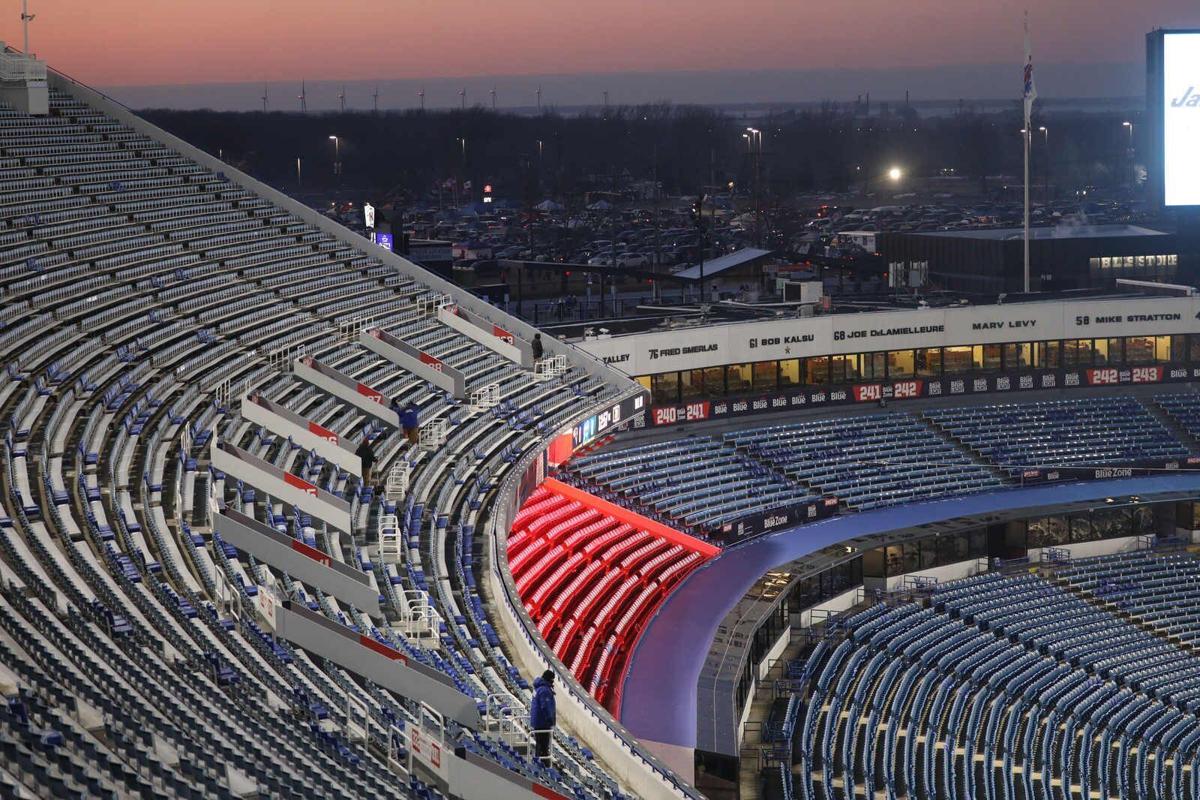
Still, the question remains – how much development is possible in the area known now more for raucous tailgating in vast parking lots around Highmark Stadium? There has been little spinoff development in the area around the stadium since it opened a half century ago.
When significant government funding is part of any stadium negotiations, opposition to the proposal is a given, said to Dan Etna, partner and co-chair of the sports law group at New York City law firm Herrick.
The ultimate success of the project will hinge on how much additional tax revenue and jobs are created and the kind of community benefits that are generated as part of the deal, though that’s not always easily quantifiable, he said.
“That’s what often times can make it a hard sell,” Etna said. “You can’t just say, ‘this is going to happen and that’s going to happen.’ It’s just not that linear.”
Pegula Sports and Entertainment commissioned a 160-page economic impact study that indicates the construction of a new stadium would expand the team's economic impact and create more jobs.
A new venue would generate an estimated average of $793 million annually for Erie County and Buffalo economy over the next 30 years, according to the report conducted by the sports consultancy CAA ICON and reviewed by the University at Buffalo’s Regional Institute. That includes factors such as employment, income and spending.
“The amount of jobs, the amount of apprenticeships that are created in this project will change the Western New York landscape for decades to come,” Ron Raccuia, Pegula Sports’ executive vice president and lead negotiator, told The Buffalo News after the study was released.
An open-air football stadium, however, may make it more difficult to catalyze ancillary development or bring in other activities that increase economic spillover effects, according to Silverman of UB.
“Public funding should tie into an overall strategy for local economic development, not just maintain the status quo in terms of what a stadium brings to an area,” Silverman said.
“The benefit is that it will keep the Bills in Western New York for a couple decades and give them a more up-to-date stadium to play in during that time, but in terms of economic development, we’d be treading water," he added.
Matheson said there is no reason to think a new stadium across the street in Orchard Park would change a neighborhood that has essentially stood pat for the past five decades. There are only several bar-restaurants near the stadium and a lack of hotels in the area.
“The current stadium is not surrounded by thousands of retail establishments and bars and restaurants and housing. It’s a big stadium in the middle of parking lots,” Matheson said.
Orchard Park Supervisor Eugene Majchrzak hopes the Bills organization is planning to bring more development around the stadium with a hotel, restaurants and pedestrian bridges across Abbott Road leading to what will become the former site of the stadium.
The infrastructure is already there, making it easier to build something without having to incorporate high-rise or under-the-street parking, he said.
“It would be nice,” Majchrzak said. “As long as you’re going to take down the old stadium, then why not build a little village on that side of the street? Then, you’ve got a great looking complex.”
Majchrzak is unsure of how much say the town will have in that development. He said town officials have called the Bills on a few occasions and haven't heard back.
“I’m a little bit disappointed in that,” Majchrzak said. “I think we’ve been good neighbors over all these decades.”
Raccuia recently said the Bills at some point will be meeting with “all of their partners” about what’s next. The organization is also continuing to conduct forums to seek the opinions and ideas of some season ticket holders.
“This is a public-private partnership,” he said. “It isn’t just New York State, Erie County and the Bills. The NFL is involved in this, and the towns also will have a say. I mean, the entire community does.”
A community benefits agreement would make sure at least some of residents' interests were represented in any deal.
Sen. Sean Ryan and Erie County Legislator April Baskin are among local leaders pushing to make sure communities like Orchard Park benefit from the Bills presence in town as part of a potential community benefits agreement. Ryan has advocated for Orchard Park to be reimbursed for police services.
Assemblyman Pat Burke would like to see the new stadium turned into an opportunity to expand public transportation. He is calling for a project that would create a commuter train connecting the stadium to downtown Buffalo and other surrounding areas.
A community benefits agreement could also include the Bills providing certain amenities that can be used by the public or improving the environmental surroundings around the stadium, like taking vacant land and making it into green space for the community.
When a new Yankees Stadium was built in the Bronx more than a decade ago, the MLB franchise agreed to fund the building of several Little League fields on the property of the former stadium across the street.
On Wednesday, Poloncarz said a community benefits agreement is in the works and its details would be released on an ongoing basis while the new stadium is under construction.
“There are many ways that teams can give back to the community,” Etna said.


