

Tearing down the Skyway is more than a big, expensive road project.
Think of it as an economic development opportunity, one that could dovetail with many of the positive things that already have happened at Canalside and along the Outer Harbor.
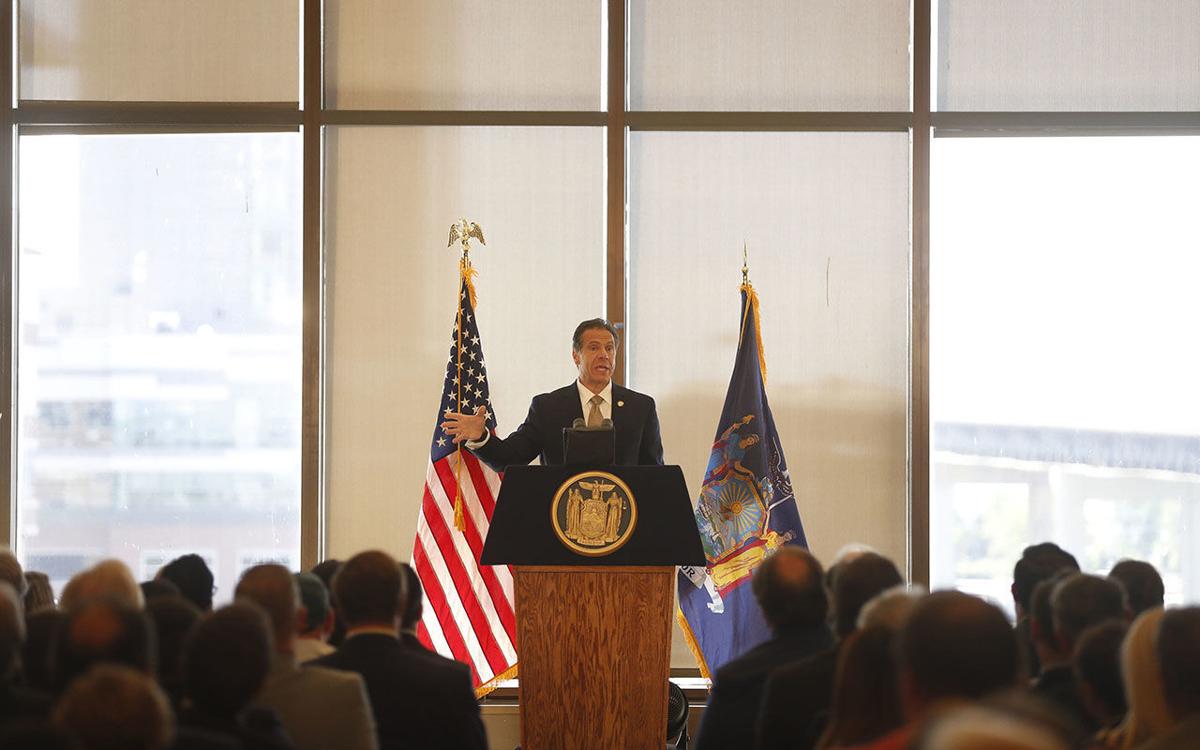
Gov. Andrew M. Cuomo came to Buffalo on Tuesday to announce the winner of his contest to reimagine the Skyway, with a plan by a Rochester group to take down part of the Skyway while turning a section of the elevated highway into a "Skyway Park" that links downtown to the Outer Harbor and offers panoramic views to cyclists and pedestrians.
Who knows how much of that plan will survive the lengthy planning and environmental review process, but one of the most intriguing elements of it is how it frees up a dozen acres of land downtown – and about 100 acres along the four-mile corridor – for development.
People are also reading…
That's a blank canvas – without old buildings or costly cleanup requirements – that could lead to another, not yet imagined, chapter in the waterfront's economic development.
"You're opening it up for private development," Cuomo said during a meeting with editors and reporters from The Buffalo News. "It opens up a new chapter of economic development potential."
"This is creating an entire new downtown space where you don't have to rehab an old building. You don't have to deal with what was. It's a blank sheet of paper. Just remove the Skyway and all the connected ramps," Cuomo said. "Remove that and you have a whole new downtown."
That may be overstating it a bit, but getting rid of the Skyway would change the entire view of downtown, especially along the waterfront, which has proven to be one of the city's greatest attractions since it was cleaned up and opened up to pedestrians, kayakers and bicyclists over the past decade.
Howard Zemsky, the Buffalo developer who is chairman of Empire State Development, sees the demise of the Skyway as a key cog in his overall vision for economic development policies that aren't built around silver bullet projects, but instead rely on creating the type of places where people and businesses want to be.
"The water is our greatest asset in Western New York," Zemsky said. "We have this beautiful view. We have this beautiful waterfront and right smack dab in the middle of it in downtown Buffalo we have the elevated highway."
Buffalo, sadly, was slow to realize just how valuable the waterfront is. While other cities made the same elevated highway mistake Buffalo did, many of those places rectified the error sooner. San Francisco's Embarcadero elevated highway obscured that city's waterfront for more than 30 years, until it was damaged in the 1989 earthquake and was too costly to repair, leading to its removal and replacement by a ground-level road that doesn't obscure the view of the bay.
"It isn't what any city does in the year 2019 anymore, and it's time we got on the right road," Zemsky said.
It's pretty clear by now that people are drawn to the water – even in a place with short summers like Buffalo.
Our waterfront draws people downtown. People coming downtown causes restaurants and craft breweries and distilleries to open – and flourish – downtown. Millennials like to live downtown, so that helps build up neighborhoods in places that were left for dead during the dark days three decades ago. Attracting – and keeping – millennials is the key to reversing the region's decadeslong decline in population, which is essential if the region is going to start growing at a pace that is anywhere near the national average.
Of course, all of this is years away. Removing the Skyway will cost upwards of $600 million. Funding has to be arranged, though Cuomo said the state will pony up 20%. Environmental and traffic studies have to be done, and those will take at least a couple of years. Southtowns commuters will have to be satisfied that their drive home won't get too much longer. Then the new roads that will handle the Skyway's current traffic will need to be built. Only then will the Skyway come down.
And even then, a state report warns that freeing up the coveted land for development will take time.
"Removal of the Skyway would not make the land occupied by the Skyway immediately available for development. Issues such as land rights would need to be addressed," the 2014 report said. "Public land rights would need to be sold or transferred out of transportation purposes before the land made available by removal of the Skyway could be utilized."
So it won't be quick. But it could be worthwhile.

