

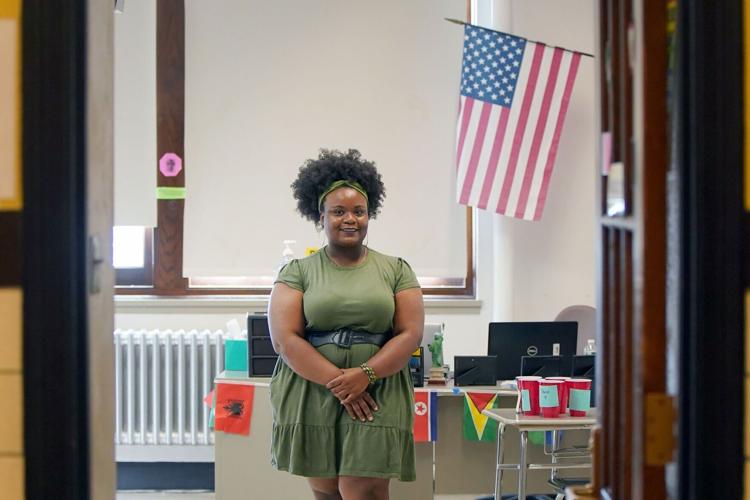
Sydney Favors went to SUNY – Buffalo State College to study political science with the idea of becoming a prosecutor.
Then, in her senior year, she had a change of heart.
“I began to think about, ‘What if I put someone in prison unjustly?’ ” she said. “So, I decided, ‘What if I became a teacher? That way I could prevent people from going to jail.' ”
Favors heard the University at Buffalo’s Graduate School of Education was launching a year-long Teacher Residency Program to increase the ranks, diversity and retention of teachers in Buffalo amid a looming teacher shortage. She joined the pilot program weeks after graduating from Buffalo State.
Three years later, Favors has her master’s in education from UB and is entering her second year as a social studies teacher at Frederick Law Olmsted High School in Buffalo. She plans to stay.
People are also reading…
“The Buffalo Public Schools made me,” said Favors, an alum of Hutchinson Central Technical High School. “I come from this community, and I want to support it.”
That's exactly the type of commitment officials from UB and the city schools were hoping for when UB modeled its Teacher Residency Program after the medical student experience. The idea was to give aspiring teachers a deeper classroom experience and better mentoring than the traditional 15 weeks of student teaching, usually split between 7 to 8 weeks each in two different schools.
In contrast, the program allows anyone with a qualifying bachelor’s degree to spend a year of intensive training to be a teacher, including co-teaching and being mentored by a veteran teacher in a Buffalo public school classroom for the full school year. The program assists residents with an $18,000 stipend and requires they commit to three years of teaching in city schools afterward.
Favors was among the first 13 residents in 2019-20. Since then, the program has placed 70 new teachers in city school classrooms and demonstrated that residencies are the best way to train teachers and serve students, said Julie Gorlewski, senior associate dean for academic affairs and teacher education at UB Graduate School of Education.
“Because it’s a full year, you don’t have that situation where you are student teaching for eight weeks, and just when you’re starting to hit your stride, you go to another school,” Gorlewski said. “In this model, the students also benefit from having better prepared teachers all year long.”
The model has proven so successful that UB is moving to replace its student teaching requirement with year-long residencies for all students in its teacher education programs.
UB piloted the new requirement with five students last year, and this year upped it to 24.
“That represents more than half of our student teachers for this year, and next year we will fully implement the residency requirement for more than 100 students,” Gorlewski said.
The school isn’t able to offer stipends to residents outside the Teacher Residency Program, but sees that as a goal, Gorlewski said.
“We have applied for grant funding, and we are looking into apprenticeship models, as well as substitute teaching, to provide funding for these residencies,” she said.
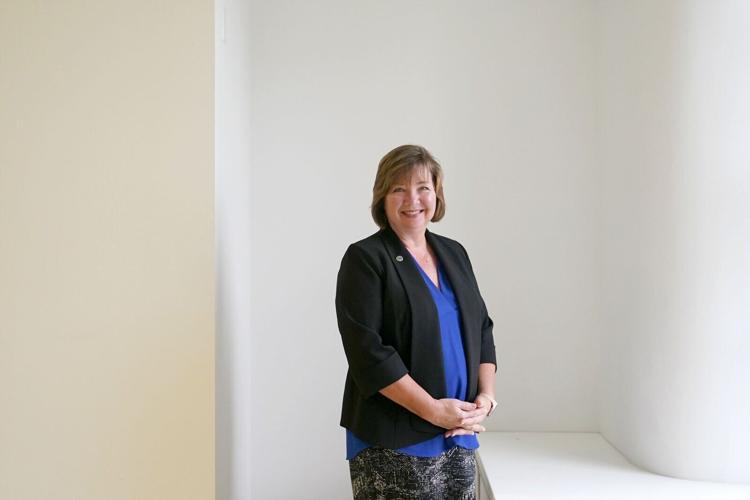
The Teacher Residency Program is funded by the Cullen Foundation, Oishei Foundation, U.S. Department of Education Teacher Quality Partnership Program and the National Science Foundation’s Noyce Scholars Program, said Amanda Winkelsas, director of the UB program.
Besides the pilot group of 13, another 15 completed the program in 2020-21, and 23 completed it last year. Nineteen start their residencies this week.
The initiative also is training more teachers from linguistically and ethnically diverse backgrounds that reflect the city student body, better preparing them to teach in an urban setting and retaining them to stay in the profession, Winkelsas said.
The 2022-23 cohort is the most diverse ever – 32% are white, 47% are Black/African American, 11% are Hispanic/Latinx, and 11% are Asian or multiracial. Nearly half are first-generation college graduates. The residents include students who are bilingual or have advanced proficiency in Spanish, French, Urdu, Arabic, Brazilian, Portuguese, Swahili, Kinyarwanda, and Kirundi, Winkelsas said.
The program has also strengthened the partnership between UB and the Buffalo Public Schools with the goal of giving historically marginalized city school students the attention they need to succeed and producing “learner-ready” teachers with the support they need to do the work.
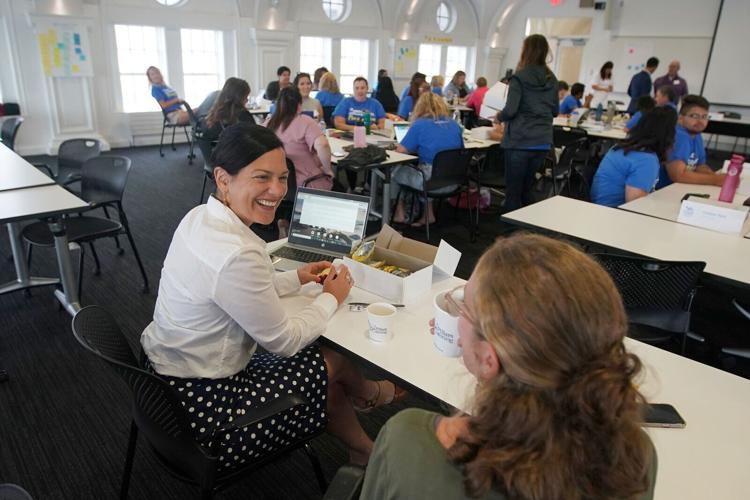
“We have built a community of 70 residents, 60 mentors and more than 40 UB faculty,” Winkelsas told a gathering of past and current residents and mentors at UB’s Teacher Residency Summer Institute last month. “We are doing hard work together and moving closer to the educational spaces that matter to students.”
Favors and her friend Caitlin Orgek bonded as the first two social studies residents in 2019-20, and still rely on each other to plan curriculum and discuss ways to make their subject relevant to their students.
“The students we serve need to know, ‘Why are we learning this?’ ” Favors said. “We’re teaching history and the Tops massacre, George Floyd, Asian hate, Covid and the Jan. 6 insurrection all happened while we were teaching in Buffalo public schools. We have to have those discussions.”
In Orgek’s residency at South Park High School, she experienced every aspect of the school year. This week, she starts teaching global history at East Community High School.
“As residents, we were able to see from the beginning of the year to the end how teachers get to know their students, how they build on their curriculum and how they change and differentiate throughout the year and get students ready for a big exam, the Regents at the end of the year,” she said.
“You also form relationships with the students that you wouldn’t with student teaching,” she added. “I have a student from two years ago who just graduated high school and I still keep in touch with her.”
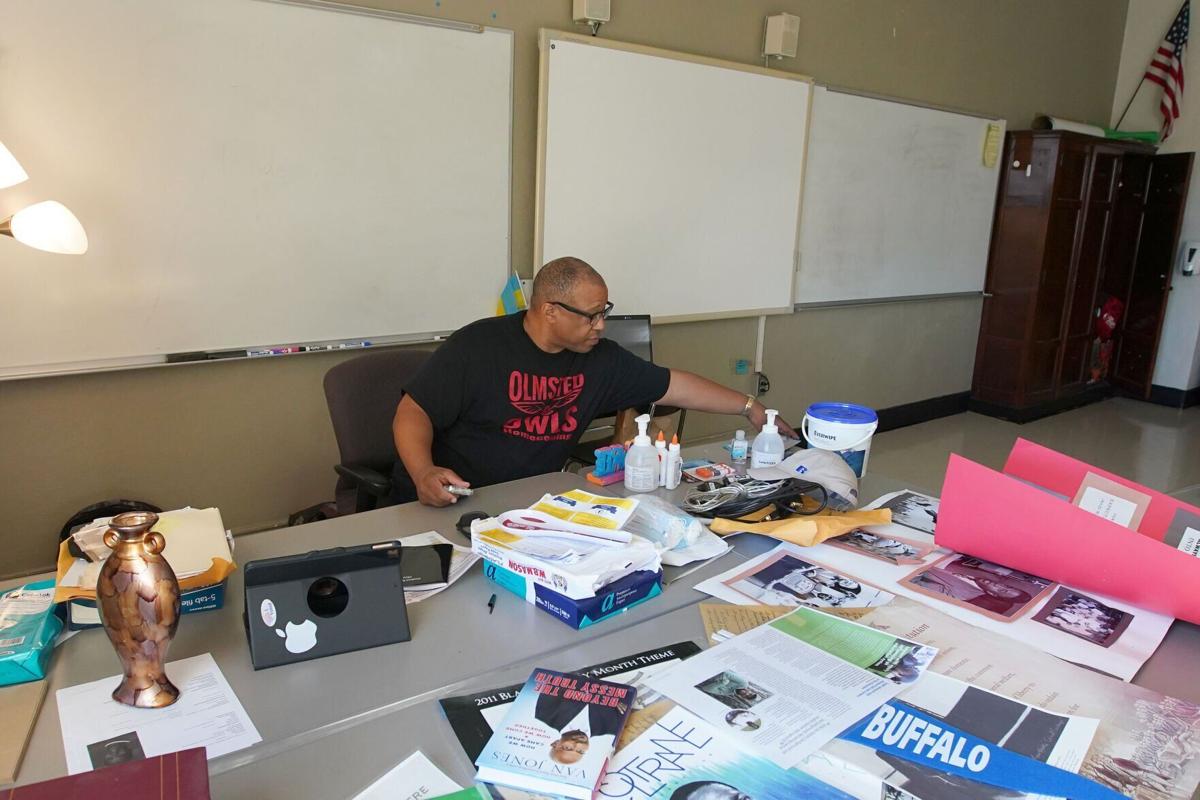
Gary Crump came through the program in 2020-21 and now teaches social studies at Olmsted High School. He changed his career from law to education for reasons similar to Favors.
“I was working in criminal defense, and we had one particular case with an FBI sting operation involving young people from the South Bronx,” Crump said. “They were found guilty and the leader was sentenced to 75 years in prison, and his two lieutenants each received 50 years. And at that point I decided to pivot to education to provide young people, especially those in urban settings, with a different option.”
Crump moved from New York City to Buffalo to attend the UB program, and plans to stay well beyond his three-year commitment. He knows he is making a difference to students here.
“After the Tops shooting, I stopped instruction for two days and created a big circle where students could express their feelings and ask anything they wanted to,” he said. “They had become aware in a New York minute about the segregation that enabled the alleged perpetrator to come here and do what he did.”
Crump said he sees the program’s biggest benefit as “UB’s commitment to having a diverse cadre of teachers dedicated to making change and bringing joy to the classroom."
“This is the future of teacher education,” said Will Keresztes, the Buffalo schools' chief of administration, public affairs and planning. “This is the deepest dive in New York State into teacher residencies.”
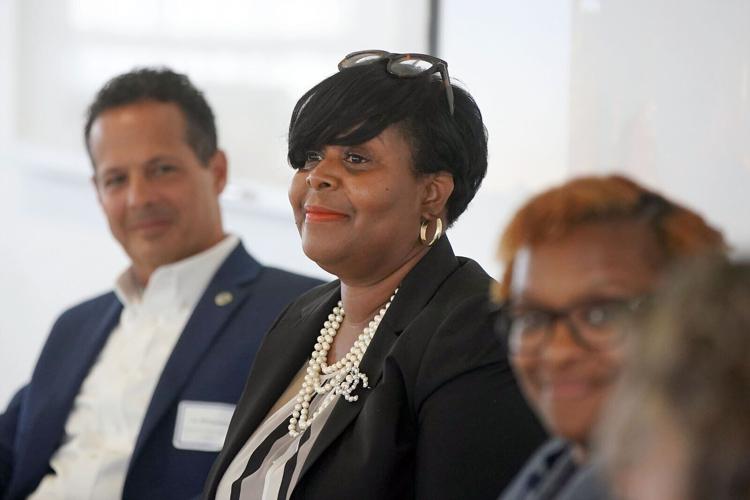
Buffalo Schools Superintendent Tonja Williams said the Maasai people of East Africa greet one another with the question, “How are the children?”
“That is the priority and the pulse in the community,” she said.
“Our children have experienced a lot in the last couple years, including a pandemic that has led them to experience isolation, grief, trauma – and sometimes the child who needs the most love asks for it in the most unloving ways,” Williams added. “So it’s a challenge to be a teacher, but this is also a time when it’s possible to really make a difference.
“This program seems built just for this moment.”


