

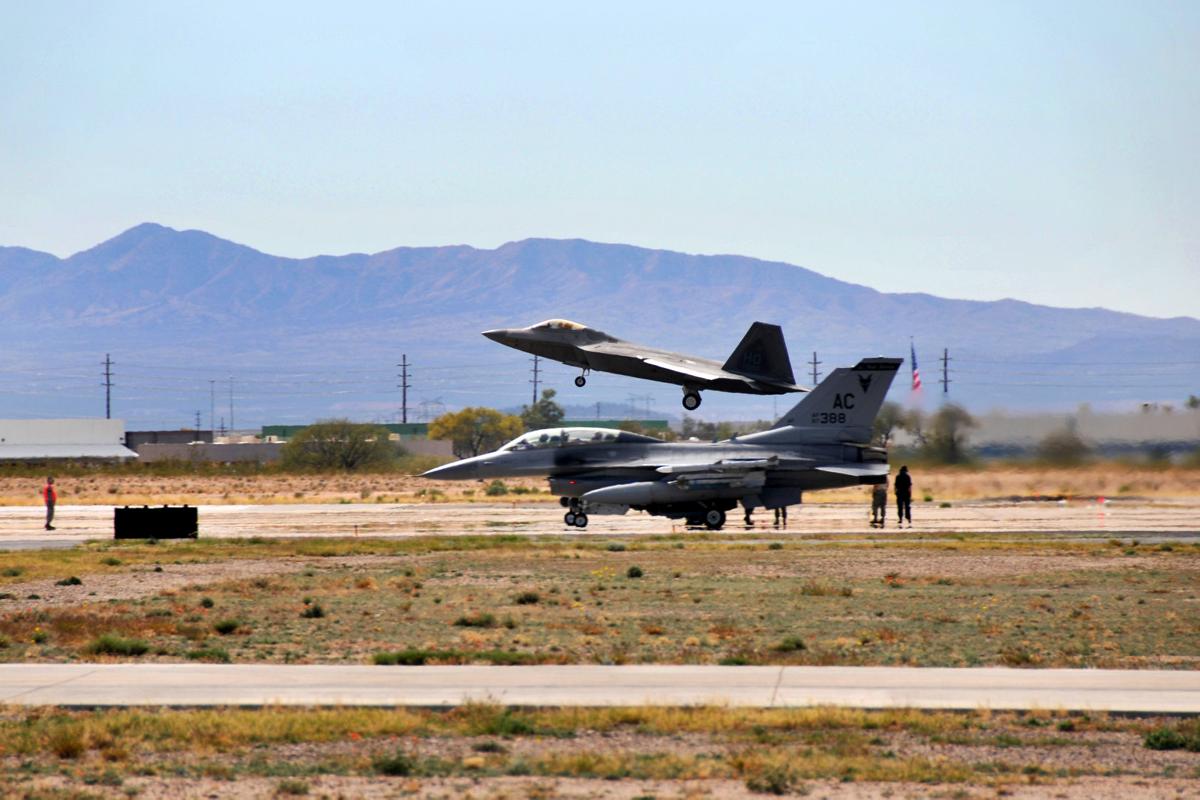
The Air Force has released the latest draft environmental assessment of a proposal to greatly increase the number of training flights visiting units make at Davis-Monthan Air Force Base.
The report is available online at www.dm.af.mil/library/tftea.asp and at several area libraries.
Like a version released for public comment in 2012, the latest draft environmental assessment includes a finding that increasing flights under the Air National Guard’s Operation Snowbird and other training programs would have “no significant impact” in the human or natural environment. That finding would eliminate the requirement for a more detailed environmental impact statement.
The study of the Total Force Training Mission includes training flights flown by units not based at D-M, including Operation Snowbird training coordinated by the Air National Guard 162nd Fighter Wing, which is based at Tucson International Airport; separate foreign-ally pilot training; and training by other U.S. service branches, including the Navy and Marine Corps.
People are also reading…
Under the “preferred alternative” in the latest draft, the number of training sorties under Operation Snowbird, special training for foreign-ally pilots and U.S. cross-service training combined could nearly double, from 1,408 sorties in the baseline year of 2009 to a maximum of 2,326 annually.
Based on an extended public comment period, the Air Force revised parts of the draft to reflect community concerns, D-M commander Col. James Meger said at a news conference.
Meger noted that if the preferred alternative is approved, the number of training sorties would represent about 6 percent of D-M’s annual total.
Among the changes were the inclusion of several different types of aircraft not including in the original draft, including louder jets such as the F-22 Raptor and the AV-8B Harrier.
As a result of some of the noise-modeling changes, the noise contour around D-M — the zone in which residents may experience significant noise from aircraft operations — was expanded by about 100 feet on either side, Meger said.
In areas northwest of D-M, an additional 128 homes would be located in the zone where sound-pressure levels are estimated at between 65 to 69 decibels, the report says.
Release of the latest revision of the environmental assessment kicks off a 30-day public comment period, Meger said. After that, Meger said, the undersecretary of the Air Force for installations will review the public comments and decide whether further study is needed or accept the finding of no significant impact.
Besides online, the report is available for viewing at several area libraries:
Eckstrom-Columbus Branch Library, 4350 E. 22nd St., Himmel Park Branch Library, 1035 N. Treat Ave.; the University of Arizona Library, 1510 E. University Blvd.; the Quincie Douglas Library, 1585 E. 36th St.; the Pascua Yaqui Tribe Public Library, 7418 South Camino Cocoim; the Salazar-Ajo Library, 33 W. Plaza Street, Ajo; and the Tohono O’odham Nation Venito Garcia Library & Archives in Sells.
Public comments must be submitted in writing by October 23, either via e-mail to 355fw.pa.comment@us.af.mil or by mail to:
ATTN: TFT EA COMMENT SUBMITTAL, 355th Fighter Wing Public Affairs, 3405 S Fifth St., Davis-Monthan AFB, Arizona 85707. Mail must be postmarked by Oct. 23.
For further questions, contact the 355th Fighter Wing Public Affairs Office at 520-228-3406.
