

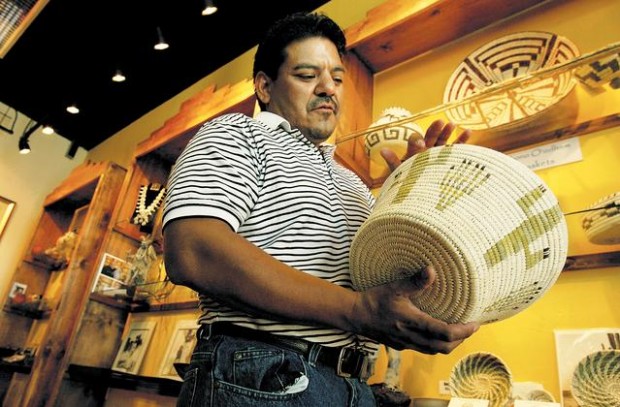
John Fendenheim opened his first shop in 1996 on the Tohono O'odham reservation.
Now the 41-year-old O'odham entrepreneur has three stores, including Spirit Mountain Trading, 845 E. University Blvd., near the University of Arizona. The trading post, Fendenheim's first shop in Tucson, sells a mix of American Indian arts and crafts, traditional O'odham baskets, American Indian paintings by local artists, and silver and Southwest-style jewelry.
Fendenheim also owns Wiwpul Du'ag Trading at San Pedro, on Arizona 86 west of Three Points, and Wiwpul Du'ag Trading East, at San Xavier Plaza near Mission San Xavier del Bac.
"I often tell people, 'I'm just an old rez boy trying to get by,' " Fendenheim said.
Getting by indeed, especially if you throw in Fendenheim's other job, chairman of the board of the Tohono O'odham Gaming Enterprise. In that role — unpaid except for a per diem amount he wouldn't specify — Fendenheim and the rest of the board oversee major operations at the O'odham Nation's three casinos.
People are also reading…
Fendenheim grew up in Akron, Ohio, but spent summers with relatives on the reservation. After graduating from Kent State University with a bachelor's degree in business administration, he got his first job as a retail buyer for Dillard's department stores.
Eventually, he decided to move to Tucson and worked for the Tohono O'odham Utility Authority as a buyer. When the O'odham started a business-loan program, Fendenheim applied and walked away with $56,000 to start Wiwpul Du'ag Trading.
Before starting a day at the new store last week, Fendenheim sat down for an interview.
Q: This is your third store to open. Why did you decide to open a shop on University Boulevard?
A: It was the excitement of growing a business. I wanted to expand to Tucson and knew this was the right place. It's close to the UA, the (University Avenue) Market and the Marriott (University Park Hotel). Marketability here was strong. It's also laid-back here. It's not like La Encantada, where it's more high-end. It felt right.
Q: Bureaucratic red tape can hold up the process of starting businesses on the reservation. Was it easier to set up a shop in Tucson as opposed to the reservation?
A: It took two years for approval on the reservation. It took two weeks to get approved here. There are established buildings for retail here. Out there, the community districts only have ability to give land for home sites, not businesses. Land approvals have to go through the district, and then it's up to the BIA (Bureau of Indian Affairs) for approval. The Nation is working on establishing more retail space and ways to eliminate red tape.
Q: Few American Indians actually open small businesses in the city. What do you think the reasons might be?
A: I think the area is full of (American Indian) entrepreneurs. They might not be mainstream, with storefronts. They're the basket weavers, artists and pottery makers. They all have the entrepreneurial spirit. It's just a matter of taking it to the next level with business plans.
Q: You could have opened any type of business. Why did you decide to open a trading post?
A: The market seemed like a good idea. It was something I was familiar with and it was marketable for me to do.
Q: How were you able to grow your business from one store to three?
A: A lot of hard work, passion and putting money back into the business. It comes down to giving back to your employees. I also had a lot of support from family and the community. It felt good to have people say, "I'm proud of you." When I first started out, my parents said, "You can do it. The rewards will come." But having that support and encouragement keeps me going.
Q: How did you get your start in business — what was your first job?
A: I was 8 years old. I sold firecrackers, but it was shut down by the police. I sold them for five cents apiece. One of the parents called and the police said I couldn't sell any more. But at the time I didn't know it was illegal. We got the firecrackers in Mexico and started to sell them out my door. I also used to pick up (aluminum) cans at festivals in San Xavier to recycle them.
Q: What is meant by Spirit Mountain's name and the names of your other stores?
A: Wiwpul Du'ag means "Tobacco Mountain" in O'odham. The mountain is behind my first store and that's where wild Tobacco grows. We use tobacco in ceremonies — it gives us strength and spirit. I felt like giving respect to the mountain. When we made a move to Tucson, I felt that Spirit Mountain was a good choice.
Q: How is the tribe promoting economic growth on the reservation?
A: With gaming revenue from the Nation. The tribe is adamant with putting that money back into economic development and training for the people. We're also strengthening tribal loan programs. It's hard for some to come up with collateral to build on the rez. Banks ask, "What can we repossess?" But they can't repossess land there. The nation is strengthening infrastructure and buildings to run more businesses. There is not a lot of retail space for businesses. But the nation is starting to get more business-friendly.
Q: How do you balance or manage your roles as chairman of the Tohono O'odham Gaming Enterprise and your role as a small-business owner?
A: Owning your own business is a lot easier to manage. You have the ability for flexibility with your time. The shops allow me to be flexible to be on the board. Operating a business, you get to know economics and hear what people want. And you take that experience to the board and apply your business principles to running the board.
Q: Oftentimes, tribes stress kinship and community spirit. How do you see yourself giving back to the O'odham community?
A: I sponsor baseball teams, help with charitable events and hold fund-raising events at the store through donations for community members. I think the people give to me and I like to give back to the people.
I often tell people, 'I'm just an old rez boy trying to get by.'
John Fendenheim, stores' owner and casino overseer