

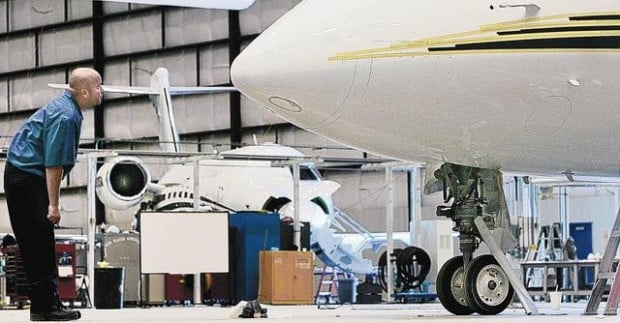
An aircraft-completion company that sold itself as the savior of laid-off Bombardier workers in 2004 folded this month.
DunnAir Business Jet Completion Center planned to fill a hangar at Tucson International Airport with corporate jets being outfitted with all the touches executives wanted. The company expected to employ up to 600 workers, many from the pool of 800 Bombardier laid off from its own finishing operation starting in 2004.
But DunnAir never lived up to those plans. At its height, the company employed about 55 people.
The company last year laid off 40 of its workers, leaving 10 employees working in a hangar big enough to hold 21 business jets or four Boeing 747s.
Dale Dunn, founder of DunnAir, could not be reached for comment. The phone number for the business has been disconnected and Jim Garcia, senior director of business development for the Tucson Airport Authority, said the authority has not been able to reach him directly, either.
People are also reading…
"It doesn't come as a surprise that it's finally over," said Tim Kanavel, who worked for DunnAir as director of human resources and director of operations until he was laid off in July.
Now the massive hangar at 1555 E. Aero Park Blvd. is vacant.
It may not remain that way for long, however.
Bombardier is reviewing its options for the modern 255,000-square-foot hangar, said Eric Brammer, general manager of Bombardier's facilities in Tucson.
Brammer said there are no signed contracts with anyone to take over the space, but he noted its special nature.
"I believe it's the only facility of its kind and space and vintage in the southwest United States," Brammer said.
New tenants being sought
On Friday, the Airport Authority started researching the aircraft maintenance and repair industry and assembling a list of prospective companies that could use the hangar, Garcia said .
Because the hangar is big enough to house many of the major freight and passenger aircraft in service today, airlines and freight companies could rent the area for maintenance work.
Among the targets: Southwest Airlines, FedEx, and UPS. Military aircraft maintenance is also a possibility, as are companies like Hamilton Aerospace Technologies, which already has a facility at the airport.
Garcia said he would prefer to see a company that's been around at least 10 years take on the site. He would also like the company to be focused on maintenance and repair instead of completion work because the demand for maintenance services is steady compared with the market for finishing aircraft or updating business aircraft interiors.
"The planes always have to be repaired, always have to have maintenance," Garcia said.
That said, the decision on who should use the facility and how much it would lease for remains in Bombardier's hands.
"We will assist them," said Bonnie Allin, president and CEO of the Tucson Airport Authority, "but the reality is it is Bombardier's decision."
Facilities date to 1990
DunnAir's closure is the latest setback for a facility that has rarely been used to its potential.
The Tucson Airport Authority leased more than 32 acres to Lockheed Martin, which built the hangar and adjacent office buildings in September 1990 for $25 million and operated it for five years. Then it sat vacant for six years until Bombardier's Learjet subsidiary bought it in 2001, and used it for aircraft completion work. Bombardier moved its business-jet completion operations to Wichita, Kan., and Montreal starting in 2004.
DunnAir leased the hangar from Bombardier for $108,000 a month, or about $1.3 million a year, according to Kanavel. Bombardier pays the airport authority $285,000 a year to lease the land the hangar and facilities sit on.
Bombardier has to pay for the lease whether or not it sublets the hangar.
The monthly rent on the hangar will be a major factor in getting a new tenant for the property.
Kanavel said the cost was a heavy burden for DunnAir to try to overcome, particularly because the company never used more than half of the hangar.
"Did I think that was excessive? Yes," Kanavel said.
He said a good market value for the space would be about $50,000 a month, although $100,000 "is not bad for that hangar."
Garcia said figuring out the right price for the current market "is the Rubik's Cube" of negotiating a new deal.
Dunn's enterprise never took off because DunnAir did not have an established customer base, Garcia said.
"Every startup has its own inherent risk," said Kanavel, who used to serve as a state economic-development official.
Kanavel said he would not second-guess Dunn's decisions, but noted that the company was paying full price for the hangar and not using much of the space.
"We were paying twice as much for half as much," he said.
He also said the investment group funding the operation seemed to lose interest.
"It looked like it was a funding issue that wrecked the whole train," he said. "If the money's not there, you simply can't continue."