

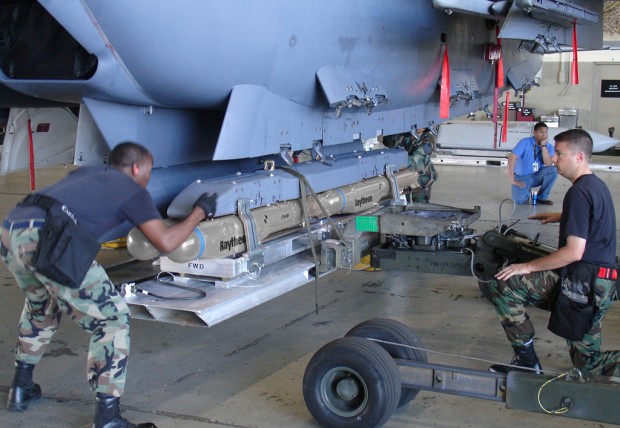
Tucson-based Raytheon Missile Systems has reached a major milestone in development of its Small Diameter Bomb II, successfully engaging and hitting a moving target vehicle during the guided bomb's first flight test at White Sands Missile Range, N.M.
Raytheon said Thursday that during a test on Tuesday, the crew of an Air Force F-15E Strike Eagle fighter jet operating from Holloman Air Force Base in New Mexico released an SDB II, which then tracked and guided itself to a moving vehicle, scoring a direct hit.
The first-time flight-test hit was a big deal for Raytheon and for the Air Force, which runs the program from Eglin Air Force Base in Florida.
"The excitement level here (at Raytheon) is only matched by the excitement level at Eglin," said John O'Brien, Raytheon's SDB II program director, adding that the program remains on schedule and budget.
People are also reading…
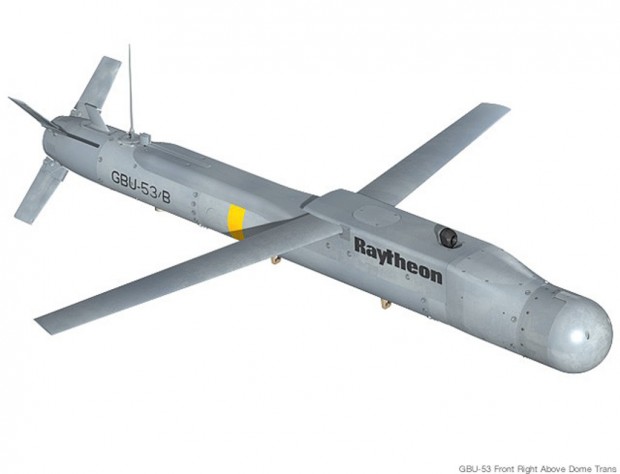
The SDB II uses GPS satellite and inertial navigation and Raytheon's "tri-mode" target seeker - built at the company's automated seeker plant in Tucson - which combines millimeter-wave radar, uncooled imaging infrared and semiactive laser sensors on a single assembly.
The SDB II's relatively small but powerful warhead is capable of destroying armored targets yet keeps collateral damage to a minimum, Raytheon said. The skinny SDB II is just 7 1/2 inches in diameter and about 6 feet long, with wings that pop out right after launch.
A weapon data link for in-flight target updates and status reporting allows control of the weapon after launch.
The technology gives the guided glide bomb the ability to peer through bad weather or battlefield smoke to destroy threats such as swarming boats, mobile air-defense systems or armored targets at ranges of up to 45 miles. The current Small Diameter Bomb, made by Boeing Co., lacks the ability to hit moving targets.
Tuesday's test - which used a target vehicle mocked up as a mobile missile launcher - was just the first of nine planned flight tests of the SBD II's end-to-end sensor capabilities over the next year to 14 months, O'Brien said. The last two tests will feature live warheads, he added.
The company also is performing tests using control testing vehicles and with so-called captive carry flights, in which helicopters carry the bombs through a mission flight path, O'Brien said.
But the first complete flight test already shows the SDB II can handle a real-world combat situation, he said.
"One of the things that's amazing about this is, it's very representative of how a pilot will use this thing in a time of war, and this is the first shot that we did to do that," O'Brien said.
Under development for the Air Force and the Navy, the SDB II is currently scheduled to go into low-rate production by late 2013 and be formally deployed on its first platform, the F-15E, in 2016. The weapon would next be adapted to the F-35 stealth fighter and other aircraft.
The Pentagon plans to buy more than 1,200 SDB IIs through 2017 and potentially 17,000 over the life of the program, according to budget documents. The bombs are expected to initially cost more than $200,000 each.
The stakes were high for this week's test - perhaps more so than usual.
Raytheon wrested the next-generation SDB program from incumbent Boeing in 2010, winning a $450 million contract after a competitive bid process.
Raytheon is developing the SDB II under a "fixed-price, firm" contract - placing more cost risk on the contractor - that is seen as a model for future development contracts as the Pentagon tries to rein in cost overruns.
Under the contract, Raytheon and the Pentagon will share any cost savings - or overruns - to a point, but ultimately the government's share is capped, O'Brien said.
Raytheon didn't take on that risk lightly but is confident that its tri-mode seeker technology - now in its fourth generation - will perform as expected, he said.
Contact Assistant Business Editor David Wichner at dwichner@azstarnet.com or 573-4181.