

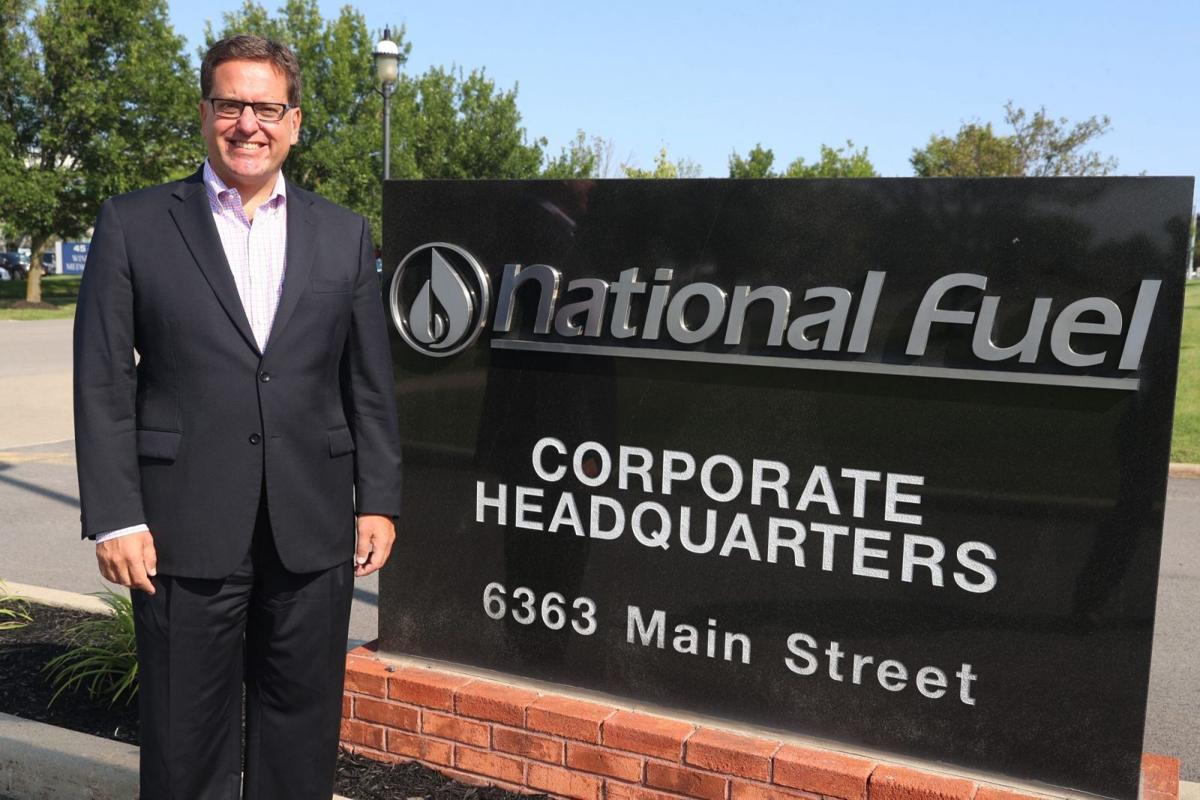
The top executive at the Buffalo Niagara region's largest natural gas utility is calling the state's plan to rapidly move away from climate-changing fossil fuels to rely on renewable energy and electricity "incredibly irresponsible" and warning that it could result in much higher energy prices for consumers.
David Bauer, the president and chief executive officer of National Fuel Gas Co., said Friday that the plan to move the state away from fossil fuels toward electrification, in everything from appliances to commercial buildings, goes too far, too fast.
Gov. Kathy Hochul proposes her fiscal year 2024 budget at the State Capitol in Albany.
Bauer, in remarks during a conference call with stock market analysts and investors, said the plan would require the state to add renewable energy sources – mostly wind and solar power – at an unrealistically rapid rate to meet the soaring demand for electricity and require costly upgrades to the state's electricity transmission system to accommodate it.
People are also reading…
"The scoping plan would have New Yorkers electrify almost everything at any cost," Bauer said.
The plan recommends that starting around 2025, newly built single-family homes be prohibited from installing equipment powered by fossil fuels, such as natural gas. That would require a newly built home's appliances, such as hot water heaters and furnaces, to run on a zero-emission system such as a heat pump, which is more energy efficient, but costs more than a conventional heating system.
The plan also recommends that, starting in 2030, homeowners who need to replace existing heating systems and appliances be required to do so with zero-emission systems.
Supporters say the plan puts the state at the forefront of efforts to safeguard the environment and slow climate change. The state is aiming to cut greenhouse gas emissions from 1990 levels by 40% by 2030, and 85% by 2050. Plans call for regulations stemming from the recommendations to be in place by 2024.
"Our plan is to make sure that we can protect our environment and there are a lot of smart ways to do that," Gov. Kathy Hochul said during a stop in Dunkirk last month. "There's also a lot of hyperbole and exaggeration around what's being proposed."
The plan was approved in December by a 19-3 vote, with National Fuel's representative on the council voting against it. About 90% of the homes in the Buffalo Niagara region are heated by natural gas, so a shift to electrify appliances and heating would likely cost National Fuel a major part of its current business.
Bauer expressed doubts about the state's ability to add renewable electricity generation fast enough to meet the soaring demand that would result from the push to electrify. He said the state currently has about 2 gigawatts of wind and solar generating capacity and the plan would require more than 4 gigawatts of wind and solar generation to be installed each year for the next 18 years to meet the plan's targets.
"Stop and think about it," Bauer said. "It's taken us decades to get to our current 2 gigawatts of capacity, but we'll somehow be able to build double that amount each and every year for the next two decades. While many might consider that incredibly aggressive, the scoping plan sees it as a sure thing."
Bauer said the soaring demand also would force electric utilities to make massive investments to upgrade the transmission system that brings electricity to homes and businesses – a cost that he warned would lead to higher rates. And he expressed doubt that new generation could be added fast enough to ensure that enough power would be available on a reliable basis.
The New York Independent System Operator, which manages the state's power grid, has forecast that the climate law's mandate of an emissions-free grid would require the state to triple its electricity generating capacity by 2040.
"It makes no sense to mandate the electrification of space heating in Western New York when it's uncertain the necessary power and electric infrastructure will be there to meet the increased demand for electricity that will result," he said.
Instead, Bauer said the state should take a "more reasoned approach" that would first examine whether renewable generation can be added fast enough, while also encouraging customers to invest in improved energy efficiency and better insulation to reduce demand.
Then, he recommended that the state adopt a hybrid plan to reduce emissions that matches the pace that new generation can be added – a path he said could result in the state achieving 85% of the emission reductions contemplated in the council's plan. Full electrification would be required only after the state has developed a cost-effective way to meet all of the demand for electricity, especially during winter when consumption would spike because of the big increase in the use of electric heating systems.


