ALBANY – More than 108,000 homes or businesses in Western New York lost electrical power during December’s blizzard. Before the storm passed, a dozen people in Erie County died in freezing residences.
Less than three months later, that harrowing experience is informing a fight over the speed and degree of New York's transition from fossil fuels, which currently warm more than 80% of New York homes.
Freezing and without power, some Western New York residents in December lit natural gas stoves using matches, a dangerous maneuver that nonetheless provided warmth and cooked food. Others used gas generators to run furnaces, appliances or power entire homes.
The CEO of Amherst-based National Fuel Gas Co., Dave Bauer, said when his elderly parents lost power for three days, they huddled around a natural gas fireplace.
People are also reading…
In a February call with investors of National Fuel, the main provider of natural gas heat in Western New York, Bauer said that against the blizzard's backdrop, "it's astonishing that New York State policymakers are unwavering in their push for a rapid transformation to a predominantly electric future."
For their part, environmental groups also are citing the blizzard. They say the storm's power should provide state lawmakers even more impetus to pass laws curbing climate change caused by fossil fuels.
In 2019, state lawmakers passed major environmental legislation setting the goal of zero-emission electricity in New York by 2040, and an 85% drop in statewide greenhouse gas emissions by 2050. A 22-person panel, the state Climate Action Council, was then charged with issuing recommendations on how to achieve those goals, and passed a plan in December.
Now, lawmakers face the thornier task of turning aspirations into laws. Building electrification is a first major test of how that political process will play out, and in that fight, Western New York has become a battleground, spurred by a multipronged campaign by the gas industry.

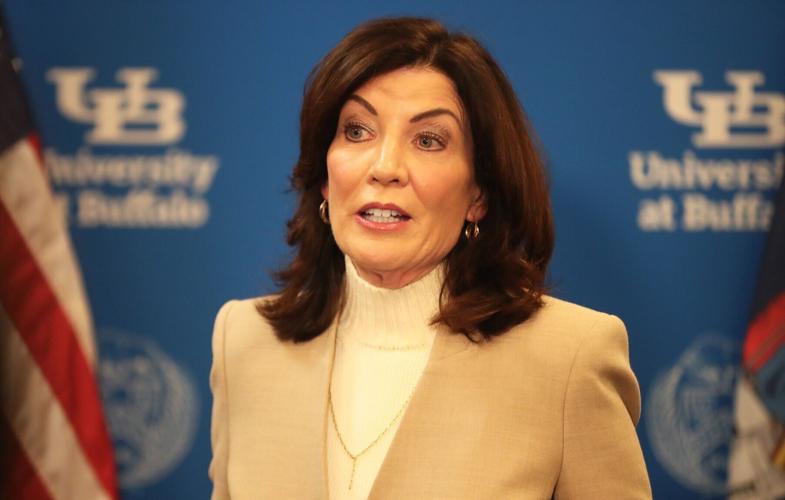
Governor Kathy Hochul addresses the media after speaking at the Center for Tomorrow on UB North's Campus in Buffalo during the afternoon of Feb. 27, 2023.
In her January State of the State address, Gov. Kathy Hochul called for all new construction in New York to be “fully sustainable” – with no on-site fossil fuel combustion – by 2025 for smaller buildings and by 2028 for larger ones. The prohibition would bar hookups allowing gas furnaces in new buildings.
Hochul also proposed prohibiting the sale of any new fossil fuel-powered heating equipment by no later than 2030 for smaller buildings, and no later than 2035 for larger structures.
After that point, if a gas or oil-fueled furnace needed to be replaced, an existing building would have to switch to a non-combustion source of heat, such as a geothermal heat pump using electricity.
A day before Hochul made her proposals, an uproar began in national conservative media over a statement made by a member of the U.S. Consumer Product Safety Commission, who said the federal body was considering a possible ban on gas stoves over health concerns.
The body's chairman clarified that the commission was not considering a ban, and Hochul herself explained that she was seeking only to bar the replacement of gas heating equipment in New York, not stoves.
Gas stoves, including replacements, would be allowed indefinitely in current buildings, though Hochul is indeed proposing a ban on gas stoves in new construction starting in 2030.
Hochul's proposals also include regulatory processes that would examine whether exemptions from the law are appropriate, including for certain type of businesses, such as restaurants, according to her office.
Multiple fronts
Hochul's decision to push the electrification issue in the state budget has forced Democrats in the Legislature to deal with an emotionally charged, pocketbook issue that's been seized upon by Republicans.
Still, advocates on both sides of the debate believe that in mid-March, the Democratic-controlled Assembly and Senate are likely to include building electrification plans in one-house budget resolutions. Combined with Hochul's proposal, that would give electrification serious momentum ahead of the April 1 state budget deadline.
But pressure has also recently mounted on Western New York lawmakers. Last week, a poll stated 57% of New York residents supported banning natural gas furnaces and appliances in new building construction starting in 2025, while 39% were opposed. Yet only 28% of Erie and Niagara county residents supported the proposal and 68% were opposed.
“We’ve talked to a lot people who say, if they didn’t have access to natural gas, the storm would have been much worse for them,” said Michelle Hook, executive director of New Yorkers for Affordable Energy, a lobbying group that funded the poll.

The poll was commissioned by New Yorkers for Affordable Energy, a coalition of utilities, business groups and labor unions. The poll focused on elements of the state's energy roadmap, which calls for transforming energy use in homes and buildings.
According to the poll, 90% of residents in Erie and Niagara are at least somewhat concerned that "switching all buildings to being all-electric will result in power outages."
The statewide poll was of 897 New York residents with a 3.7% margin of error. Within Erie or Niagara counties specifically, 100 people were sampled, with a margin of error of 9.8%.
The survey was conducted by a well-respected polling operation run out of Siena College, but was funded by the lobbying group, whose steering committee includes National Fuel, National Grid and other organizations supportive of natural gas. Hook said before the poll was conducted, her organization sent Siena’s pollster topics of interest, but had “zero say” over the wording of the questions or who was sampled.
Since the poll’s release, state lawmakers on both sides of the aisle have been reaching out for more specifics on the results, Hook said. And a day before the poll's release, Hook said, National Fuel had privately shared the results during a "round of meetings" with state lawmakers from Western New York.
National Fuel in recent weeks has also engaged in a robocall campaign in Erie County, which, in turn, led to a flood of calls to the offices of area Assembly members and senators from constituents. The robocall stated Albany lawmakers were “finalizing a plan to phase out natural gas.”
“Banning natural gas could lead to power outages and cost increases,” the robocall stated. “We need all energy options to keep the lights on and heat flowing.”
Call recipients could then press a button and be connected directly to the office of their local state lawmaker.
“You can tell them to vote against any legislation that would ban natural gas use in Western New York,” the call stated.
Hochul’s proposal would not remove the current natural gas heating system from anyone's current home, a nuance not captured in the call. Donna DeCarolis, president of National Fuel, said time constraints of the medium meant the company's message simply had to be shared as “quickly and efficiently as possible.”
Assemblyman Jonathan Rivera, a Buffalo Democrat, said he takes every constituent call seriously, but differentiates between those originating more organically, such as when a person reads a newspaper article, and those stemming from a "robocall from a utility stirring them up."
Rivera said he's waiting to see the final proposal in the state budget before taking a position on the issue.
"I was already aware many folks in Western New York were not in favor of it," he said. "Part of that is misinformation people are getting. People are thinking government will come in and steal their stoves tomorrow, when no proposal, anywhere, would do that."

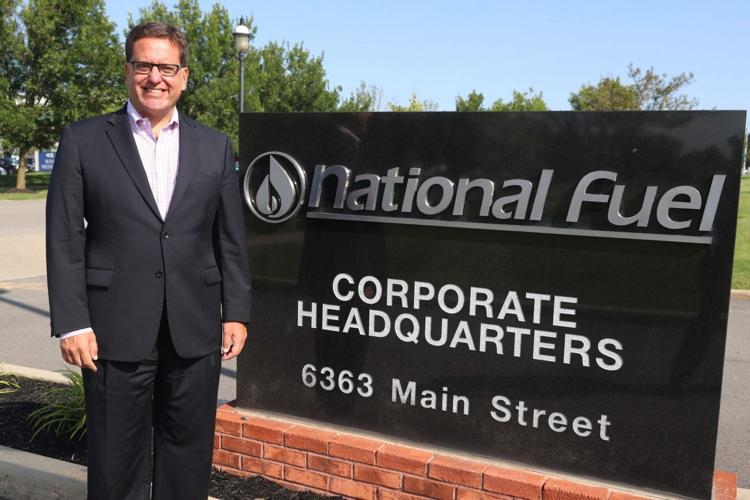
David Bauer at National Fuel headquarters.
Instead of Hochul's plan, National Fuel is advocating a "multi-pronged approach” to hitting the state’s climate targets. One plank is increasing energy efficiency of homes.
"A tight building envelope is going to be the low hanging fruit for reducing emissions," Bauer said. "If you burn less fuel to keep your house warm, whatever it is, you're just going to automatically lower emissions."
Another centerpiece would be a “hybrid approach” toward powering homes. Residences would have an electric heat pump that works down to 35 degrees. Below that, a natural gas furnace would kick in.
National Fuel estimates residential consumers would save an average of $710 a year on energy bills from that approach, as compared with all-electric heating, and that it would significantly reduce emissions.

While the plan lays out the projected benefits – making steep cuts in harmful emissions and protecting public health – there are potentially significant costs that come with achieving those ambitious goals, for homeowners, businesses and the state's power grid.
“It would result, by our estimates, in as much as a 60% reduction in customer use of natural gas,” Bauer said. “How you tackled the remaining delta – to get to an 85% reduction (in emissions) – would be technologies like renewable natural gas and hydrogen. I think the state should be doing everything you can to promote those technologies.”
'Existential threat'
Two Democratic state senators who support building electrification sponsored a briefing last week for members of the State Legislature and their staffs, meant to counter what they called “disinformation” from the fossil fuel industry.
The briefing, widely advertised in flyers posted around the state Legislative Office Building, featured as speakers two members of the Climate Action Council. One of them, Raya Salter, argued that solutions put forward by the fossil fuel industry, including "renewable" gas and hydrogen, were means of buying time and creating a “narrative that justifies a prominent role for fossil gas.”
During a question-and-answer session, the speakers were asked about two issues at top of mind for many state lawmakers: How will low-income homeowners absorb the significant cost of the retrofitting homes to electric power, a process that can cost tens of thousands of dollars? And what happens when the electric power goes out and other sources of heat are not available?
Dr. Robert Howarth, a biogeochemist and ecosystem scientist at Cornell University, responded that consumers would enjoy much lower monthly bills from using electric heat pumps, ultimately covering the upfront cost.
“Anyone will save money over the time period of five to 10 years maximum, anywhere in the state, by making that conversion,” he said. “They just need help with those upfront costs."
The state offers rebates defraying the cost of heat pumps, on top of a new federal tax credit. State residents also may be eligible for low-interest financing up to $25,000.
As for what happens when the electric power goes out, Howarth said a “thermal storage system” can be installed with electric heat pumps keeping heat going for “at least a day or two," noting that feature is not present in gas furnaces ignited by electrical power.
“Longer than that, it's a real challenge,” Howarth acknowledged. “And so we need to do a better job of weatherizing the (electric) grid … Our grid is very, very much in need of an upgrade no matter what we do for our energy future. We need to make it resilient to this climate we have."
Supporters of electrification are pushing the cause in other ways. A nonprofit, People United for Sustainable Housing Buffalo, is touting a 49-unit, zero emission West Side Homes project now underway, powered solely by electricity. The group’s sustainability director, Sarah Burger, said the units are so well-insulated, they keep relatively warm even with the heat off – a demonstration, she said, of electrification as a viable option in Western New York winters.
The Public Accountability Initiative, another nonprofit, released a report Wednesday on how utility companies are “trying to block building electrification to protect billions of dollars in profits.” The report found National Fuel and National Grid spent a combined $715,000 on lobbying in New York in 2022.
In addition, a group funded by the biofuel heat industry recently sought to raise $1 million or more for its own campaign to kill the electrification measure, according to a video of a recent meeting obtained by The News. Rocco Lacertosa, CEO of the New York State Energy Coalition, declared at the outset that lawmakers’ electrification efforts were an “existential threat the likes of which we have never seen.”
A blizzard of resolutions
As part of its own campaign, National Fuel has been providing “talking points” pressing its arguments not just to Albany lawmakers, but to Western New York's local governments.
Citing concerns expressed by constituents, many local governments in recent weeks have formally denounced Hochul's plan. National Fuel has been keeping an eye on the resolutions, sending a lengthy list of those passed or pending to The News last week.
On Jan. 19, the Erie County Legislature noted people froze to death during the blizzard and "many more would have suffered if they had to rely on a power grid for cooking and emergency heating."
Since then, several other local governments have passed resolutions containing those exact words or other copied passages from Erie County's, including bodies representing Olean, Cheektowaga, Holland, Freedom and the counties of Cattaraugus, Niagara, Wyoming and Wayne.
According to a spokesman for the Niagara County Legislature, local governments have been sharing language with one another, accounting for the copied language in Niagara's resolution.
A number of other local governments have passed originally worded resolutions with similar messages, including the Buffalo Common Council, a body entirely made up of Democrats.
One of the Buffalo resolutions last month expressed strong concern with Hochul's “proposal to ban gas stoves” in new construction.
The other urged the state Climate Action Council to pause "implementation" of the state's climate goal law while the body examined “real-life impacts which may be felt by New York State residents, specifically in Buffalo.” (In fact, the Climate Action Council has no binding authority to implement its plan; implementation is up to state lawmakers and agencies.)
Though the Buffalo resolutions had already passed, the Common Council subsequently sought comment on them at a committee meeting last week – and got an earful from local environmental groups alleging the resolutions were inaccurate. They argued the Common Council relied on misinformation put out by a fossil-fuel lobby seeking advantage through a blizzard of its own creation.
“It is evident that this storm was aggravated by climate change caused by burning fossil fuels,” said Bob Ciesielski, a longtime official in the Niagara Chapter of the Sierra Club. “Ironically, the storm is now being used as in an attempt to maintain the use of fossil fuels throughout the state.”
After a bombshell study linking gas stoves to childhood asthma, governments are under growing pressure to address the health risks from their emissions.
This article has been updated to say that geothermal heat pumps use electricity to produce heat and that a resolution was presented to the Village of East Aurora concerning Gov. Kathy Hochul's building electrification plan, but was not passed. An earlier version of this story misstated those facts.