

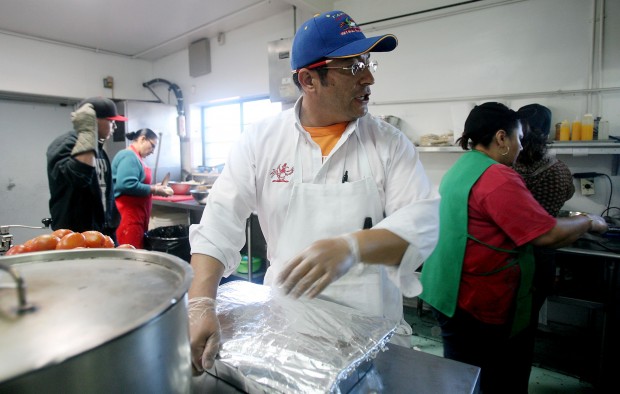
If you think you can cook at home and sell to make some extra bucks - think again.
Many people start doing this casually to boost their income, and it's especially common among Hispanics. Many make tamales, which are so popular this time of year. Others make burritos, cheeses, flour tortillas and the like.
But if it's hot food, it's not legal to cook at home for public consumption.
To follow the law and get a permit from the Pima County Health Department, people must cook outside their home in a commercial kitchen and meet other requirements.
"State law specifically prohibits that people make food at home to serve to the public," said Sharon Browning, program manager at the county Health Department. It doesn't matter if it's for sale or to give away, she added. Bake sales are exempt.
People are also reading…
Using a commercial kitchen ensures that small-business owners have access to the equipment necessary to cook in a healthy way and prevent illnesses.
That's why, when Adan Delgado wanted to start catering food to charter schools in South Tucson, he had to start cooking in another business his family owns, Taqueria Pico de Gallo, on South Sixth Avenue at East 36th Street.
Delgado's Catering has been making things such as hamburgers, hot dogs, lasagnas and pizzas for six years now at the Mexican eatery.
Delgado uses the kitchen at Pico de Gallo on school days, next to the other employees who work there. He preps, cooks and puts food items in disposable trays; all is ready to serve once it leaves the restaurant.
Cooks who don't have immediate access to a commercial kitchen, as Delgado does, can contact churches, community centers, bakeries or other restaurants, and ask to use their kitchens, Browning said.
"It becomes a private arrangement," she said, in which the cost and access to the facility are determined.
Once people have found a commercial kitchen, they have to show the Health Department their menu, break down the preparation process, and tell how the food will be served to people.
After that, the county department will inspect their kitchen as well as the preparation process.
Right now the cost of the inspections plus the annual fee is $226, Browning said.
You also need a business license to get a Health Department permit, Delgado noted.
But because the process can get pretty confusing, it's a good idea to contact the Health Department, where people will get help navigating the system.
There's a reason everything is so formalized, Browning said. "When people do this they are really running a business. From our perspective they may be small; but they follow the same food code as a restaurant."
Groups such as clubs or civic organizations that want to sell food at festivals, for example, also need a temporary Health Department permit.
Using a commercial kitchen benefits the owner just as much as the public, Delgado said. Through his family's Mexican restaurant, Delgado's Catering has access to up-to-date equipment that's in compliance with health codes.
The classes that the Health Department requires teach how different it is to cook at home versus cooking for the public. "You have to use gloves, you have to wash your hands frequently, the food has to be stored at a certain temperature," he said.
And those guidelines are also key for the bottom line. "Having to throw away food because you didn't store it right is costly," Delgado said.
get more info
For more information on how to operate a food business in compliance with the law, call the Pima County Health Department's consumer health and food safety unit at 243-7908.