

Baby boomers are famous for staying and acting young, but there's no denying that the oldest among them are turning 65.
And that will create job opportunities for younger generations, as the number of caregivers is not growing as quickly as the aging population in Arizona.
Caregivers provide services ranging from measuring blood pressure and reading prescriptions to bathing and dressing, cooking nutritionally and doing laundry. Elderly people with disabilities and those of all ages with chronic conditions often need such entry-level health care at home or in nursing homes and care centers.
Tucson-based Caregiver Training Institute, also known as CGTI, is the only nonprofit school here helping to meet that demand, although Pima Community College offers a smaller training program in Tucson, and Eastern Arizona College in Thatcher also trains caregivers.
People are also reading…
Tucson College is a major for-profit competitor.
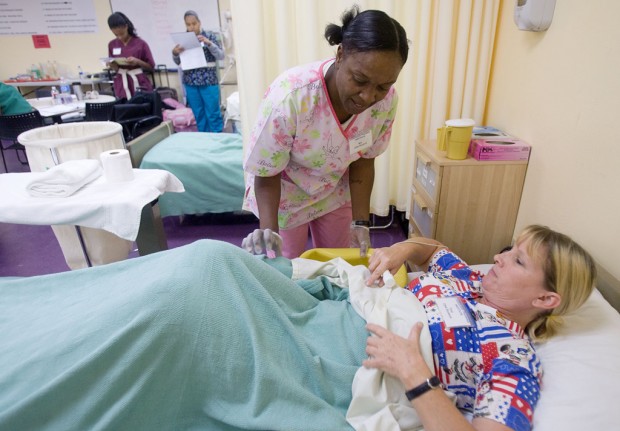
In Caregiver Training Institute's seven-week-long day course or 12-week evening course, students study health-care theory in class and practice clinical skills in an on-site lab. At the end, students either become certified nursing assistants after passing the Arizona State Board of Nursing Certified Nursing Assistant exam, or certified caregivers.
Caregiver Training Institute offers the only dual-certification program in Tucson, said Felipe Jacome, its vice president. Tuition for either is $2,975.
Caregivers may work at assisted-living homes, while certified nursing assistants are qualified to work in hospitals or skilled nursing facilities.
"Just see what is available right now," said Peter Holmquist, who is graduating and preparing to take the CNA exam. "I can either work at a hospital, like University Medical Center, or just do home care."
Arizona State Board of Nursing statistics show that 153 CGTI students passed the CNA exam in 2010. Ninety-three percent of the institute's students who took the exam passed the written test, and 88 percent passed the skills test.
Many CGTI students had been laid off during the economic downturn and wanted to be retrained for another field, Jacome said.
The U.S. Bureau of Labor Statistics says that in 2006, the latest figures available, the average annual earnings of direct-care workers ranged from $16,314 to $20,276.
In Tucson, caregivers' starting pay is in the $9- to $11-an-hour range, while certified nursing assistants can make $10.50 to $14 an hour to start, Jacome said.
"To me, the job is more important than what I am earning," said Kathy Little, a certified caregiver. "It is all about the resident or the person you are taking care of and protecting their dignity and their respect."
Caregiver Training Institute has more than 1,000 alumni since its founding in 2000. Jacome said it recorded an employment rate of its graduates at 78 percent or so every year since the first graduating class in 2002.
Aspen Care Home, a new facility for seniors in Tucson, is currently hiring two graduates from CGTI to assist with residents' daily activities.
"They come very prepared," said Tracey Anderson, Aspen's owner.
Kami Cowan is an employee at Aspen Care Home who graduated from CGTI three years ago. She likes the relationships she has built with residents, saying they are as close as family.
But now Cowan is looking to enhance her career. She's continuing her studies at Pima Community College and hopes to get her nursing degree and become a registered nurse at a hospital.
"I have no idea where I am going to specialize, but being a caregiver is challenging," she said. "Good caregivers have to know where the people they serve come from, what they go through and what frustrations they have."
BY THE NUMBERS
Arizona is getting older.
New figures today from the U.S. Census Bureau show the state's median age increased by more than one year in the last decade. It now stands at 35.9.
The report also shows that 17 percent of all Arizonans are at least 62 years old. In 2000, only 15.3 percent of Arizonans had reached that age.
And 3.5 percent are 80 and older, up four-tenths of a point from the prior census.
Capitol Media Services
Who will care for this population?
In 2009, there were more than 30,000 care workers in Arizona, which represented 34.6 caregivers per 1,000 residents age 65 or over, the U.S. Bureau of Labor Statistics says.
JOB RETRAINING
Students or potential students with financial problems can seek federal workforce development aid from Pima County OneStop, 243-6700 or 798-0500, if they cannot afford the tuition for caregiver programs.
Ziniu Chen is a University of Arizona journalism student who is an apprentice at the Star. Contact him at starapprentice@azstarnet.com