


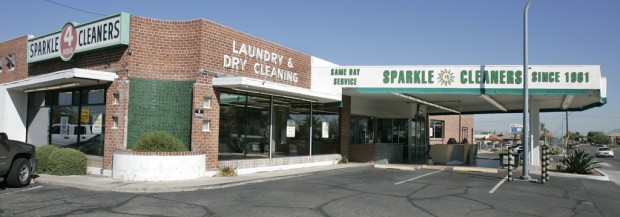
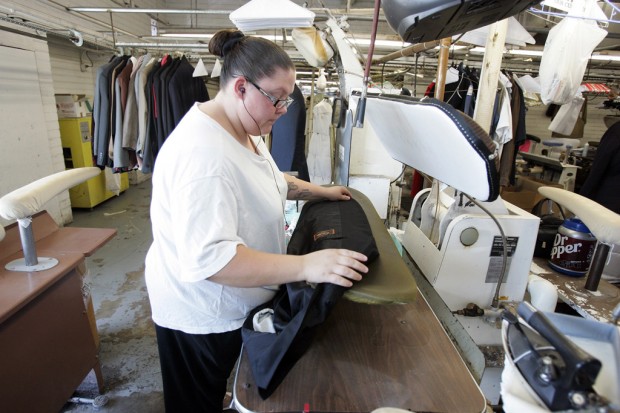
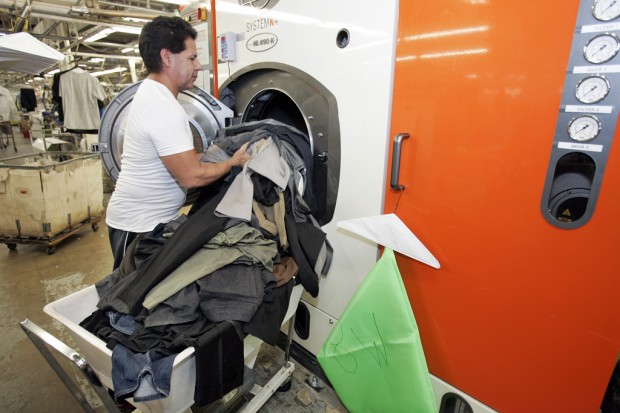
Southern Arizona's largest dry-cleaning company is investing about half a million dollars to make the switch to a safer solvent.
Tucson-based Sparkle Cleaners, established in 1961, is the latest to transition away from using the traditional dry-cleaning solvent perchloroethylene - known as perc - that the EPA calls a likely human carcinogen.
California, with the nation's toughest regulations, has ordered dry cleaners in that state to eliminate use of perc by the 2020s.
Several Tucson companies already are using alternatives that are safer than perc and easier on the environment, but still are not recommended by California regulators. Wet-cleaning and CO2 solvents are the only dry-cleaning methods identified as completely environmentally friendly by California.
Tucson's Sparkle Cleaners is moving to SystemK4, developed by the German company Kreussler.
People are also reading…
Sparkle Cleaners owner Heath Bolin said the new solvent is 100 percent biodegradable and will be offered to customers at no extra charge. Kreussler says it's also dermatology-tested to be easy on skin.
Bolin said Sparkle also offers wet-cleaning, which the company tries to use as often as possible.
To switch to a different dry-cleaning method requires companies to replace their washing machines entirely.
According to the American Dry Cleaner magazine, the shift to new environmentally friendly technologies has been slowed by the bad economy.
About 70 percent of U.S. dry cleaners continue to operate with perc, the industry magazine said in a recent article.
Sparkle Cleaners is in the process of switching all its machines to be compatible with SystemK4. SystemK4 is available to customers by request during the transition.
Sparkle hopes to be perc-free by next year.
SystemK4 is made synthetically through a reaction that takes two toxic petroleum byproducts and results in a nontoxic substance, the company says. The result is an acetal formula.
Bolin said SystemK4 is gentler on clothes than items cleaned with perc, and leaves the clothes with no lingering odor.
"Clothes remain softer and have a better feel," Bolin said.
A material safety data sheet produced for this compound paints a relatively benign picture of it. It does not irritate the eyes or skin, although it can kill rats who take in high doses of the substance. On decomposition, it produces toxic carbon monoxide. But otherwise it's not classified in any formal category of toxicological substances, the sheet says.
Shaffer Dry Cleaning and Laundry, another longtime Tucson dry cleaner, switched to GreenEarth Cleaning in 2007.
Bake Shaffer, the owner, said GreenEarth is so nontoxic that it's safe enough to drink. He has even tasted it himself, he said.
The chemicals used in GreenEarth are silicone based, and are used in some makeup and deodorant products.
Shaffer said perc is the best solvent for cleaning clothes but is dangerous for the environment.
"Perc can lead to dirt contaminations. If it contacts the underlying soil, it can lead to water contaminations," Shaffer said.
Use of GreenEarth eliminates the problem of environmental contamination, Shaffer said.
Tom Roof Cleaners, established in Tucson in 1984, switched to GreenEarth about five years ago.
Owner Scott Lusko said that none of his employees have had any problem when handling GreenEarth.
"If GreenEarth was spilled, it causes no harm," said Lusko.
However, the U.S. Environmental Protection Agency has some concerns about GreenEarth ingredient solvent D5.
The EPA reported that a study done on rats with D5 inhalation proved dangerous to the test subjects. The study showed a "statistically significant increase in uterine tumors." The increased risk in uterine cancer is only a risk for rats, however, because people don't have the same biological process with the release of progesterone as rats, the EPA says.
According to the American Dry Cleaner magazine, there are more than 900 dry cleaners using GreenEarth today.
Tucson-owned Catalina Cleaners switched from perc to Exxon DF-2000 in 1995.
"The chemical that we use is environmentally friendly," Trevor Moore of Catalina Cleaners said.
Exxon DF-2000 is a synthetic hydrocarbon fluid.
The American Dry Cleaner reported that hydrocarbons are still volatile organic compounds, but have extremely low emissions when used in dry-to-dry machinery.
EPA says DF-2000 is more flammable than perc, but it is less flammable than other hydrocarbon-based solvents because it has a higher flashpoint than the others.
But EPA also says DF-2000 poses risks of central nervous system damage and skin and eye irritation for workers who handle it. It also has the potential to contribute to smog and global warming, EPA says.
"While DF-2000 is likely at least marginally better than perc in terms of health and environment, it is not green," wrote author Christopher Wanjek in a 2007 article on the Live Science website. "Semantics aside, the toxic DF-2000 is safe only in comparison to what it hopes to replace."
The EPA said that approximately 28,000 U.S. dry cleaners are still using perc today.
Jennifer Sass of the National Resources Defense Council said the use of perc is not necessary for the dry-cleaning process.
Sass said the main way people gain dangerous exposure from perc is through inhalation. It's particularly a problem for people who work at a dry cleaners, or live nearby, Sass said.
"Unventilated areas are the worst," Sass said. Unventilated areas could include a car or a closet. The remnants of perc on the clothing could lead to inhalation in areas with poor air circulation, she said.
Inhaling low levels of perc can cause dizziness or headaches, Sass said.
According to the EPA, exposure to perc has caused liver and kidney damage to rodents, and can cause neurological effects in humans. This could include loss in coordination and irritation in the eyes, nose and throat.
"We don't need to take health risks for our dry cleaning," Sass said - and a growing number of local dry cleaners agree.
"Clothes remain softer and have a better feel."
Heath Bolin
Sparkle Cleaners owner, on new solvent
"While DF-2000 is likely at least marginally better than perc in terms of health and environment, it is not green."
Christopher Wanjek
Author
Star reporter Tony Davis contributed to this report. Ashley Grove is a NASA Space Grant intern at the University of Arizona. Contact her at agrove@azstarnet.com or 573-4674.