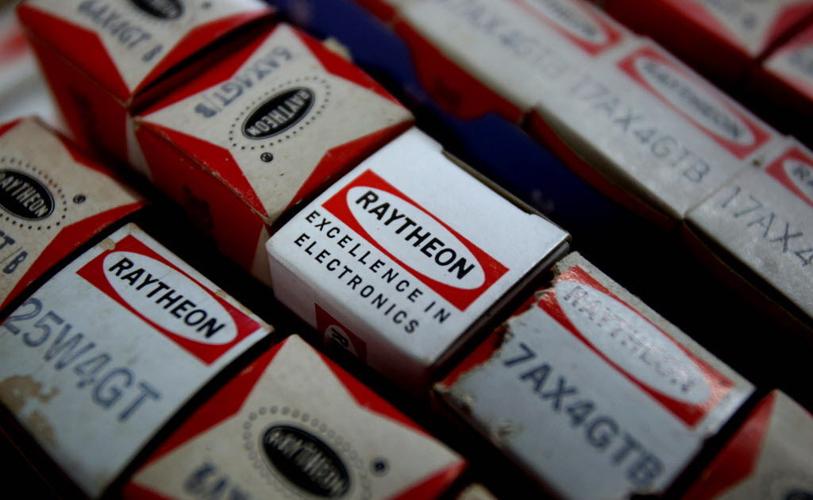

Raytheon is best known as a major defense contractor, but the company’s roots go far deeper, starting as a major manufacturer of vacuum tubes in the early days of radio.

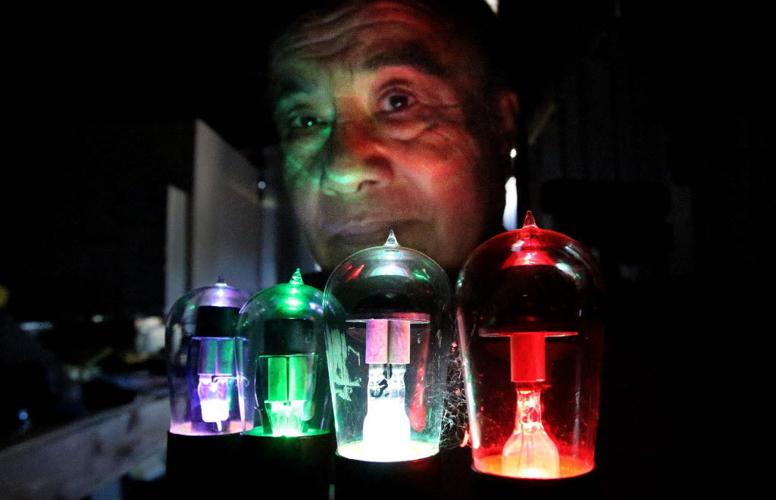
Tsukii has been amassing vacuum tubes for 50 years. He’s particularly proud of his B- and BH-model rectifier tubes, developed for early radio.
Today, the company is mostly out of the civilian electronics business, but its heritage isn’t lost on Toshikazu Tsukii, a principal engineering fellow at Raytheon Missile Systems with more than 40 years with Raytheon and 15 years at the Tucson-based missile business.
An inveterate tinkerer — perhaps best known for the guesthouse he made from Boeing airliners — Tsukii has taken vintage Raytheon vacuum tubes and used them to create colorful night lights oozing with retro charm.
The idea came upon Tsukii, known to friends and colleagues simply as “Ski,” after he started thinking about the large collection of Raytheon vacuum tubes, including some from the 1920s, he had amassed over some 50 years.
People are also reading…
The tubes have a cool retro vibe but aren’t particularly useful or valuable to collectors, generally fetching $10-$20 apiece.
““I kept these in a box in storage, where they weren’t doing anything. Then I started thinking maybe there’s a way to utilize these things,” said Tsukii — who at 78 still works full time at Raytheon.
Then the proverbial light bulb went off in his head: Why not night lights?
It seemed like an easy hack, using tiny LED (light-emitting diode) lamps and off-the-shelf photoelectric night lights as bases. But Tsukii worked on and off for several years before devising a special tooling to remove the fragile ceramic bases of some Raytheon tubes without breaking them.
Tsukii, who holds numerous patents for his work at Raytheon, perfected his night-light design first with single-color LEDs and then with color-changing LED lamps.
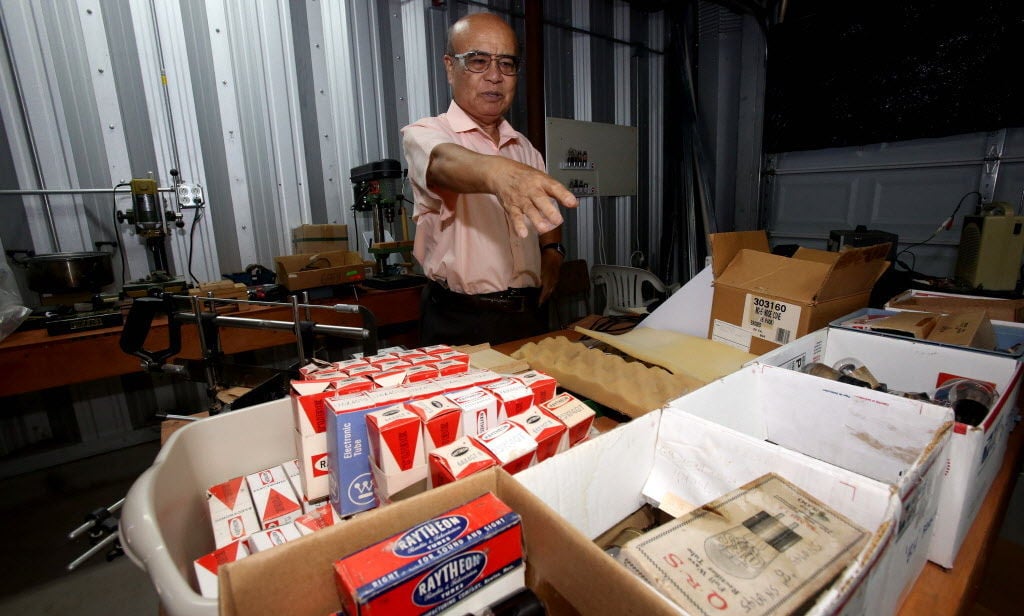
Raytheon engineer Toshikazu Tsukii shows off his collection of vacuum tubes.
While other do-it-yourselfers have made night lights and electric “candles” with old vacuum tubes and LEDs, Tsukii’s main aim is to pay homage to his company’s pioneering electronics past.
Tsukii is particularly proud of his collection of historically significant Raytheon B- and BH-model rectifier tubes.
The large tubes were developed in the 1920s to adapt the widely used DC battery-operated radios of the day to household AC current — helping push radio into the collective American living room.
Though Tsukii has given some of his tube night lights to friends and colleagues, he’s not offering the lights for sale, nor does he plan to any time soon.
“I learned the lesson long ago, you cannot mix your hobby and business,” he said.
He also has no current plans to retire from his gig at Raytheon — or from his electronics projects. His latest home project: a karaoke machine of his own design.