

Ventana Medical Systems Inc. already is an internationally known maker of automated instruments used by pathologists to diagnose diseased tissue.
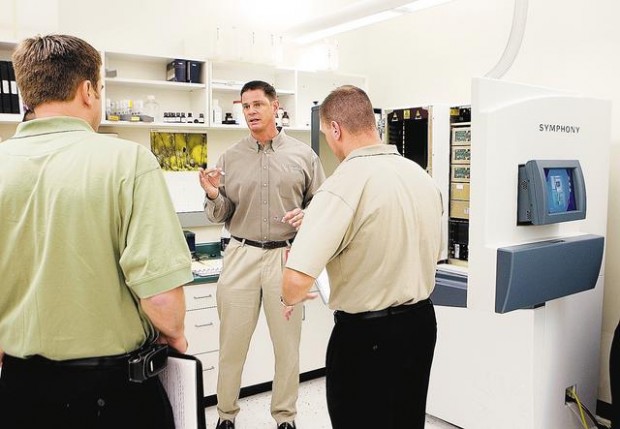
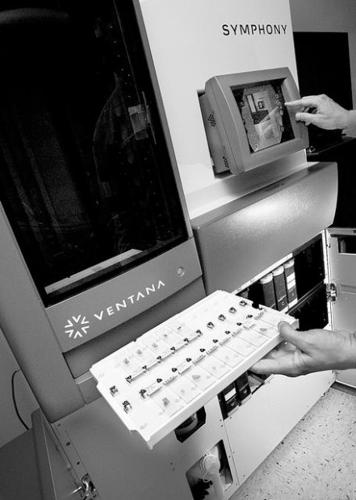
Now, the Oro Valley-based company is staking its future on Symphony, a new machine the company says can make pathologists' work better and easier.
Founded in 1985 by University of Arizona pathologist Dr. Tom Grogan, Ventana has become a leader in instruments that automate "advanced" tissue testing, performed to obtain greater detail after an initial analysis has shown an abnormality.
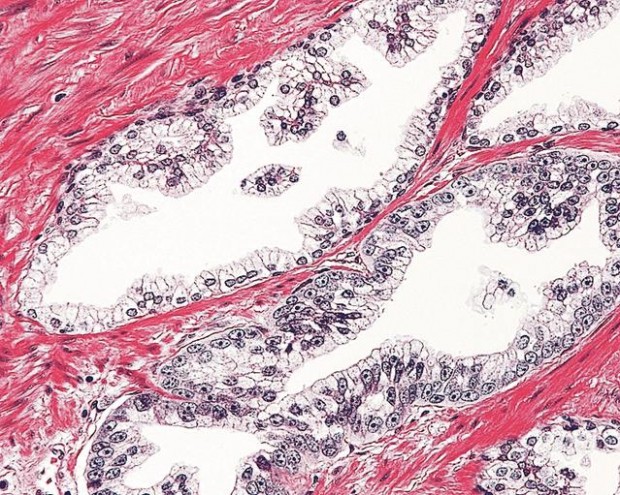
Symphony is for the 20-times-larger "primary" staining market. Primary staining refers to the treating of tissue samples, to highlight cell abnormalities and make it possible for a pathologist to detect them when viewing slide-mounted stained samples under a microscope, and determine whether the organ it came from is diseased.
People are also reading…
Specific reagents, or "stains," turn parts of tissue at the cellular level different colors.
The tissue, removed from a patient during a biopsy or surgery, is encased in paraffin, sliced microns thin, mounted on a glass slide, exposed to a variety of reagents — stains — and viewed under a microscope to determine whether it is diseased, or normal.
Usually, primary staining is done by hand, or with partial automation, "dipping and dunking" slides in trays of stain, then drying them.
There is the potential for contamination and dilution of the reagents as slide after slide is dipped in the same solution, said Ron Price, Ventana's director of Symphony sales.
Symphony automates the process, taking a tray of 20 slides, giving each a precise fresh dose of reagent, which Price said results in a higher-resolution image of consistent quality.
Any improvement in image resolution could improve diagnoses, a local pathologist said.
Often, says longtime pathologist Dr. Ron Spark, testing is done on a tissue sample taken in the operating room and rushed to the hospital's lab for a pathologist's opinion before the surgeon proceeds.
The question is, "Is the tissue cancerous?," or, "Has the cancer spread?" Meanwhile, the patient is on the table and the surgeon is waiting to proceed with removing a diseased organ, or closing and telling the patient's family the news.
It's not always an obvious answer, says Spark, a veteran of 28 years at Tucson Medical Center's pathology unit and now a Tucson Veterans Affairs Hospital pathologist. Spark is familiar with Ventana but has no ties to the company.
"Mind-numbingly dull" is the way Spark describes the job of looking through a microscope to count the telltale stained areas that indicate disease. He said it's not unlike counting red shirts in Arizona Stadium during a Wildcat football game.
"Sometimes you're called in late at night. It's nervy," he said. "Sometimes it's life or death for the patient, and (you) have to make (the diagnosis) within minutes, often. There's a lot riding on it."
Inkjet printers or razors
There's a lot riding on Symphony for Ventana.
The machine lists at $200,000, but Malden said that's not where most of the money is for Ventana.
Ventana not only can sell the machines, but also can guarantee itself a cash stream from the specific reagents Symphony requires. Unlike manual or semi-automated systems, Symphony users have to buy Ventana consumables.
Malden compares it to the razor or ink-jet printer business model, where the razor or printer is a way to sell blades or ink cartridges.
"With a printer, you give it away and sell the ink," says Malden. "We don't give (the machine) away, but . . ."
Malden said supplies account for 80 percent of Ventana's revenue. Ventana has been selling the consumables for its other diagnostic machines all along.
On Symphony, "you have to use a Ventana reagent," he said.
Symphony requires not only specifically formulated re-agents, he said, but encoded information crucial to the machine's performance.
Malden declined to give Symphony sales figures or projections, but said the company expects to sell 60 percent to 65 percent of the units directly to hospitals, or to companies leasing them to hospitals; the rest will be supplied under agreements requiring hospitals to buy a minimum amount of reagent during a specific period.
To minimize down time, Symphony units can be connected to the Internet and be diagnosed by a Ventana technician via a wireless BlackBerry device thousands of miles away.
With a potential massive increase in hardware and consumable sales, Malden said Ventana will need more space. The company plans to break ground later this year on a $35 million, 135,000-square foot addition to its Innovation Park campus in Oro Valley.
The company employs 517 workers in Tucson, 850 worldwide.
TECH FILE