

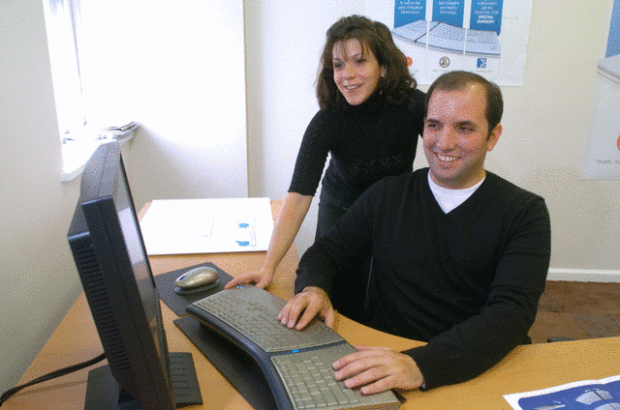
Smartfish Technologies says it has invented the world's first computer keyboard that won't cause wrist injuries.
The brainchild of Englewood, N.J., chiropractor-turned-inventor Jack Atzmon, the regular-size keyboard contains a small motor and enough computer power to tilt slightly every so often — on three different axes — thus moving the user's typing position.
Smartfish finished building a working prototype in January and has not yet conducted clinical trials to support its theory, but it collaborated with The Hospital for Special Surgery in Manhattan on the keyboard design.
"It has the potential to decrease the incidence of carpal tunnel (syndrome)," said JaMe Cioppa-Mosca, a physical therapist and assistant vice president of the hospital's rehabilitation program, who also serves as an unpaid adviser to Smartfish.
People are also reading…
So-called ergonomic keyboards are nothing new, but Atzmon's novel approach has caught the attention of some big fish.
"We've gone beyond what any other keyboard manufacturer has done," said Atzmon, a 40-year-old father of two whose wife, Ellen, works as Smartfish's director of administration.
The company completed its first round of venture capital funding last year. Smartfish's cash support came from Alan Tannenbaum, a former managing director and head of institutional equity sales at Lehman Bros., who is also chief executive of a Long Island company that makes propulsion systems for hybrid electric trucks and buses.
To date, Smartfish has no deals, but has met with 14 of the world's 18 largest computer peripheral manufacturers, including Logitech, Microsoft, Best Buy, Kensington and Lenovo, according to Alan M. Shafer, Smartfish's executive vice president and a 32-year IBM veteran whose last position at the computer maker was chief merchandising executive.
Atzmon, the company's president and CEO, hopes to license the Pro:Motion keyboard technology (which Smartfish has also developed for use with a computer mouse and game controller), or sell the company outright if the price is right.
Atzmon had his "aha!" moment, as he calls it, during a trip to a Best Buy about two years ago. A tinkerer since he was a boy (Atzmon's father was also an inventor), he realized that by having the keyboard itself move slightly every so often, it would shift the angle of a typist's wrists and keep the carpal tunnel region from staying in the same position all the time.
"It's the static that's scary," said Atzmon, who made the trip to the International Consumer Electronics Show in Las Vegas last month for some closed-door meetings with keyboard makers.
Smartfish's Pro:Motion keyboard, with a suggested retail price of $130, moves every 4,000 to 6,000 keystrokes, according to the company. It remembers the last user's typing pattern and will reposition itself about eight times a day. It also knows when you pause, and moves only then, so it doesn't interrupt work flow.
Atzmon says his 20 years of chiropractic training and experience, including treating people with repetitive stress injuries related to typing, helped spark the inventor side of his brain.
As for showing that the keyboard eliminates injuries, Smartfish plans clinical trials and wants OSHA (Occupational Health and Safety Administration) to take a look at the device, but no timetable has been set, the company says.
Shafer says all keyboards on the market, including ergonomic keyboards, have a warning label on the bottom that says "Improper or prolonged keyboard use may result in injury." Smartfish's goal is to have its Pro:Motion keyboard be the first ergonomic keyboard sold without that warning label, Shafer says.