

Flying Spaghetti Monster religion; ponies' tails cut; no penalty over stripper
- Updated
Odd and interesting news from the Midwest.
- By MARCUS JACKSON The (Champaign) News-Gazette
- Updated
By MARCUS JACKSON
The (Champaign) News-Gazette
CHAMPAIGN, Ill. (AP) — It's just after 8 on a sunny Tuesday morning, and a loud whirring sound reverberates through Champaign Fire Station 1.
Alex Kocher is an hour into his shift, handling a chore you won't find anywhere in the official job description of a probationary firefighter: He's vacuuming the carpet of the first-floor lounge, maneuvering around seven plush recliners that face a flat-screen TV.
This is where the crew at Station 1 comes to relax — what little time for that there is, even on fire-free days in Champaign. For the 10 men on first shift, grabbing anything more than a few Zs in one of the 12 beds upstairs is rare — those who don't have second jobs to get to will have the 48 hours following their 24-hour shift to catch up.
In a cramped office a few feet away, lieutenants Brian Ball and Brad Diel click away on their keyboards, taking care of paperwork.
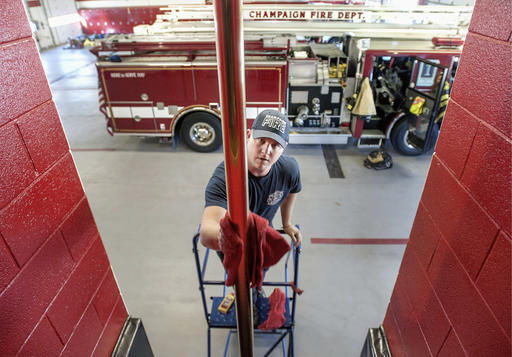
Over in the garage, firefighter Jeremy Hunt tests machinery. Soon, he'll be joined by Kocher, and the two of them will perform another unglamorous weekly duty at Station 1 — waxing the old-school poles firefighters slide down in case a call comes in when they're upstairs. Of the six firehouses in Champaign, 307 S. Randolph St. is the only one that's two stories tall.
"The poles aren't common anymore," says the 39-year-old Ball, who joined the CFD in 1999 after moving over from Decatur. "They're a huge expense, and there just aren't many two-story firehouses anymore."
Last year, Station 1's squad vehicle was the busiest in the city, responding to 2,689 calls. The house also claimed the most active ladder truck in the department, with 1,120 calls.
Today is a slow day for calls — real ones, anyway. Just after 9 a.m., Capt. Roger Cruse and others on shift return on a ladder truck. They've been training at the Illinois Fire Service Institute, and they reek of smoke.
"Around here, we call that cologne," Fire Chief Gary Ludwig says.
Cruse and his crew have spent part of the morning brushing up on how to respond to mayday calls, those frightening instances when a firefighter needs to be rescued by colleagues while battling a blaze.
At 9:15, it's others' turn to head to Campustown for the same exercise. Once at the institute, Kocher, Diel and Jeremy Allen strap on full fire suits, oxygen tanks, masks and helmets — about 75 pounds' worth of gear — and brace themselves.
Mayday calls have been on the rise nationally — there were 563 during one recent stretch, according to a survey of 843 departments in 47 states, session co-leader J.P. Childers tells Kocher, Diel, Allen and firefighters sent here from other stations.
Today is about sharpening skills.
In his first 26 years as a firefighter, Capt. Gary Gula informs the group, his department didn't have a single mayday call. But in this business, everyone on hand knows all too well, that sort of streak doesn't often last.
In March 2013, Gula was on the scene of a house fire when he fell down a flight of stairs. It was one of two mayday calls for the department in a short time span.
"They came down pretty quick and pulled me out within five, six minutes," says Gula, who suffered multiple injuries that required four operations.
He was out of work for 16 months, he told the group.
"It doesn't happen a lot, but you've got to be ready for it," Gula says afterward. "I can tell them that experience first-hand on both sides of it."
During these drills, Gula will be "saved" another three times. Teams of three or four firefighters take turns getting the captain safely out of a smoke-filled structure at the institute that resembles a diner.
Ludwig's here, too, all geared up.
Routine training exercises like this aren't required of the 57-year-old chief, but he's a big believer that hands-on leaders set the best examples.
He has been in Champaign for about 17 months, taking over the department after stints in Memphis and his hometown of St. Louis. He became a firefighter just a couple months out of high school and has been at it for 39 years.
Ludwig grew up a few blocks from a station in south St. Louis, downwind from the Anheuser-Busch Brewery, where "you could smell the hops and the yeast and the barley."
"One day, my mom took me to the fire station, and the guys just treated me fantastically," he says. "When I got older, I bought a scanner so I could listen to the calls. I was hooked on the profession."
If there's one thing he could change, it would be the look of his firefighting team. It's all-male and mostly white, not nearly as diverse as other cities he has worked in.
Champaign's last female firefighter left for the East Coast in the last year.
"One of my priorities is increasing my minority population and my female population," Ludwig says. "I believe in a diversified workforce because I've seen it work. I've seen it work in St. Louis and Memphis. I think we're stronger as an organization when we're diversified."
Gula's work at the institute wraps up at 11:20. As trainees remove their masks and chug bottles of water, he leaves them with a few parting words.
"We've got to be prepared if something like this happens," he says. "This is our environment; that's our office."
The job isn't all serious all the time. On their drive back to CFD headquarters on Randolph Street, Diel and Kocher tease Allen about his good looks.
"Jeremy is hot," Diel says. "Like, model hot."
On South Neil, people in cars wave at the three of them while gawking at their fancy ride.
Back at Station 1, Cruse and Lt. Tyler Funk are preparing lunch. On today's menu: grilled cheese sandwiches with salami, tomato soup, potato chips, cottage cheese, cole slaw and applesauce.
"Wash 'em up, it's time to eat," Funk announces over the station intercom at 11:50.
Meals are served on a large wooden table with place settings for 12. Every day, firefighters on shift each pitch in $5, which someone from the house will collect and use to buy something to cook.
Ludwig calls lunch "the best time of the day" — a break for everyone to come together and catch up.
The chief takes a moment to update one member of his team on the arrangements for the victims of last weekend's deadly fire. Ludwig says he has been in contact with the families of Christian Sheehan and Sara Shuler, and CFD plans to have a presence at services for both.
"Just to let them know they have our support," he says. "If they need anything from us, we'll be there for them. The whole department feels that.
"Our firefighter who pulled the man out of that house, that hit him hard. There was smoke all the way to the floor there, and he didn't hesitate."
To become a firefighter in Ludwig's department, candidates must spend six months at the institute and become certified EMTs, which involves about another semester-and-a-half's worth of training.
Danger aside, it's good work if you can get it.
According to figures from the city, a probationary firefighter, like Kocher, earns between $55,417 and $69,011 a year. Full-time firefighters make between $58,250 and $66,750, engineers between $71,300 and $88,589, lieutenants between $79,786 and $99,195, captains between $94,144 and $116,956, and chiefs and deputy chiefs between $120,048 and $162,080.
It's a different world than it was when Ball came aboard in 1999.
Back then, he says, "it seemed like everyone had a side job. Plumbers, electricians, carpenters. We had a bricklayer. Today, there's probably more working spouses, so more guys stay home on their off days and take care of their kids, but we've still got a few."
There are opportunities to earn extra cash on off days. Ball teaches a Hazmat class in Bloomington and an occasional course at the institute.
Kocher, who is recently married, spends his off days getting work done around his new home.
Allen had off-day jobs before he had kids. Now, he moonlights "taking care of my 3-year old. My wife works full time and coaches. For the most part, I'm home with my daughter."
One rule at Station 1: He who cooks is excused from 12:30 p.m. dish duty.
It's a three-man cleanup crew today — Allen on dishes, engineer Courtney Moravek on table and counter wipe-down and, unfortunately for him, Diel on the stove. He accidently touches one of the hot burners, which singes his hand. He's all right, though. He has felt worse.
The hour after lunch is relaxation time — some firefighters head for the beds upstairs, others fiddle with their phones or catch a short nap in front of the TV in the lounge.
"We like for our guys to get some rest," Ludwig says. "Studies have shown that with sleep deprivation, you're slower to make those tough decisions."
At 1:30 p.m., it's back to work.
It's the rescue truck members' turn to head to the institute for training. Outside, Moravek and Funk inspect the ladder truck. Kocher and Ludwig climb inside the basket at the end of the ladder, and Kocher operates it, extending about 60 feet into the air and showing his boss he knows what he's doing.
"It's not very hard to operate, but in an emergency situation, you don't want to be testing that thing out and getting used to it for the first time," Ludwig says.
The 24-year-old Kocher is eight months into his yearlong probationary period. He'll become eligible to be a full-fledged firefighter on Aug. 10.
As a kid growing up in Mahomet, he was drawn to sirens and lights, and he loved fire trucks. When he got older, he worked at Mahomet's volunteer department, feeding off the adrenaline rush he would get from helping those in need and putting out small fires.
"That's when I decided I wanted to make it a career," he says.
Every shift, Kocher peppers his elders with questions. Station 1 veterans often put him on the spot, pulling equipment from a truck and asking him what it is and what it's used for.
"They do it in a crawl, walk, run phase," he says. "I believe I'm at a point where they're able to start throwing more stuff at me, and I'm able to handle it."
Around 2, Kocher takes the wheel of a reserve fire engine and gets a driving lesson, with Diel and Allen onboard.
"Let's go to the city garage," Diel says.
They're going to check on a truck that's being serviced after blowing the engine.
But five minutes into the lesson, there's a change of plans. A call comes in: A wheelchair-bound woman has fallen at an apartment building on North Prospect, and a public assist is needed.
"Pull over," Diel tells Kocher.
Allen reaches in the back of the truck for a white binder with detailed maps of all of the city's apartment buildings. He grabs the right page, jumps out and takes the wheel.
Engine 155 beat them to the address. After spending five minutes inside to help, Engine 151's work is done. And Kocher's driving lesson resumes.
On the way to the city garage, Allen gives Kocher a tutorial on the various lights on the dashboard.
He's a pro — as the engineer, it's Allen's job to drive the truck and know every inch of it. He pumps the water from it and can recite all of the tools inside it.
Growing up the son of a volunteer firefighter in Mahomet, Allen has a lifetime's worth of experience. But this wasn't part of his original career plan.
Allen earned a bachelor's degree in kinesiology/athletic training from the University of Illinois, went to graduate school at Michigan State University and took a job with Carle's sports medicine division.
"I wanted to be more active, and I started looking at going this route," he says. "I've been doing it ever since."
Allen was hired as a CFD probationary firefighter in 2006. He was promoted to firefighter, then late last year jumped a rank to engineer.
His next step: lieutenant.
"Everyone's goal is to get promoted," he says. "You're trying to learn the next job. Every day, I try to learn something new about my current job, but also for the job of lieutenant so I can do a good job if I'm lucky enough to get promoted to that rank in the future."
One of the first calls Allen went on was a bad motorcycle accident where a victim was down and unresponsive.
That, he says, was his ah-ha moment.
"Growing up, whenever you saw an accident or a fire or anything catastrophic, there was always somebody you'd call to help and make it better," he says. "There's nobody else for the firefighters to call — you are it. People are waiting for you to get there and make things better.
"It was a humbling experience, not something I take lightly. When people are having their worst day, they're calling me to come make it better."
___
Source: The (Champaign) News-Gazette, http://bit.ly/1N4cjBy
___
Information from: The News-Gazette, http://www.news-gazette.com

- Updated
PORT HURON, Mich. (AP) — A St. Clair County woman convicted in son's death from a Benadryl overdose has been ordered to serve up to 50 years in prison.
The Times Herald reports (http://bwne.ws/1RX4J1h ) Elizabeth Long received the sentence of 22-50 years on Thursday in a Port Huron courtroom. A jury last month found her guilty of second-degree murder and second-degree child abuse.
Sixteen-month-old Lukas died in January 2015. Investigators say he had at least 10 times the normal amount of the medication in his system.
Long says she didn't intend to harm her child but failed to save him. She had testified that she gave him a teaspoon of Benadryl and a chewable Motrin the day he died.
Prosecutors say Lukas' death was avoidable and unnecessary.
___
Information from: Times Herald, http://www.thetimesherald.com
- Updated
STAFFORD, Kan. (AP) — High school students in Stafford have been training dogs from animal shelters to become service, therapy or companion pets.
Stafford High School teacher Mike Cargill started the "Training to Lead" program four years ago, The Hutchinson News (http://bit.ly/1T6ENzd ) reports. The trained dogs are donated to people with post-traumatic stress disorder, traumatic brain injuries or mobility issues, particularly emergency responders and veterans.
Each student in the program fosters and trains a dog that was otherwise facing euthanasia. The recipients get the dogs for free and are trained on how to handle them.
The program is funded by donations and fundraisers. It spends about $1,000 on each dog.
Jerry, a golden retriever, was assigned to Tracey Pettijohn's first-grade class at Stafford Elementary School. Jerry rolls around in the grass during recess and allows students to pet him before they head back to class. Jerry helps the students stay calm and resist stress. Pettijohn said Jerry recognizes when students need reassurance, and he'll lay his head on them or nuzzle up to them.
Senior Brooke McNickle said it will be tough to let go of Ellie, the dog she has been training under the program.
"That's going to break my heart," she said. "But I know she's going to a good home for a good purpose, so that helps with the pain."
___
Information from: The Hutchinson (Kan.) News, http://www.hutchnews.com
- Updated
KANSAS CITY, Mo. (AP) — Kansas City police are warning people to ignore emails that claim the motorists were ticketed after being caught speeding by a red light camera.
Police say it's likely the emails are part of a scam targeting motorists whose GPS information has been leaked.
The department no longer issues tickets from red light cameras. The city suspended its red light camera program in November 2013 after several court cases against them were filed.
The department also notes the city's Municipal Court doesn't send emails about citations or court dates. The court responds to emails only if they are initiated by citizens.
The Missouri Supreme Court issued new guidelines to re-establish the red-light camera programs but Kansas City has not yet done so.
- Updated
MIDDLETON, Wis. (AP) — Free lunch for high schoolers in Middleton accompanied by discussions about Christianity has some administrators calling for an end to the practice because of legal concerns.
The noontime meetings, which students call "Jesus Lunches," have been organized by a handful of parents since 2014. The free food and spiritual discussions outside Middleton High has grown, prompting parents to move the lunches to Fireman's Park across from the school.
In an email to parents this week, Superintendent Donald Johnson and Principal Stephen Plank have called for an end to the lunches. They say the district leases the park during school hours, so its rules apply.
The State Journal (http://bit.ly/1NpGmnC ) reports parents say the group is legally allowed to gather at the public park, which is accessible to everyone for the purposes of assembly and free speech.
___
Information from: Wisconsin State Journal, http://www.madison.com/wsj
- Updated
JEFFERSON CITY, Mo. (AP) — The Missouri Senate is missing the large wooden gavel used to call the chamber to order.
Senate leaders said Thursday that the gavel was last seen March 18, the day after lawmakers left Jefferson City for their annual spring break. A staff member noticed it was gone March 22 from its usual resting place on the Senate dais.
Some senators at first wondered if it was a prank. But if so, they are no longer amused.
During a Senate Administration Committee on Thursday, senators said they fear the gavel has been stolen.
Senate President Pro Tem Ron Richard says he's unsure of the value of the handmade gavel. He is most upset that someone would take something from the Senate chamber.
Senators have been using a smaller, backup gavel.
- Updated
TRENTON, Mich. (AP) — Police say three ponies and a horse that give rides to children had their tails cut off at a suburban Detroit park.
Police say about half of each tail was cut sometime between Monday afternoon and Tuesday afternoon at Elizabeth Park in Trenton, where the animals are kept. Trenton police Chief Steven Voss tells WWJ-AM animal cruelty charges could be brought.
Their owner, Nicole West, tells WXYZ-TV it will take at least a year for the tails to fully grow back. She says the animals need their tails — especially in the summer, when they're used to swat away mosquitoes, flies and other biting insects.
West says she hopes "someone who has a big heart for animals, especially horses, if they hear about this, they would say something to someone."
- Updated
INDIANAPOLIS (AP) — The number of Indiana students receiving private school vouchers grew by 12 percent this school year to nearly 33,000.
Figures released Thursday by the state Department of Education show that private schools could receive nearly $135 million in state voucher payments this school year, up from $116 million last year.
Almost 4,700 students living in the Fort Wayne Community Schools district are receiving vouchers, which is the highest mark in the state. The Indianapolis Public Schools and South Bend Community Schools are the next highest.
The state report says students receiving vouchers represent 2.9 percent of the total statewide school enrollment.
- Updated
WARREN, Ohio (AP) — The remains of a Pennsylvania-born soldier declared missing during the Korean War have been returned to his family in Ohio after DNA testing helped with identification.
U.S. Army Cpl. Dennis Buckley was 23 when he was declared missing in action in February 1951 while serving near Wonju, South Korea. He was declared dead four months later, The Warren Tribune Chronicle (http://bit.ly/1qmexHC ) reported.
Buckley's unit was supporting the Republic of Korea against units of the Chinese People's Volunteer Forces on Feb. 5. He was later captured and is believed to have died at a prisoner of war camp.
He was posthumously promoted to corporal in May 1953.
His remains were among those turned over decades later by the Democratic People's Republic of Korea. They were cross-checked with thousands of DNA swabs collected by military specialists.
Eleanor Stevenson, of Youngstown, said she received a phone call from Maj. Jerry Mourn about two months ago asking whether she had a relative named Dennis Buckley. She confirmed that she was his niece, and Mourn then explained that the Army had Buckley's remains. Stevenson quickly agreed to have them transported back to Ohio.
"There was not a question," she said. "He has been over there for too long. He needed to come home."
Although Stevenson doesn't remember her uncle, she said, other relatives have served in the Navy and Army.
"Military service always has been very important in my family," Stevenson said.
Buckley's remains were flown into the Army Reserve Base in Corapolis, Pennsylvania, on Tuesday. A service is planned Thursday at a funeral home in Austintown Township, a suburb of Youngstown, Ohio. The escort to Ohio Western Reserve National Cemetery will include police and the Patriot Guard.
___
Information from: The Tribune Chronicle, http://www.tribtoday.com
- By SHARI RUDAVSKY The Indianapolis Star
- Updated
IBy SHARI RUDAVSKY
The Indianapolis Star
NDIANAPOLIS (AP) — Tessa Embry has never thought of herself as obese. A catcher for her travel softball team, the eighth-grader is generally positive about her body image. Her mother describes her 14-year-old daughter as muscular and strong. Her doctor deems her perfectly healthy and fit.
But the body mass index, or BMI, calculation does not agree.
Recently Tessa's gym teacher weighed the class and told the students to calculate their BMIs and see where they fell on the spectrum of underweight, normal weight, overweight or obese.
Obese, Tessa's BMI told her. She came home that day bawling, says her mother, Mindi Embry.
After thinking it over, Tessa decided that the problem lay not with her but with the BMI itself.
So when a few weeks later Tessa's teacher gave the class a follow-up assignment that asked the students to describe what the BMI was and to calculate their own BMI, Tessa did not hold back.
"Ever since I can remember, I've been a 'bigger' girl and I am completely fine with that," Tessa wrote, continuing, "I am just beginning to love my body like I should and I'm not going to let some outdated calculator . tell me I'm obese because I'm not."
Tessa then goes on to tear apart the concept of the body mass index, which is based solely on height and weight and does not take into account whether the weight consists of fat or muscle.
Devised by a mathematician more than 100 years ago, the BMI was originally intended as a simple way to measure populations of people rather than individuals. But in the mid-1980s doctors started using the BMI to gauge an individual's risk of developing diseases such as diabetes, stroke and heart disease.
More recently the calculation has come under attack by some experts who note it does not take into account different body types and argue for either a different formula or a different measure all together, such as waist circumference.
A team of UCLA scientists published a paper in the February issue of the International Journal of Obesity that found that the BMI was not a good predictor of a person's health based on several factors, such as blood pressure, glucose, cholesterol and triglyceride levels.
According to the BMI, Michael Jordan would be considered overweight during the peak of his basketball career.
A 14-year-old girl who carries 175 pounds or more on a 5-foot-7 frame, such as Tessa's, falls into the obese range, regardless of how muscular her frame may be.
Earlier this year, Tessa writes, she started having doubts about her body — not unheard of for a teenager. She recounts wrapping Ace bandages around her stomach to make her look slimmer.
Her mother took her to the doctor, who ran some tests and talked about her activity level and diet. While he conceded she was a "bit overweight," he said he had no worries about her health.
When Tessa heard about the assignment, she went to her mother, told her what she planned to do, and asked her whether she would be OK with her getting an F on it. That's fine, Mindi said.
Then she saw what her daughter had written.
With Tessa's permission, Mindi posted the essay on her Facebook page. Other friends shared it, and Tessa's tale was shared more than 200 hundred times as of Thursday.
The Embrys, who live in Evansville, have had messages of support from people around the world. Mindi said that they are not naming the school Tessa attends because many schools around the country use the BMI as a measure of student health.
In her essay, Tessa has a message for all educators who would ask students to calculate their BMIs: "(I)t's a measurement that SHOULD NOT be in a school setting where students are already self-conscious and lacking confidence in their unique bodies."
___
Source: The Indianapolis Star, http://indy.st/1SxmUqm
___
Information from: The Indianapolis Star, http://www.indystar.com
This is an AP-Indiana Exchange story offered by The Indianapolis Star.
- By MARCUS JACKSON The (Champaign) News-Gazette
By MARCUS JACKSON
The (Champaign) News-Gazette
CHAMPAIGN, Ill. (AP) — It's just after 8 on a sunny Tuesday morning, and a loud whirring sound reverberates through Champaign Fire Station 1.
Alex Kocher is an hour into his shift, handling a chore you won't find anywhere in the official job description of a probationary firefighter: He's vacuuming the carpet of the first-floor lounge, maneuvering around seven plush recliners that face a flat-screen TV.
This is where the crew at Station 1 comes to relax — what little time for that there is, even on fire-free days in Champaign. For the 10 men on first shift, grabbing anything more than a few Zs in one of the 12 beds upstairs is rare — those who don't have second jobs to get to will have the 48 hours following their 24-hour shift to catch up.
In a cramped office a few feet away, lieutenants Brian Ball and Brad Diel click away on their keyboards, taking care of paperwork.
Over in the garage, firefighter Jeremy Hunt tests machinery. Soon, he'll be joined by Kocher, and the two of them will perform another unglamorous weekly duty at Station 1 — waxing the old-school poles firefighters slide down in case a call comes in when they're upstairs. Of the six firehouses in Champaign, 307 S. Randolph St. is the only one that's two stories tall.
"The poles aren't common anymore," says the 39-year-old Ball, who joined the CFD in 1999 after moving over from Decatur. "They're a huge expense, and there just aren't many two-story firehouses anymore."
Last year, Station 1's squad vehicle was the busiest in the city, responding to 2,689 calls. The house also claimed the most active ladder truck in the department, with 1,120 calls.
Today is a slow day for calls — real ones, anyway. Just after 9 a.m., Capt. Roger Cruse and others on shift return on a ladder truck. They've been training at the Illinois Fire Service Institute, and they reek of smoke.
"Around here, we call that cologne," Fire Chief Gary Ludwig says.
Cruse and his crew have spent part of the morning brushing up on how to respond to mayday calls, those frightening instances when a firefighter needs to be rescued by colleagues while battling a blaze.
At 9:15, it's others' turn to head to Campustown for the same exercise. Once at the institute, Kocher, Diel and Jeremy Allen strap on full fire suits, oxygen tanks, masks and helmets — about 75 pounds' worth of gear — and brace themselves.
Mayday calls have been on the rise nationally — there were 563 during one recent stretch, according to a survey of 843 departments in 47 states, session co-leader J.P. Childers tells Kocher, Diel, Allen and firefighters sent here from other stations.
Today is about sharpening skills.
In his first 26 years as a firefighter, Capt. Gary Gula informs the group, his department didn't have a single mayday call. But in this business, everyone on hand knows all too well, that sort of streak doesn't often last.
In March 2013, Gula was on the scene of a house fire when he fell down a flight of stairs. It was one of two mayday calls for the department in a short time span.
"They came down pretty quick and pulled me out within five, six minutes," says Gula, who suffered multiple injuries that required four operations.
He was out of work for 16 months, he told the group.
"It doesn't happen a lot, but you've got to be ready for it," Gula says afterward. "I can tell them that experience first-hand on both sides of it."
During these drills, Gula will be "saved" another three times. Teams of three or four firefighters take turns getting the captain safely out of a smoke-filled structure at the institute that resembles a diner.
Ludwig's here, too, all geared up.
Routine training exercises like this aren't required of the 57-year-old chief, but he's a big believer that hands-on leaders set the best examples.
He has been in Champaign for about 17 months, taking over the department after stints in Memphis and his hometown of St. Louis. He became a firefighter just a couple months out of high school and has been at it for 39 years.
Ludwig grew up a few blocks from a station in south St. Louis, downwind from the Anheuser-Busch Brewery, where "you could smell the hops and the yeast and the barley."
"One day, my mom took me to the fire station, and the guys just treated me fantastically," he says. "When I got older, I bought a scanner so I could listen to the calls. I was hooked on the profession."
If there's one thing he could change, it would be the look of his firefighting team. It's all-male and mostly white, not nearly as diverse as other cities he has worked in.
Champaign's last female firefighter left for the East Coast in the last year.
"One of my priorities is increasing my minority population and my female population," Ludwig says. "I believe in a diversified workforce because I've seen it work. I've seen it work in St. Louis and Memphis. I think we're stronger as an organization when we're diversified."
Gula's work at the institute wraps up at 11:20. As trainees remove their masks and chug bottles of water, he leaves them with a few parting words.
"We've got to be prepared if something like this happens," he says. "This is our environment; that's our office."
The job isn't all serious all the time. On their drive back to CFD headquarters on Randolph Street, Diel and Kocher tease Allen about his good looks.
"Jeremy is hot," Diel says. "Like, model hot."
On South Neil, people in cars wave at the three of them while gawking at their fancy ride.
Back at Station 1, Cruse and Lt. Tyler Funk are preparing lunch. On today's menu: grilled cheese sandwiches with salami, tomato soup, potato chips, cottage cheese, cole slaw and applesauce.
"Wash 'em up, it's time to eat," Funk announces over the station intercom at 11:50.
Meals are served on a large wooden table with place settings for 12. Every day, firefighters on shift each pitch in $5, which someone from the house will collect and use to buy something to cook.
Ludwig calls lunch "the best time of the day" — a break for everyone to come together and catch up.
The chief takes a moment to update one member of his team on the arrangements for the victims of last weekend's deadly fire. Ludwig says he has been in contact with the families of Christian Sheehan and Sara Shuler, and CFD plans to have a presence at services for both.
"Just to let them know they have our support," he says. "If they need anything from us, we'll be there for them. The whole department feels that.
"Our firefighter who pulled the man out of that house, that hit him hard. There was smoke all the way to the floor there, and he didn't hesitate."
To become a firefighter in Ludwig's department, candidates must spend six months at the institute and become certified EMTs, which involves about another semester-and-a-half's worth of training.
Danger aside, it's good work if you can get it.
According to figures from the city, a probationary firefighter, like Kocher, earns between $55,417 and $69,011 a year. Full-time firefighters make between $58,250 and $66,750, engineers between $71,300 and $88,589, lieutenants between $79,786 and $99,195, captains between $94,144 and $116,956, and chiefs and deputy chiefs between $120,048 and $162,080.
It's a different world than it was when Ball came aboard in 1999.
Back then, he says, "it seemed like everyone had a side job. Plumbers, electricians, carpenters. We had a bricklayer. Today, there's probably more working spouses, so more guys stay home on their off days and take care of their kids, but we've still got a few."
There are opportunities to earn extra cash on off days. Ball teaches a Hazmat class in Bloomington and an occasional course at the institute.
Kocher, who is recently married, spends his off days getting work done around his new home.
Allen had off-day jobs before he had kids. Now, he moonlights "taking care of my 3-year old. My wife works full time and coaches. For the most part, I'm home with my daughter."
One rule at Station 1: He who cooks is excused from 12:30 p.m. dish duty.
It's a three-man cleanup crew today — Allen on dishes, engineer Courtney Moravek on table and counter wipe-down and, unfortunately for him, Diel on the stove. He accidently touches one of the hot burners, which singes his hand. He's all right, though. He has felt worse.
The hour after lunch is relaxation time — some firefighters head for the beds upstairs, others fiddle with their phones or catch a short nap in front of the TV in the lounge.
"We like for our guys to get some rest," Ludwig says. "Studies have shown that with sleep deprivation, you're slower to make those tough decisions."
At 1:30 p.m., it's back to work.
It's the rescue truck members' turn to head to the institute for training. Outside, Moravek and Funk inspect the ladder truck. Kocher and Ludwig climb inside the basket at the end of the ladder, and Kocher operates it, extending about 60 feet into the air and showing his boss he knows what he's doing.
"It's not very hard to operate, but in an emergency situation, you don't want to be testing that thing out and getting used to it for the first time," Ludwig says.
The 24-year-old Kocher is eight months into his yearlong probationary period. He'll become eligible to be a full-fledged firefighter on Aug. 10.
As a kid growing up in Mahomet, he was drawn to sirens and lights, and he loved fire trucks. When he got older, he worked at Mahomet's volunteer department, feeding off the adrenaline rush he would get from helping those in need and putting out small fires.
"That's when I decided I wanted to make it a career," he says.
Every shift, Kocher peppers his elders with questions. Station 1 veterans often put him on the spot, pulling equipment from a truck and asking him what it is and what it's used for.
"They do it in a crawl, walk, run phase," he says. "I believe I'm at a point where they're able to start throwing more stuff at me, and I'm able to handle it."
Around 2, Kocher takes the wheel of a reserve fire engine and gets a driving lesson, with Diel and Allen onboard.
"Let's go to the city garage," Diel says.
They're going to check on a truck that's being serviced after blowing the engine.
But five minutes into the lesson, there's a change of plans. A call comes in: A wheelchair-bound woman has fallen at an apartment building on North Prospect, and a public assist is needed.
"Pull over," Diel tells Kocher.
Allen reaches in the back of the truck for a white binder with detailed maps of all of the city's apartment buildings. He grabs the right page, jumps out and takes the wheel.
Engine 155 beat them to the address. After spending five minutes inside to help, Engine 151's work is done. And Kocher's driving lesson resumes.
On the way to the city garage, Allen gives Kocher a tutorial on the various lights on the dashboard.
He's a pro — as the engineer, it's Allen's job to drive the truck and know every inch of it. He pumps the water from it and can recite all of the tools inside it.
Growing up the son of a volunteer firefighter in Mahomet, Allen has a lifetime's worth of experience. But this wasn't part of his original career plan.
Allen earned a bachelor's degree in kinesiology/athletic training from the University of Illinois, went to graduate school at Michigan State University and took a job with Carle's sports medicine division.
"I wanted to be more active, and I started looking at going this route," he says. "I've been doing it ever since."
Allen was hired as a CFD probationary firefighter in 2006. He was promoted to firefighter, then late last year jumped a rank to engineer.
His next step: lieutenant.
"Everyone's goal is to get promoted," he says. "You're trying to learn the next job. Every day, I try to learn something new about my current job, but also for the job of lieutenant so I can do a good job if I'm lucky enough to get promoted to that rank in the future."
One of the first calls Allen went on was a bad motorcycle accident where a victim was down and unresponsive.
That, he says, was his ah-ha moment.
"Growing up, whenever you saw an accident or a fire or anything catastrophic, there was always somebody you'd call to help and make it better," he says. "There's nobody else for the firefighters to call — you are it. People are waiting for you to get there and make things better.
"It was a humbling experience, not something I take lightly. When people are having their worst day, they're calling me to come make it better."
___
Source: The (Champaign) News-Gazette, http://bit.ly/1N4cjBy
___
Information from: The News-Gazette, http://www.news-gazette.com

PORT HURON, Mich. (AP) — A St. Clair County woman convicted in son's death from a Benadryl overdose has been ordered to serve up to 50 years in prison.
The Times Herald reports (http://bwne.ws/1RX4J1h ) Elizabeth Long received the sentence of 22-50 years on Thursday in a Port Huron courtroom. A jury last month found her guilty of second-degree murder and second-degree child abuse.
Sixteen-month-old Lukas died in January 2015. Investigators say he had at least 10 times the normal amount of the medication in his system.
Long says she didn't intend to harm her child but failed to save him. She had testified that she gave him a teaspoon of Benadryl and a chewable Motrin the day he died.
Prosecutors say Lukas' death was avoidable and unnecessary.
___
Information from: Times Herald, http://www.thetimesherald.com
STAFFORD, Kan. (AP) — High school students in Stafford have been training dogs from animal shelters to become service, therapy or companion pets.
Stafford High School teacher Mike Cargill started the "Training to Lead" program four years ago, The Hutchinson News (http://bit.ly/1T6ENzd ) reports. The trained dogs are donated to people with post-traumatic stress disorder, traumatic brain injuries or mobility issues, particularly emergency responders and veterans.
Each student in the program fosters and trains a dog that was otherwise facing euthanasia. The recipients get the dogs for free and are trained on how to handle them.
The program is funded by donations and fundraisers. It spends about $1,000 on each dog.
Jerry, a golden retriever, was assigned to Tracey Pettijohn's first-grade class at Stafford Elementary School. Jerry rolls around in the grass during recess and allows students to pet him before they head back to class. Jerry helps the students stay calm and resist stress. Pettijohn said Jerry recognizes when students need reassurance, and he'll lay his head on them or nuzzle up to them.
Senior Brooke McNickle said it will be tough to let go of Ellie, the dog she has been training under the program.
"That's going to break my heart," she said. "But I know she's going to a good home for a good purpose, so that helps with the pain."
___
Information from: The Hutchinson (Kan.) News, http://www.hutchnews.com
KANSAS CITY, Mo. (AP) — Kansas City police are warning people to ignore emails that claim the motorists were ticketed after being caught speeding by a red light camera.
Police say it's likely the emails are part of a scam targeting motorists whose GPS information has been leaked.
The department no longer issues tickets from red light cameras. The city suspended its red light camera program in November 2013 after several court cases against them were filed.
The department also notes the city's Municipal Court doesn't send emails about citations or court dates. The court responds to emails only if they are initiated by citizens.
The Missouri Supreme Court issued new guidelines to re-establish the red-light camera programs but Kansas City has not yet done so.
MIDDLETON, Wis. (AP) — Free lunch for high schoolers in Middleton accompanied by discussions about Christianity has some administrators calling for an end to the practice because of legal concerns.
The noontime meetings, which students call "Jesus Lunches," have been organized by a handful of parents since 2014. The free food and spiritual discussions outside Middleton High has grown, prompting parents to move the lunches to Fireman's Park across from the school.
In an email to parents this week, Superintendent Donald Johnson and Principal Stephen Plank have called for an end to the lunches. They say the district leases the park during school hours, so its rules apply.
The State Journal (http://bit.ly/1NpGmnC ) reports parents say the group is legally allowed to gather at the public park, which is accessible to everyone for the purposes of assembly and free speech.
___
Information from: Wisconsin State Journal, http://www.madison.com/wsj
JEFFERSON CITY, Mo. (AP) — The Missouri Senate is missing the large wooden gavel used to call the chamber to order.
Senate leaders said Thursday that the gavel was last seen March 18, the day after lawmakers left Jefferson City for their annual spring break. A staff member noticed it was gone March 22 from its usual resting place on the Senate dais.
Some senators at first wondered if it was a prank. But if so, they are no longer amused.
During a Senate Administration Committee on Thursday, senators said they fear the gavel has been stolen.
Senate President Pro Tem Ron Richard says he's unsure of the value of the handmade gavel. He is most upset that someone would take something from the Senate chamber.
Senators have been using a smaller, backup gavel.
TRENTON, Mich. (AP) — Police say three ponies and a horse that give rides to children had their tails cut off at a suburban Detroit park.
Police say about half of each tail was cut sometime between Monday afternoon and Tuesday afternoon at Elizabeth Park in Trenton, where the animals are kept. Trenton police Chief Steven Voss tells WWJ-AM animal cruelty charges could be brought.
Their owner, Nicole West, tells WXYZ-TV it will take at least a year for the tails to fully grow back. She says the animals need their tails — especially in the summer, when they're used to swat away mosquitoes, flies and other biting insects.
West says she hopes "someone who has a big heart for animals, especially horses, if they hear about this, they would say something to someone."
INDIANAPOLIS (AP) — The number of Indiana students receiving private school vouchers grew by 12 percent this school year to nearly 33,000.
Figures released Thursday by the state Department of Education show that private schools could receive nearly $135 million in state voucher payments this school year, up from $116 million last year.
Almost 4,700 students living in the Fort Wayne Community Schools district are receiving vouchers, which is the highest mark in the state. The Indianapolis Public Schools and South Bend Community Schools are the next highest.
The state report says students receiving vouchers represent 2.9 percent of the total statewide school enrollment.
WARREN, Ohio (AP) — The remains of a Pennsylvania-born soldier declared missing during the Korean War have been returned to his family in Ohio after DNA testing helped with identification.
U.S. Army Cpl. Dennis Buckley was 23 when he was declared missing in action in February 1951 while serving near Wonju, South Korea. He was declared dead four months later, The Warren Tribune Chronicle (http://bit.ly/1qmexHC ) reported.
Buckley's unit was supporting the Republic of Korea against units of the Chinese People's Volunteer Forces on Feb. 5. He was later captured and is believed to have died at a prisoner of war camp.
He was posthumously promoted to corporal in May 1953.
His remains were among those turned over decades later by the Democratic People's Republic of Korea. They were cross-checked with thousands of DNA swabs collected by military specialists.
Eleanor Stevenson, of Youngstown, said she received a phone call from Maj. Jerry Mourn about two months ago asking whether she had a relative named Dennis Buckley. She confirmed that she was his niece, and Mourn then explained that the Army had Buckley's remains. Stevenson quickly agreed to have them transported back to Ohio.
"There was not a question," she said. "He has been over there for too long. He needed to come home."
Although Stevenson doesn't remember her uncle, she said, other relatives have served in the Navy and Army.
"Military service always has been very important in my family," Stevenson said.
Buckley's remains were flown into the Army Reserve Base in Corapolis, Pennsylvania, on Tuesday. A service is planned Thursday at a funeral home in Austintown Township, a suburb of Youngstown, Ohio. The escort to Ohio Western Reserve National Cemetery will include police and the Patriot Guard.
___
Information from: The Tribune Chronicle, http://www.tribtoday.com
- By SHARI RUDAVSKY The Indianapolis Star
IBy SHARI RUDAVSKY
The Indianapolis Star
NDIANAPOLIS (AP) — Tessa Embry has never thought of herself as obese. A catcher for her travel softball team, the eighth-grader is generally positive about her body image. Her mother describes her 14-year-old daughter as muscular and strong. Her doctor deems her perfectly healthy and fit.
But the body mass index, or BMI, calculation does not agree.
Recently Tessa's gym teacher weighed the class and told the students to calculate their BMIs and see where they fell on the spectrum of underweight, normal weight, overweight or obese.
Obese, Tessa's BMI told her. She came home that day bawling, says her mother, Mindi Embry.
After thinking it over, Tessa decided that the problem lay not with her but with the BMI itself.
So when a few weeks later Tessa's teacher gave the class a follow-up assignment that asked the students to describe what the BMI was and to calculate their own BMI, Tessa did not hold back.
"Ever since I can remember, I've been a 'bigger' girl and I am completely fine with that," Tessa wrote, continuing, "I am just beginning to love my body like I should and I'm not going to let some outdated calculator . tell me I'm obese because I'm not."
Tessa then goes on to tear apart the concept of the body mass index, which is based solely on height and weight and does not take into account whether the weight consists of fat or muscle.
Devised by a mathematician more than 100 years ago, the BMI was originally intended as a simple way to measure populations of people rather than individuals. But in the mid-1980s doctors started using the BMI to gauge an individual's risk of developing diseases such as diabetes, stroke and heart disease.
More recently the calculation has come under attack by some experts who note it does not take into account different body types and argue for either a different formula or a different measure all together, such as waist circumference.
A team of UCLA scientists published a paper in the February issue of the International Journal of Obesity that found that the BMI was not a good predictor of a person's health based on several factors, such as blood pressure, glucose, cholesterol and triglyceride levels.
According to the BMI, Michael Jordan would be considered overweight during the peak of his basketball career.
A 14-year-old girl who carries 175 pounds or more on a 5-foot-7 frame, such as Tessa's, falls into the obese range, regardless of how muscular her frame may be.
Earlier this year, Tessa writes, she started having doubts about her body — not unheard of for a teenager. She recounts wrapping Ace bandages around her stomach to make her look slimmer.
Her mother took her to the doctor, who ran some tests and talked about her activity level and diet. While he conceded she was a "bit overweight," he said he had no worries about her health.
When Tessa heard about the assignment, she went to her mother, told her what she planned to do, and asked her whether she would be OK with her getting an F on it. That's fine, Mindi said.
Then she saw what her daughter had written.
With Tessa's permission, Mindi posted the essay on her Facebook page. Other friends shared it, and Tessa's tale was shared more than 200 hundred times as of Thursday.
The Embrys, who live in Evansville, have had messages of support from people around the world. Mindi said that they are not naming the school Tessa attends because many schools around the country use the BMI as a measure of student health.
In her essay, Tessa has a message for all educators who would ask students to calculate their BMIs: "(I)t's a measurement that SHOULD NOT be in a school setting where students are already self-conscious and lacking confidence in their unique bodies."
___
Source: The Indianapolis Star, http://indy.st/1SxmUqm
___
Information from: The Indianapolis Star, http://www.indystar.com
This is an AP-Indiana Exchange story offered by The Indianapolis Star.
Most Popular
-
Arizona lawmaker seeks to jump-start I-11 construction
-
Faculty concerned about changes to U of A admissions policy -
Report: Sheriff Nanos improperly used position, resources in political foe's suspension
-
Tucson Water violates state rules for keeping track of its drinking supply -
Former Arizona governor admitted to partaking in Peep jousting

