

By MARCUS JACKSON
The (Champaign) News-Gazette
CHAMPAIGN, Ill. (AP) — It's just after 8 on a sunny Tuesday morning, and a loud whirring sound reverberates through Champaign Fire Station 1.
Alex Kocher is an hour into his shift, handling a chore you won't find anywhere in the official job description of a probationary firefighter: He's vacuuming the carpet of the first-floor lounge, maneuvering around seven plush recliners that face a flat-screen TV.
This is where the crew at Station 1 comes to relax — what little time for that there is, even on fire-free days in Champaign. For the 10 men on first shift, grabbing anything more than a few Zs in one of the 12 beds upstairs is rare — those who don't have second jobs to get to will have the 48 hours following their 24-hour shift to catch up.
People are also reading…
In a cramped office a few feet away, lieutenants Brian Ball and Brad Diel click away on their keyboards, taking care of paperwork.
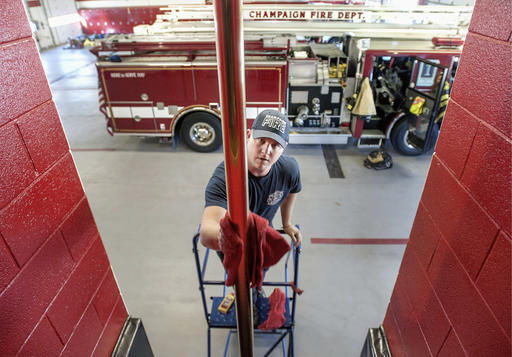
Over in the garage, firefighter Jeremy Hunt tests machinery. Soon, he'll be joined by Kocher, and the two of them will perform another unglamorous weekly duty at Station 1 — waxing the old-school poles firefighters slide down in case a call comes in when they're upstairs. Of the six firehouses in Champaign, 307 S. Randolph St. is the only one that's two stories tall.
"The poles aren't common anymore," says the 39-year-old Ball, who joined the CFD in 1999 after moving over from Decatur. "They're a huge expense, and there just aren't many two-story firehouses anymore."
Last year, Station 1's squad vehicle was the busiest in the city, responding to 2,689 calls. The house also claimed the most active ladder truck in the department, with 1,120 calls.
Today is a slow day for calls — real ones, anyway. Just after 9 a.m., Capt. Roger Cruse and others on shift return on a ladder truck. They've been training at the Illinois Fire Service Institute, and they reek of smoke.
"Around here, we call that cologne," Fire Chief Gary Ludwig says.
Cruse and his crew have spent part of the morning brushing up on how to respond to mayday calls, those frightening instances when a firefighter needs to be rescued by colleagues while battling a blaze.
At 9:15, it's others' turn to head to Campustown for the same exercise. Once at the institute, Kocher, Diel and Jeremy Allen strap on full fire suits, oxygen tanks, masks and helmets — about 75 pounds' worth of gear — and brace themselves.
Mayday calls have been on the rise nationally — there were 563 during one recent stretch, according to a survey of 843 departments in 47 states, session co-leader J.P. Childers tells Kocher, Diel, Allen and firefighters sent here from other stations.
Today is about sharpening skills.
In his first 26 years as a firefighter, Capt. Gary Gula informs the group, his department didn't have a single mayday call. But in this business, everyone on hand knows all too well, that sort of streak doesn't often last.
In March 2013, Gula was on the scene of a house fire when he fell down a flight of stairs. It was one of two mayday calls for the department in a short time span.
"They came down pretty quick and pulled me out within five, six minutes," says Gula, who suffered multiple injuries that required four operations.
He was out of work for 16 months, he told the group.
"It doesn't happen a lot, but you've got to be ready for it," Gula says afterward. "I can tell them that experience first-hand on both sides of it."
During these drills, Gula will be "saved" another three times. Teams of three or four firefighters take turns getting the captain safely out of a smoke-filled structure at the institute that resembles a diner.
Ludwig's here, too, all geared up.
Routine training exercises like this aren't required of the 57-year-old chief, but he's a big believer that hands-on leaders set the best examples.
He has been in Champaign for about 17 months, taking over the department after stints in Memphis and his hometown of St. Louis. He became a firefighter just a couple months out of high school and has been at it for 39 years.
Ludwig grew up a few blocks from a station in south St. Louis, downwind from the Anheuser-Busch Brewery, where "you could smell the hops and the yeast and the barley."
"One day, my mom took me to the fire station, and the guys just treated me fantastically," he says. "When I got older, I bought a scanner so I could listen to the calls. I was hooked on the profession."
If there's one thing he could change, it would be the look of his firefighting team. It's all-male and mostly white, not nearly as diverse as other cities he has worked in.
Champaign's last female firefighter left for the East Coast in the last year.
"One of my priorities is increasing my minority population and my female population," Ludwig says. "I believe in a diversified workforce because I've seen it work. I've seen it work in St. Louis and Memphis. I think we're stronger as an organization when we're diversified."
Gula's work at the institute wraps up at 11:20. As trainees remove their masks and chug bottles of water, he leaves them with a few parting words.
"We've got to be prepared if something like this happens," he says. "This is our environment; that's our office."
The job isn't all serious all the time. On their drive back to CFD headquarters on Randolph Street, Diel and Kocher tease Allen about his good looks.
"Jeremy is hot," Diel says. "Like, model hot."
On South Neil, people in cars wave at the three of them while gawking at their fancy ride.
Back at Station 1, Cruse and Lt. Tyler Funk are preparing lunch. On today's menu: grilled cheese sandwiches with salami, tomato soup, potato chips, cottage cheese, cole slaw and applesauce.
"Wash 'em up, it's time to eat," Funk announces over the station intercom at 11:50.
Meals are served on a large wooden table with place settings for 12. Every day, firefighters on shift each pitch in $5, which someone from the house will collect and use to buy something to cook.
Ludwig calls lunch "the best time of the day" — a break for everyone to come together and catch up.
The chief takes a moment to update one member of his team on the arrangements for the victims of last weekend's deadly fire. Ludwig says he has been in contact with the families of Christian Sheehan and Sara Shuler, and CFD plans to have a presence at services for both.
"Just to let them know they have our support," he says. "If they need anything from us, we'll be there for them. The whole department feels that.
"Our firefighter who pulled the man out of that house, that hit him hard. There was smoke all the way to the floor there, and he didn't hesitate."
To become a firefighter in Ludwig's department, candidates must spend six months at the institute and become certified EMTs, which involves about another semester-and-a-half's worth of training.
Danger aside, it's good work if you can get it.
According to figures from the city, a probationary firefighter, like Kocher, earns between $55,417 and $69,011 a year. Full-time firefighters make between $58,250 and $66,750, engineers between $71,300 and $88,589, lieutenants between $79,786 and $99,195, captains between $94,144 and $116,956, and chiefs and deputy chiefs between $120,048 and $162,080.
It's a different world than it was when Ball came aboard in 1999.
Back then, he says, "it seemed like everyone had a side job. Plumbers, electricians, carpenters. We had a bricklayer. Today, there's probably more working spouses, so more guys stay home on their off days and take care of their kids, but we've still got a few."
There are opportunities to earn extra cash on off days. Ball teaches a Hazmat class in Bloomington and an occasional course at the institute.
Kocher, who is recently married, spends his off days getting work done around his new home.
Allen had off-day jobs before he had kids. Now, he moonlights "taking care of my 3-year old. My wife works full time and coaches. For the most part, I'm home with my daughter."
One rule at Station 1: He who cooks is excused from 12:30 p.m. dish duty.
It's a three-man cleanup crew today — Allen on dishes, engineer Courtney Moravek on table and counter wipe-down and, unfortunately for him, Diel on the stove. He accidently touches one of the hot burners, which singes his hand. He's all right, though. He has felt worse.
The hour after lunch is relaxation time — some firefighters head for the beds upstairs, others fiddle with their phones or catch a short nap in front of the TV in the lounge.
"We like for our guys to get some rest," Ludwig says. "Studies have shown that with sleep deprivation, you're slower to make those tough decisions."
At 1:30 p.m., it's back to work.
It's the rescue truck members' turn to head to the institute for training. Outside, Moravek and Funk inspect the ladder truck. Kocher and Ludwig climb inside the basket at the end of the ladder, and Kocher operates it, extending about 60 feet into the air and showing his boss he knows what he's doing.
"It's not very hard to operate, but in an emergency situation, you don't want to be testing that thing out and getting used to it for the first time," Ludwig says.
The 24-year-old Kocher is eight months into his yearlong probationary period. He'll become eligible to be a full-fledged firefighter on Aug. 10.
As a kid growing up in Mahomet, he was drawn to sirens and lights, and he loved fire trucks. When he got older, he worked at Mahomet's volunteer department, feeding off the adrenaline rush he would get from helping those in need and putting out small fires.
"That's when I decided I wanted to make it a career," he says.
Every shift, Kocher peppers his elders with questions. Station 1 veterans often put him on the spot, pulling equipment from a truck and asking him what it is and what it's used for.
"They do it in a crawl, walk, run phase," he says. "I believe I'm at a point where they're able to start throwing more stuff at me, and I'm able to handle it."
Around 2, Kocher takes the wheel of a reserve fire engine and gets a driving lesson, with Diel and Allen onboard.
"Let's go to the city garage," Diel says.
They're going to check on a truck that's being serviced after blowing the engine.
But five minutes into the lesson, there's a change of plans. A call comes in: A wheelchair-bound woman has fallen at an apartment building on North Prospect, and a public assist is needed.
"Pull over," Diel tells Kocher.
Allen reaches in the back of the truck for a white binder with detailed maps of all of the city's apartment buildings. He grabs the right page, jumps out and takes the wheel.
Engine 155 beat them to the address. After spending five minutes inside to help, Engine 151's work is done. And Kocher's driving lesson resumes.
On the way to the city garage, Allen gives Kocher a tutorial on the various lights on the dashboard.
He's a pro — as the engineer, it's Allen's job to drive the truck and know every inch of it. He pumps the water from it and can recite all of the tools inside it.
Growing up the son of a volunteer firefighter in Mahomet, Allen has a lifetime's worth of experience. But this wasn't part of his original career plan.
Allen earned a bachelor's degree in kinesiology/athletic training from the University of Illinois, went to graduate school at Michigan State University and took a job with Carle's sports medicine division.
"I wanted to be more active, and I started looking at going this route," he says. "I've been doing it ever since."
Allen was hired as a CFD probationary firefighter in 2006. He was promoted to firefighter, then late last year jumped a rank to engineer.
His next step: lieutenant.
"Everyone's goal is to get promoted," he says. "You're trying to learn the next job. Every day, I try to learn something new about my current job, but also for the job of lieutenant so I can do a good job if I'm lucky enough to get promoted to that rank in the future."
One of the first calls Allen went on was a bad motorcycle accident where a victim was down and unresponsive.
That, he says, was his ah-ha moment.
"Growing up, whenever you saw an accident or a fire or anything catastrophic, there was always somebody you'd call to help and make it better," he says. "There's nobody else for the firefighters to call — you are it. People are waiting for you to get there and make things better.
"It was a humbling experience, not something I take lightly. When people are having their worst day, they're calling me to come make it better."
___
Source: The (Champaign) News-Gazette, http://bit.ly/1N4cjBy
___
Information from: The News-Gazette, http://www.news-gazette.com
