Skip to main contentSkip to main content
Register for more free articles.
Log in Sign up
Back to homepage
Subscriber Login
Keep reading with a digital access subscription.
Subscribe now
You have permission to edit this collection.
Edit
Arizona Daily Star
101°
  • Sign in
  • Subscribe Now
  • Manage account
  • Logout
    • Manage account
    • e-Newspaper
    • Logout
  • News
    • Sign up for newsletters
    • Local
    • Arizona
    • Business
    • Crime
    • Nation & World
    • Markets & Stocks
    • SaddleBrooke
    • Politics
    • Archives
    • News Tip
  • Arizona Daily Star
    • E-edition
    • E-edition-Tutorial
    • Archives
    • Special Sections
    • Merchandise
    • Circulars
    • Readers' Choice Awards
    • Buyer's Edge
  • Obituaries
    • Share Your Story
    • Recent Obituaries
    • Find an Obituary
  • Opinion
    • Submit a Letter
    • Submit guest opinion
    • Letters to the Editor
    • Opinion & Editorials
    • National Columnists
  • Sports
    • Arizona Wildcats
    • Greg Hansen
    • High Schools
    • Roadrunners
  • Lifestyles
    • Events Calendar
    • Arts & Theatre
    • Food & Cooking
    • Movies & TV
    • Movie Listings
    • Music
    • Comics
    • Games
    • Columns
    • Play
    • Home & Gardening
    • Health
    • Get Healthy
    • Parenting
    • Fashion
    • People
    • Pets
    • Travel
    • Faith
    • Retro Tucson
    • History
    • Travel
    • Outdoors & Rec
    • Community Pages
  • Brand Ave. Studios
  • Join the community
    • News tip
    • Share video
  • Buy & Sell
    • Place an Ad
    • Shop Local
    • Jobs
    • Homes
    • Freedom RV AZ
    • Marketplace
    • I Love A Deal
  • Shopping
  • Customer Service
    • Manage My Account
    • Newsletter Sign-Up
    • Subscribe
    • Contact us
  • Mobile Apps
  • Weather: Live Radar
  • Facebook
  • Twitter
  • Bluesky
  • YouTube
  • Pinterest
  • Instagram
© 2026 Lee Enterprises
Terms of Service | Privacy Policy
Arizona Daily Star
News+
Read Today's E-edition
Arizona Daily Star
News+
  • Log In
  • $1 for 3 months
    Subscribe Now
    • Manage account
    • e-Newspaper
    • Logout
  • E-edition
  • News
  • Obituaries
  • Opinion
  • Wildcats
  • Lifestyles
  • Newsletters
  • Comics & Puzzles
  • Buyer's Edge
  • Jobs
  • Freedom RV AZ
  • 101° Sunny
Share This
  • Facebook
  • Twitter
  • Bluesky
  • WhatsApp
  • SMS
  • Email

These stories are covered in the Street Smarts quiz

  • Arizona Daily Star
  • Oct 2, 2022
  • Oct 2, 2022 Updated Oct 2, 2022

Street Smarts: Tucson's Garrett Avenue named for man who killed Billy the Kid

“Pat” Garrett, the 1880s sheriff famous for tracking, arresting and eventually killing outlaw Billy the Kid, is commemorated by a Tucson street name.

Patrick Floyd Jarvis “Pat” Garrett was born in 1850 in Chambers County, Alabama. When he was 3 years old, his family moved to a plantation or large farm in Claiborne Parish, Louisiana, in an area where his family would hold prominence and he would receive some education.

By the time he was in his late teens, his father and mother had died and their large farm was heavily in debt. Seeing little hope for a prosperous future there, Garrett headed west in 1869.

He arrived in Dallas County, Texas, where he worked as a ranch cowboy, followed in 1874 by time as a buffalo hunter based out of Fort Griffin, Texas, although sources disagree on how much success he had in the buffalo hide trade.

In 1876, Garrett found himself in a heated argument with a hunter named Joe Briscoe, which led to Garrett shooting and killing the man. While he was never prosecuted for this slaying, it ended his buffalo-hunting profession.

The following year he drifted farther west, ending up in Tascosa, Texas, and living as a cowboy. In 1878, he left Texas for New Mexico, where he was employed on a ranch for a year.

He next moved to Fort Sumner, New Mexico, where he was employed as a barkeep at a saloon. It was here he would make the acquaintance of William H. Bonney (namesake of Tucson’s Bonney Avenue), who was more commonly known as Billy the Kid.

Around this time Garrett married, but soon after, his wife died. He then wed her sister, with whom he would have eight or nine children.

In 1880, Garrett was elected sheriff of Lincoln County, New Mexico, and at once set about capturing Bonney, his former acquaintance.

At the time, Bonney was wanted for murder for gunning down a sheriff and a deputy. In the final month of the year, the new sheriff and his posse confronted Bonney and his men when they came into Fort Sumner, but Bonney and most of his gang eluded capture.

Garrett would once again get his shot when he and his posse tracked the gang down in the Stinking Springs area. After a short skirmish, Bonney and his men were brought back to stand trial.

In April 1881, Bonney was found guilty of murder and was sentenced to hang. But while awaiting execution he managed to escape, in the process killing two guards.

Garrett once again went on the hunt, riding to a ranch owned by a man named Peter Maxwell, whom he thought might know the whereabouts of the convicted killer.

At the ranch, Garrett is said to have shot and killed Bonney, one of the Old West’s most notorious outlaws.

As a result of the shooting and his sudden fame, a book, “The Authentic Life of Billy the Kid,” appeared in 1882 under Garrett’s name, but it was learned that his friend Ash Upson actually wrote it.

After his time as Lincoln County sheriff came to a close in 1882, Garrett moved his family to Texas and for a brief interlude served as a lieutenant in the Texas Rangers, in 1884. Soon after, he resigned and the Garrett family returned to their ranch in New Mexico. Garrett spent the following decade in unsuccessful business ventures including failed irrigation schemes for southeastern New Mexico.

Street Smarts: Garrett Avenue

“An Authentic Life of Billy the Kid” helped spread Garrett’s fame.

Library of Congress (LC-USZ62-87581)

He returned to law enforcement in 1897 as sheriff of Doña Ana County, primarily to solve the murder of Judge Albert J. Fountain and his son. Garrett remained in this position until his resignation in 1900.

In 1901, Garrett’s life seemed to be improving when President Theodore Roosevelt (who is said to have read his book) appointed him collector of customs in El Paso. He held this post for four or five years, but endured questions about his character as well as his lack of qualifications for the job.

When Garrett returned to New Mexico, he bought a horse ranch but had little success and was forced to lease part of his land to a man named Jesse Wayne Brazel.

In 1908, a dispute occurred between the two men over the lease, which led to Brazel shooting and killing Garrett.

In court, Brazel stated he shot Garrett in self-defense, and he was acquitted in a short trial.

Tucson’s Garrett Avenue was recorded in the Los Ranchitos No. 7 subdivision in 1948. This small south-side street is bordered by (Jeff) Milton Road and (Burt) Alvord Road (both also named for Old West lawmen) in a neighborhood that could be called Lawmen and Outlaws Square.

Street Smarts: Nationally known lecturer gave name to Tucson's McCormick Park

McCormick Park on Tucson’s north side is named for a nationally prominent marriage/family expert, magazine writer and advocate of progressive causes who lived here for four decades beginning in the 1930s.

Ada Peirce, who would later add the name McCormick through marriage, was born in 1888 in Bangor, Maine. Her family was involved in the lumber business, and one brother, Waldo Peirce, become an internationally known painter, while another, Hayford Peirce, was a noted author on Byzantine art.

Her godparents were Dr. Richard C. Cabot, a famous physician and Harvard University professor, and his wife, Ella, who would both be a large influence in her life.

Ada Peirce was educated at The Ogontz School for Young Ladies in Philadelphia, the Boston School of Social Workers and Radcliffe College, which is now part of Harvard.

Street Smarts: McCormick Place and Park

The McCormick home on Columbus Boulevard.

Courtesy of the Little Chapel of All Nations

While brought up in a home that neither encouraged nor barred religion, after a stay with her godparents, she decided at age 23 to be baptized in the Episcopal Church.

In 1912, Ada met Fred C. McCormick, a Princeton graduate, and a three-year letter-writing romance began .

The “pen pals” wed in 1915, with the couple deciding to live in Fred’s hometown of Williamsport, Pennsylvania, where he worked with his father in his fire insurance business.

While Ada had written in the past, in 1924 her potentially most enduring piece was published in Harper’s Magazine. It was entitled “Richard: A Portrait of a Little Boy” and was about Theodore Roosevelt’s grandson.

Her account shares a brief but meaningful period of her life, at her summer home near Otsego Lake, New York, in 1922.

She had been asked by her neighbors, Dr. Richard and Ethel Derby, to watch their children, Richard Jr., Edith and Sarah.

The 8-year-old boy, Richard, whose death would soon follow their short time together, amazed her with his honesty, genuine selflessness and faith in God, she wrote, causing her to reevaluate what greatness in a human being really was.

By February 1930, Ada was a nationally known lecturer on marriage and family, and was a winter visitor to Tucson. That year she is known to have sponsored a speech at the University of Arizona by Ida M. Tarbell, a well-known journalist and biographer.

Street Smarts: McCormick Place and Park

The Little Chapel of All Nations on Highland Avenue.

Courtesy of the Little Chapel of All Nations 1958

In 1932-33, the McCormicks purchased property on both sides of Columbus Boulevard south of Ft. Lowell Road in a sparsely populated desert area and would construct a two-story home on the west side of the street.

Around 1937, the McCormicks bought an adobe duplex on the corner of Highland Avenue and First Street. In the tiny garage attached to the home, Ada created The Chapel of Wandering Scholars, which was open to University of Arizona Episcopal students and faculty.

By 1943, its name had changed to the Cabot Chapel, in honor of her godparents. The Cabot Chapel was moved temporarily to Olive Road in mid-1945 but was back on Highland Avenue by late 1946. In 1954, the chapel was incorporated as the Little Chapel of All Nations and at that point or a few years before became non-denominational, open to all faiths.

Years later, the adobe duplex was torn down and a new brick structure replaced it, called the Ada Peirce McCormick Building, which included the Little Chapel of All Nations. Today, it also includes the offices of the Southwest Center and the Journal of the Southwest magazine.

Around the beginning of the U.S. involvement in World War II, Ada led a campaign to provide a USO center for African-American soldiers, who couldn’t use the regular USO. In time, her efforts resulted in one being created in the Estevan Park area, along Main Avenue.

As a result of her dedication to equality for black soldiers, she was given a plaque signed on the back by many individuals who appreciated her work, including Morgan Maxwell Sr., the longtime principal of Dunbar School and the namesake of Morgan Maxwell K-8 School, 2802 W. Anklam Road.

During much of the 1940s, Ada published a small magazine called Letters in which she supported the war effort and advocated for her progressive causes.

She wrote many of the articles herself, in addition to including stories that previously ran in other media sources such as Common Sense magazine, the Saturday Evening Post and the Ladies’ Home Journal.

Hayford Peirce Jr., Ada’s nephew, shared this story: “In 1948, upon publication of Alfred Kinsey’s Sexual Behavior in the Human Male, Ada was horrified. Ada, in spite of her progressive views, or perhaps because of them, was a stern moralist. Although she had numerous objections to the Kinsey Report, according to my mother, it was that the Report had stated flatly that many American women had been unfaithful to their husbands during their service overseas during World War II. That, according to Ada, was clearly impossible. So, with the resources of her magazine behind her, she set out to disprove the findings of the best-selling Report. To do so, she began to accumulate evidence of her own.

“At some point after this my mother made a visit to Tucson and incautiously agreed to stay at Ada’s house. For a person of her means, Ada’s home was curiously small. A somewhat dilapidated stucco building in the local style, it had a small second floor with only two bedrooms and a bathroom. The entire house, as well as the various outbuildings, was filled to overflowing with books, folders, letters, and papers of all sorts. Ada showed my mother up to her room on the second floor, and then to the bathroom. At which point Ada only now appeared to notice that the bathtub was entirely filled with books. ‘Oh,’ said Ada apologetically, ‘those are the books I’ve assembled to refute the Kinsey Report.’”

Street Smarts: McCormick Place and Park

Ada Peirce McCormick Building in 2017.

David Leighton

In 1974, Ada P. McCormick died and, with her husband already deceased, she willed her two-story home and land on both sides of Columbus to the YMCA and YWCA.

The two organizations decided to sell the land on the east side to the city for a park, with the agreement that the YMCA could operate a recreational center there.

In 1975, the Tucson City Council named it Ada Peirce McCormick Park, more commonly known as just McCormick Park.

The land and home on the west side of Columbus and a little bit of land on the east side was sold to Jeffrey A. Bohm and The Bohm Co., who a few years later constructed McCormick Place Townhomes Block I and Block II on the west side and then McCormick Place Townhomes, Block III on the east side.

Bohm said he derived the name from nearby McCormick Park, and added the street name Allison Road to his subdivision to honor his daughter.

When McCormick Place Townhomes Block I was first recorded, the entrance street had no name. But some maps now list the entrance street as McCormick Place, though this may be an error.

Street Smarts: Tucson's Magee Road got its name from 1929 homesteader

Homesteading - or claiming federal land with the intent of living on it and improving it - gave a prominent northwest-side street its name.

Lt. Col. John Arthur Magee homesteaded some land on Tucson's northwest side. In an interview with his granddaughter, Catherine Euler, a few years before his death, Magee said: "Homesteading was the interest of many in 1929. We homesteaded 640 acres, 10 miles northwest of Tucson. I had learned that a homesteader wished to relinquish his claim on this land, so I bought his little frame house a mile west of Oracle Road at the northwest corner of what became Magee Road and La Cañada (Drive). We lived there four or five years and got a patent deed to the section."

Magee was born in 1899 in the New York City borough of Queens to John W. Magee, a lawyer, and Florence (Hull) Magee. He came to Tucson in 1919 and earned his degree from the University of Arizona in 1924.

While at the university, he played for the first university polo team, which competed in the U.S. Polo Championship against Princeton in 1924.

At college he also met his future wife, Catherine Fowler. They married in 1925.

After graduation, Magee entered the U.S. Forest Service and was stationed in the Santa Rita Mountains at the Southwest Experimental Station.

Magee was chairman of the Chamber of Commerce's New Industries Committee, which began the city of Tucson's acquisition of the land now occupied by Davis-Monthan Air Force Base. He served in World War I in the Navy, and spent two years after World War II, 1947 to 1949, in Japan with the 24th Infantry Division and 8th Army. While there, his wife taught English to Japanese teachers.

In 1950, Magee returned to the U.S. Forest Service, this time in California. He retired eight years later and returned to Tucson. He remained active through the Southern Arizona Hiking Club.

Catherine Magee spent several years as director of the Beacon Foundation. She also authored two novels, "The Crystal Horse" and "One of the Family."

John and Catherine had four children: Jack, Betty and Bob, who were born in Tucson, and Sally, who was born in San Diego.

Jack died in 1990 and Catherine in 1987.

Magee Road was officially recorded with Pima County in 1931 and is named in honor of John and Catherine.

Editor's note

Each week the Star will tell the stories behind Tucson street names. If you have streets to suggest or stories to share, contact writer David Leighton at streetsmarts@azstarnet.com

Sources: Special thanks to Jane Eppinga, author of the book "Saguaro National Park"; Yvonne Magee and Sarah "Sally" Magee Moffett; Catherine A. Euler, "The Life of John Arthur Magee, Sr.: Early Arizona Homesteader," self-published, 1985 (In private collection); John A. Magee obituary, Arizona Daily Star, May 20, 1990; "Services are set for John Magee; teacher, soldier," Arizona Daily Star, May 20, 1990; "Catherine Magee dies; ran agency," Arizona Daily Star, March 15, 1987; Office of Vital Records; Homestead Records - U.S. Bureau of Land Management

Street Smarts: Tucson neighborhood originally was chicken colony

A south-side neighborhood began as a colony for people who raised chickens.

Its developer, Alfred J. Emery, was known as the “Judge Emery” because of all the judging he did at poultry contests across the United States.

He was born on Oct. 23, 1879 in Petrolia, Pennsylvania and studied poultry and dairy husbandry at Pennsylvania State University.

He married Elizabeth Shields in about 1901 and they had several children including Mildred, Camilla, Enos, Jack, Joseph and Paul.

From 1907 to 1913, he was the chief dairy inspector of Oklahoma. He then relocated to Petaluma, California, to take charge of extensive poultry interests. He later moved to Livermore, California, and founded what is said to have been the biggest poultry farm in the state.

He moved to Tucson in 1925.

On Jan. 30, 1926, Judge Emery, announced that he would begin construction of a poultry demonstration farm. He started clearing a large tract of land, five miles south of Tucson on the Nogales Highway to be converted into a poultry colony.

Part of the reason for the site, which was considered far out of town at the time, was its sandy-loam soil, which exposes itself easily to the sun’s rays when turned over and as a result ensures the killing of germs, maintaining a healthier environment for chickens.

The following month, ads for Judge Emery’s Poultry Colony, more commonly known as Emery Park, began to appear in the Arizona Daily Star, some giving the names of individuals from out of state who had purchased property in the new development.

Judge Emery would give instruction on raising chickens and laying eggs at the demonstration farm, which was was built on five acres. It was also the location of the large incubator house where the hatching for the entire colony was done.

All the colonists received their baby chicks at the exact rate it cost the demonstration farm to produce. White Leghorns were principally raised there because of their high egg production compared to other types of chickens.

Each individual or family that became a part of the colony came in under the same plan. Each received a tract of 2ƒ acres of land, with the homes being individual to suit the owner but constructed with certain restrictions. The rest of the equipment and buildings were uniform in measurements and character for almost all the homes.

The house was in the middle and near the front of the each tract, with a 3,000-gallon redwood water tank to the rear of the house. An electric motor pulled water from about 50 to 60 feet below ground to the water tank. On the north side of the land was the brooder house and behind it, to the west, was the garage, with the chicken coops attached to the garage in a long building.

Shade or fruit trees, such as peaches or apricots, were planted and the remaining land was used to grow food for the family or greens, such alfalfa, kale, chard and cabbage, which were used to feed the chickens.

Just to the east of Emery Park was the Aguirre Station and siding that was part of the Southern Pacific and Southern Pacific de Mexico railroad line. The close proximity of the station and the colony made it easy for colonists to travel to Tucson and to transport poultry products, although Emery Park had its own trucks to carry products to Tucson and other areas.

The Emery Park Post Office was also set up at some point along Nogales Highway, near present-day Bilby Road. For many years it operated as an independent post office until becoming a branch of the Tucson post office system.

In an April 1927, interview Judge Emery stated: “Ninety-five percent of the persons located at Emery Park have no experience in raising poultry … in fact, it is preferable that they have no experience to start with, for they are more teachable when they do not come to the colony with preconceived notions as to how the thing should be done. Among our colonists we have all kinds of trades and professions. There are laborers, mechanics, North Dakota farmers, bankers and druggists.”

One of the families that arrived at Emery Park in 1928 was the Korte family, which included Edward and Grace, along with children Dennis and Marcella with son Gerald being born the following year. Edward had been a tool and die man for the Ford Motor Co., in Dearborn, Michigan. He had developed severe asthma, likely as result of his service in World War I, and was looking for another place to live for his health.

His son Dennis, born in 1925, lived in the poultry colony from the time he was 3 years old until he was 17. He remembers attending the Sunny Side School (now Sunnyside) that had been built around 1927 and was on the southwest corner of Valencia Road and Nogales Highway. He recalls it was a two-story brick building that had four classrooms with an auditorium upstairs. The school served first through eighth grades with two grades per class.

He remembers that every morning all of the children, many of whom were from Emery Park, would gather in front of the flagpole by the main entrance and recite the Pledge of Allegiance.

As time passed, Judge Emery — who was quite successful in his business venture — began to purchase more and more land in the area and bought a large parcel northeast of the original Emery Park.

In March 1928, Emery recorded the plot with Pima County as Emery Park Unit #6 subdivision, along with several streets named after family members. Camilla Avenue (now part of Park Avenue) was named after his daughter, Elizabeth Avenue (now abandoned) was named after his wife, and Mildred Avenue (now abandoned) named after another daughter.

He also gave some streets names that relate to poultry such as Bantam Road, Minorka Road (correctly spelled Minorca), White Rock Avenue, Leghorn Avenue and Wyandotte Avenue (now part of Campbell Avenue). Much of this land is now the South Lawn Memorial Cemetery.

By September 1929, Emery Park comprised about 2,000 acres and Judge Emery may have owned more land that wasn’t yet part of Emery Park. The following month the Crash of 1929 took place and the Great Depression began. Judge Emery’s dream colony collapsed, although the Emery family held on for a while.

On Dec. 1, 1935 son Jack Emery, a clerk at Steinfeld’s department store, died and was buried at Holy Hope Cemetery. The following year is believed to be the final year the family lived in Tucson.

Note: In the late 1940s, parts of the original Emery Park were re-subdivided under the name San Xavier Vista by Albert and Adelia Walker, Harold and Anna Schilling, and Everett and Vivian Dunton. The streets Walker Place, Schilling Place, Dunton Avenue and Vivian Drive were recorded by these individuals.

Street Smarts: Toole helped bring railroad to Tucson

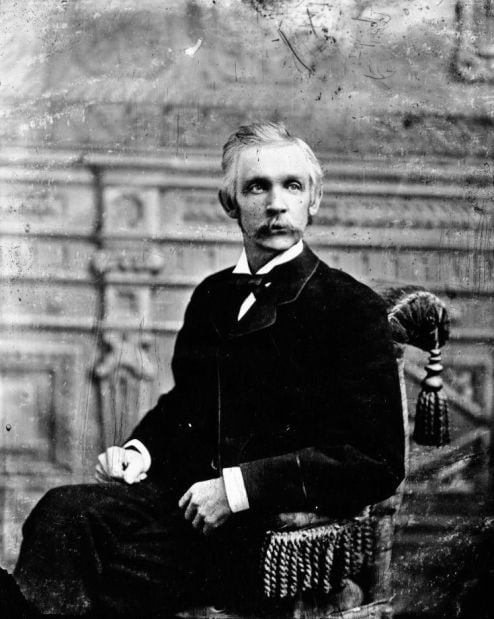
James H. Toole, born in 1824 in New York, began his career in the mercantile business in New Orleans, but traveled to California during the gold rush in 1849.

He was a miner in Placer County until 1861, when he joined the Union Army. He became a 2nd lieutenant in Company G of the California Column, and with his company he came to Tucson in 1862. While here, he served as acting assistant quartermaster and commissary from May 30, 1962, to Jan. 9, 1863, then was promoted to 1st lieutenant and transferred to field and staff as regimental quartermaster on Jan. 10, 1863.

James H. Toole

James H. Toole came to Tucson with the Army in 1862 and was first elected mayor in 1873.

Arizona Historical Society, photo B#93,412

He was transferred to Company D on May 19, 1863, in Tucson, and remained here until he was transferred to Las Cruces, Territory of New Mexico, on Nov. 28, 1864. His final stop during the Civil War was El Paso, Texas, where he was discharged on April 5, 1865.

Toole returned to the Arizona Territory and, in 1867, purchased the sutler’s store at Tubac, where he also provided a club room for military officers.

For a few months, in late 1868, he was the adjutant general of the Arizona Territory, in charge of the state militia. The following year he sold his interest in the La Paz silver mine 12 miles west of Tucson.

Two years later, he was listed in the 1870 U.S. Census as a retail merchant, with $2,500 in real estate and $20,000 in his personal estate. That same year, on Oct. 3, 1870, Gov. Anson Peacely-Killen Safford appointed him to the Pima County Board of Supervisors to replace E.N. Fish.

In April, 1872, Toole’s poor health induced him to leave Tucson and return to New York. While on leave, John B. “Pie” Allen (namesake of the Pie Allen Neighborhood) rented his place. He returned in late October with his health restored and, by December, he — along with Gov. Safford, Judge Titus and Dr. J.C. Handy — were looking into mines in Sonora, Mexico.

In January 1873, Toole was elected mayor of the Village of Tucson for a year. That April, he wed Louise M. Dexter, and the couple spent their honeymoon touring Guaymas and other towns in Mexico. They would go on to have five children: James Jr., Robert, Richard, Anna Belle and Catherine.

He was a popular mayor and won 100 of the 101 votes cast in the 1874 re-election. On May 1, 1875, the Arizona Citizen newspaper reported that the by-then former mayor was spending his time conducting research in the “exact sciences.” He was experimenting with ways to get his hens to produce bigger eggs. Toole challenged anyone in Tucson to a competition in producing a larger egg.

On Sept. 23, 1876, the Arizona Citizen declared to a hopeful, but trainless, Tucson: “In three years, the people of this section, and very likely those of Tucson, will daily hear the cheery and energizing sound of the locomotive whistle.”

Toole was once again elected mayor in January 1878. By November, surveyors for the Southern Pacific Railroad were in Tucson, surveying out a route for the train.

L.C. Hughes, editor of the Arizona Daily Star, wrote on May 1, 1879: “The first sound of the locomotive’s whistle will be the notice of a new life for our city and its vicinity, and we look forward to the time when the last spike is driven that connects Tucson with the outside world by a band of iron with a degree of pleasure that we cannot describe.”

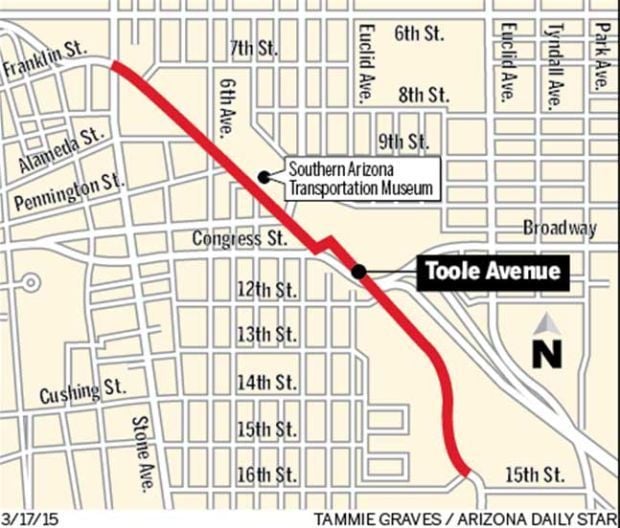
Toole, who had been re-elected mayor for a fourth term, and the City Council met with Col. George Gray, chief engineer for the Southern Pacific Railroad, on May 14, 1879. Gray asked for a 100-foot- wide strip of land for tracks to be laid at a northwest to southeast angle across the undeveloped northern part of the village. He also requested a 350-foot wide parcel of land for a freight and passenger depot, as well as a dozen city blocks close by for maintenance facilities, repair shops and roundhouses. All of the railroad’s wishes were granted, free of charge.

Toole and the council called a special election to decide if $10,000 worth of bonds should be issued to defray the cost of obtaining sufficient right-of-way for the railroad. Voters approved the issue and the city government began acquiring the land requested by the railroad.

Toole wrote to Gray: “It affords me pleasure to say that our whole people have heartily cooperated with the corporate authorities in accomplishing the very liberal requirements of your company, and we confidently look for the early completion of your road to Tucson to give a new impetus and prosperity to our city.”

On Aug. 8, 1879, the Arizona Citizen announced that, two days earlier, the City Council had passed Ordinance No. 20, providing for the opening of Toole Avenue.

On March 20, 1880, R.N. Leatherwood, then the mayor of Tucson, greeted the Iron Horse and officials of the Southern Pacific Railroad. Estevan Ochoa — who, along with Pinckney R. Tully, owned one of the most successful freighting businesses in town — was one of many prominent citizens to make speeches. Ochoa presented Charles Crocker, a top official with the railroad, with an engraved silver spike crafted from the first bullion produced by the Tough Nut Mine in Tombstone. Anyone who was anyone in Tucson attended the celebration of the arrival of the train that day.

Toole later became a principal member of the banking firm of Safford, Hudson & Co. (later called Hudson & Co.). When the firm went out of business, the loss took a toll on Toole, both financially and mentally. He lost everything except for his home on the corner of Stone Avenue and Ochoa Street. After sending his wife and children to Beaver Falls, Wisconsin, to stay with her relatives, he boarded a train to join his family. Stepping off the train, onto the platform in Trinidad, Colorado on Oct. 15, 1884, he shot himself and died instantly.

He was buried at Oakwood Cemetery in Beaver Dam, Wisconsin.

Note: It’s believed that Toole’s children went to live with relatives in Iowa, since they appear in the 1885 Iowa State Census.

Street Smarts: Tucson Indian School taught hoeing, sewing

Tucson once had an Indian School and a street named after it — but both are gone.

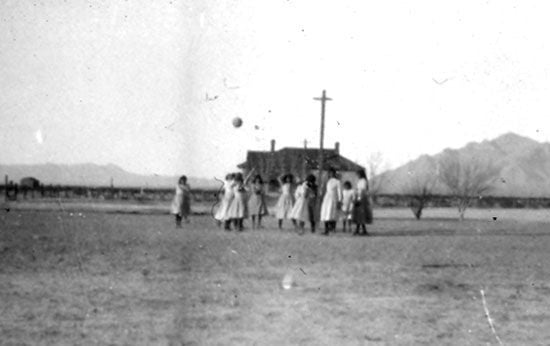
On August 24, 1886, T.C. Kirkwood, superintendent of the Board of Home Missions of the Presbyterian Church, petitioned the Tucson Common Council for a grant or extended lease on 15 acres of land just west of the university to build an industrial school for Native American boys. The council let a 99-year lease at $1 per year for an area of four blocks near the university. The Board of Home Missions then purchased 42 acres on the Santa Cruz River from Sam Hughes for its farms.

While the school was being built in early 1888, Mary Whitaker used a temporary site — the old adobe public school building on Congress Street — to teach about 10 pupils. Later that year, the school’s first permanent superintendent, Rev. Howard Billman, arrived and the school opened with 54 boys and girls.

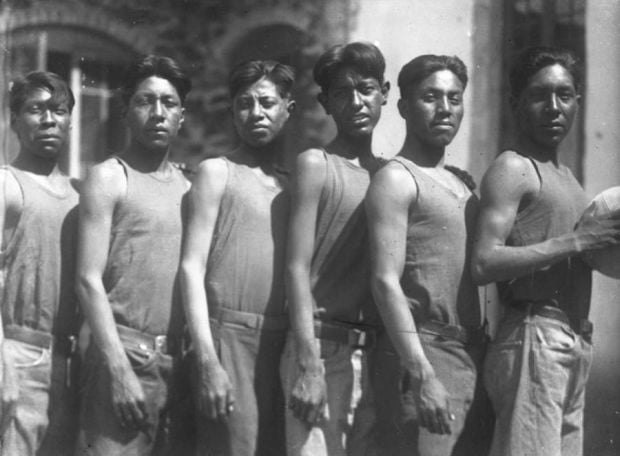
The new boarding school was semireligious. Boys learned trades such as farming, blacksmithing, carpentry and tinning, while girls were taught sewing and similar skills.

In 1890, additional buildings were finished. The stone and adobe work was done by Jules Flin, whose daughter Monica later founded El Charro Restaurant. Even with the additional space, the school soon became inadequate for the demand and students had to be turned away. The following year, Fort Lowell was abandoned and transferred to the U.S. Department of the Interior for use as an Indian school, but it appears it was never used for this purpose.

In 1894, the Tucson Indian School became the last of the schools run by the Presbyterian Church to stop accepting government aid. The same year, boys from the school helped build a small bridge and built chairs for a new Native American church, while the girls sang in a cantata, a religious-themed musical work, at an opera house in town.

By 1895, Rev. Billman had become the second president of the University of Arizona and the Rev. Frazier Herndon became superintendent of the Tucson Indian School. Herndon, who came from Missouri, soon wed one of the teachers, Elise Prugh. Under his direction, the school entered into a contract with the city of Tucson to grade and maintain streets as a way to raise funds. He also expanded the curriculum and brought in more students. One student, Jose Xavier Pablo, who may have been the first Tohono O’odham to graduate from the school in 1903, later became a leader in the tribe.

Around 1903, Rev. Herndon set up the Papago Mission (sometimes listed as an Indian school) around what is now 22nd Street and 10th Avenue. From there, he and his wife carried out missionary work with the Tohono O’odham. In 1904, when George Pusch recorded a subdivision called the Native American Addition just north of that location, he recorded four street names: Papago Street, Sacaton Avenue, Quijotoa Avenue and Herndon Place. The latter was named in honor of the Herndons and still exists. The other three seem to have disappeared in the 1950s.

The school next was under the direction of Rev. Haddington Brown, who along with the Presbyterian Board of Missions on Dec. 31, 1906, purchased the land near the university from the city for $480 and resold it to a developer for a sizeable profit. Then, in 1907, the Board of Missions bought 160 acres just east of the Santa Cruz River and about 4 miles south of downtown for a new school.

On March 25, 1907, the Escuela Post Office was set up on campus, with Rev. Brown as postmaster. The name was chosen after the U.S. Post Office rejected the name Indian School Post Office. Many people came to know the Tucson Indian School as Escuela. The new school opened in the fall of 1908.

In 1912, Pima County made the dirt path in front of the new school a county road, but it doesn’t appear the road was given a name.

The school went through several superintendents until 1915, when Martin L. Girton took the helm for 26 years. By 1920, it appears that the name Indian School Road was in use.

In a pamphlet written by Girton in the mid-1930s said, “The school was originally organized for two tribes: the Pimas and Papagos (Tohono O’odham), but at present the Maricopas and Apaches are also represented....Girls are graded on their ability to darn a stocking just the same as on their ability to ‘do sums’ (and) boys on their ability to handle a hoe as to recite history.” He also wrote that, the “School plant covers 160 acres, 60 acres under irrigation, has 9 buildings, capacity 130 pupils.”

In 1940, about 18 tribes were represented on campus. Around 1950, Indian School Road was made part of Ajo Way.

In 1960, the Tucson Indian Training School at 802 W. Ajo Way — then under its final superintendent, William D. Hennessy — closed its doors. Four years later the Tucson Citizen newspaper announced that the landmark was being razed to make room for a shopping center.

Street Smarts: Contest named streets of El Encanto Estates

The first known use of the land that El Encanto Estates now occupies was as part of a 160-acre homestead bounded by present-day Fifth Street, Country Club Road, Broadway and Palo Verde Avenue.

Henry J. Blaise received a homestead patent on the land from the U.S. government on April 1, 1907.

Blaise was born around 1861, in Iowa and married Agapita Saenz on April 27, 1901 in Pima County (likely in Tucson). They had a daughter, Rose, around 1902.

Blaise was involved in mining and owned at least one mine in Pima County, which he sold for $500 in 1904.

The 1910 U.S. Census lists him as a cattle rancher, 'working on his own account'. So while it seems unlikely today, this affluent neighborhood might have been, a least for a couple years, a small ranch.

In October 1910, Sheriff John Nelson seized the 160-acre homestead after Blaise failed to pay a debt of $466.30 to Albert Steinfeld & Co. The foreclosed land eventually was sold to Steinfeld's brother-in-law, Hugo J. Donau in March 1913.

Donau, born in Germany on June 18, 1870, moved around the United States before coming to Tucson in 1895 to follow his sister Bettina (Donau) Steinfeld and brother Alfred S. Donau. He worked for the merchant firm L. Zeckendorf & Co.,, which later became Albert Steinfeld & Co. He was also involved, with his brother, in the Arizona Land & Cattle Co.

Donau didn't hold the land for long, selling the 160 acres in June, 1913 to Urban Realty. The following year, that company sold a 10-acre portion at present-day Broadway Boulevard and Country Club Road to P.E. Fogle.

Around 1921, Leroy C. James was living at the corner of Broadway and Country Club and a few years later owned 10 acres of land, presumably the same parcel once owned by Fogle. On the site was a three-room cottage, believed to have been built prior to 1921 that is the oldest residence in the El Encanto Estates. The house still exists, although in an altered form, at 128 N. Country Club Road.

James was born on Sept. 13, 1879, in Yellow Springs, Ohio. He married Annette May Roper, on Dec. 16, 1908, in Columbus, Ohio, and they had a daughter, Florence in 1911. His marriage license application lists him as a salesman. By 1918 they lived in Phoenix with James employed at McArthur Brothers automobile dealership. They moved to Tucson in 1919 and James managed the McArthur Brothers' Dodge dealership at Broadway and Scott Street He later became president of L.C. James Motor Co He died in Los Angeles on May 18, 1944 but was buried in Tucson.

In 1925, Urban Realty sold the eastern 40 acres of the original 160-acre homestead to an investor in the El Conquistador Hotel. That land is now part of the parking lot of El Con Mall. The rest of the land was sold to William B. Powhatan.

Powhatan was born into a farming family in Spencer County, Ind., on April 29, 1880 and married Ethel C. around 1907. They lived for many years in St. Louis, Mo., where their daughter Betty was born, and where Powhatan was owner and manager of a theater. The family relocated to Tucson for health reasons and he became a land speculator, buying 600 acres in the Castle Rock Ranch area near Tanque Verde Road and later selling it for development. He was an avid hunter and spent his last 10 years in semi-retirement living at the Santa Rita Hotel before his death in 1959.

In 1928, William E. Guerin Jr. purchased all the land minus the 10 acres owned by James. Then Guerin, James and Powhatan, along with their wives, incorporated to form El Encanto Estates, Inc., with Guerin as president and Walter E. Lovejoy Sr., as assistant secretary.

Guerin was born Nov. 24, 1871 in Ft. Scott, Kansas. He grew up in Columbus and served in the Ohio National Guard from 1883 to 1889. He studied law at Cornell University in Ithica, N.Y., graduating in 1893. He returned home and practiced law in Ohio for many years and also served in the Ohio State Legislature. On Mar. 7, 1895, he wed Alice T. Greenleaf in Columbus and the couple had a daughter, Mary B. Guerin. Around 1928, the family relocated to Tucson, where Guerin became involved in the development of El Encanto Estates. He later had his own home built there, at 30 E. Calle de Felicidad. He died in San Diego on Jan. 8, 1960.

Lovejoy was born on Nov. 27, 1891, in Rippey, Iowa, and moved with his family to Tucson in 1906. He was in the first graduating class of 10 students at Tucson High School in 1910, then located in the building known today as Roskruge Bilingual K-8 School. After high school he worked for Nathaniel Plumer (namesake of Plumer Avenue) at the Southern Arizona Bank for many years and later was president and chairman of the board of the Arizona Trust Co. Mayor Lewis C. Murphy proclaimed April 17, 1974 to be Walter E. Lovejoy Day. He died in 1978.

Lovejoy's grandson, Walter E. "Bucky" Lovejoy III, who worked at Arizona Trust along with his father and grandfather, remembers a story that the elder Lovejoy told his wife, Hazel, that she could have any lot at El Encanto Estates that she wanted. She turned down the offer because it was too far for her son, Walter Jr., to ride his bike to University Heights School at Park Avenue and Helen Street. Instead they built a large home at 627 E. Speedway Blvd, which still stands.

El Encanto Estates advertised a contest to choose Spanish street names for the new subdivision and received more than 600 submissions. On July 29, 1928, the Arizona Daily Star announced that, "A committee of seven directors and officers (including L.C. James, W.E. Lovejoy Sr. and W.E. Guerin) of the sub-division organization made the awards."

Winning contestants were awarded $5 apiece. The article named the winners, along with the Spanish names they suggested and their English translations (although some are loose translations). Women who won were listed under their husbands' names, but their full names are included here:

Louise U. Sibley: Calle de Felicidad (Happiness Street) and Calle Portal (Entrance Street)

Milton M. Cohen: Calle Primorosa (Neat Street)

Isma C. Blacklidge: Calle Encanto (Enchanted Street)

Olivia Maxey: Calle de Amistad (Friendship Street)

Rose M. Scruggs: Calle Corta (Short Street)

Carrie G. Meyer: Calle Belleza (Beauty Street)

Juan Lujan: Calle Claravista (Clearview Street)

Bessie Strohmajer: Camino Miramonte (Mountain View Road)

Petra Diaz: Calle Conquista (Conquest Street) and Calle Mirasol (Sunny View Street)

Margaret S. Galvez: Calle Resplandor (Splendor Street)

Note: The El Encanto Estates subdivision, along with the street names, was recorded with Pima County on Aug. 1, 1928. The first house built was by a Mr. Nail in 1929 and the second was by Ralph E. Ellinwood, who was editor and co-owner of the Arizona Daily Star and wrote the book, "Behind the German Lines: A Narrative of the Everyday Life of an American Prisoner of War." He also came up with the name of the now-demolished El Conquistador Hotel, from which El Con Mall derives its name.

Related to this collection

Most Popular

Photos: Tucson Festival of Books returns

Photos: Tucson Festival of Books returns

Tucson Festival of Books is back through 5:30 p.m. on Sunday at the University of Arizona.

Photos: Arizona Wildcats gather with fans for Selection Sunday

Photos: Arizona Wildcats gather with fans for Selection Sunday

The Arizona Wildcats were given the No. 1 NCAA Tournament seed in the West Region, and assigned a first-round game Sunday in San Diego. Their …

Photos: Cologuard Classic Pro-Am day 1

Photos: Cologuard Classic Pro-Am day 1

Day one of the Cologuard Classic Pro-Am kicked off on Wednesday morning; bringing together professional and amateur golfers to play 18 holes a…

19 political cartoons target the war in Iran

19 political cartoons target the war in Iran

The nation's top cartoonists react to the U.S. and Israel's war with Iran. 

Photos: Wildflowers blooming in Tucson

Photos: Wildflowers blooming in Tucson

As the days grow longer and the temperature warms up, wildflowers are beginning to bloom along city roads and out on hiking trails.

Photos: Arizona baseball drops its midweek game to New Mexico 6-3

Photos: Arizona baseball drops its midweek game to New Mexico 6-3

The Wildcats erased a first inning deficit in the second, but gave it right back in the third, surrendering four runs in a 6-3 loss to the vis…

Tucson speaks up: Letters to the editor for the week of Mar. 13, 2026

Tucson speaks up: Letters to the editor for the week of Mar. 13, 2026

Our weekly round-up of letters published in the Arizona Daily Star.

Apache women seek court intervention to stop Arizona mining project

March 16 recap: Tucson news you may have missed today

Get a quick digest of today's top local news stories from Arizona Daily Star.

Photos: See stars arriving on the red carpet at the 2026 Oscars

Photos: See stars arriving on the red carpet at the 2026 Oscars

Stars were decked out for the 98th annual Academy Awards, the final stop on Hollywood's monthslong awards season.

Arizona Daily Star
  • Facebook
  • Twitter
  • Bluesky
  • YouTube
  • Instagram
  • Arizona Daily Star Store
  • This is Tucson
  • Saddlebag Notes
  • Tucson Festival of Books

Sites & Partners

  • E-edition
  • Classifieds
  • Events calendar
  • Careers @ Lee Enterprises
  • Careers @ Gannett
  • Online Features
  • Sponsored Blogs
  • Get Healthy

Services

  • Advertise with us
  • Register
  • Contact us
  • RSS feeds
  • Newsletters
  • Photo reprints
  • Subscriber services
  • Subscription FAQ
  • Licensing
  • Shopping
© Copyright 2026 Arizona Daily Star, PO Box 26887 Tucson, AZ 85726-6887
Terms of Use | Privacy Policy | Advertising Terms of Use | Do Not Sell My Info | Cookie Preferences
Powered by BLOX Content Management System from bloxdigital.com.
  • Notifications
  • Settings
You don't have any notifications.

Get up-to-the-minute news sent straight to your device.

Topics

News Alerts

Breaking News