

Justice on wheels; stink bugs spreading; worker shortage
- Updated
Odd and interesting news from the Midwest.
- By JULIE ANDERSON Omaha World-Herald
- Updated
OMAHA, Neb. (AP) — Cheryl Henry remembers putting on her first pair of glasses in second grade and getting a whole new view of her family's Iowa farm.
"Mom," she recalls saying, "did you know you can see to the end of the driveway?"
She switched to contact lenses as a high school freshman — she was a volleyball player — and had worn them ever since.
Recently, however, Henry, 63, threw out her contact lens solution.
She'd developed the beginnings of cataracts, so she scheduled the first of two cataract surgeries to replace her clouding lenses. On Sept. 1, the retired teacher became the first person in Nebraska to receive a new type of lens implant that offers a greater depth of focus than other available lens implants — improving vision at near, medium and far distances. It also reduces patients' reliance on glasses after surgery.
"To be able to have nothing," Henry said of life without glasses or contacts, "it's exciting."
Dr. Lance Kugler, the Omaha ophthalmologist who performed the procedure, said the Tecnis Symfony Intraocular Lens allows doctors to offer advanced lenses to a wider range of patients, some of whom couldn't have them before.
But even more important, he said, the lens' arrival highlights a string of advances that have helped bring cataract surgery into the modern age.
"Cataract surgery today is not your father's cataract surgery," said Kugler, who specializes in refractive surgery at his west Omaha practice.
The vast majority of patients receiving lens implants still are treating cataracts. In terms of sheer numbers, cataract surgery is the most common surgical procedure in the United States. Everyone develops cataracts eventually, if they live long enough. By age 80, more than half of Americans either have cataracts or have had cataract surgery.
But Kugler and other ophthalmologists said a growing number of people are getting lens implants before they develop cataracts, replacing natural lenses that have lost their ability to change shape and shift from near to far with age, a condition called presbyopia. Kugler said lens replacement is the fastest-growing segment of his practice.
Dr. Brent Timperly, an assistant professor at the University of Nebraska Medical Center's Truhlsen Eye Institute, said lens implants may be a good option for older people who are presbyopic and have lost near vision. Although any surgery comes with risks, cataract surgery is a relatively low-risk procedure.
"It is a coming thing for baby boomers," he said.
Dr. Michael Feilmeier, an ophthalmologist at Midwest Eye Care in Omaha, agreed that pre-cataract lens implants are a reasonable option for some patients, particularly those who aren't candidates for the cornea-correcting Lasik and those who are over 50.
But surgeons need to make sure patients understand that there is some risk, said Feilmeier, president of the Nebraska Academy of Eye Physicians and Surgeons. For men under 50 in particular, cataract surgery comes with a risk of retinal tear or detachment, said Feilmeier, who serves on a national cataract curriculum committee for the American Academy of Ophthalmologists.
Kugler said it's important to choose the right procedure for each patient based on individual eye conditions and what patient wants from the procedure. If patients have risk factors, he sends them to a retina specialist for an evaluation before surgery.
The recent advances are exciting because they offer more options. "It's not a miracle cure," he said. "It's not for everybody. Patient selection is key."
The Omaha World-Herald (http://bit.ly/2czvL24 ) reported that doctors started to replace natural lenses with artificial lenses in the mid-1970s. Those lenses, known as monofocal lenses because they focus at one point, work well for distance vision, but wearers typically still need reading glasses or bifocals to see clearly up close.
Dr. Guy Kezirian, a Scottsdale, Arizona, ophthalmologist and pioneer in the field, got lens implants a month ago. At 57, he'd become farsighted and had lost or broken a lot of glasses. He chose a monofocal lens because they perform better in low light, which he works in a lot.
"The job of the surgeon is to help match the right patient to the right technology," he said.
Multifocal lens implants came along about a decade ago. They focus light at different distances, functioning more like bifocal glasses. But those with astigmatism — corneas that don't focus well because they're more football-shaped than round — couldn't use them. Some users had side effects, seeing rings or halos around headlights or streetlights at night. About the same time, manufactures produced a lens that could fix astigmatism. It improved distance vision, but users still needed reading glasses.
"Everyone had some compromise," said Kugler, who heads a committee working on clinical guidelines with the Refractive Surgery Alliance.
The Symfony, made by Abbott Medical Optics and approved by the Food and Drug Administration in July, uses a different type of technology. Rather than splitting light into near and distant focal points, the layered rings in the lens extend the depth of focus. The lenses also can be used in people with eye problems, including mild macular degeneration, that rule out traditional multifocal lenses. And it comes in a version that fixes astigmatism.
Most cataract surgeries are done manually, a safe and accurate procedure. Kugler and others also have begun using the femtosecond laser, which was introduced in the United States in 2011.
Kugler said the laser allows him to correct astigmatism at the same time he's implanting lenses, and the laser's consistency and precision allow him to collect data to improve outcomes.
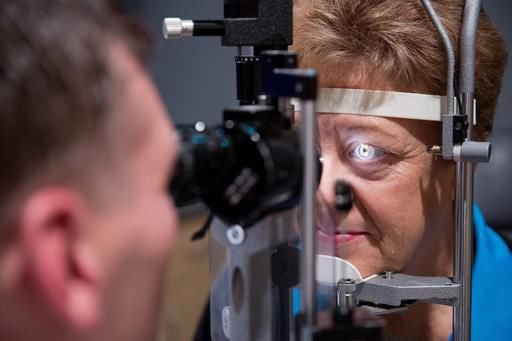
Before her procedure at the Miracle Hills Surgery Center, Henry's right eye was dilated and numbed. She received just enough IV anesthetic to relax her, then lay in a reclining chair. Kugler used the laser to soften her lens, which is inside the eye, and to make two tiny incisions in the cornea to treat her astigmatism. Time elapsed: two minutes, nine seconds. Then Henry moved on to an operating room, where Kugler extracted her lens through a tiny slit and inserted the new lens, which is about the size of a pencil eraser tip and has two tiny arms to secure it in the eye.
Back in a recovery area, Henry said she could see the face of a person across the room, something she couldn't have done before without glasses. At a follow-up appointment, both her near and distance vision were 20/20. She had her left eye treated Sept. 15. Two other ophthalmologists who operate at the Miracle Hills center, Dr. Matthew Brumm and Dr. Carol Drake, also implanted their first Symfony lenses this month.
Henry can now wake up and see her alarm clock without glasses. "It really is amazing to get up and be able to see," Henry said.
Henry's results are in line with those in a clinical trial of the Symfony lens. Dr. Jason Jones, a Sioux City ophthalmologist who participated in the trial, summarized the results in a recent journal article. In the randomized trial, 148 people received the Symfony lens in both eyes and 150 got monofocal lenses. Distance vision for the two groups was comparable, but intermediate and near vision without glasses was significantly better in the Symfony group.
The Symfony group also wore glasses less. Eighty-five percent of Symfony users reported wearing glasses "none" or "a little bit" of the time. The majority — 63 percent — said they never wore glasses, nearly twice as many as the control group. Most — 90 percent or more — reported mild or no halos, glare or starbursts.
The advanced lenses and lasers do come with more out-of-pocket costs than a traditional cataract surgery. Insurance and Medicare cover what's needed to fix a patient's cataracts, Kugler said. But neither covers the cost of laser corrections or advanced lens technology. Patients pay those costs, which can range from $2,000 to $6,000 an eye.
But Kugler said the costs generally are thousands less than the cumulative costs of glasses, contacts and solutions. And having corrected vision frees people to do what they want to do, whether it's pursuing an active lifestyle or being able to see cellphone screens, car navigation systems or the sports ticker at the bottom of the TV without stopping to put on glasses.
"The quality of life," Kugler said, "it's pretty hard to put a price on it."
___
Information from: Omaha World-Herald, http://www.omaha.com
An AP Exchange shared by the Omaha World-Herald
- Updated
CHICAGO (AP) — A federal grand jury in Chicago has indicted a man accused of fraudulently causing $13 million in losses at his trading firm while giving the appearance he was making profits.
Federal prosecutors say 48-year-old Thomas Lindstrom faces four counts of commodities fraud and four counts of wire fraud. Thursday's indictment says Lindstrom's losses led to the collapse of his firm, Chicago-based Rock Capital Markets.
Lindstrom is due in court Tuesday. A number listed for him was disconnected and it wasn't clear whether he had an attorney who could comment on his behalf.
Investigators say Lindstrom made trades knowing they would result in losses but not before temporarily appearing as having a substantial value. The indictment alleges Lindstrom obtained $285,000 with his scheme during a six-month period in 2014 and 2015.
- Updated
MACOMB TOWNSHIP, Mich. (AP) — A woman has been killed after calling 911 to report a dispute with her husband in suburban Detroit.
The Macomb County sheriff's office says gunshots could be heard over the phone when the call was made early Saturday. Deputies found the 38-year-old woman dead. Her husband apparently shot himself and was in custody at a hospital.
A 16-year-old son in the Macomb Township home was not physically hurt. The sheriff's office says there's no record of deputies visiting the home in the past.
Neighbors couldn't believe what happened. They said the couple appeared to be happy.
Benjamin Virga, who lives across the street, says he and the man joked about who had the cleanest car. Virga says gun violence "is truly an epidemic."
- Updated
ST. PAUL, Minn. (AP) — It's like a food truck, but instead of tacos it serves up free walk-up justice.
The Mitchell Hamline School of Law in St. Paul has unveiled a legal services van. The school plans to park the van in neighborhoods across Minnesota.
The St. Paul Pioneer Press (http://bit.ly/2dKQPCR ) reports the van will be staffed by students and supervised by college faculty. The bright-red, 31-foot RV is scheduled to make its first stop Oct. 7 in Mankato.
Law school dean Mark Gordon says donations covered the $40,000 cost of buying and retrofitting the 20-year-old van.
The van, nicknamed "The Wheels of Justice," was christened Thursday. Board chairwoman Helen Meyer says the van is designed to help "the silent and lost members of society who don't have access to justice."
___
Online:
http://mitchellhamline.edu/about/mobile-law-network
___
Information from: St. Paul Pioneer Press, http://www.twincities.com
- Updated
OMAHA, Neb. (AP) — The Douglas County commissioners are seeking a change to a major Omaha thoroughfare to honor of a Union Army general and his brother instead of a pro-slavery U.S. senator from Iowa.
But residents wouldn't notice a difference — the city's main traffic artery would still be Dodge Street.
The commissioners voted 7-0 Tuesday to ask Gov. Pete Ricketts to rename Dodge Street for Maj. Gen. Grenville Dodge and his brother, N.P. Dodge. Commissioner Chris Rodgers said state government approval is needed, because Dodge Street also is a state highway.
Executives with the Historic General Dodge House in Council Bluffs, Iowa, are pushing for the change in honor of the 100th anniversary of Grenville Dodge's death.
Many Omaha residents believe Dodge Street was named long ago for the two brothers and still honors their prominent Omaha family. But the Douglas County Historical Society has said it is named for Augustus C. Dodge, no relation to the brothers.
Historian Michael Todd Landis at Tarleton State University in Texas told the Omaha World-Herald (http://bit.ly/2cVy37G ) that Augustus Dodge was born and raised on a Missouri plantation with slaves. During his political career, the senator defended slavery, attacked abolitionism and endorsed the Kansas-Nebraska Act of 1854, which permitted the spread of slavery into formerly free territory, Landis said.
But Grenville Dodge, also famed as a railroad builder, fought for the Union Army, and his brother, N.P. Dodge, helped the war effort from home, said Danette Hein-Snider, memberships and special projects coordinator for the Historic General Dodge House. She and Dodge House Executive Director Kori Nelson asked the county board for the renaming.
Commissioner Clare Duda embraced the proposal.
"This is so fitting and appropriate," Duda said. "It is righting a little bit of a wrong that has existed for a long time."
___
Information from: Omaha World-Herald, http://www.omaha.com
- Updated
MUSCATINE, Iowa (AP) — Muscatine residents are being warned of a now-common phone scam with a new twist.
The Muscatine Journal reports (http://bit.ly/2d1vAZn ) that scammers are calling elderly residents around the eastern Iowa city pretending to be a grandchild. The scammers say they are in jail and need bail money before the call is cut off. Immediately afterward comes a follow-up call from someone claiming to be an attorney representing the grandchild and seeking bail money.
Kenneth Irwin says he was a recent target. The 78-year-old Muscatine man says someone claiming to be his grandson called asking for help, followed by another call from someone claiming to be the grandson's attorney. When Irwin peppered the "attorney" with questions, the caller hung up.
Police say residents should be on the lookout for such scams.
___
Information from: Muscatine Journal, http://www.muscatinejournal.com
- Updated
FLINT, Mich. (AP) — Paul Edwards accepted promotions at General Motors but the new assignments didn't last long.
Instead of telling people what to do, Edwards said he preferred to do it himself. And he did — for nearly 63 years.
The 84-year-old retired Friday at GM's Flint Metal Center after more than six decades at the automaker. The Flint Journal (http://bit.ly/2dg1Z3X ) said dozens of co-workers, past and present, joined Edwards for cake and kind words.
"I've had enough. ... I spent just as much time with them as I did with my wife," Edwards said of his co-workers. "So, yeah, it's sad. But we'll see them around."
His last job at GM was machine repairman. GM retiree Al Hudkins said he always thought "they'd have to carry Paul out of here."
Edwards and his wife, Mary, have been married for 65 years. She's glad to have him home — but for how long? Edwards already has been offered a part-time welding job.
Mary "thinks I work too much but I have to keep going," he said.
___
Information from: The Flint Journal, http://www.mlive.com/flint
- Updated
SPRINGFIELD, Ill. (AP) — Small and medium-sized public universities hurt by the state's historic budget standoff saw the biggest enrollment declines this year compared with similar-sized schools in nearby states.
The nonpartisan Illinois Campaign for Political Reform said in a report released this week that Chicago State University's enrollment declined by nearly 25 percent — the largest decrease among schools with less than 10,000 students. Eastern Illinois University had the third highest decline in that group at 13 percent.
The report compared the schools with universities in Missouri, Indiana, Iowa, Michigan, Wisconsin and Kentucky.
Enrollment at Southern Illinois University at Carbondale decreased by 7.5 percent. That was the largest enrollment decrease among universities serving between 10,000 and 20,000 students. Western Illinois University, which is also in that size category, saw enrollment decrease by 6.5 percent — the second largest decrease in that group.
The Springfield bureau of Lee Enterprises newspapers says (http://bit.ly/2cIHStW ) the report emphasized that several factors besides the state budget impasse could have contributed to the declines. But university officials and lawmakers have said high school counselors have been encouraging students to apply out of state because of Illinois' financial uncertainty.
SIU spokeswoman Rae Goldsmith said state universities' efforts to recruit students will continue to be negatively impacted by the lack of a state budget.
"It is still going to hang over us and many other public institutions in the state as along as the budget impasse continues," Goldsmith said.
The state has gone without a full budget since July 1, 2015 because of an ideological battle between Republican Gov. Bruce Rauner and Democrats who control the Legislature. The state is currently operating under a six-month stopgap budget, and universities received a small boost in funding in April. But before that infusion of cash they had gone nearly a year without state support, prompting Chicago State University to lay off about 300 staffers and at one point the school considered closing its doors.
"Without drawing a direct correlation, I think we all should be a little bit alarmed at what we're seeing and hopefully keep this in mind when it comes time to renegotiate the stopgap budget," said Sarah Brune, the executive director of the Illinois Campaign for Political Reform.
Illinois' larger universities, those with more than 20,000 students, have fared better than smaller institutions. Illinois State University and the University of Illinois' three campuses saw slight enrollment increases, ranging from 0.2 percent and 1.8 percent.
___
Information from: Mattoon Journal-Gazette, http://www.jg-tc.com
- Updated
HAYS, Kan. (AP) — A Kansas police officer was justified in the fatal shooting of an autistic man who tried to wrestle away his gun, but the incident might have turned out differently if the officer had known about the man's mental condition, an attorney for his family said.
Crafting a new law that would allow people with mental or physical disabilities to alert officers of their conditions before confrontations might help others avoid the pain Joseph "Joey" Weber's loved ones are experiencing, Salina attorney Ken Wasserman said.
Ellis County prosecutor Thomas Drees announced this week that Hays Police Sgt. Brandon Hauptman wouldn't face criminal charges after being confronted with deadly force on Aug. 18 when Weber grabbed the officer's gun as Hauptman was trying to take him into custody.
Wasserman, who represents Weber's parents, said there was nothing about Weber's appearance that would have indicated to an officer that he had mental health issues, the Salina Journal (http://bit.ly/2dfFeur) reported.
Weber, 36, was proud of his physical condition and worked out regularly, Wasserman said. But he also was bothered by loud noises, and on the day he died, he was faced with the raised voices of police officers and patrol car sirens.
"There were a number of things that significantly added to his stress level," Wasserman said.
The attorney and the Webers met with Hays officials on Wednesday to review investigation materials. Many of those at the meeting, including Drees, Hays Police Chief Don Scheibler and Ellis County coroner Dr. Lyle Noordhoek, agreed on the idea of Joey's Law, Wasserman said.
The concept would be to give people the option to indicate on their vehicle registration information any mental or physical conditions or health concerns that might cause erratic behavior, he said. That way, when an officer calls in a license plate, a dispatcher could provide that information.
"I'm sure there would have been a different result if some of that information had been available to the officer," Wasserman said. "It's difficult to sort through, but hopefully something can come out of it that's going to have an impact for someone else."
The incident began around 2:30 p.m. Aug. 18 when Hauptman tried to stop a car Weber was driving because the license plate had expired, Drees said.
Weber kept driving even after Hauptman turned on his emergency lights, Drees said, and appeared to be moving objects on the front seat. Weber eventually stopped the car, got out and started running toward a house before Hauptman managed to trip him, taking both to the ground.
Hauptman, who remains on administrative leave as the Kansas Highway Patrol conducts a professional standards investigation, didn't know Weber was running toward a home that assists people with special needs.
"There's not an easy answer, and certainly after it's transpired, there's not an easy explanation," Wasserman said.
___
Information from: The Salina (Kan.) Journal, http://www.salina.com
- Updated
INDIANAPOLIS (AP) — The state Supreme Court has suspended an eastern Indiana city judge who is facing a felony battery charge.
The Indianapolis Star reports (http://indy.st/2dkpIf9 ) that Judge Tommy Phillips II of Dunkirk City Court in Jay County was charged Thursday with battery against a public safety official.
He will remain suspended with pay until the Supreme Court orders otherwise or until any disciplinary proceedings are determined.
According to court documents, the charge is connected with an Aug. 16 meeting meant to resolve differences between the judge and the police chief, who is his nephew.
Prosecutors say Phillips pushed the man during the meeting. Phillips has not been arrested, but has been summoned to court.
A woman who answered the phone Saturday at a listing for Phillips said, "No comment," and hung up.
___
Information from: The Indianapolis Star, http://www.indystar.com

- By KAY FATE Post-Bulletin
- Updated
ROCHESTER, Minn. (AP) — "Overthinking isn't necessarily a good thing, but it's how answers come," Brad Nelson said Thursday, his last as a detective with the Olmsted County Sheriff's Office.
Over the past 29 years in law enforcement — the last 18 as a detective — he admits he's done "a lot of thinking at home, in bed at night. I do take it home; I can't shut it off. I'm sure it's left an impression on how I handle things in my own life," Nelson told the Post-Bulletin (http://bit.ly/2dpCBEh ). "And it's probably a part of what's helping me make this decision" to retire.
"I've seen a lot of tragedy in people's lives."
He was hired by Olmsted County in 1988, right out of college, as a patrol deputy. He was promoted to patrol sergeant in 1996, then moved to investigations in 1998.
"I felt that was my niche, where my interest was, and what I was better at," Nelson said. "But I'm not the military-tactical guy, I'm more the 'sit down and tell me what's going on, help me out here' guy."
While acknowledging that "technology keeps cases alive," he said it's also his weakness in investigations.
"My strength is old school. You've got to get out and talk to people," he said. "I like to find the weak link in the case — a good, law-abiding citizen — and make a connection with them. You have to share a little bit to get a little bit, put on the game face and build some trust.
"I'm dealing with people's tragedies," Nelson said. "It's big to them. I haven't lost the ability to understand it's important to them."
For the past three years, he's been working in the Olmsted County Attorney's office for Mark Ostrem and his staff.
"Brad's been an exceptional addition to our office," Ostrem said Thursday. "Our relationship, and his sense of urgency, have made our work so much easier. It changed the work we did, really. His commitment to us has been outstanding."
It was a pair of tragedies early in his career that made him a better cop:
A couple came home to discover their teenage daughter had died in the garage of carbon monoxide poisoning. The gas had seeped one floor up, into the bedroom of a younger sibling who also died; Nelson did CPR "even though she was obviously deceased."
It was uncertain if the older girl's death was accidental or intentional, Nelson said, until he spotted something.
"(The teenager) had a pet rabbit that lived in a cage in the garage," he said. "She'd taken the cage outside — but ended up taking her little sister, too."
In another incident as a young deputy, Nelson had to notify a set of parents about their son's death in a traffic crash. He "took a deep breath, and tried to do the notification as gently as I could. As soon as I gave it, I heard a blood-curdling scream."
It came from the couple's teenage daughter, who had overheard the news from another room.
"Those were the tough ones that seasoned me, I guess, to deal with other things" that came along, Nelson said.
As a detective, he's handled more than 900 cases, all of them entered into a logbook by hand.
Investigations Sgt. Kirby Long said Nelson isn't his senior detective "just because of his years of service, but the way he talks to people. He's driven, takes pride in his work and is so knowledgeable."
Scott Behrns, captain of the investigations division, spoke of Nelson's tenacity.
"He never gave up on a case; he never quit," Behrns said. "Obviously, I'll miss his friendship, but also his presence in the briefing room. His ability to speak with anyone made him a great detective."
"If we have a hard case, Brad's is the first name to come up," Long said. "His work behind the scene, working with families for weeks, months — some of that can play with your psyche."
So it's time, Nelson said, for a couple of reasons.
"I'm going to miss some of the people, but some are part of my frustration," he said. He'll also miss "the challenge of bringing control to chaos. I like to think I can bring calm and focus," and treat victims and families with dignity.
"What I've done for people who are in pain... I didn't do this for any of the five sheriffs I've worked for," Nelson said. "I did it for those people."
He's hung on to the cards and letters he's received throughout the years from grateful families, including one woman who brings him baked goods every year on the anniversary of her son's death death as a thank you for Nelson's compassion in the investigation.
"I'm going to miss that," he said of those connections, because his next job will keep him mostly behind the scenes: Nelson has accepted a job with the Minnesota Department of Public Safety as the ignition interlock coordinator for the Third Judicial District, which includes Olmsted County.
The part-time job will leave him more time to dedicate to his role as coordinator and coach of the Mayo Youth Wrestling program.
"It's my new passion outside of law enforcement," Nelson said. "It's my outlet."
He recently told a new officer that it's the ability to adapt to any person and any situation that brings many cases to resolution.
"I've gotten to where I can get a confession — and they thank me when they leave the room," he smiled.
___
Information from: Post-Bulletin, http://www.postbulletin.com
An AP Member Exchange shared by the Post-Bulletin.

- By Dan Nielsen Traverse City Record-Eagle
- Updated
TRAVERSE CITY, Mich. (AP) — Talk to any contractor in northwest Lower Michigan and you'll probably notice an undercurrent of frustration.
The Traverse City Record-Eagle (http://bit.ly/2dtj1ah ) reports that potential construction projects are everywhere but contractors cannot take on some jobs simply because they can't find enough people to swing hammers.
"I've got enough work to keep me busy through next year," said John Desmond, owner of Traverse City-based JD Construction. "But I don't have enough workers. I can't get applicants. I've been having a heck of a time."
Desmond, like most contractors across the region, wants to take on additional projects — if he could find people to cut lumber, lay cement blocks and guide a paint brush. But the bodies just aren't there. The frustration in his voice is obvious as he talks while standing on the roof of a house under construction, a sweeping view of Lake Michigan spread out in front of him.
"I get a few calls, but they don't show up," he said of his efforts to attract workers with help-wanted ads.
Desmond clearly feels crimped by his inability to find workers, experienced or not.
"It's been going on a good six months," he said. "I turned down nine houses last week."
There is hope on the horizon. High school students are beginning to recognize the opportunity in the construction industry. Sam McCrumb is a local high school senior. He just ended a second summer working for Pathway Homes and is looking at the trades as a career.
"I'm interested in project management," said McCrumb.
The shortage of skilled trades workers is a national issue. The term "skilled trades" includes the various jobs that require training and contribute to the construction industry — masons, bricklayers, electricians, plumbers, painters, carpenters, roofers and heating/cooling (HVAC) workers. All are in varying degrees of short supply across the nation.
Associated General Contractors of America, an industry trade group, is well aware of the problem. It recently released the results of a nationwide survey on the worker shortage.
"Labor shortages are not going away any time soon," Brian Turmail, AGC senior executive director of public affairs said. "Many construction firms across the nation are facing chronic workers shortages, particularly hourly workers."
More than half — 54 percent — of the nearly 1,500 survey respondents across the country expect it will continue to be difficult to find and hire skilled tradesmen through the next 12 months. An additional 21 percent expect it will become more difficult.
Attitudes are even more pessimistic in the Midwest, where 57 percent of survey respondents believe the situation will remain difficult and 25 percent think it will get worse.
"With the construction industry in most of the country now several years into a recovery, many firms have gone from worrying about not having enough work to not having enough workers," Stephen Sandherr, AGC CEO said during a conference call arranged by the organization to announce the study's results.
Skilled trades positions are available because construction — both residential and commercial — is booming in most regions nationwide. A generation of skilled trades workers are aging out of the workforce, leaving a gap between plenty of work and not enough workers.
Young people who in past generations might have sought careers in the skilled trades have instead followed the crowd into higher education. College enrollment has swelled in recent decades. The ranks of 20-somethings entering the skilled trades have been shrinking.
"My crew is 10 years older than it was 10 years ago," said Bob Roe of Precision Plumbing and Heating. "To find new skilled trade workers is very difficult across the board. I talk to carpenters and framers and they say it's the same."
Thomas Jurkovich, 17, of Traverse City, aims to pursue construction as his lifelong career. That's not too surprising, since his father owns Pathway Homes. Jurkovich already works summers for Pathway, and may hire on full time after he graduates in 2017. He's considering joining the Marines next year, but even he does, he said he will return to Pathway after four years. He has been enjoying the variety of tasks during his summers.
"Every day is a little different," he said. "When it's gotta be done, I'll do it."
Jurkovich is one of a growing number of students entering the workforce who may help solve the worker shortage in coming years. Northwestern Michigan College's construction trades classes have attracted many folks already in the workforce who seek a switch in career and steady employment. But the average age of students in the program has skewed lower in the last two semesters, said Dan Goodchild, coordinator of Construction Technology at NMC, indicating that youngsters are becoming more aware of career opportunities in construction.
"We are seeing more younger people than we have in the past, but they're still in their 20s," Goodchild said.
Do local contractors expect relief soon for the worker shortage?
"Not that I see," said Desmond.
The shortage of skilled workers has driven some contractors to hire laborers with no construction experience, people who require on-the-job training and simply can't work as fast.
"I'm even to the point where I'll hire people who don't have experience, just people to get nails and saws. I'll train 'em. But I can't get people," said Desmond.
The worker pinch has resulted in a 1-2-3 punch to home buyers. They typically need to wait before their project can begin, the work itself can take longer and the tight labor market has driven up prices.
"You definitely see costs inching up," said Marcy Hurst, executive assistant at MAC Custom Homes. "People are able to charge more because they're in demand. This area is drawing (home buyers) from all over — we have clients from overseas, all areas, Chicago, one from Oregon moving back. Basically we're just operating with a lot of patience.
"It's harder to find skilled people. Not only do we have smaller crews, there can be a lot of re-work. That's been our biggest challenge."
MAC Custom Homes operates with seven employees, including three in the field at job sites. The company works with about 25 subcontractors. Those subcontractors, in turn, deal with the problem of finding enough workers who have the skills required to create a quality product.
"We have a core group (of subcontractors) that we work with," Hurst said. "We are seeing some struggles on their end."
Nancy and Victor Lisabeth, both licensed builders, own Grand Bay Building and Remodeling. They've been working in the Traverse City area since 2003, when they began building in the Lochenheath development.
"We started out doing new homes here, then added the remodeling," Nancy Lisabeth said. "That now seems to be our niche. We've got some larger projects going, and can take smaller projects only occasionally. I feel sorry for the people who have small projects."
Industry experts believe the long-term solution to the worker shortage is to attract more interest among high school students.
The Home Builders Association Grand Traverse Area dedicated its 2015 annual Scholarship Dinner to raising awareness of trades career opportunities among students, parents and area residents. The HBAGTA has since 1985 awarded 124 scholarships totalling $84,500 to students who plan to make a career in the building trades. The organization's annual scholarship dinner is scheduled for Oct. 26.
The HBAGTA, the Career Tech Center and NMC's Construction Technology Program have begun working toward a common goal to bring a greater awareness of the skilled trades to junior high and high school students, said Judy Vajda, HBAGTA executive officer.
Efforts to attract the interest of younger workers appears to be gaining traction.
"We've had to over-enroll our courses, primarily in carpentry," said NMC's Goodchild. "We max out our classes at about 15, but our three classes this fall are running at 18 each."
Dustin Parks, 38, hired on at Pathway Homes 10 months ago as a purchasing coordinator. He swiveled his career into the construction industry to seek opportunity for advancement.
"I do see it as a long-term career," said Parks.
Thousands of miles away in Washington state, an industry group has launched an advertising campaign touting the rewards of careers in the skilled trades. That state forecasts a shortage of carpenters, laborers, masons and painters at least through the year 2020.
"Students now starting classes will have internship offers and job interviews within 30 days of beginning classes," said Nancy Munro, executive manager of MidMountain Contractors, Inc., based in Kirkland, Washington. "Most seniors have jobs before graduation in Washington construction college programs."
___
Information from: Traverse City Record-Eagle, http://www.record-eagle.com
An AP Member Exchange shared by the Traver City Record-Eagle.
- Updated
CHAMPAIGN, Ill. (AP) — University of Illinois researchers say an invasive variety of stink bug is spreading in the state.
Kelly Estes is cooperative agricultural pest survey coordinator at the university's Prairie Research Institute. She said in a news release Friday that brown marmorated stink bugs have been found in five new, widely scattered Illinois counties. The bugs' presence was recently confirmed in Macon, Winnebago, Clinton, Effingham and Stephenson counties.
The stink bugs were first found in the state in 2010 in Cook County and in the East St. Louis area.
The bugs feed on a wide variety of host plants in gardens, orchards and fields.
Estes said the bugs often winter in homes and with the onset of cooler weather may be seen on houses looking for winter shelter.
___
Online: http://www.prairie.illinois.edu/

- By MIKE FREY The (Kankakee) Daily Journal
- Updated
KANKAKEE, Ill. (AP) — Michael Le Buhn thought he was "fine" when he returned from a tour of duty in Iraq around Christmas 2007.
But the rigors of war, made more intense by the fact he was injured in a blast, which earned him a Purple Heart, left him in a mental shape that was anything but OK. The U.S. Army veteran had great difficulty sleeping, and when he was able to doze off, he encountered "horrible" nightmares.
To cope with the problem, Le Buhn, now 32, began self-medicating and his life took a downward spiral. Then, he sought help for his problem, and was diagnosed with severe post-traumatic stress disorder. He was able to regain control, and currently spends much of his time helping others who also suffer from PTSD.
Le Buhn now is working as both a writing instructor and veterans' consultant at Kankakee Community College. He also is a comedian who performs regularly at a couple of Champaign clubs.
But regardless of what role he is in, his goal is largely the same.
"I fight as a comedian; I fight as a veteran and I fight as a veterans' consultant," Le Buhn said.
These days, he carries a message, rather than a gun, to wage the battle. By sharing his experiences, he has helped his brethren share as well, and he said the ability to open up is a key tool in curbing a problem that has become all too common among veterans — suicide.
"Veterans who are engaged and part of a mission are much less likely to commit suicide," Le Buhn said.
Why is opening the channels of communication so important? Statistics cited by the U.S. Department of Veteran Affairs estimate 22 veterans commit suicide each day. In 2014, 18 percent of the suicides committed by all U.S. adults involved veterans, 7,403 in all.
Le Buhn was a clergyman at the Church of God Worship Center in Bradley before he left the profession when he joined the Army in 2005. His spiritual background does play a role in his current feelings about war, but the opinion largely was honed through his experience in Iraq.
"Don't misunderstand me, I'm proud of my service," he said. "But, hopefully, we'll be more cautious about rushing into war."
Le Buhn is not a complete pacifist, but said his reluctance concerning war is shared by many who similar to him, served in combat.
"Anybody who has been to war should (feel this way)," he said. "We have a natural instinct to protect each other. War is unnatural."
Even without a military background, Le Buhn said the general public can help those vets who suffer from PTSD, and they are not all that difficult to identify.
"We are the ones that will never sit with our back to the door," he said. "We are the ones standing out in front of the stores smoking."
Veterans seeking support can find it at KCC, which, with the help of a $21,000 grant through Prevention Institute and Movember Foundation, has enhanced its already active assistance program.
Outreach has been performed in a number of ways, and the college is on the cusp of opening a Veterans Center. It will be located on the second floor and will provide a variety of services.
"We have tried to build a cohesive unit among veterans," Le Buhn said. "Many of them don't know anyone when they come here. We connect them with someone who can help."
The college is eager to provide more help, said Cari Stevenson, a KCC psychology veteran who has taken a particular interest in veterans affairs and has worked closely with Le Buhn.
"Our district serves 18,000 veterans," Stevenson said."We typically have around 200 veterans enrolled as students." That's a number Stevenson would like to see increase.
___
Source: The (Kankakee) Daily Journal, http://bit.ly/2dchtpj
___
Information from: The Daily Journal, http://www.daily-journal.com
This is an AP-Illinois Exchange story offered by The (Kankakee) Daily Journal.
- By CHRIS DUNKER Lincoln Journal Star
- Updated
LINCOLN, Neb. (AP) — The Certificate of Appreciation which Raad Mhmdah keeps as a cherished keepsake is dog-eared, bent but not creased and has an American flag laminated on the reverse.
Formerly known as Bus Driver 911, Mhmdah spent two years and two months during Operation Iraqi Freedom shuttling troops between barracks and mess hall on a U.S. military base in Iraq.
It was a great job, he said Tuesday through an interpreter, a job he hoped to keep performing in service to American troops near the Kurdish territory of northern Iraq that Mhmdah and his family called home.
But Islamic militants in the region saw Mhmdah differently. After the Islamic State invaded the region, the bus driver was labeled an American spy and targeted for assassination.
Mhmdah learned his family was on a target list in a mosque frequented by Islamic fighters, so he and his wife Fadheela packed their five children and fled to Dohuk in the north, about 30 miles away.
That's when they began the long process of obtaining refugee status to travel to the United States.
The process requires providing identifying documents and biometrics, attending interviews and undergoing background checks.
The Lincoln Journal Star (http://bit.ly/2dnDEHu ) reports less than 1 percent of the global refugee population is approved to move to the second step of the process, which assigns them for resettlement in places like Lincoln. Once the U.S. screening is complete, applicants undergo further checks by counterterrorism units and the FBI, the Department of Homeland Security and other agencies.
Over the course of six months, Raad and Fadheela made multiple trips from Dohuk to Baghdad, the capital.
They flew, Raad said, because "it was too dangerous to travel any other way."
"Iraq wasn't livable anymore," Fadheela said.
The process, as slow and grinding as it was, was a ray of hope for the Mhmdahs, whose five children range in age from 3 to 13. Eventually, they were approved for resettlement and set to move to Lincoln.
That's when three Lincoln women entered their lives.
Sara Gilliam went to Greece in January to distribute aid to refugees arriving in the Port of Athens on their way to Macedonia.
The experience left such a lasting impression that she returned in April but this time with friends Gillian Jenkins and Laurel Maslowski, delivering supplies to some 75,000 people in Greek refugee camps.
"When we came back to Lincoln, we agreed we couldn't keep flying to Greece, but we wanted to get involved on this side of the refugee resettlement process," Gilliam said.
Back in the U.S., the three discussed how they might get involved, eventually settling on hosting a refugee family through Lutheran Family Services, Jenkins said. To do "whatever was needed," Gilliam added.
They learned the Mhmdahs would be arriving in late September, just 7 of 129 refugees Lutheran Family Services has helped resettle in Lincoln this month alone.
That's when the trio snapped into action.
The Facebook post Gilliam put out asking who had furniture, housewares and other essential items that could be donated to an Iraqi family received overwhelming support, she said.
"I believe they deserve a beautiful home," she said. "We wanted them to feel loved by their Lincoln community, feel comfortable, safe and happy in their new life."
Friends donated a barely used living-room set and brand new bunk beds, a dining-room table and a glass coffee table for the house. Others gave backpacks full of school supplies for all five kids, gift cards to local stores and cash.
Even decorative wall hangings, mirrored and twisting in modern designs, were donated and hung with care in the apartment in north Lincoln, and Jenkins' daughter helped pick out toys for the Mhmduhs' two girls.
So many items were donated, in fact, that some were turned over to Lutheran Family Services, Jenkins said.
All of the items were placed in time for the Mhmdahs' arrival in Lincoln on Monday evening.
Coming down the walkway, after flying 15 hours from Jordan to Chicago, Chicago to Denver, and Denver to Lincoln, was a relief.
Thirteen-year-old Alind, who will enroll as an eighth-grader at Lincoln Public Schools in a few weeks, is quiet and polite, mindful of his little brothers and sisters. Omeed, 12, a laid back preteen who enjoys shooting baskets and playing video games, shares a room with his older brother in the basement.
Upstairs, with brand new bunkbeds in the girls' room, Eilaf, 8, and Inas, 5, accommodate their little brother Amad, 3, a showstopper with boundless energy.
The trip around the world drained them, and some of the children sleep in their parents' room in their first night in the new house.
That's OK, Raad says. He hopes to find a new job as a bus driver in town, while Gilliam thinks she may have a job lead for him with a friend's company.
"These people will do nothing but enrich our community," Gilliam said. "They are so eager to get to work and be productive members of the city. It's not a belief shared by everybody, but I believe immigration and resettlement of refugees is nothing but a blessing for a city like Lincoln."
Gilliam, Jenkins and Maslowski hope to bring the Mhmdahs into their social circle and allow their children to grow up together.
The women also encourage others to get involved helping refugees find a new home in Lincoln.
"We've had nothing but fun and joy in sponsoring a family," she said.
___
Information from: Lincoln Journal Star, http://www.journalstar.com
An AP Member Exchange shared by the Lincoln Journal Star.
- By MARK STEIL MPR News
- Updated
BALATON, Minn. (AP) — Minnesota is known for its lakes and freshwater fishing. Now, a big agribusiness hopes to make the state a leader in producing America's favorite seafood, shrimp.
Marshall, Minn.-based Ralco Nutrition has been in the livestock feed business for more than 40 years, producing mainly hog, cattle and poultry food, MPR News (http://bit.ly/2dpEy3e ) reported. But the firm wants to expand and has set its sights on producing seafood.
It might seem like an odd project for this part of the country, but the firm already has a pilot Pacific white shrimp operation up and running on the southwest Minnesota prairie — one of the driest parts of the state — 1,000 miles from the nearest ocean.
Inside the company's test shrimp production facility in the community of Balaton are rows of shrimp rearing basins. Each has a footprint about as big as a school bus and holds a foot of water.
"This is where we really do a lot of the hard work in terms of the husbandry of the shrimp," Michael Ziebell, general manager of Ralco's seafood production division, named "tru Shrimp Systems," said during a recent visit to the operation. "Studying their growth, perfecting our processes and methods. This is where it happens."
The room in Balaton is just a rough draft. Ziebell hopes construction will begin by next spring on the company's first commercial-sized shrimp production facility. It will be a massive, $54 million, nine-acre building roughly twice the size of a Walmart supercenter filled with basins two football fields long and stacked six high.
"We're not here to build what the world calls a shrimp farm, we're here to build an industry here in the Upper Midwest," said Ziebell.
That may sound like folly, but Ziebell is not kidding. The firm hopes to capitalize on shifting consumer preferences.
In decades past, most shrimp consumed in the U.S. were raised or caught domestically; 90 percent now come from low-cost producers abroad, said David Veal, head of the American Shrimp Processors Association.
"It's because of the success of the pond-raised shrimp industry in Asia and in Central and South America," said Veal. "They are hugely competitive. They now dominate the U.S. market."
Ralco believes it can beat foreign competitors on quality. Its shrimp will be raised antibiotic free, something the company thinks will attract consumer interest in an era when sustainability is an important value. Company officials also believe their product will benefit from the local foods movement, and from the backlash over a slavery scandal in Thailand's shrimp industry.
"If you could produce locally sourced fresh shrimp with great quality, flavor, at a reasonable price point; that would be a great thing. I think consumers would really like it," said Tim Lauer, who runs one of Minnesota's largest seafood sellers, Fortune Minnesota, formerly Coastal Seafoods.
Ralco also believes it can make money on its shrimp operations by beating the foreign competition through productivity. Pond-raised shrimp farms abroad typically have two shrimp harvests a year but Ralco can double that, said Ziebell.
Ralco still needs to deliver for investors. Veal, with the shrimp trade association, says he has no doubt that the Minnesota company can successfully grow millions of shrimp. Selling them at a profit, however, will be a challenge.
These are multi-million dollar investments, he added, and "we're operating on a very few percent margin of profit."
___
Information from: Minnesota Public Radio News, http://www.mprnews.org
An AP Member Exchange shared by MPR News.
- By JULIE ANDERSON Omaha World-Herald
OMAHA, Neb. (AP) — Cheryl Henry remembers putting on her first pair of glasses in second grade and getting a whole new view of her family's Iowa farm.
"Mom," she recalls saying, "did you know you can see to the end of the driveway?"
She switched to contact lenses as a high school freshman — she was a volleyball player — and had worn them ever since.
Recently, however, Henry, 63, threw out her contact lens solution.
She'd developed the beginnings of cataracts, so she scheduled the first of two cataract surgeries to replace her clouding lenses. On Sept. 1, the retired teacher became the first person in Nebraska to receive a new type of lens implant that offers a greater depth of focus than other available lens implants — improving vision at near, medium and far distances. It also reduces patients' reliance on glasses after surgery.
"To be able to have nothing," Henry said of life without glasses or contacts, "it's exciting."
Dr. Lance Kugler, the Omaha ophthalmologist who performed the procedure, said the Tecnis Symfony Intraocular Lens allows doctors to offer advanced lenses to a wider range of patients, some of whom couldn't have them before.
But even more important, he said, the lens' arrival highlights a string of advances that have helped bring cataract surgery into the modern age.
"Cataract surgery today is not your father's cataract surgery," said Kugler, who specializes in refractive surgery at his west Omaha practice.
The vast majority of patients receiving lens implants still are treating cataracts. In terms of sheer numbers, cataract surgery is the most common surgical procedure in the United States. Everyone develops cataracts eventually, if they live long enough. By age 80, more than half of Americans either have cataracts or have had cataract surgery.
But Kugler and other ophthalmologists said a growing number of people are getting lens implants before they develop cataracts, replacing natural lenses that have lost their ability to change shape and shift from near to far with age, a condition called presbyopia. Kugler said lens replacement is the fastest-growing segment of his practice.
Dr. Brent Timperly, an assistant professor at the University of Nebraska Medical Center's Truhlsen Eye Institute, said lens implants may be a good option for older people who are presbyopic and have lost near vision. Although any surgery comes with risks, cataract surgery is a relatively low-risk procedure.
"It is a coming thing for baby boomers," he said.
Dr. Michael Feilmeier, an ophthalmologist at Midwest Eye Care in Omaha, agreed that pre-cataract lens implants are a reasonable option for some patients, particularly those who aren't candidates for the cornea-correcting Lasik and those who are over 50.
But surgeons need to make sure patients understand that there is some risk, said Feilmeier, president of the Nebraska Academy of Eye Physicians and Surgeons. For men under 50 in particular, cataract surgery comes with a risk of retinal tear or detachment, said Feilmeier, who serves on a national cataract curriculum committee for the American Academy of Ophthalmologists.
Kugler said it's important to choose the right procedure for each patient based on individual eye conditions and what patient wants from the procedure. If patients have risk factors, he sends them to a retina specialist for an evaluation before surgery.
The recent advances are exciting because they offer more options. "It's not a miracle cure," he said. "It's not for everybody. Patient selection is key."
The Omaha World-Herald (http://bit.ly/2czvL24 ) reported that doctors started to replace natural lenses with artificial lenses in the mid-1970s. Those lenses, known as monofocal lenses because they focus at one point, work well for distance vision, but wearers typically still need reading glasses or bifocals to see clearly up close.
Dr. Guy Kezirian, a Scottsdale, Arizona, ophthalmologist and pioneer in the field, got lens implants a month ago. At 57, he'd become farsighted and had lost or broken a lot of glasses. He chose a monofocal lens because they perform better in low light, which he works in a lot.
"The job of the surgeon is to help match the right patient to the right technology," he said.
Multifocal lens implants came along about a decade ago. They focus light at different distances, functioning more like bifocal glasses. But those with astigmatism — corneas that don't focus well because they're more football-shaped than round — couldn't use them. Some users had side effects, seeing rings or halos around headlights or streetlights at night. About the same time, manufactures produced a lens that could fix astigmatism. It improved distance vision, but users still needed reading glasses.
"Everyone had some compromise," said Kugler, who heads a committee working on clinical guidelines with the Refractive Surgery Alliance.
The Symfony, made by Abbott Medical Optics and approved by the Food and Drug Administration in July, uses a different type of technology. Rather than splitting light into near and distant focal points, the layered rings in the lens extend the depth of focus. The lenses also can be used in people with eye problems, including mild macular degeneration, that rule out traditional multifocal lenses. And it comes in a version that fixes astigmatism.
Most cataract surgeries are done manually, a safe and accurate procedure. Kugler and others also have begun using the femtosecond laser, which was introduced in the United States in 2011.
Kugler said the laser allows him to correct astigmatism at the same time he's implanting lenses, and the laser's consistency and precision allow him to collect data to improve outcomes.
Before her procedure at the Miracle Hills Surgery Center, Henry's right eye was dilated and numbed. She received just enough IV anesthetic to relax her, then lay in a reclining chair. Kugler used the laser to soften her lens, which is inside the eye, and to make two tiny incisions in the cornea to treat her astigmatism. Time elapsed: two minutes, nine seconds. Then Henry moved on to an operating room, where Kugler extracted her lens through a tiny slit and inserted the new lens, which is about the size of a pencil eraser tip and has two tiny arms to secure it in the eye.
Back in a recovery area, Henry said she could see the face of a person across the room, something she couldn't have done before without glasses. At a follow-up appointment, both her near and distance vision were 20/20. She had her left eye treated Sept. 15. Two other ophthalmologists who operate at the Miracle Hills center, Dr. Matthew Brumm and Dr. Carol Drake, also implanted their first Symfony lenses this month.
Henry can now wake up and see her alarm clock without glasses. "It really is amazing to get up and be able to see," Henry said.
Henry's results are in line with those in a clinical trial of the Symfony lens. Dr. Jason Jones, a Sioux City ophthalmologist who participated in the trial, summarized the results in a recent journal article. In the randomized trial, 148 people received the Symfony lens in both eyes and 150 got monofocal lenses. Distance vision for the two groups was comparable, but intermediate and near vision without glasses was significantly better in the Symfony group.
The Symfony group also wore glasses less. Eighty-five percent of Symfony users reported wearing glasses "none" or "a little bit" of the time. The majority — 63 percent — said they never wore glasses, nearly twice as many as the control group. Most — 90 percent or more — reported mild or no halos, glare or starbursts.
The advanced lenses and lasers do come with more out-of-pocket costs than a traditional cataract surgery. Insurance and Medicare cover what's needed to fix a patient's cataracts, Kugler said. But neither covers the cost of laser corrections or advanced lens technology. Patients pay those costs, which can range from $2,000 to $6,000 an eye.
But Kugler said the costs generally are thousands less than the cumulative costs of glasses, contacts and solutions. And having corrected vision frees people to do what they want to do, whether it's pursuing an active lifestyle or being able to see cellphone screens, car navigation systems or the sports ticker at the bottom of the TV without stopping to put on glasses.
"The quality of life," Kugler said, "it's pretty hard to put a price on it."
___
Information from: Omaha World-Herald, http://www.omaha.com
An AP Exchange shared by the Omaha World-Herald
CHICAGO (AP) — A federal grand jury in Chicago has indicted a man accused of fraudulently causing $13 million in losses at his trading firm while giving the appearance he was making profits.
Federal prosecutors say 48-year-old Thomas Lindstrom faces four counts of commodities fraud and four counts of wire fraud. Thursday's indictment says Lindstrom's losses led to the collapse of his firm, Chicago-based Rock Capital Markets.
Lindstrom is due in court Tuesday. A number listed for him was disconnected and it wasn't clear whether he had an attorney who could comment on his behalf.
Investigators say Lindstrom made trades knowing they would result in losses but not before temporarily appearing as having a substantial value. The indictment alleges Lindstrom obtained $285,000 with his scheme during a six-month period in 2014 and 2015.
MACOMB TOWNSHIP, Mich. (AP) — A woman has been killed after calling 911 to report a dispute with her husband in suburban Detroit.
The Macomb County sheriff's office says gunshots could be heard over the phone when the call was made early Saturday. Deputies found the 38-year-old woman dead. Her husband apparently shot himself and was in custody at a hospital.
A 16-year-old son in the Macomb Township home was not physically hurt. The sheriff's office says there's no record of deputies visiting the home in the past.
Neighbors couldn't believe what happened. They said the couple appeared to be happy.
Benjamin Virga, who lives across the street, says he and the man joked about who had the cleanest car. Virga says gun violence "is truly an epidemic."
ST. PAUL, Minn. (AP) — It's like a food truck, but instead of tacos it serves up free walk-up justice.
The Mitchell Hamline School of Law in St. Paul has unveiled a legal services van. The school plans to park the van in neighborhoods across Minnesota.
The St. Paul Pioneer Press (http://bit.ly/2dKQPCR ) reports the van will be staffed by students and supervised by college faculty. The bright-red, 31-foot RV is scheduled to make its first stop Oct. 7 in Mankato.
Law school dean Mark Gordon says donations covered the $40,000 cost of buying and retrofitting the 20-year-old van.
The van, nicknamed "The Wheels of Justice," was christened Thursday. Board chairwoman Helen Meyer says the van is designed to help "the silent and lost members of society who don't have access to justice."
___
Online:
http://mitchellhamline.edu/about/mobile-law-network
___
Information from: St. Paul Pioneer Press, http://www.twincities.com
OMAHA, Neb. (AP) — The Douglas County commissioners are seeking a change to a major Omaha thoroughfare to honor of a Union Army general and his brother instead of a pro-slavery U.S. senator from Iowa.
But residents wouldn't notice a difference — the city's main traffic artery would still be Dodge Street.
The commissioners voted 7-0 Tuesday to ask Gov. Pete Ricketts to rename Dodge Street for Maj. Gen. Grenville Dodge and his brother, N.P. Dodge. Commissioner Chris Rodgers said state government approval is needed, because Dodge Street also is a state highway.
Executives with the Historic General Dodge House in Council Bluffs, Iowa, are pushing for the change in honor of the 100th anniversary of Grenville Dodge's death.
Many Omaha residents believe Dodge Street was named long ago for the two brothers and still honors their prominent Omaha family. But the Douglas County Historical Society has said it is named for Augustus C. Dodge, no relation to the brothers.
Historian Michael Todd Landis at Tarleton State University in Texas told the Omaha World-Herald (http://bit.ly/2cVy37G ) that Augustus Dodge was born and raised on a Missouri plantation with slaves. During his political career, the senator defended slavery, attacked abolitionism and endorsed the Kansas-Nebraska Act of 1854, which permitted the spread of slavery into formerly free territory, Landis said.
But Grenville Dodge, also famed as a railroad builder, fought for the Union Army, and his brother, N.P. Dodge, helped the war effort from home, said Danette Hein-Snider, memberships and special projects coordinator for the Historic General Dodge House. She and Dodge House Executive Director Kori Nelson asked the county board for the renaming.
Commissioner Clare Duda embraced the proposal.
"This is so fitting and appropriate," Duda said. "It is righting a little bit of a wrong that has existed for a long time."
___
Information from: Omaha World-Herald, http://www.omaha.com
MUSCATINE, Iowa (AP) — Muscatine residents are being warned of a now-common phone scam with a new twist.
The Muscatine Journal reports (http://bit.ly/2d1vAZn ) that scammers are calling elderly residents around the eastern Iowa city pretending to be a grandchild. The scammers say they are in jail and need bail money before the call is cut off. Immediately afterward comes a follow-up call from someone claiming to be an attorney representing the grandchild and seeking bail money.
Kenneth Irwin says he was a recent target. The 78-year-old Muscatine man says someone claiming to be his grandson called asking for help, followed by another call from someone claiming to be the grandson's attorney. When Irwin peppered the "attorney" with questions, the caller hung up.
Police say residents should be on the lookout for such scams.
___
Information from: Muscatine Journal, http://www.muscatinejournal.com
FLINT, Mich. (AP) — Paul Edwards accepted promotions at General Motors but the new assignments didn't last long.
Instead of telling people what to do, Edwards said he preferred to do it himself. And he did — for nearly 63 years.
The 84-year-old retired Friday at GM's Flint Metal Center after more than six decades at the automaker. The Flint Journal (http://bit.ly/2dg1Z3X ) said dozens of co-workers, past and present, joined Edwards for cake and kind words.
"I've had enough. ... I spent just as much time with them as I did with my wife," Edwards said of his co-workers. "So, yeah, it's sad. But we'll see them around."
His last job at GM was machine repairman. GM retiree Al Hudkins said he always thought "they'd have to carry Paul out of here."
Edwards and his wife, Mary, have been married for 65 years. She's glad to have him home — but for how long? Edwards already has been offered a part-time welding job.
Mary "thinks I work too much but I have to keep going," he said.
___
Information from: The Flint Journal, http://www.mlive.com/flint
SPRINGFIELD, Ill. (AP) — Small and medium-sized public universities hurt by the state's historic budget standoff saw the biggest enrollment declines this year compared with similar-sized schools in nearby states.
The nonpartisan Illinois Campaign for Political Reform said in a report released this week that Chicago State University's enrollment declined by nearly 25 percent — the largest decrease among schools with less than 10,000 students. Eastern Illinois University had the third highest decline in that group at 13 percent.
The report compared the schools with universities in Missouri, Indiana, Iowa, Michigan, Wisconsin and Kentucky.
Enrollment at Southern Illinois University at Carbondale decreased by 7.5 percent. That was the largest enrollment decrease among universities serving between 10,000 and 20,000 students. Western Illinois University, which is also in that size category, saw enrollment decrease by 6.5 percent — the second largest decrease in that group.
The Springfield bureau of Lee Enterprises newspapers says (http://bit.ly/2cIHStW ) the report emphasized that several factors besides the state budget impasse could have contributed to the declines. But university officials and lawmakers have said high school counselors have been encouraging students to apply out of state because of Illinois' financial uncertainty.
SIU spokeswoman Rae Goldsmith said state universities' efforts to recruit students will continue to be negatively impacted by the lack of a state budget.
"It is still going to hang over us and many other public institutions in the state as along as the budget impasse continues," Goldsmith said.
The state has gone without a full budget since July 1, 2015 because of an ideological battle between Republican Gov. Bruce Rauner and Democrats who control the Legislature. The state is currently operating under a six-month stopgap budget, and universities received a small boost in funding in April. But before that infusion of cash they had gone nearly a year without state support, prompting Chicago State University to lay off about 300 staffers and at one point the school considered closing its doors.
"Without drawing a direct correlation, I think we all should be a little bit alarmed at what we're seeing and hopefully keep this in mind when it comes time to renegotiate the stopgap budget," said Sarah Brune, the executive director of the Illinois Campaign for Political Reform.
Illinois' larger universities, those with more than 20,000 students, have fared better than smaller institutions. Illinois State University and the University of Illinois' three campuses saw slight enrollment increases, ranging from 0.2 percent and 1.8 percent.
___
Information from: Mattoon Journal-Gazette, http://www.jg-tc.com
HAYS, Kan. (AP) — A Kansas police officer was justified in the fatal shooting of an autistic man who tried to wrestle away his gun, but the incident might have turned out differently if the officer had known about the man's mental condition, an attorney for his family said.
Crafting a new law that would allow people with mental or physical disabilities to alert officers of their conditions before confrontations might help others avoid the pain Joseph "Joey" Weber's loved ones are experiencing, Salina attorney Ken Wasserman said.
Ellis County prosecutor Thomas Drees announced this week that Hays Police Sgt. Brandon Hauptman wouldn't face criminal charges after being confronted with deadly force on Aug. 18 when Weber grabbed the officer's gun as Hauptman was trying to take him into custody.
Wasserman, who represents Weber's parents, said there was nothing about Weber's appearance that would have indicated to an officer that he had mental health issues, the Salina Journal (http://bit.ly/2dfFeur) reported.
Weber, 36, was proud of his physical condition and worked out regularly, Wasserman said. But he also was bothered by loud noises, and on the day he died, he was faced with the raised voices of police officers and patrol car sirens.
"There were a number of things that significantly added to his stress level," Wasserman said.
The attorney and the Webers met with Hays officials on Wednesday to review investigation materials. Many of those at the meeting, including Drees, Hays Police Chief Don Scheibler and Ellis County coroner Dr. Lyle Noordhoek, agreed on the idea of Joey's Law, Wasserman said.
The concept would be to give people the option to indicate on their vehicle registration information any mental or physical conditions or health concerns that might cause erratic behavior, he said. That way, when an officer calls in a license plate, a dispatcher could provide that information.
"I'm sure there would have been a different result if some of that information had been available to the officer," Wasserman said. "It's difficult to sort through, but hopefully something can come out of it that's going to have an impact for someone else."
The incident began around 2:30 p.m. Aug. 18 when Hauptman tried to stop a car Weber was driving because the license plate had expired, Drees said.
Weber kept driving even after Hauptman turned on his emergency lights, Drees said, and appeared to be moving objects on the front seat. Weber eventually stopped the car, got out and started running toward a house before Hauptman managed to trip him, taking both to the ground.
Hauptman, who remains on administrative leave as the Kansas Highway Patrol conducts a professional standards investigation, didn't know Weber was running toward a home that assists people with special needs.
"There's not an easy answer, and certainly after it's transpired, there's not an easy explanation," Wasserman said.
___
Information from: The Salina (Kan.) Journal, http://www.salina.com
INDIANAPOLIS (AP) — The state Supreme Court has suspended an eastern Indiana city judge who is facing a felony battery charge.
The Indianapolis Star reports (http://indy.st/2dkpIf9 ) that Judge Tommy Phillips II of Dunkirk City Court in Jay County was charged Thursday with battery against a public safety official.
He will remain suspended with pay until the Supreme Court orders otherwise or until any disciplinary proceedings are determined.
According to court documents, the charge is connected with an Aug. 16 meeting meant to resolve differences between the judge and the police chief, who is his nephew.
Prosecutors say Phillips pushed the man during the meeting. Phillips has not been arrested, but has been summoned to court.
A woman who answered the phone Saturday at a listing for Phillips said, "No comment," and hung up.
___
Information from: The Indianapolis Star, http://www.indystar.com
- By KAY FATE Post-Bulletin
ROCHESTER, Minn. (AP) — "Overthinking isn't necessarily a good thing, but it's how answers come," Brad Nelson said Thursday, his last as a detective with the Olmsted County Sheriff's Office.
Over the past 29 years in law enforcement — the last 18 as a detective — he admits he's done "a lot of thinking at home, in bed at night. I do take it home; I can't shut it off. I'm sure it's left an impression on how I handle things in my own life," Nelson told the Post-Bulletin (http://bit.ly/2dpCBEh ). "And it's probably a part of what's helping me make this decision" to retire.
"I've seen a lot of tragedy in people's lives."
He was hired by Olmsted County in 1988, right out of college, as a patrol deputy. He was promoted to patrol sergeant in 1996, then moved to investigations in 1998.
"I felt that was my niche, where my interest was, and what I was better at," Nelson said. "But I'm not the military-tactical guy, I'm more the 'sit down and tell me what's going on, help me out here' guy."
While acknowledging that "technology keeps cases alive," he said it's also his weakness in investigations.
"My strength is old school. You've got to get out and talk to people," he said. "I like to find the weak link in the case — a good, law-abiding citizen — and make a connection with them. You have to share a little bit to get a little bit, put on the game face and build some trust.
"I'm dealing with people's tragedies," Nelson said. "It's big to them. I haven't lost the ability to understand it's important to them."
For the past three years, he's been working in the Olmsted County Attorney's office for Mark Ostrem and his staff.
"Brad's been an exceptional addition to our office," Ostrem said Thursday. "Our relationship, and his sense of urgency, have made our work so much easier. It changed the work we did, really. His commitment to us has been outstanding."
It was a pair of tragedies early in his career that made him a better cop:
A couple came home to discover their teenage daughter had died in the garage of carbon monoxide poisoning. The gas had seeped one floor up, into the bedroom of a younger sibling who also died; Nelson did CPR "even though she was obviously deceased."
It was uncertain if the older girl's death was accidental or intentional, Nelson said, until he spotted something.
"(The teenager) had a pet rabbit that lived in a cage in the garage," he said. "She'd taken the cage outside — but ended up taking her little sister, too."
In another incident as a young deputy, Nelson had to notify a set of parents about their son's death in a traffic crash. He "took a deep breath, and tried to do the notification as gently as I could. As soon as I gave it, I heard a blood-curdling scream."
It came from the couple's teenage daughter, who had overheard the news from another room.
"Those were the tough ones that seasoned me, I guess, to deal with other things" that came along, Nelson said.
As a detective, he's handled more than 900 cases, all of them entered into a logbook by hand.
Investigations Sgt. Kirby Long said Nelson isn't his senior detective "just because of his years of service, but the way he talks to people. He's driven, takes pride in his work and is so knowledgeable."
Scott Behrns, captain of the investigations division, spoke of Nelson's tenacity.
"He never gave up on a case; he never quit," Behrns said. "Obviously, I'll miss his friendship, but also his presence in the briefing room. His ability to speak with anyone made him a great detective."
"If we have a hard case, Brad's is the first name to come up," Long said. "His work behind the scene, working with families for weeks, months — some of that can play with your psyche."
So it's time, Nelson said, for a couple of reasons.
"I'm going to miss some of the people, but some are part of my frustration," he said. He'll also miss "the challenge of bringing control to chaos. I like to think I can bring calm and focus," and treat victims and families with dignity.
"What I've done for people who are in pain... I didn't do this for any of the five sheriffs I've worked for," Nelson said. "I did it for those people."
He's hung on to the cards and letters he's received throughout the years from grateful families, including one woman who brings him baked goods every year on the anniversary of her son's death death as a thank you for Nelson's compassion in the investigation.
"I'm going to miss that," he said of those connections, because his next job will keep him mostly behind the scenes: Nelson has accepted a job with the Minnesota Department of Public Safety as the ignition interlock coordinator for the Third Judicial District, which includes Olmsted County.
The part-time job will leave him more time to dedicate to his role as coordinator and coach of the Mayo Youth Wrestling program.
"It's my new passion outside of law enforcement," Nelson said. "It's my outlet."
He recently told a new officer that it's the ability to adapt to any person and any situation that brings many cases to resolution.
"I've gotten to where I can get a confession — and they thank me when they leave the room," he smiled.
___
Information from: Post-Bulletin, http://www.postbulletin.com
An AP Member Exchange shared by the Post-Bulletin.
- By Dan Nielsen Traverse City Record-Eagle
TRAVERSE CITY, Mich. (AP) — Talk to any contractor in northwest Lower Michigan and you'll probably notice an undercurrent of frustration.
The Traverse City Record-Eagle (http://bit.ly/2dtj1ah ) reports that potential construction projects are everywhere but contractors cannot take on some jobs simply because they can't find enough people to swing hammers.
"I've got enough work to keep me busy through next year," said John Desmond, owner of Traverse City-based JD Construction. "But I don't have enough workers. I can't get applicants. I've been having a heck of a time."
Desmond, like most contractors across the region, wants to take on additional projects — if he could find people to cut lumber, lay cement blocks and guide a paint brush. But the bodies just aren't there. The frustration in his voice is obvious as he talks while standing on the roof of a house under construction, a sweeping view of Lake Michigan spread out in front of him.
"I get a few calls, but they don't show up," he said of his efforts to attract workers with help-wanted ads.
Desmond clearly feels crimped by his inability to find workers, experienced or not.
"It's been going on a good six months," he said. "I turned down nine houses last week."
There is hope on the horizon. High school students are beginning to recognize the opportunity in the construction industry. Sam McCrumb is a local high school senior. He just ended a second summer working for Pathway Homes and is looking at the trades as a career.
"I'm interested in project management," said McCrumb.
The shortage of skilled trades workers is a national issue. The term "skilled trades" includes the various jobs that require training and contribute to the construction industry — masons, bricklayers, electricians, plumbers, painters, carpenters, roofers and heating/cooling (HVAC) workers. All are in varying degrees of short supply across the nation.
Associated General Contractors of America, an industry trade group, is well aware of the problem. It recently released the results of a nationwide survey on the worker shortage.
"Labor shortages are not going away any time soon," Brian Turmail, AGC senior executive director of public affairs said. "Many construction firms across the nation are facing chronic workers shortages, particularly hourly workers."
More than half — 54 percent — of the nearly 1,500 survey respondents across the country expect it will continue to be difficult to find and hire skilled tradesmen through the next 12 months. An additional 21 percent expect it will become more difficult.
Attitudes are even more pessimistic in the Midwest, where 57 percent of survey respondents believe the situation will remain difficult and 25 percent think it will get worse.
"With the construction industry in most of the country now several years into a recovery, many firms have gone from worrying about not having enough work to not having enough workers," Stephen Sandherr, AGC CEO said during a conference call arranged by the organization to announce the study's results.
Skilled trades positions are available because construction — both residential and commercial — is booming in most regions nationwide. A generation of skilled trades workers are aging out of the workforce, leaving a gap between plenty of work and not enough workers.
Young people who in past generations might have sought careers in the skilled trades have instead followed the crowd into higher education. College enrollment has swelled in recent decades. The ranks of 20-somethings entering the skilled trades have been shrinking.
"My crew is 10 years older than it was 10 years ago," said Bob Roe of Precision Plumbing and Heating. "To find new skilled trade workers is very difficult across the board. I talk to carpenters and framers and they say it's the same."
Thomas Jurkovich, 17, of Traverse City, aims to pursue construction as his lifelong career. That's not too surprising, since his father owns Pathway Homes. Jurkovich already works summers for Pathway, and may hire on full time after he graduates in 2017. He's considering joining the Marines next year, but even he does, he said he will return to Pathway after four years. He has been enjoying the variety of tasks during his summers.
"Every day is a little different," he said. "When it's gotta be done, I'll do it."
Jurkovich is one of a growing number of students entering the workforce who may help solve the worker shortage in coming years. Northwestern Michigan College's construction trades classes have attracted many folks already in the workforce who seek a switch in career and steady employment. But the average age of students in the program has skewed lower in the last two semesters, said Dan Goodchild, coordinator of Construction Technology at NMC, indicating that youngsters are becoming more aware of career opportunities in construction.
"We are seeing more younger people than we have in the past, but they're still in their 20s," Goodchild said.
Do local contractors expect relief soon for the worker shortage?
"Not that I see," said Desmond.
The shortage of skilled workers has driven some contractors to hire laborers with no construction experience, people who require on-the-job training and simply can't work as fast.
"I'm even to the point where I'll hire people who don't have experience, just people to get nails and saws. I'll train 'em. But I can't get people," said Desmond.
The worker pinch has resulted in a 1-2-3 punch to home buyers. They typically need to wait before their project can begin, the work itself can take longer and the tight labor market has driven up prices.
"You definitely see costs inching up," said Marcy Hurst, executive assistant at MAC Custom Homes. "People are able to charge more because they're in demand. This area is drawing (home buyers) from all over — we have clients from overseas, all areas, Chicago, one from Oregon moving back. Basically we're just operating with a lot of patience.
"It's harder to find skilled people. Not only do we have smaller crews, there can be a lot of re-work. That's been our biggest challenge."
MAC Custom Homes operates with seven employees, including three in the field at job sites. The company works with about 25 subcontractors. Those subcontractors, in turn, deal with the problem of finding enough workers who have the skills required to create a quality product.
"We have a core group (of subcontractors) that we work with," Hurst said. "We are seeing some struggles on their end."
Nancy and Victor Lisabeth, both licensed builders, own Grand Bay Building and Remodeling. They've been working in the Traverse City area since 2003, when they began building in the Lochenheath development.
"We started out doing new homes here, then added the remodeling," Nancy Lisabeth said. "That now seems to be our niche. We've got some larger projects going, and can take smaller projects only occasionally. I feel sorry for the people who have small projects."
Industry experts believe the long-term solution to the worker shortage is to attract more interest among high school students.
The Home Builders Association Grand Traverse Area dedicated its 2015 annual Scholarship Dinner to raising awareness of trades career opportunities among students, parents and area residents. The HBAGTA has since 1985 awarded 124 scholarships totalling $84,500 to students who plan to make a career in the building trades. The organization's annual scholarship dinner is scheduled for Oct. 26.
The HBAGTA, the Career Tech Center and NMC's Construction Technology Program have begun working toward a common goal to bring a greater awareness of the skilled trades to junior high and high school students, said Judy Vajda, HBAGTA executive officer.
Efforts to attract the interest of younger workers appears to be gaining traction.
"We've had to over-enroll our courses, primarily in carpentry," said NMC's Goodchild. "We max out our classes at about 15, but our three classes this fall are running at 18 each."
Dustin Parks, 38, hired on at Pathway Homes 10 months ago as a purchasing coordinator. He swiveled his career into the construction industry to seek opportunity for advancement.
"I do see it as a long-term career," said Parks.
Thousands of miles away in Washington state, an industry group has launched an advertising campaign touting the rewards of careers in the skilled trades. That state forecasts a shortage of carpenters, laborers, masons and painters at least through the year 2020.
"Students now starting classes will have internship offers and job interviews within 30 days of beginning classes," said Nancy Munro, executive manager of MidMountain Contractors, Inc., based in Kirkland, Washington. "Most seniors have jobs before graduation in Washington construction college programs."
___
Information from: Traverse City Record-Eagle, http://www.record-eagle.com
An AP Member Exchange shared by the Traver City Record-Eagle.
CHAMPAIGN, Ill. (AP) — University of Illinois researchers say an invasive variety of stink bug is spreading in the state.
Kelly Estes is cooperative agricultural pest survey coordinator at the university's Prairie Research Institute. She said in a news release Friday that brown marmorated stink bugs have been found in five new, widely scattered Illinois counties. The bugs' presence was recently confirmed in Macon, Winnebago, Clinton, Effingham and Stephenson counties.
The stink bugs were first found in the state in 2010 in Cook County and in the East St. Louis area.
The bugs feed on a wide variety of host plants in gardens, orchards and fields.
Estes said the bugs often winter in homes and with the onset of cooler weather may be seen on houses looking for winter shelter.
___
Online: http://www.prairie.illinois.edu/
- By MIKE FREY The (Kankakee) Daily Journal
KANKAKEE, Ill. (AP) — Michael Le Buhn thought he was "fine" when he returned from a tour of duty in Iraq around Christmas 2007.
But the rigors of war, made more intense by the fact he was injured in a blast, which earned him a Purple Heart, left him in a mental shape that was anything but OK. The U.S. Army veteran had great difficulty sleeping, and when he was able to doze off, he encountered "horrible" nightmares.
To cope with the problem, Le Buhn, now 32, began self-medicating and his life took a downward spiral. Then, he sought help for his problem, and was diagnosed with severe post-traumatic stress disorder. He was able to regain control, and currently spends much of his time helping others who also suffer from PTSD.
Le Buhn now is working as both a writing instructor and veterans' consultant at Kankakee Community College. He also is a comedian who performs regularly at a couple of Champaign clubs.
But regardless of what role he is in, his goal is largely the same.
"I fight as a comedian; I fight as a veteran and I fight as a veterans' consultant," Le Buhn said.
These days, he carries a message, rather than a gun, to wage the battle. By sharing his experiences, he has helped his brethren share as well, and he said the ability to open up is a key tool in curbing a problem that has become all too common among veterans — suicide.
"Veterans who are engaged and part of a mission are much less likely to commit suicide," Le Buhn said.
Why is opening the channels of communication so important? Statistics cited by the U.S. Department of Veteran Affairs estimate 22 veterans commit suicide each day. In 2014, 18 percent of the suicides committed by all U.S. adults involved veterans, 7,403 in all.
Le Buhn was a clergyman at the Church of God Worship Center in Bradley before he left the profession when he joined the Army in 2005. His spiritual background does play a role in his current feelings about war, but the opinion largely was honed through his experience in Iraq.
"Don't misunderstand me, I'm proud of my service," he said. "But, hopefully, we'll be more cautious about rushing into war."
Le Buhn is not a complete pacifist, but said his reluctance concerning war is shared by many who similar to him, served in combat.
"Anybody who has been to war should (feel this way)," he said. "We have a natural instinct to protect each other. War is unnatural."
Even without a military background, Le Buhn said the general public can help those vets who suffer from PTSD, and they are not all that difficult to identify.
"We are the ones that will never sit with our back to the door," he said. "We are the ones standing out in front of the stores smoking."
Veterans seeking support can find it at KCC, which, with the help of a $21,000 grant through Prevention Institute and Movember Foundation, has enhanced its already active assistance program.
Outreach has been performed in a number of ways, and the college is on the cusp of opening a Veterans Center. It will be located on the second floor and will provide a variety of services.
"We have tried to build a cohesive unit among veterans," Le Buhn said. "Many of them don't know anyone when they come here. We connect them with someone who can help."
The college is eager to provide more help, said Cari Stevenson, a KCC psychology veteran who has taken a particular interest in veterans affairs and has worked closely with Le Buhn.
"Our district serves 18,000 veterans," Stevenson said."We typically have around 200 veterans enrolled as students." That's a number Stevenson would like to see increase.
___
Source: The (Kankakee) Daily Journal, http://bit.ly/2dchtpj
___
Information from: The Daily Journal, http://www.daily-journal.com
This is an AP-Illinois Exchange story offered by The (Kankakee) Daily Journal.
- By CHRIS DUNKER Lincoln Journal Star
LINCOLN, Neb. (AP) — The Certificate of Appreciation which Raad Mhmdah keeps as a cherished keepsake is dog-eared, bent but not creased and has an American flag laminated on the reverse.
Formerly known as Bus Driver 911, Mhmdah spent two years and two months during Operation Iraqi Freedom shuttling troops between barracks and mess hall on a U.S. military base in Iraq.
It was a great job, he said Tuesday through an interpreter, a job he hoped to keep performing in service to American troops near the Kurdish territory of northern Iraq that Mhmdah and his family called home.
But Islamic militants in the region saw Mhmdah differently. After the Islamic State invaded the region, the bus driver was labeled an American spy and targeted for assassination.
Mhmdah learned his family was on a target list in a mosque frequented by Islamic fighters, so he and his wife Fadheela packed their five children and fled to Dohuk in the north, about 30 miles away.
That's when they began the long process of obtaining refugee status to travel to the United States.
The process requires providing identifying documents and biometrics, attending interviews and undergoing background checks.
The Lincoln Journal Star (http://bit.ly/2dnDEHu ) reports less than 1 percent of the global refugee population is approved to move to the second step of the process, which assigns them for resettlement in places like Lincoln. Once the U.S. screening is complete, applicants undergo further checks by counterterrorism units and the FBI, the Department of Homeland Security and other agencies.
Over the course of six months, Raad and Fadheela made multiple trips from Dohuk to Baghdad, the capital.
They flew, Raad said, because "it was too dangerous to travel any other way."
"Iraq wasn't livable anymore," Fadheela said.
The process, as slow and grinding as it was, was a ray of hope for the Mhmdahs, whose five children range in age from 3 to 13. Eventually, they were approved for resettlement and set to move to Lincoln.
That's when three Lincoln women entered their lives.
Sara Gilliam went to Greece in January to distribute aid to refugees arriving in the Port of Athens on their way to Macedonia.
The experience left such a lasting impression that she returned in April but this time with friends Gillian Jenkins and Laurel Maslowski, delivering supplies to some 75,000 people in Greek refugee camps.
"When we came back to Lincoln, we agreed we couldn't keep flying to Greece, but we wanted to get involved on this side of the refugee resettlement process," Gilliam said.
Back in the U.S., the three discussed how they might get involved, eventually settling on hosting a refugee family through Lutheran Family Services, Jenkins said. To do "whatever was needed," Gilliam added.
They learned the Mhmdahs would be arriving in late September, just 7 of 129 refugees Lutheran Family Services has helped resettle in Lincoln this month alone.
That's when the trio snapped into action.
The Facebook post Gilliam put out asking who had furniture, housewares and other essential items that could be donated to an Iraqi family received overwhelming support, she said.
"I believe they deserve a beautiful home," she said. "We wanted them to feel loved by their Lincoln community, feel comfortable, safe and happy in their new life."
Friends donated a barely used living-room set and brand new bunk beds, a dining-room table and a glass coffee table for the house. Others gave backpacks full of school supplies for all five kids, gift cards to local stores and cash.
Even decorative wall hangings, mirrored and twisting in modern designs, were donated and hung with care in the apartment in north Lincoln, and Jenkins' daughter helped pick out toys for the Mhmduhs' two girls.
So many items were donated, in fact, that some were turned over to Lutheran Family Services, Jenkins said.
All of the items were placed in time for the Mhmdahs' arrival in Lincoln on Monday evening.
Coming down the walkway, after flying 15 hours from Jordan to Chicago, Chicago to Denver, and Denver to Lincoln, was a relief.
Thirteen-year-old Alind, who will enroll as an eighth-grader at Lincoln Public Schools in a few weeks, is quiet and polite, mindful of his little brothers and sisters. Omeed, 12, a laid back preteen who enjoys shooting baskets and playing video games, shares a room with his older brother in the basement.
Upstairs, with brand new bunkbeds in the girls' room, Eilaf, 8, and Inas, 5, accommodate their little brother Amad, 3, a showstopper with boundless energy.
The trip around the world drained them, and some of the children sleep in their parents' room in their first night in the new house.
That's OK, Raad says. He hopes to find a new job as a bus driver in town, while Gilliam thinks she may have a job lead for him with a friend's company.
"These people will do nothing but enrich our community," Gilliam said. "They are so eager to get to work and be productive members of the city. It's not a belief shared by everybody, but I believe immigration and resettlement of refugees is nothing but a blessing for a city like Lincoln."
Gilliam, Jenkins and Maslowski hope to bring the Mhmdahs into their social circle and allow their children to grow up together.
The women also encourage others to get involved helping refugees find a new home in Lincoln.
"We've had nothing but fun and joy in sponsoring a family," she said.
___
Information from: Lincoln Journal Star, http://www.journalstar.com
An AP Member Exchange shared by the Lincoln Journal Star.
- By MARK STEIL MPR News
BALATON, Minn. (AP) — Minnesota is known for its lakes and freshwater fishing. Now, a big agribusiness hopes to make the state a leader in producing America's favorite seafood, shrimp.
Marshall, Minn.-based Ralco Nutrition has been in the livestock feed business for more than 40 years, producing mainly hog, cattle and poultry food, MPR News (http://bit.ly/2dpEy3e ) reported. But the firm wants to expand and has set its sights on producing seafood.
It might seem like an odd project for this part of the country, but the firm already has a pilot Pacific white shrimp operation up and running on the southwest Minnesota prairie — one of the driest parts of the state — 1,000 miles from the nearest ocean.
Inside the company's test shrimp production facility in the community of Balaton are rows of shrimp rearing basins. Each has a footprint about as big as a school bus and holds a foot of water.
"This is where we really do a lot of the hard work in terms of the husbandry of the shrimp," Michael Ziebell, general manager of Ralco's seafood production division, named "tru Shrimp Systems," said during a recent visit to the operation. "Studying their growth, perfecting our processes and methods. This is where it happens."
The room in Balaton is just a rough draft. Ziebell hopes construction will begin by next spring on the company's first commercial-sized shrimp production facility. It will be a massive, $54 million, nine-acre building roughly twice the size of a Walmart supercenter filled with basins two football fields long and stacked six high.
"We're not here to build what the world calls a shrimp farm, we're here to build an industry here in the Upper Midwest," said Ziebell.
That may sound like folly, but Ziebell is not kidding. The firm hopes to capitalize on shifting consumer preferences.
In decades past, most shrimp consumed in the U.S. were raised or caught domestically; 90 percent now come from low-cost producers abroad, said David Veal, head of the American Shrimp Processors Association.
"It's because of the success of the pond-raised shrimp industry in Asia and in Central and South America," said Veal. "They are hugely competitive. They now dominate the U.S. market."
Ralco believes it can beat foreign competitors on quality. Its shrimp will be raised antibiotic free, something the company thinks will attract consumer interest in an era when sustainability is an important value. Company officials also believe their product will benefit from the local foods movement, and from the backlash over a slavery scandal in Thailand's shrimp industry.
"If you could produce locally sourced fresh shrimp with great quality, flavor, at a reasonable price point; that would be a great thing. I think consumers would really like it," said Tim Lauer, who runs one of Minnesota's largest seafood sellers, Fortune Minnesota, formerly Coastal Seafoods.
Ralco also believes it can make money on its shrimp operations by beating the foreign competition through productivity. Pond-raised shrimp farms abroad typically have two shrimp harvests a year but Ralco can double that, said Ziebell.
Ralco still needs to deliver for investors. Veal, with the shrimp trade association, says he has no doubt that the Minnesota company can successfully grow millions of shrimp. Selling them at a profit, however, will be a challenge.
These are multi-million dollar investments, he added, and "we're operating on a very few percent margin of profit."
___
Information from: Minnesota Public Radio News, http://www.mprnews.org
An AP Member Exchange shared by MPR News.
Tags
Most Popular
-
 Lake Mead's drops raise prospect of unaffordable Hoover Dam electricity
 -
Tucson's San Xavier Mission is ready for her close-up
-
U of A coach Tommy Lloyd's new contract spells out direct relationship with Garimella
-
Speed limits lowered on streets across Tucson
-
'Copper corridor' revival could bring jobs, pollution back to Arizona town

