

Don't slam car door; teacher steals violin; pro-life club ban challenged
- Updated
Odd and interesting news from the Midwest.
- Updated
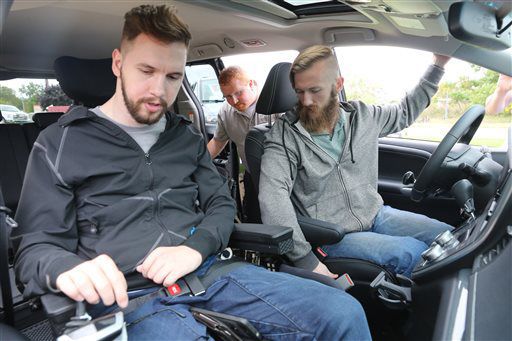
GRAND RAPIDS, Mich. (AP) — A group of strangers touched by the story of two paralyzed brothers has given them a customized minivan.
The Kalamazoo Gazette (http://bit.ly/2dqJ2sk ) reported that 26-year-old Matthew and 24-year-old Adam Chaffee, who were paralyzed in two separate accidents, received the $80,000 vehicle Monday from a Grand Rapids-area couple, a Grand Haven man and pastors in East Jordan.
Once they heard the brothers' story the group felt compelled to help them and launched a public campaign to raise funds for the van and worked with Grand Rapids-based Clock Mobility, a company that specializes in handicapped-accessible vans, to create the vehicle for the brothers' needs.
"It's really nice," Adam Chaffee, 24, said. "I didn't have anything before so, yeah, this is really nice."
The brothers have lived together in a downtown Grand Rapids apartment for the past 11 months and up until Monday, had no transportation of their own.
Matt became a paraplegic after a November 2014 motorcycle crash. Adam was living with and taking care of his brother in Kalamazoo when he became injured in a lake accident in July 2015. He is now a quadriplegic.
The brothers have also been the recipients of an online fundraising site that has paid for medical bills and some living expenses.
"What everybody has done and what everybody has given is just amazing," said the Chaffee brothers' mother, Carol Chaffee. "It is just wonderful what people have done for them."
___
Information from: Kalamazoo Gazette, http://www.mlive.com/kalamazoo
- Updated
GRAND HAVEN TOWNSHIP, Mich. (AP) — A western Michigan man faces charges in the fatal shootings of three sandhill cranes.
The Grand Haven Tribune reports (http://bit.ly/2dHVbaS ) Tuesday that state officials received a tip last week on a poaching hotline.
Conservation Officer Ivan Perez tells the newspaper that the cranes were shot after a neighbor chased some of the birds from his yard to the property owner's yard in Grand Haven Township, northwest of Grand Rapids.
Perez says the man "claimed he thought he could treat them as varmints" and didn't know the migratory birds are protected.
The man also faces up to 90 days in jail and up to $1,500 in restitution. His shotgun was confiscated.
Sandhill cranes are tall, grey birds reaching heights up to 4 feet, with wingspans of 6 to 7 feet.
___
Information from: Grand Haven Tribune, http://www.grandhaventribune.com
- Updated
KANSAS CITY, Mo. (AP) — A 63-year old Missouri postal clerk has admitted stealing gift cards from the mail at a Kansas City mail processing center where she worked.
U.S. Attorney Tammy Dickinson says Veronica Grant waived her right to a grand jury and pleaded guilty Tuesday to one count of theft of mail by a postal employee.
The Postal Service received a complaint in April 2015 that a T.J. Maxx gift card had been reported missing from the mail. When confronted, Grant admitted stealing the gift card and using it in Blue Springs.
Investigators found five additional cards in Grant's purse after an October 2015 interview and later identified 11 victims of her mail theft.
A plea agreement with prosecutors will recommend probation and restitution to the victims.
- Updated
TOPEKA, Kan. (AP) — Some Kansas lawmakers are expressing concern over whether another backlog of Medicaid applications in the state will emerge.
The Topeka-Capital Journal (http://bit.ly/2dcfzjn ) reports that the Kansas Department of Health and Environment is on track to clear a current KanCare backlog after the agency told federal officials in June the number of unprocessed applications was underreported by 12,000.
"The Kansas Department of Health and Environment, along with our partners; Accenture and Maximus; will continue to improve our processes and our technology to ensure we minimize any possibility of additional backlogs," KDHE Deputy Secretary Aaron Dunkel wrote.
The backlog developed in 2015, spurred by problems with a new electronic eligibility system. The department retained temporary staff and enlisted the help of the Department for Children and Families to deal with the backlog.
State Rep. Jim Ward says he thinks that it's probable that another backlog will emerge and that the agency is unprepared to keep the volume of applications under control.
To fix one backlog, the agency created another. For the moment, KDHE has stopped processing Medicaid renewal applications. The agency said less than 5 percent of renewal applications are typically rejected.
As of mid-July, more than 35,000 renewal applications sat idle. KDHE plans to begin once again reviewing renewals when the first-time application backlog approaches a manageable figure.
Auditors found Kansas was not in compliance with a federal law that requires applicants to receive an eligibility determination within 45 days. Currently, KDHE must send CMS a report every two weeks detailing the size of the backlog. The audit report said CMS officials plan no further actions once the backlog is resolved.
Sean Gatewood of KanCare Advocates Network is conflicted as to whether KDHE should face punishment over the backlog.
"Certainly, do I feel like KDHE needs some sort of sanctioning? You better believe it," Gatewood said. "But at the same time, taking money out of a starved system is a terrible option. I don't know what the right move is. I don't think a right move exists."
___
Information from: The Topeka (Kan.) Capital-Journal, http://www.cjonline.com
- Updated
JACKSON, Mich. (AP) — A 36-year-old substitute teacher has pleaded guilty in the attempted theft of violins from a southern Michigan school.
The Jackson Citizen Patriot reports (http://bit.ly/2duzr2S ) Tuesday that Benjamin Ross will be sentenced Nov. 2 in Jackson County Circuit Court on a larceny from a building charge.
Three violins were taken March 30 from Jackson's Middle School at Parkside and stashed in a bush outside the building.
An orchestra student told the school's principal that a teacher had removed several violins from a classroom. Surveillance video showed the violins being taken from the building and hidden in the bush.
School officials found the violins and called police.
___
Information from: Jackson Citizen Patriot, http://www.mlive.com/jackson
- Updated
KANSAS CITY, Mo. (AP) — An agreement has been reached that will allow a tilapia farm and community garden project in a poor Kansas City neighborhood to move forward.
Dre Taylor started the project about a year ago to provide food in the city's food desert. Taylor wanted to use boys in a mentoring group he founded called Males to Men to help with the project.
The Kansas City Star (http://bit.ly/2dohwyQ ) reports that Kansas City Keys president Harrel Johnson Jr. barred Taylor from the property when construction was nearly complete. The Kansas City Keys owns the project site.
Taylor said the plan would build neighborhood pride and become one of the most innovative community gardens in the country, until Johnson put new locks on the gate which barred Taylor from the site.
Kansas City Keys bought the land from Land Bank of Kansas City. When Land Bank's executive director learned of the issue, he sent a letter to Kansas City Keys board members, reminding them that the land's purchase was contingent on the project. After Land Bank threatened to take back the property, Taylor and Johnson agreed that Nile Valley Aquaponics will proceed as a project of the M2M (Males to Men) Community Foundation.
"I'm pleased that we have moved past our differences," Johnson said in a joint statement with Taylor. "We have more in common than any issues that may have divided us."
In the joint statement, Taylor said and the boys in M2M would "be forever grateful for the Keys' vital role and generosity associated with this project."
___
Information from: The Kansas City Star, http://www.kcstar.com
- Updated
INDIANAPOLIS (AP) — Indiana State Police say they've expanded their voter registration fraud investigation to include seven more counties.
State police said they served a search warrant Tuesday morning for the Indiana Voter Registration Project in downtown Indianapolis. The investigation started last month when at least 10 voter registration forms were confirmed to have fraudulent information. They were among thousands of forms the project submitted to registration offices in Marion and Hendricks counties.
Investigators said the expanded number of counties leads them to believe there may be hundreds of potentially fraudulent records. Police say this could disenfranchise many voters. The possible false information includes real names paired with made up or incorrect addresses and birthdates.
The investigation now includes Allen, Delaware, Hamilton, Hancock, Johnson, Lake and Madison counties.
- Updated
DES MOINES, Iowa (AP) — The Iowa State Patrols says the high number of traffic deaths in the state is slowing down investigations.
According to the Iowa Department of Transportation, there have been 282 deaths due to vehicle accidents as of Monday. That's 37 more deaths compared to the same time last year. It's the state's highest number of deaths by vehicle crashes through that date in five years.
Spokesman Sgt. Nathan Ludwig says the state patrol has been assigned to investigate 125 of these cases this year, which is 24 more than a year ago.
Ludwig said 60 cases are still open, with no determination of whether charges will be filed, however 20 of those cases are nearing completion.
The Des Moines Register (http://dmreg.co/2dPhxaR ) reports that the agency does not have any full-time crash investigators. Ludwig says troopers investigating these crashes also have other duties to fulfill.
The increase in fatal crashes caused Gov. Terry Branstad to take action. Branstad said in July that he wants to address cyclist and motorist deaths on Iowa roads as part of next year's state legislative priorities.
Some families of crash victims have expressed distress with the slow pace of investigations.
"It's not just me waiting, it's our entire family... We want answers. We want to know. It's been very devastating," said Samantha Bell, niece of a recent crash victim.
___
Information from: The Des Moines Register, http://www.desmoinesregister.com
- Updated
GRETNA, Neb. (AP) — A Gretna High School student is questioning the school's unwillingness to sponsor her club dedicated to fighting abortion and educating mothers on other options.
The Omaha World-Herald (http://bit.ly/2dbsulU ) reported that the Thomas More Society wrote a letter to district administrators Monday, saying the school's decision is discrimination and violates the First Amendment and the Equal Access Act.
The society describes itself as a national nonprofit law firm "dedicated to restoring respect in law for life, family and religious liberty." It's representing high school junior Bridget Christensen, who is a co-president of Dragons for Life, a chapter of the Students for Life of America.
School administrators said the club was denied sponsorship because its topic is a controversial one that's political and religious.
"We're a public school," said Superintendent Kevin Riley. "It's not just anybody's socioeconomic, religious, political or ideological playground."
However Danielle Conrad, executive director of the American Civil Liberties Union of Nebraska disagreed with the superintendent.
"These students do not check their rights at the schoolhouse door," said Conrad.
According to Conrad if the school allows one non-curricular student group to meet during school hours then they cannot deny access to other groups based on religious, political, philosophical or other reasons related to the subject matter.
The Thomas More Society argued that the district's policy is inconsistent. The society pointed out that some of the school's sponsored clubs such as the Chess Club and the Gay Straight Alliance have nothing to do with curriculum.
Jocelyn Floyd, the Thomas More Society attorney, said the society is asking for the student's pro-life club to be treated on an equal basis with the other student-led, non-curriculum-related clubs.
"We're going to have our attorneys thoroughly go through all of our club situations and make sure we're following the law," said Superintendent Riley. "We'll get this worked out."
The club currently is permitted to meet at the school, but not during school hours.
Omaha-area school district officials said they haven't dealt with similar issues.
___
Information from: Omaha World-Herald, http://www.omaha.com
- By STEVE LUNDY (Arlington Heights) Daily Herald
- Updated
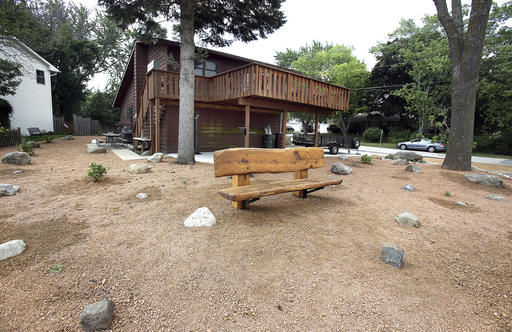
WILDWOOD, Ill. (AP) — Alex Rothacker's yard is easy to find -- it's the one with no grass, tons of rocks and sand and a variety of cactuses.
While on a trip in Arizona three years ago, Rothacker, 61, of Wildwood, hired a taxi cab to drive him 5 miles into the desert. The driver stopped and Rothacker said "drop me off here," paid and sent him on his way.
"He looked at me and said 'you're crazy man,'" Rothacker recalled.
Armed with a jug of water, Rothacker walked back into town.
He's a huge fan of the desert landscape. So much so he turned his green yard into a desert scape of rocks, gravel and cactuses.
Rothacker admires the decor of the desert and describes it as clean and fresh.
"You won't see a weed," he said.
He likes looking out and seeing the green of the cactuses all year.
"I had thousands of flowers here, beautiful flowers, but when the end of July, beginning of August comes, everything kind of dies off," he said.
Rothacker estimates he removed 160 tons of dirt to level his yard. He replaced it with 260 tons of rocks and gravel.
At first, Rothacker's neighbors thought he was crazy, but now he claims he gets nothing but complements.
He recruited three friends to help with the desert transformation. It took about a month to complete the project that cost about $13,000, he said.
With 13 varieties of cactuses, Rothacker admits the winter will be challenge.
"There are five I have to pull in for sure," he said. "The other ones will survive if I do the right steps with them."
Most of his cactus plants come from a friend who lives in Florida. All of the smaller rocks were put in place by Rothacker and his friends.
"Nothing professional. We did it with sweat and muscle and got it done. It's just friends who did this," Rothacker said.
___
Source: (Arlington Height) Daily Herald, http://bit.ly/2cGMvQV
___
Information from: Daily Herald, http://www.dailyherald.com
This is an AP-Illinois Exchange story offered by the (Arlington Heights) Daily Herald.
- By VIC RYCKAERT The Indianapolis Star
- Updated
INDIANAPOLIS (AP) — When someone drowns in Indiana, conservation officer Jim Hash is tasked with finding the body.
He's been called four times since July, including in August when 56-year-old David Fiege went missing while paddleboarding on Eagle Creek Reservoir. Without any witnesses to help — and with 2.3 square miles of water to search — authorities faced a tough challenge.
With the assistance of a helicopter, boats and sonar equipment, Fiege's body was found within two days. Officials also relied on one particularly important tool: an ROV — short for underwater remotely operated vehicle — which functions like a submarine drone.
Weighing 14 pounds, or about the size of a beer cooler, the device glides through water with propellers while using sonar and a camera to locate victims' bodies, cars, guns and other evidence. The drone allows officers to work more quickly while making the job less risky for divers.
"The most important part of our job is to bring closure to the family members," said Hash, who piloted a drone during the search for Fiege's body. "Paramount to that, is the safety of our officers."
Divers are in harm's way the moment they enter the water.
Murky water with zero visibility. Waterways loaded with tree limbs, fishing line and other unseen obstacles.
In the past, divers would line up tethered to each other with ropes and slowly search underwater to find a victim's body. Divers had to take breaks and refill their air tanks. A search even in the best conditions could take days.
Now, most recovery operations are over within a few hours.
"These are dives that require heavy exertion in zero-visibility water with entanglement risks," said Fishers Fire Chief Steve Orusa, a diver for 30 years who authored a training manual on the subject. "If you can use sonar, boat-based or on a remotely operated vehicle, now you have the ability to keep the divers out of the water."
Technology has made diving safer, but the equipment came after two Indianapolis firefighters were killed in training accidents.
Paul Jolliff became entangled 48 feet underwater on June 14, 2002, during what would have been his last training dive before becoming certified. His diving partner swam to the surface and yelled for help. But without a line or radio, rescue divers couldn't find Jolliff's exact location. The 37-year-old father of two was lost.
Two years earlier, Warren "J.C." Smith died in a similar training accident. Both deaths were ruled accidental, but lawsuits and investigations led to a statewide overhaul in training and an improvement in safety measures.
The biggest change was the investment in new equipment. Before Jolliff's death, Indiana dive teams didn't own sonar equipment. Now, most Indiana agencies have boat-mounted sonar equipment that can scan under the water.
But Indiana conservation officers are the only ones with access to submarine drones. The Indiana Department of Natural Resources bought its first ROV for about $150,000 about six years ago. A few years later, the department bought another one.
The two drones — one stationed in the north near Lake Michigan and the other south near the Ohio River — have been called in for 23 drownings this year.
While most in the diving community agree that the devices reduce risk to divers, there are differing opinions as to just how effective they can be.
Michael Gast, president of the National Academy of Police Diving, is among those who are skeptical.
"The man in the water is more capable than the ROV," Gast said. "It's safer in that you are not putting divers down. Is the capability more effective? I would say no."
Properly trained divers, Gast said, use their senses and intuition in ways technology can't. Humans are better at adapting to unforeseen circumstances, he said.
The ROV and boat-mounted sonars, Gast said, are usually paired with laptop computers that break when the wrong parts get wet.
To Hash, though, ROVs are necessary to keep officers safe.
"You have the ability to pinpoint a location before you send divers down," Hash said. "You don't put a human being in harm's way."
Hash took IndyStar journalists on board a small flat-bottom boat along the Wabash River in Terre Haute on a September day. He was there to assist trainees as they searched for a submerged vehicle.
Hash guided the boat to rest near the shore. He connected a cable to the drone before pulling a cord to start the small generator that provides power.
He gently placed the drone in the water and picked up the controller: a metal box with a joystick and knobs.
Hash sat looking at two screens, one displaying a sonar image and the other showing camera video. He moved the joystick and knobs to guide the drone through the water.
Cars are easy.
Hash found it in less than 10 minutes.
___
Source: The Indianapolis Star, http://indy.st/2cYm0ZI
___
Information from: The Indianapolis Star, http://www.indystar.com
This is an AP-Indiana Exchange story offered by The Indianapolis Star.
- Updated
COLUMBUS, Ohio (AP) — The number of Ohioans who have asked for an absentee ballot ahead of the November presidential election is closing in on 1 million.
Republican Secretary of State Jon Husted (HYOO'-sted) says more than 957,000 absentee ballot applications were received as of Friday. That's 35,000 more than at this point in the 2012 election.
Almost 15,000 of the requests for an absentee ballot are from military and overseas voters.
Residents in the swing state can vote absentee by mail or in person without having to give a reason.
Military and overseas voters can already cast ballots for the Nov. 8 election. Early voting for other Ohioans begins on Oct. 12.
Completed absentee ballots must be postmarked by Nov. 7.
___
Online:
- Updated
CHAMPAIGN, Ill. (AP) — Last month was one of the warmest Septembers on record in Illinois.
State climatologist Jim Angel says September's average temperature was nearly 71 degrees, or 4.5 degrees above normal. State records go back to 1895. September of this year was tied for sixth place with the year 2005.
The warmest September was a tie between 1933 and 1925 when the statewide average was 72.2 degrees.
Most parts of the state received 3 to 5 inches of rain. Southwestern Illinois was the wettest part of the state with between 5 and 7.5 inches of rain.
The statewide average for September's rainfall was 3.47 inches, a bit above normal.
Angel works for the Illinois State Water Survey at the University of Illinois at Urbana-Champaign, a division of the Prairie Research Institute.
GRAND RAPIDS, Mich. (AP) — A group of strangers touched by the story of two paralyzed brothers has given them a customized minivan.
The Kalamazoo Gazette (http://bit.ly/2dqJ2sk ) reported that 26-year-old Matthew and 24-year-old Adam Chaffee, who were paralyzed in two separate accidents, received the $80,000 vehicle Monday from a Grand Rapids-area couple, a Grand Haven man and pastors in East Jordan.
Once they heard the brothers' story the group felt compelled to help them and launched a public campaign to raise funds for the van and worked with Grand Rapids-based Clock Mobility, a company that specializes in handicapped-accessible vans, to create the vehicle for the brothers' needs.
"It's really nice," Adam Chaffee, 24, said. "I didn't have anything before so, yeah, this is really nice."
The brothers have lived together in a downtown Grand Rapids apartment for the past 11 months and up until Monday, had no transportation of their own.
Matt became a paraplegic after a November 2014 motorcycle crash. Adam was living with and taking care of his brother in Kalamazoo when he became injured in a lake accident in July 2015. He is now a quadriplegic.
The brothers have also been the recipients of an online fundraising site that has paid for medical bills and some living expenses.
"What everybody has done and what everybody has given is just amazing," said the Chaffee brothers' mother, Carol Chaffee. "It is just wonderful what people have done for them."
___
Information from: Kalamazoo Gazette, http://www.mlive.com/kalamazoo
GRAND HAVEN TOWNSHIP, Mich. (AP) — A western Michigan man faces charges in the fatal shootings of three sandhill cranes.
The Grand Haven Tribune reports (http://bit.ly/2dHVbaS ) Tuesday that state officials received a tip last week on a poaching hotline.
Conservation Officer Ivan Perez tells the newspaper that the cranes were shot after a neighbor chased some of the birds from his yard to the property owner's yard in Grand Haven Township, northwest of Grand Rapids.
Perez says the man "claimed he thought he could treat them as varmints" and didn't know the migratory birds are protected.
The man also faces up to 90 days in jail and up to $1,500 in restitution. His shotgun was confiscated.
Sandhill cranes are tall, grey birds reaching heights up to 4 feet, with wingspans of 6 to 7 feet.
___
Information from: Grand Haven Tribune, http://www.grandhaventribune.com
KANSAS CITY, Mo. (AP) — A 63-year old Missouri postal clerk has admitted stealing gift cards from the mail at a Kansas City mail processing center where she worked.
U.S. Attorney Tammy Dickinson says Veronica Grant waived her right to a grand jury and pleaded guilty Tuesday to one count of theft of mail by a postal employee.
The Postal Service received a complaint in April 2015 that a T.J. Maxx gift card had been reported missing from the mail. When confronted, Grant admitted stealing the gift card and using it in Blue Springs.
Investigators found five additional cards in Grant's purse after an October 2015 interview and later identified 11 victims of her mail theft.
A plea agreement with prosecutors will recommend probation and restitution to the victims.
TOPEKA, Kan. (AP) — Some Kansas lawmakers are expressing concern over whether another backlog of Medicaid applications in the state will emerge.
The Topeka-Capital Journal (http://bit.ly/2dcfzjn ) reports that the Kansas Department of Health and Environment is on track to clear a current KanCare backlog after the agency told federal officials in June the number of unprocessed applications was underreported by 12,000.
"The Kansas Department of Health and Environment, along with our partners; Accenture and Maximus; will continue to improve our processes and our technology to ensure we minimize any possibility of additional backlogs," KDHE Deputy Secretary Aaron Dunkel wrote.
The backlog developed in 2015, spurred by problems with a new electronic eligibility system. The department retained temporary staff and enlisted the help of the Department for Children and Families to deal with the backlog.
State Rep. Jim Ward says he thinks that it's probable that another backlog will emerge and that the agency is unprepared to keep the volume of applications under control.
To fix one backlog, the agency created another. For the moment, KDHE has stopped processing Medicaid renewal applications. The agency said less than 5 percent of renewal applications are typically rejected.
As of mid-July, more than 35,000 renewal applications sat idle. KDHE plans to begin once again reviewing renewals when the first-time application backlog approaches a manageable figure.
Auditors found Kansas was not in compliance with a federal law that requires applicants to receive an eligibility determination within 45 days. Currently, KDHE must send CMS a report every two weeks detailing the size of the backlog. The audit report said CMS officials plan no further actions once the backlog is resolved.
Sean Gatewood of KanCare Advocates Network is conflicted as to whether KDHE should face punishment over the backlog.
"Certainly, do I feel like KDHE needs some sort of sanctioning? You better believe it," Gatewood said. "But at the same time, taking money out of a starved system is a terrible option. I don't know what the right move is. I don't think a right move exists."
___
Information from: The Topeka (Kan.) Capital-Journal, http://www.cjonline.com
JACKSON, Mich. (AP) — A 36-year-old substitute teacher has pleaded guilty in the attempted theft of violins from a southern Michigan school.
The Jackson Citizen Patriot reports (http://bit.ly/2duzr2S ) Tuesday that Benjamin Ross will be sentenced Nov. 2 in Jackson County Circuit Court on a larceny from a building charge.
Three violins were taken March 30 from Jackson's Middle School at Parkside and stashed in a bush outside the building.
An orchestra student told the school's principal that a teacher had removed several violins from a classroom. Surveillance video showed the violins being taken from the building and hidden in the bush.
School officials found the violins and called police.
___
Information from: Jackson Citizen Patriot, http://www.mlive.com/jackson
KANSAS CITY, Mo. (AP) — An agreement has been reached that will allow a tilapia farm and community garden project in a poor Kansas City neighborhood to move forward.
Dre Taylor started the project about a year ago to provide food in the city's food desert. Taylor wanted to use boys in a mentoring group he founded called Males to Men to help with the project.
The Kansas City Star (http://bit.ly/2dohwyQ ) reports that Kansas City Keys president Harrel Johnson Jr. barred Taylor from the property when construction was nearly complete. The Kansas City Keys owns the project site.
Taylor said the plan would build neighborhood pride and become one of the most innovative community gardens in the country, until Johnson put new locks on the gate which barred Taylor from the site.
Kansas City Keys bought the land from Land Bank of Kansas City. When Land Bank's executive director learned of the issue, he sent a letter to Kansas City Keys board members, reminding them that the land's purchase was contingent on the project. After Land Bank threatened to take back the property, Taylor and Johnson agreed that Nile Valley Aquaponics will proceed as a project of the M2M (Males to Men) Community Foundation.
"I'm pleased that we have moved past our differences," Johnson said in a joint statement with Taylor. "We have more in common than any issues that may have divided us."
In the joint statement, Taylor said and the boys in M2M would "be forever grateful for the Keys' vital role and generosity associated with this project."
___
Information from: The Kansas City Star, http://www.kcstar.com
INDIANAPOLIS (AP) — Indiana State Police say they've expanded their voter registration fraud investigation to include seven more counties.
State police said they served a search warrant Tuesday morning for the Indiana Voter Registration Project in downtown Indianapolis. The investigation started last month when at least 10 voter registration forms were confirmed to have fraudulent information. They were among thousands of forms the project submitted to registration offices in Marion and Hendricks counties.
Investigators said the expanded number of counties leads them to believe there may be hundreds of potentially fraudulent records. Police say this could disenfranchise many voters. The possible false information includes real names paired with made up or incorrect addresses and birthdates.
The investigation now includes Allen, Delaware, Hamilton, Hancock, Johnson, Lake and Madison counties.
DES MOINES, Iowa (AP) — The Iowa State Patrols says the high number of traffic deaths in the state is slowing down investigations.
According to the Iowa Department of Transportation, there have been 282 deaths due to vehicle accidents as of Monday. That's 37 more deaths compared to the same time last year. It's the state's highest number of deaths by vehicle crashes through that date in five years.
Spokesman Sgt. Nathan Ludwig says the state patrol has been assigned to investigate 125 of these cases this year, which is 24 more than a year ago.
Ludwig said 60 cases are still open, with no determination of whether charges will be filed, however 20 of those cases are nearing completion.
The Des Moines Register (http://dmreg.co/2dPhxaR ) reports that the agency does not have any full-time crash investigators. Ludwig says troopers investigating these crashes also have other duties to fulfill.
The increase in fatal crashes caused Gov. Terry Branstad to take action. Branstad said in July that he wants to address cyclist and motorist deaths on Iowa roads as part of next year's state legislative priorities.
Some families of crash victims have expressed distress with the slow pace of investigations.
"It's not just me waiting, it's our entire family... We want answers. We want to know. It's been very devastating," said Samantha Bell, niece of a recent crash victim.
___
Information from: The Des Moines Register, http://www.desmoinesregister.com
GRETNA, Neb. (AP) — A Gretna High School student is questioning the school's unwillingness to sponsor her club dedicated to fighting abortion and educating mothers on other options.
The Omaha World-Herald (http://bit.ly/2dbsulU ) reported that the Thomas More Society wrote a letter to district administrators Monday, saying the school's decision is discrimination and violates the First Amendment and the Equal Access Act.
The society describes itself as a national nonprofit law firm "dedicated to restoring respect in law for life, family and religious liberty." It's representing high school junior Bridget Christensen, who is a co-president of Dragons for Life, a chapter of the Students for Life of America.
School administrators said the club was denied sponsorship because its topic is a controversial one that's political and religious.
"We're a public school," said Superintendent Kevin Riley. "It's not just anybody's socioeconomic, religious, political or ideological playground."
However Danielle Conrad, executive director of the American Civil Liberties Union of Nebraska disagreed with the superintendent.
"These students do not check their rights at the schoolhouse door," said Conrad.
According to Conrad if the school allows one non-curricular student group to meet during school hours then they cannot deny access to other groups based on religious, political, philosophical or other reasons related to the subject matter.
The Thomas More Society argued that the district's policy is inconsistent. The society pointed out that some of the school's sponsored clubs such as the Chess Club and the Gay Straight Alliance have nothing to do with curriculum.
Jocelyn Floyd, the Thomas More Society attorney, said the society is asking for the student's pro-life club to be treated on an equal basis with the other student-led, non-curriculum-related clubs.
"We're going to have our attorneys thoroughly go through all of our club situations and make sure we're following the law," said Superintendent Riley. "We'll get this worked out."
The club currently is permitted to meet at the school, but not during school hours.
Omaha-area school district officials said they haven't dealt with similar issues.
___
Information from: Omaha World-Herald, http://www.omaha.com
- By STEVE LUNDY (Arlington Heights) Daily Herald
WILDWOOD, Ill. (AP) — Alex Rothacker's yard is easy to find -- it's the one with no grass, tons of rocks and sand and a variety of cactuses.
While on a trip in Arizona three years ago, Rothacker, 61, of Wildwood, hired a taxi cab to drive him 5 miles into the desert. The driver stopped and Rothacker said "drop me off here," paid and sent him on his way.
"He looked at me and said 'you're crazy man,'" Rothacker recalled.
Armed with a jug of water, Rothacker walked back into town.
He's a huge fan of the desert landscape. So much so he turned his green yard into a desert scape of rocks, gravel and cactuses.
Rothacker admires the decor of the desert and describes it as clean and fresh.
"You won't see a weed," he said.
He likes looking out and seeing the green of the cactuses all year.
"I had thousands of flowers here, beautiful flowers, but when the end of July, beginning of August comes, everything kind of dies off," he said.
Rothacker estimates he removed 160 tons of dirt to level his yard. He replaced it with 260 tons of rocks and gravel.
At first, Rothacker's neighbors thought he was crazy, but now he claims he gets nothing but complements.
He recruited three friends to help with the desert transformation. It took about a month to complete the project that cost about $13,000, he said.
With 13 varieties of cactuses, Rothacker admits the winter will be challenge.
"There are five I have to pull in for sure," he said. "The other ones will survive if I do the right steps with them."
Most of his cactus plants come from a friend who lives in Florida. All of the smaller rocks were put in place by Rothacker and his friends.
"Nothing professional. We did it with sweat and muscle and got it done. It's just friends who did this," Rothacker said.
___
Source: (Arlington Height) Daily Herald, http://bit.ly/2cGMvQV
___
Information from: Daily Herald, http://www.dailyherald.com
This is an AP-Illinois Exchange story offered by the (Arlington Heights) Daily Herald.
- By VIC RYCKAERT The Indianapolis Star
INDIANAPOLIS (AP) — When someone drowns in Indiana, conservation officer Jim Hash is tasked with finding the body.
He's been called four times since July, including in August when 56-year-old David Fiege went missing while paddleboarding on Eagle Creek Reservoir. Without any witnesses to help — and with 2.3 square miles of water to search — authorities faced a tough challenge.
With the assistance of a helicopter, boats and sonar equipment, Fiege's body was found within two days. Officials also relied on one particularly important tool: an ROV — short for underwater remotely operated vehicle — which functions like a submarine drone.
Weighing 14 pounds, or about the size of a beer cooler, the device glides through water with propellers while using sonar and a camera to locate victims' bodies, cars, guns and other evidence. The drone allows officers to work more quickly while making the job less risky for divers.
"The most important part of our job is to bring closure to the family members," said Hash, who piloted a drone during the search for Fiege's body. "Paramount to that, is the safety of our officers."
Divers are in harm's way the moment they enter the water.
Murky water with zero visibility. Waterways loaded with tree limbs, fishing line and other unseen obstacles.
In the past, divers would line up tethered to each other with ropes and slowly search underwater to find a victim's body. Divers had to take breaks and refill their air tanks. A search even in the best conditions could take days.
Now, most recovery operations are over within a few hours.
"These are dives that require heavy exertion in zero-visibility water with entanglement risks," said Fishers Fire Chief Steve Orusa, a diver for 30 years who authored a training manual on the subject. "If you can use sonar, boat-based or on a remotely operated vehicle, now you have the ability to keep the divers out of the water."
Technology has made diving safer, but the equipment came after two Indianapolis firefighters were killed in training accidents.
Paul Jolliff became entangled 48 feet underwater on June 14, 2002, during what would have been his last training dive before becoming certified. His diving partner swam to the surface and yelled for help. But without a line or radio, rescue divers couldn't find Jolliff's exact location. The 37-year-old father of two was lost.
Two years earlier, Warren "J.C." Smith died in a similar training accident. Both deaths were ruled accidental, but lawsuits and investigations led to a statewide overhaul in training and an improvement in safety measures.
The biggest change was the investment in new equipment. Before Jolliff's death, Indiana dive teams didn't own sonar equipment. Now, most Indiana agencies have boat-mounted sonar equipment that can scan under the water.
But Indiana conservation officers are the only ones with access to submarine drones. The Indiana Department of Natural Resources bought its first ROV for about $150,000 about six years ago. A few years later, the department bought another one.
The two drones — one stationed in the north near Lake Michigan and the other south near the Ohio River — have been called in for 23 drownings this year.
While most in the diving community agree that the devices reduce risk to divers, there are differing opinions as to just how effective they can be.
Michael Gast, president of the National Academy of Police Diving, is among those who are skeptical.
"The man in the water is more capable than the ROV," Gast said. "It's safer in that you are not putting divers down. Is the capability more effective? I would say no."
Properly trained divers, Gast said, use their senses and intuition in ways technology can't. Humans are better at adapting to unforeseen circumstances, he said.
The ROV and boat-mounted sonars, Gast said, are usually paired with laptop computers that break when the wrong parts get wet.
To Hash, though, ROVs are necessary to keep officers safe.
"You have the ability to pinpoint a location before you send divers down," Hash said. "You don't put a human being in harm's way."
Hash took IndyStar journalists on board a small flat-bottom boat along the Wabash River in Terre Haute on a September day. He was there to assist trainees as they searched for a submerged vehicle.
Hash guided the boat to rest near the shore. He connected a cable to the drone before pulling a cord to start the small generator that provides power.
He gently placed the drone in the water and picked up the controller: a metal box with a joystick and knobs.
Hash sat looking at two screens, one displaying a sonar image and the other showing camera video. He moved the joystick and knobs to guide the drone through the water.
Cars are easy.
Hash found it in less than 10 minutes.
___
Source: The Indianapolis Star, http://indy.st/2cYm0ZI
___
Information from: The Indianapolis Star, http://www.indystar.com
This is an AP-Indiana Exchange story offered by The Indianapolis Star.
COLUMBUS, Ohio (AP) — The number of Ohioans who have asked for an absentee ballot ahead of the November presidential election is closing in on 1 million.
Republican Secretary of State Jon Husted (HYOO'-sted) says more than 957,000 absentee ballot applications were received as of Friday. That's 35,000 more than at this point in the 2012 election.
Almost 15,000 of the requests for an absentee ballot are from military and overseas voters.
Residents in the swing state can vote absentee by mail or in person without having to give a reason.
Military and overseas voters can already cast ballots for the Nov. 8 election. Early voting for other Ohioans begins on Oct. 12.
Completed absentee ballots must be postmarked by Nov. 7.
___
Online:
CHAMPAIGN, Ill. (AP) — Last month was one of the warmest Septembers on record in Illinois.
State climatologist Jim Angel says September's average temperature was nearly 71 degrees, or 4.5 degrees above normal. State records go back to 1895. September of this year was tied for sixth place with the year 2005.
The warmest September was a tie between 1933 and 1925 when the statewide average was 72.2 degrees.
Most parts of the state received 3 to 5 inches of rain. Southwestern Illinois was the wettest part of the state with between 5 and 7.5 inches of rain.
The statewide average for September's rainfall was 3.47 inches, a bit above normal.
Angel works for the Illinois State Water Survey at the University of Illinois at Urbana-Champaign, a division of the Prairie Research Institute.
Most Popular
-
U.S. to drastically alter Colorado River releases, Arizona officials warn
-
As Arizona basketball chases big men for 2025-26, transfer portal gets even pricier
-
 Second wall planned across Arizona as Trump administration doubles down on border
 -
Pima County Fair returns with all-new rides, big-name concerts and fun foods
-
Toddler killed, pregnant mom injured in crash with apparent street-racing car, police say

