In a March 25 social media post, U.S. Customs and Border Protection highlighted ongoing construction of a 30-foot-tall barrier made from black-painted steel bollards along a 27-mile stretch of border in the San Rafael Valley south of Sonoita.
But if "the wall works," as the post insisted, why do we need a second one?
The Trump administration's plans for the southern border now include hundreds of miles of "secondary border wall" that would be built parallel to the primary wall, sealing off an "enforcement zone" in between.
Those double walls could eventually run almost the entire length of Arizona’s 373-mile southern boundary, cutting through three national wildlife refuges, two National Park Service sites and the entire length of the Tohono O'odham Nation's 62-mile border with Mexico.
CBP’s interactive online "Smart Wall Map" shows secondary barriers planned across all but about 38 miles of the border in Arizona.
People are also reading…
Double walls are also planned or under construction along the international boundary through nearly all of California and New Mexico.
"This means from the Pacific to the Rio Grande, we are literally walling off an entire continent," said Myles Traphagen, Tucson-based borderlands program coordinator for the environmental advocacy group Wildlands Network. "That's going to alter the evolutionary history of North America. There's never been anything like this that's happened on Earth."
The Arizona Daily Star submitted a list of questions to Customs and Border Protection the evening of March 31. The agency acknowledged receiving the questions, but had not responded as of the morning of April 11.

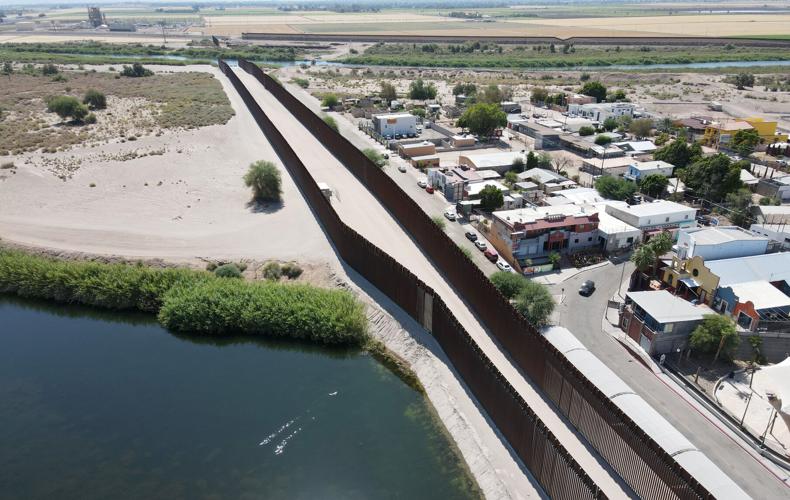
An aerial photo from 2022 shows the double barrier separating the U.S., left, from Mexico, right, looking east from the Alamo Canal in California toward the Colorado River and Yuma. The Trump administration now plans to build primary and secondary walls across almost the entire southern border through California, Arizona and New Mexico.
Border wall construction in Arizona and elsewhere has been supercharged by the so-called One Big Beautiful Bill that President Donald Trump signed into law on the Fourth of July last year. The sprawling tax and spending package poured almost $46.6 billion into CBP specifically to expand and upgrade "the border infrastructure and wall system."
That’s more than triple the wall spending in Trump’s first term.
The money is available until 2029, and the agency clearly aims to spend it.
In September, CBP awarded the first round of construction contracts paid for by the new legislation — 10 in all, totaling almost $4.5 billion. One of them, for a $607 million project known as Tucson 1, includes nearly 23 miles of secondary wall along the remote boundary of Cabeza Prieta National Wildlife Refuge southwest of Ajo.

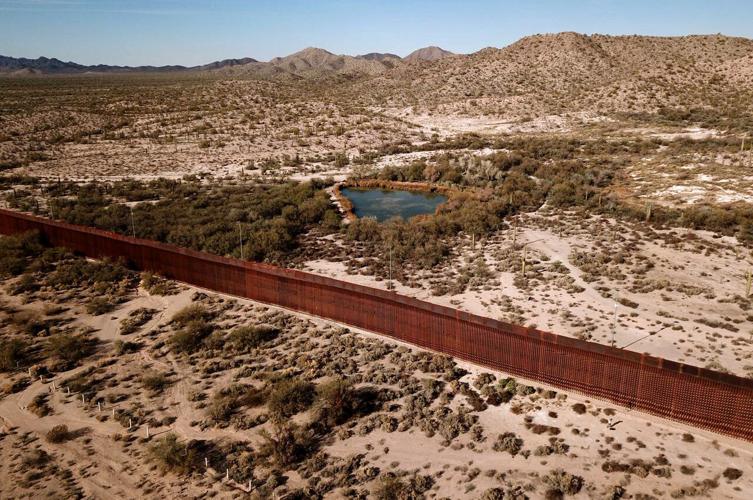
The border wall runs next to Quitobaquito Springs at Organ Pipe Cactus National Monument in an aerial photo taken from Mexico. The Trump administration is planning to build a second wall parallel to the first one, raising concerns about what the project could do to the historic oasis and other sensitive sites.
That was followed late last year by another $3.3 billion for four-wall contracts in Texas and Arizona, including the $1.5 billion Tucson 2 project to build 19 miles of primary and secondary barriers at five different locations from the Baboquivari Mountains west of Sasabe to Guadalupe Canyon at the New Mexico border.
According to CBP’s smart-wall map, the only secondary wall construction currently underway in Arizona is the continuation of a project approved during the first Trump administration. Known as Yuma 2, it will eventually include almost 52 miles of primary and secondary wall in scattered sections from Cabeza Prieta and the Goldwater Air Force Range to the Colorado River and Interstate 8 in California.
To expedite all this work, then-Homeland Security Secretary Kristi Noem issued a flurry of waivers in 2025 to exempt the projects from dozens of federal laws designed to protect wildlife, cultural and historic resources and the environment.
Traphagen said what is quickly and quietly unfolding along the southern border is without precedent in American history. The approximately $60 billion allocated for border-wall construction so far during the first and second Trump administrations already amounts, in today's dollars, to about five times what it cost the U.S. to build the Panama Canal.
"I would argue this is the largest public works project ever," he said. "I don't think people fathom that."
'Most secure' border in history
The ballooning barrier plans come as migrant encounters at the southern border have fallen to a 50-year low, according to the Pew Research Center.
As Noem herself declared during a February press event in Nogales, about a month before she was removed as DHS chief, the border is now "the most secure in American history."
Migrant arrests at the border have been falling since 2024, when former President Joe Biden implemented restrictions on asylum access and Mexican authorities worked to slow migrants' northward progress through Mexico.
Arrests fell steeply after Trump took office last year, and have remained "fairly stagnant" since, said Colleen Putzel-Kavanaugh, associate policy analyst for the nonpartisan Migration Policy Institute.
According to the latest CBP data, border agents arrested 8,200 migrants at the southern border in March, including about 1,500 in the Tucson sector — a 25% increase over February, likely due to normal seasonal fluctuations in migration, experts said.
By comparison, nearly 250,000 migrants were apprehended outside ports of entry in December 2023 alone.

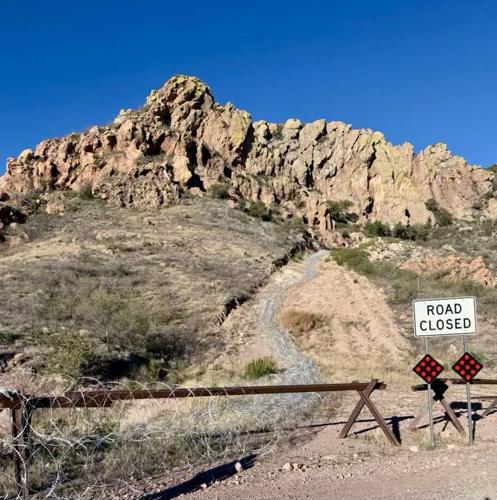
Spools of concertina wire mark the border at Cerro Del Fresnal southeast of Sasabe.
But the downward trend in border crossings hasn't cooled Trump's enthusiasm for the wall, even as focus has shifted in his second term to his mass-deportation and mass-detention agenda, Putzel-Kavanaugh said.
"I think the U.S.-Mexico border is actually still as prevalent as it was in the first Trump administration, but going somewhat under the radar because of all the other immigration pieces that are happening simultaneously," she said.
Just don’t ask her to explain the rationale for a second barrier next to the primary one.
"In terms of their efficacy, it's the same as if there’s one wall or two walls," she said. "If people can get over one wall, they can probably get over two. It creates an initial obstacle, but to me there’s not a clear reason as to what the additional wall would do."
The border barrier strategy appears to be more about perception than function, Putzel-Kavanaugh said. "I think it’s more a statement than something that will ultimately make a real difference in migrant encounters."
Windfall for companies
Critics of the expanding projects said they’re struck by the pointlessness of the massive federal expenditure on a double border wall.
"You need the second (wall) to prove that the first one doesn’t work? That’s kind of a testament of how these are so useless," said Erick Meza, borderlands coordinator for the Sierra Club. "As we all know, the real reason is to figure out ways to spend all that money. It’s not really about the national security."
Federal contracting data shows a handful of companies reaping the windfall from the administration’s immigration crackdown. The $607 million Tucson 1 Project, for example, went to BCCG A Joint Venture, an Alabama-based construction giant that also landed almost $2.6 billion in other border-wall contracts last year, on top of a $292.7 million award from Homeland Security in 2024 to build a 1,000-person immigration detention facility in Laredo, Texas.

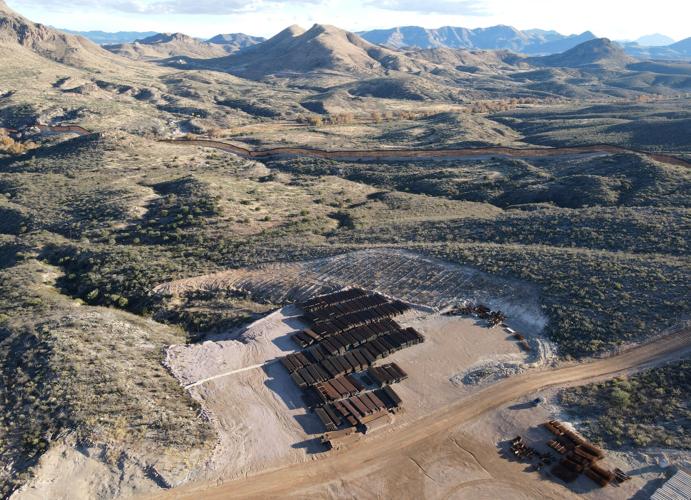
A wall construction site and staging area near Guadalupe Canyon in the southeast corner of Arizona are shown in an aerial photo from 2021.
The $1.5 billion Tucson 2 Project, meanwhile, was awarded to Fisher Sand and Gravel Co., the same North Dakota-based company picked to build that 27-mile stretch of new wall in the San Rafael Valley that CBP was crowing about on social media.
Fisher's Trump-allied owners have gotten rich off the administration’s border-wall agenda, despite a history of fines for environmental and labor violations, Bloomberg reported in March. The company has secured $8 billion in DHS wall-construction contracts since last summer alone, giving it a net worth of $1 billion, according to the Bloomberg Billionaire Index.
"It's just explainable once you start realizing who's getting the contracts," Meza said.
'No logic' to wall sites
Some double walls are already in limited use near the Naco port of entry, the Andrade port of entry west of Yuma and between San Diego and Tijuana. But Traphagen said the sudden proliferation of them across the entire southern border signals "a really big paradigm shift."
"I'm almost speechless, because there's no logic," he said. "They're building border walls in places where there's essentially been no documented crossings of any statistically significant number for years."
One of the newest — and arguably most contentious — additions to CBP’s smart wall map in Arizona is the secondary barrier now proposed across the Tohono O’odham Nation. That roughly 63-mile section suddenly appeared on the map a few months ago, along with plans for a primary wall across the same expanse. Currently, the Nation's boundary with Mexico has only a low-lying vehicle barrier, with three crossing points for enrolled tribal members to access the Tohono O'odham's ancestral land in Sonora.
Tohono O’odham Tribal Chairman Verlon Jose said the tribe learned earlier this year of the federal government’s border-wall plans, despite the tribe's long-standing opposition to such barriers.
The Nation has supported CBP's border-security technology and tactics on its land, and has put millions in tribal dollars toward the effort, Jose said. But CBP's disregard for the Nation’s opposition to the wall betrays the previous spirit of collaboration, he said.
"I believe the Nation has bent over backwards, and then some, to secure this country. We were homeland security before Homeland Security was created," he said. "We demand a seat at the table. I would never go to your home and tell you how to run your home."
Wildlife disrupted
The expansive border wall plans have also outraged environmentalists and, in West Texas at least, even united Republicans and Democrats in opposition.
But while resistance grows over CBP's plans to wall off the Rio Grande through Big Bend National Park, the barriers are already going up at two Park Service sites in Arizona, with more wall work in store.
Sanober Mirza is the Arizona program manager for the independent, nonpartisan National Parks Conservation Association. Mirza said both Organ Pipe Cactus National Monument and Coronado National Memorial already bear the needless scars from the first layer of wall construction, "so to do it all again is just honestly reckless."
The anticipated, double layer of 30-foot barriers could further disrupt wildlife movement and the natural flow of water, while militarizing a landscape that was set aside for public enjoyment and the protection of unique ecosystems, Mirza said.
"These are the worst case scenarios for both of these parks in terms of how they protect resources, in terms of how they support the communities that rely on them and in terms of how they welcome visitors," Mirza said. "Once these are built, you can't go back."
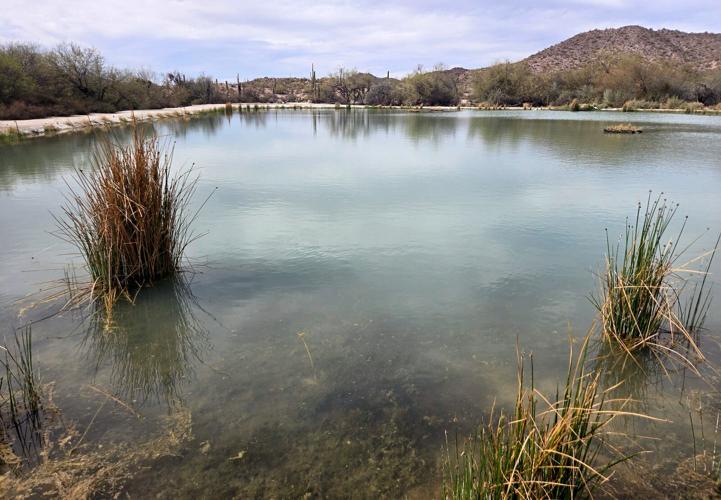
Of particular concern is Quitobaquito Springs at Organ Pipe, where water bubbling from the ground sustains a fragile oasis just 200 feet from the international boundary, 170 miles southwest of Tucson.
Saguaros were knocked down, and protests erupted during construction of the primary wall there in 2020, which some blamed for accelerating a decades-old decline in the output from the springs.
To squeeze in a second barrier could require building right up to — or even through — the pond at Quitobaquito, which provides the only known habitat in the U.S. for an endangered fish, an endangered turtle and a rare species of tiny snail.
Fragile, sacred site at risk
Protecting the springs is personal for Lorraine Eiler, an elder from a group with ties to the Tohono O’odham Nation and deep roots at Quitobaquito and elsewhere along the border.
Eiler said her great-grandparents were among the last Hia-Ced O’odham people to live at Quitobaquito, where they farmed into the early 1900s.
Long before that, the "Sand Dune People" regularly crossed the unforgiving desert to live at the spring-fed oasis for part of the year. "It was one of their main villages," Eiler said. "It was a life-saving spot for not only people that lived there but also people that came through."
She said the primary wall has already blocked wildlife movement and severed routes long used by O'odham people in the region for seasonal migrations, traditional runs to the Sea of Cortez and other spiritual pilgrimages.

The Quitobaquito Springs pond at Organ Pipe Cactus National Monument.
From what she has heard, the second wall will be just like the first: rows of tightly spaced, 30-foot-tall steel bollards stretching to the horizon in both directions across a landscape filled with archaeological sites.
"I've been told that it's going to be 150 feet from the existing wall, probably with another road in front of it. It's going to get into or near the pond," Eiler said.
And who knows what all that heavy equipment, blasting and groundwater pumping to make cement might do to the spring source, she said. "We might lose it. The whole thing is a frightening thought."
For Eiler, it's hard to know what to say about the border wall that hasn’t already been said. It’s hard to find new words to drive the point home.
"It's like somebody just dug into your mother's grave or your father's grave or your grandparents' grave and just dismantled everything just as if it was nothing," she said. "What they're doing, the disregard for everything, there's just no ethics involved whatsoever."
'Uncontrolled experiment'
A double layer of walls across the entire southern border could even shape the evolution or extinction of entire species, Traphagen said. It's an uncontrolled experiment on a continental scale, and he expects it to produce "die-off zones on either side of the border, because there are going to be places that animals are not able to disperse to," he said.
All of this will likely spell the end for jaguars and ocelots in the U.S. and American black bears in Northern Mexico, which need to cross the border to reach breeding populations and maintain their genetic diversity.
Not only will the new barriers prevent future jaguars from dispersing north into Southern Arizona, Traphagen said, they could trap any of the rare cats that are already here, effectively dooming them to "a lonely death" in a land where no females have been documented in decades.
Other border species of concern include Mexican gray wolf, Sonoran pronghorn, desert bighorn sheep, Coues whitetail deer and peninsular bighorn sheep in California.
Meza worries about what might happen to wildlife that becomes trapped between the two barriers. "It's a death zone," he said. "Animals could potentially find themselves caged in this really long area without any openings."
Endless project
Border experts and migrant advocates have long maintained what’s clear to anyone who visits the borderlands: Building an impermeable barrier along the southern border is impossible.
Floodgates must be installed in washes and canyons to accommodate fast-moving flows during monsoon season. Otherwise, the powerful flow of water and debris can knock down the wall.
Humanitarians who aid migrants at the border point to the endless repairs evident along the wall, where government-hired welders must continually fix cuts in the steel bollards made by smugglers using simple hand tools.
And people have long found ways to climb over, or tunnel under, physical barriers.

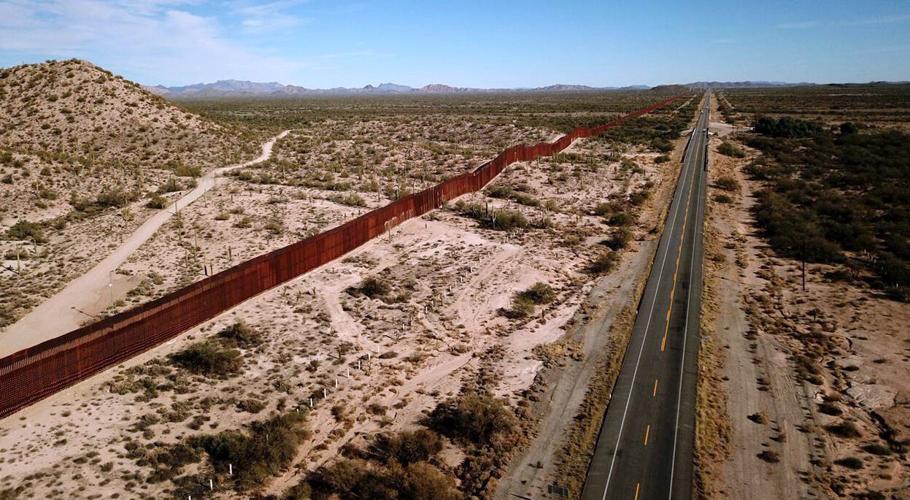
The border wall runs along Mexico's Highway 2 near Quitobaquito Springs at Organ Pipe Cactus National Monument.
Meza is hopeful that opposition to these walls will grow once taxpayers begin to see the enormous expense involved, even after they are built.
Maintenance of the double barriers and the enforcement zone in between will be endless, he said, and it will only increase over time, as the loose soil and lack of vegetation around the wall causes erosion with every summer downpour.
"I hope there's enough outrage that we’re willing to stop it," Meza said.
Traphagen is less optimistic.
"There's not many levers to pull here for opposition to the border wall. They have more money than they possibly need for walling off the entire border, and I think that they intend to use it," he said. "Perhaps there's some ray of hope for the midterm elections, but if the money is already appropriated and already spent, it's hard to reverse that."
Contact reporter Henry Brean at hbrean@tucson.com. On Twitter: @RefriedBrean
Contact reporter Emily Bregel at ebregel@tucson.com. On X, formerly Twitter: @EmilyBregel

Emily Bregel
Border reporter

Henry Brean
Reporter


 Arizona scenic grasslands become industrial site as border wall rises