
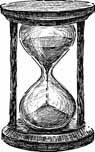
All right, everyone, grab hold of your hourglass and shake it until the sand is gone and there are no more days in 2020! Then turn it over to start the new year, with hopes that the dawn of 2021 will bring good health and contentment for our country.
It goes without saying that 2020 has been anything but uneventful. Plans? Nah! Literally every planned event was pre-empted by COVID. Sports? Again, nah! Aficionados of sports were relegated to sitting on the sidelines, as it were, to see empty stadiums for sporting events. And even The Masters golf tournament was moved to late in the year.
And, so, thinking along the lines of ending one year and going into another, here are some interesting idioms with which to END 2020.
At the End of One’s Rope
People are also reading…
Believe it or not, this idiom has been in use since the late 1600’s. It means that one has reached the end of his/her patience, resources, energy or abilities and, therefore, is unable to handle a situation any further. The saying refers to a tether, which is used to keep an animal from wandering off and, so, the animal can graze only as far as the rope will allow. Hence, at the end of the tether, the animal will run out of options and will, eventually, become frustrated and give up trying to wander off.
Bitter End
“Bitter” is an adjective that has been around, at least, since the year 725 AD. It means sour or acrid tasting. The word “bitter” was commonly used in the Middle Ages and Shakespeare used it many times in his poems and plays. It was first seen in print in "Seaman’s Grammar" (Captain Smith, 1627).
In today’s parlance it means that one will do something difficult or unpleasant until it is completely finished.
End of the Line
Used to denote a final stop in one’s destination, the idiom originated around the early 1900’s; specifically, it meant the end of a physical railway track. While not, generally, used in conversation today, the saying is often comically spoken by villains in movies and in theater.
Light at the End of the Tunnel
This saying only became popularized in the mid-twentieth century. It is a metaphor to explain the termination of a long, dark mining or railroad tunnel, hence being able to see hope at the end of the passage. President John F. Kennedy used this phrase in 1962 in a press conference in reference to the Vietnam War. The phrase was commonly used throughout the conflict.
At Ones Wit’s End
Meaning unable to think what one should do or to be perplexed about a situation, this phrase first appeared in 1377, in William Langland’s Middle English poem of narration, Piers Plowman:
Astronomyens also aren at hir wittes ende. (Astronomers are also at their wit’s end.)
This expression appeared much later in the King James version of the Bible, Psalms 107:27: They reel to and fro, and stagger like a drunken man, and are at their wit’s end.