

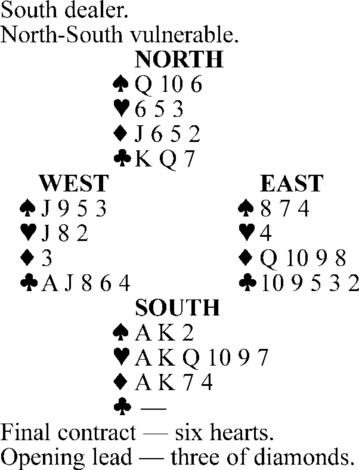
Back in 1933, the Franklin Bridge Club of Philadelphia staged its annual team-of-four club championship. It was no world-shaking event; the winners, even if their names could be recalled, would stir no excitement. But one hand played was of a remarkable nature.
The bidding by the North-South pairs varied a great deal at the different tables, but nearly all of them arrived at six hearts, certainly a reasonable undertaking. And wherever West led his singleton diamond, declarer invariably went down one.
The South hand progressed from table to table searching for a declarer who would make the slam, but it never encountered one. It was only in later analysis that the winning line of play was discovered.
Assume declarer wins the diamond lead with the ace, draws trumps and cashes the king of diamonds, learning that East has two diamond winners.
People are also reading…
The outlook may seem hopeless, but let's say our heroic declarer next plays the ace and then the deuce of spades. When West follows low, South finesses the ten! This hurdle surmounted, declarer then leads dummy's king of clubs and, after East plays low, discards the king of spades on it!
All these unusual maneuvers lead to a very satisfying denouement. West can do no better than win the club with the ace, but whatever he returns, the contract is firmly on ice. Dummy wins any return, and declarer disposes of his two diamond losers on the queen of clubs and queen of spades.
The hand demonstrates once again that ingenuity in bridge has no bounds. However, it would be a harsh critic who berated himself for missing the play shown, and, in fact, not one South cut his throat that night.
But the fact remains that in theory, every declarer should have adopted this method of play, since it offered the only chance to make the contract.


